
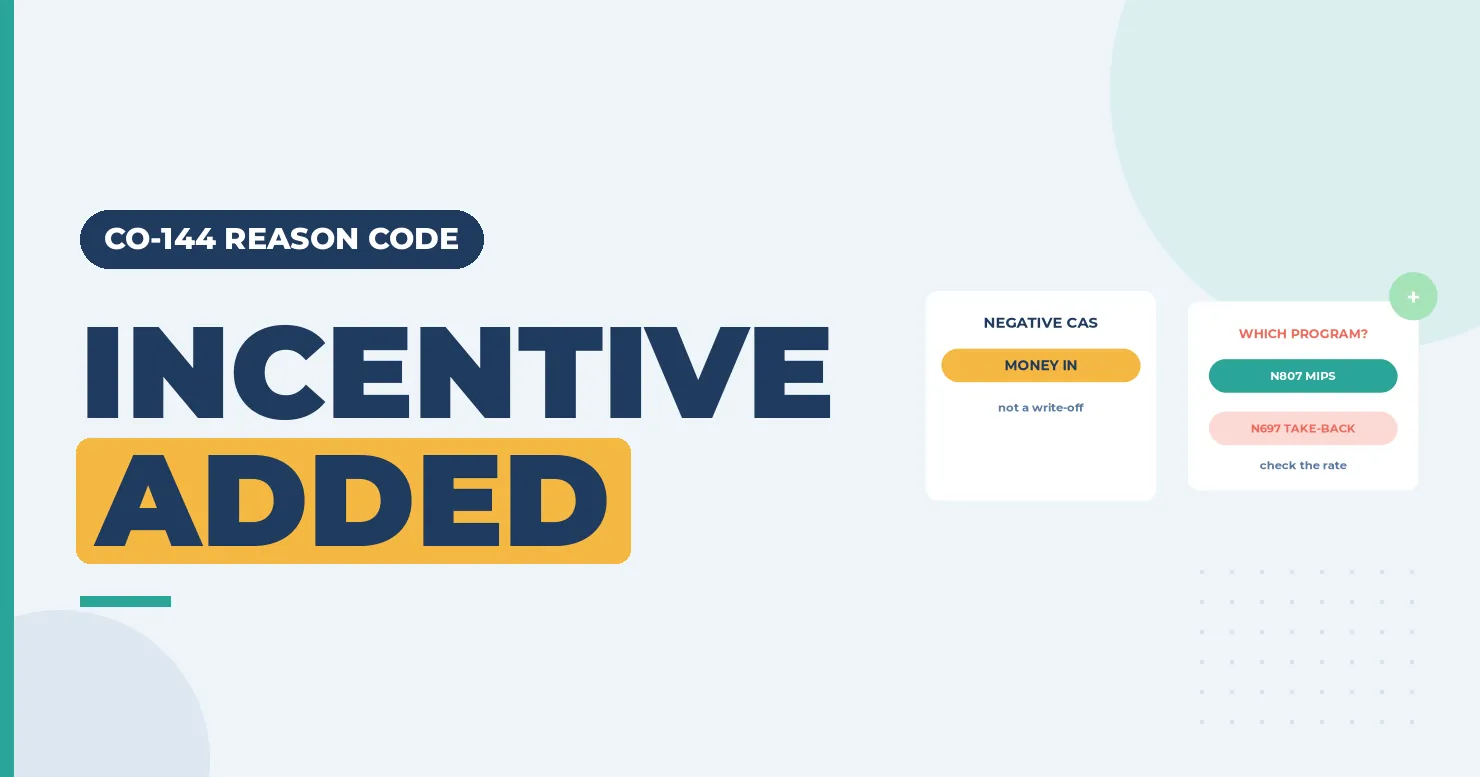
CO-144 is one of the few reason codes that usually means good news. It marks an incentive adjustment, money a payer adds or changes because you met a program goal or used a preferred product or service. On Medicare claims, the most common case is a positive MIPS payment adjustment. Because the adjustment raises payment, it often shows as a negative amount in the CAS segment. That trips up posting systems more than anything else about this code. (Primary source: X12 Claim Adjustment Reason Codes)
In brief: CARC 144 reads “Incentive adjustment, e.g. preferred product/service.” Treat a negative CO-144 amount as added payment, not a write-off. Check the remark code to see which program paid it, then confirm the amount matches the program’s rate.
From our denial codes library. Written by Manikandan J, CPC, CRCR, who has reconciled Medicare remits and quality program adjustments for physician groups. Published 21 October 2026. Last updated: 21 October 2026. Code wording quoted word for word from X12.
What X12 says about reason code 144
| Field | X12 text |
|---|---|
| Code | 144 |
| Description | “Incentive adjustment, e.g. preferred product/service.” |
| Start | 06/30/2001 |
Source: X12 Claim Adjustment Reason Codes, checked 21 October 2026.
Why a CO-144 amount can be negative
In an 835, the CAS segment is where the payer lists each adjustment as a group code, a reason code and an amount. A positive adjustment amount lowers payment. A negative adjustment amount raises it. So a line can look like this:
| Field | Example value | What it means |
|---|---|---|
| Billed | 150.00 | Your charge |
CAS*CO*45 | 52.00 | Contract reduction |
CAS*CO*144 | -1.96 | Incentive added back |
| Paid | 99.96 | Before any patient share |
The numbers are illustrative only. The point is the sign: the incentive line adds money.
The MIPS link
The Merit-based Incentive Payment System is Medicare’s quality program for many clinicians, run through the Quality Payment Program. A clinician’s final score sets a payment adjustment for a later year. CMS’s remittance advice FAQ says a positive MIPS adjustment shows as group CO, CARC 144 and RARC N807. A negative one uses a different CARC, 237, with the same remark.
Example scenario (fictional names), part 1
CO-144 Denial Example: What Happened
Kenji Morales posts payments for Brightwater Family Medicine. In January, the practice’s remits from Lakeland Medicare Services, a fictional Medicare contractor, started showing a new line on office visits like 99214 for type 2 diabetes (E11.9).
Each line had CAS*CO*144 with a small negative amount and remark LQ*HE*N807, “Payment adjustment based on the Merit-based Incentive Payment System (MIPS).” The posting system read every CO amount as a write-off and flagged the claims as overpaid.
Was Brightwater really overpaid, or was the system wrong? Keep reading, or jump to how the CO-144 denial was resolved.
Remark codes that explain CARC 144
| RARC | X12 wording |
|---|---|
| N807 | “Payment adjustment based on the Merit-based Incentive Payment System (MIPS).” |
| N422 | “Claim payment was the result of a payer’s retroactive adjustment due to a payer’s contract incentive program.” |
| N697 | “Alert: This reversal is due to a payer’s retroactive contract incentive program adjustment.” |
The full list is on the X12 RARC page.
How to post and check a CO-144 adjustment

- Read the sign. A negative CO-144 adds to payment. A positive one takes money back, often as a reversal.
- Find the program. For example, N807 points to MIPS, and N422 points to a commercial contract incentive.
- Map a separate adjustment code. Post CO-144 to its own code so it doesn’t land in contractual write-offs.
- Check the rate. Compare the adjustment to the program’s published rate, such as the MIPS adjustment for that year on the QPP payment adjustments page.
- Watch for reversals. N697 means the payer took back an earlier incentive. Match it to the original claim.
- Report incentives apart. Track them as program income, not as denials or collections.
Example scenario (fictional names), part 2
How the CO-144 Denial Was Resolved
Kenji looked at the sign on each CO-144 line. Every amount was negative, so each one had raised the payment. N807 confirmed it was the practice’s positive MIPS adjustment for the year.
Fix: he created a separate posting code for incentive adjustments with a credit sign. Then he reposted January’s remits.
Outcome: the false overpayment flags cleared, and the incentive now shows on its own report line. No claim needed to be rebilled.
Names and details are illustrative; no real patient data.
Worked example (illustrative)
Consider a home infusion pharmacy under a commercial contract that pays extra for using a preferred biosimilar. A claim for the preferred product shows CO-144 with a negative amount and N422. A later remit reverses part of it with N697 because the payer changed which product counts as preferred. The pharmacy matches the reversal to the first claim and updates its product list.
Common CO-144 posting mistakes
- Treating it as a write-off. That hides income and makes collections look worse.
- Missing the sign. A positive CO-144 is a take-back, not a bonus.
- Mixing it with CO-45. Contract reductions and incentives belong in different buckets.
- Not checking the rate. A wrong rate can mean the payer has the wrong TIN or NPI on file.
Related codes
- CO-45: charge exceeds the contracted fee arrangement.
- CO-253: sequestration reduction in federal payment.
- CO-132: prearranged demonstration project adjustment.
Key takeaways
CO-144 is an incentive adjustment. A negative amount adds money, and a positive one takes some back. Read the remark code to find the program, such as N807 for MIPS, post it to its own adjustment code and check the amount against the program’s rate.
FAQ
What does reason code CO-144 mean?
It’s an incentive adjustment. It reads “Incentive adjustment, e.g. preferred product/service.”
Is CO-144 a denial?
No. It’s usually extra payment from an incentive program.
Why is the CO-144 amount negative?
In the 835, a negative adjustment adds to payment. That’s how incentives usually appear.
What does N807 mean with CARC 144?
It means the adjustment comes from Medicare’s MIPS program.
Can I bill the patient for CO-144?
No. It’s a payer program adjustment and doesn’t create a patient balance.
What code shows a negative MIPS adjustment?
CMS uses CARC 237 with N807 for a negative MIPS adjustment. CARC 144 is for the positive one.
Sources
How we checked: each code quote on this page was matched word for word with the X12 CARC and RARC lists on 21 October 2026.
- X12, Claim Adjustment Reason Codes (CARC 144, 45, 132, 237, 253). Accessed 21 Oct 2026.
- X12, Remittance Advice Remark Codes (N807, N422, N697). Accessed 21 Oct 2026.
- CMS Quality Payment Program, MIPS overview. Accessed 21 Oct 2026.
- CMS Quality Payment Program, MIPS payment adjustments. Accessed 21 Oct 2026.
- CMS, MIPS payment adjustment remittance advice FAQ. Accessed 21 Oct 2026.
Last updated: 21 October 2026 · Educational content; not legal advice.