
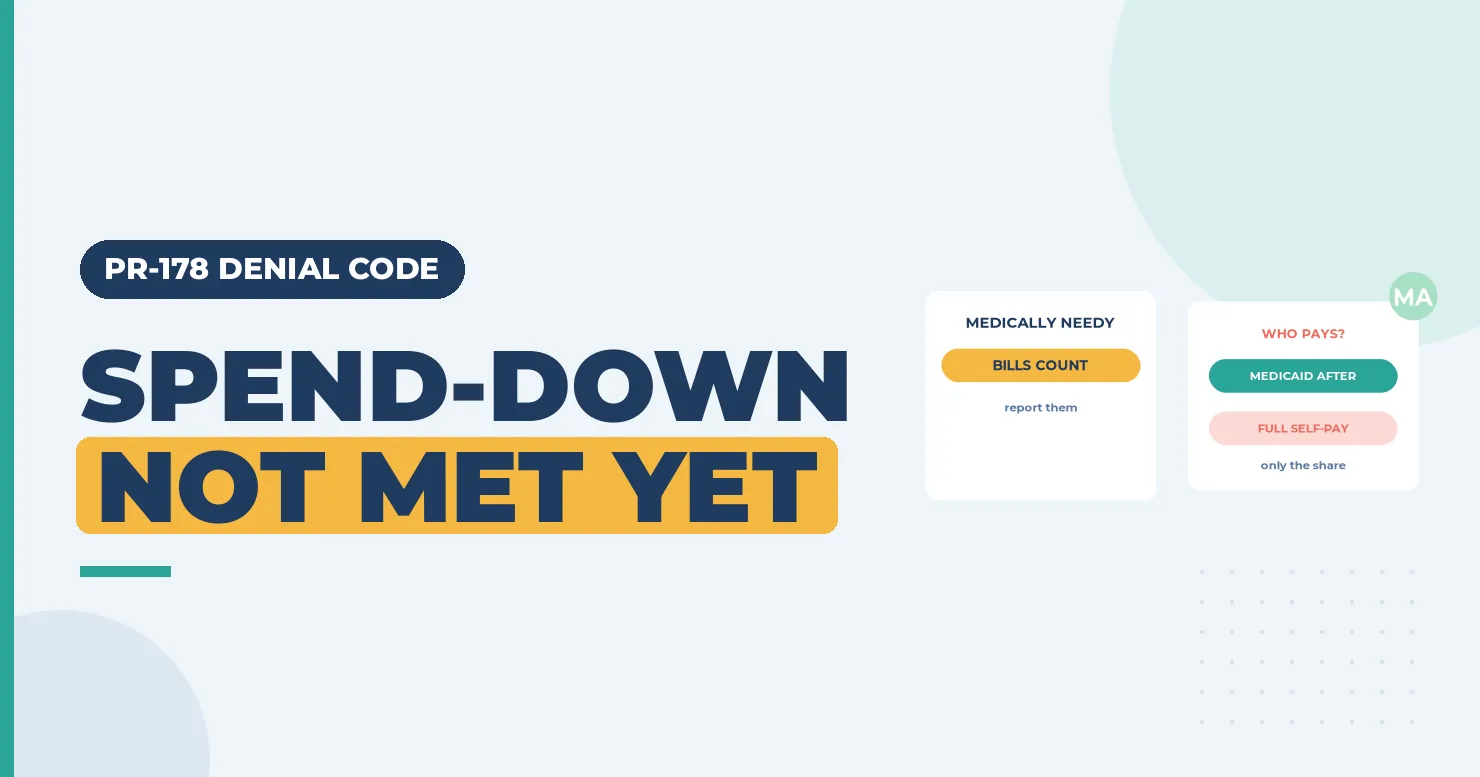
PR-178 is a Medicaid code with its own logic. Some people qualify for Medicaid only after their medical bills reach a set amount for a period, often called a spend-down or share of cost. Until they reach it, Medicaid doesn’t pay. When your claim lands before the spend-down is met, or counts toward it, the remit says PR-178. Your bill doesn’t vanish. It becomes part of the patient’s spend-down, and it can be the very bill that helps them qualify. (Primary source: X12 Claim Adjustment Reason Codes)
In brief: CARC 178 reads “Patient has not met the required spend down requirements.” Confirm the spend-down period and amount with the state, give the patient an itemized bill they can submit toward it, and rebill or ask for reprocessing once the state shows the spend-down met. Only the amount applied to the spend-down is the patient’s.
Part of our denial codes library. Written by Manikandan J, CPC, CRCR, who has worked Medicaid eligibility and self-pay accounts for safety-net hospitals. Published 22 October 2026. Last updated: 22 October 2026. Code wording quoted word for word from X12.
Official CARC 178 description
| Field | X12 text |
|---|---|
| Code | 178 |
| Description | “Patient has not met the required spend down requirements.” |
| Start | 06/30/2005 |
| Last modified | 09/30/2007 |
Source: X12 Claim Adjustment Reason Codes, checked 22 October 2026.
Key terms behind CARC 178
A spend-down is the amount of medical expenses a person must incur in a period before Medicaid starts paying. States that offer medically needy coverage use it for people whose income is too high for regular Medicaid. A budget period is the stretch of time, often one to six months, that the spend-down is counted over. Some states call the same idea a share of cost.
HealthCare.gov’s Medicaid glossary entry explains that the program is run by states under federal rules, which is why spend-down periods and amounts differ from state to state.
How spend-down affects your claim
- Before the spend-down is met, Medicaid denies the claim with PR-178. For example, a visit on day 3 of a budget period may fall entirely to the patient.
- The claim that meets it may be split: part applied to the spend-down, the rest paid by Medicaid.
- After it’s met, Medicaid pays claims for the rest of the budget period.
- Your bill counts. Unpaid medical bills, including yours, can count toward the spend-down when the patient reports them.
Example scenario (fictional names), part 1
PR-178 Denial Example: What Happened
Isabel Romero works self-pay and Medicaid follow-up at Sunrise Valley Hospital. A patient with heart failure (I50.9) had a two-day observation stay. The claim went to the state Medicaid program, and the patient was enrolled under a medically needy category with a monthly spend-down.
The 835 showed CAS*PR*178 for the full amount and remark LQ*HE*N30, “Patient ineligible for this service.” The patient had brought in pharmacy and clinic receipts that month, but nothing had been sent to the county office yet.
Was the hospital stuck with a self-pay balance, or could this claim still get paid? Keep reading, or jump to how the PR-178 denial was resolved.
Remark codes often paired with CARC 178
| RARC | X12 wording | What it tells you |
|---|---|---|
| N30 | “Patient ineligible for this service.” | Not eligible for payment until spend-down is met |
| N192 | “Alert: Patient is a Medicaid/Qualified Medicare Beneficiary.” | The patient is in a Medicaid category |
| N58 | “Missing/incomplete/invalid patient liability amount.” | The patient liability amount on the claim is an issue |
See the X12 RARC list for the full set.
How to handle a PR-178 denial

- Confirm the spend-down details. Check the state portal for the budget period, the amount and how much is met so far.
- Give the patient an itemized bill. They, or your eligibility team, submit it to the state agency toward the spend-down.
- Help collect other bills. Pharmacy, clinic and transport receipts in the same period may count too.
- Recheck eligibility after the state records the bills. Once the spend-down is met, Medicaid coverage applies for the rest of the period.
- Rebill or ask for reprocessing for any part of your claim above the spend-down amount.
- Bill the patient only the amount applied to their spend-down, and offer payment plans or financial assistance screening.
Example scenario (fictional names), part 2
How the PR-178 Denial Was Resolved
Isabel checked the state portal. The patient’s monthly spend-down hadn’t been met because none of the month’s bills had been reported. With the pharmacy and clinic receipts plus the hospital’s itemized bill, the total passed the spend-down amount.
Fix: Isabel’s eligibility team sent all the bills to the county office. After the state updated the case, the portal showed the spend-down met partway through the hospital stay. Isabel asked Medicaid to reprocess the claim. No claim field needed to change.
Outcome: Medicaid paid the part of the stay above the spend-down. The patient owed only the small amount applied to their spend-down from the hospital bill, and set up a payment plan. Isabel added spend-down checks to the hospital’s daily Medicaid eligibility list.
Names and details are illustrative; no real patient data.
Worked example (illustrative)
A patient’s spend-down is $500 for the month. On the 4th they fill prescriptions for $120. On the 10th they see a specialist, billed at an allowed amount of $200. On the 18th they have imaging allowed at $400. Once all three bills are reported, the first $500 counts toward the spend-down: $120 pharmacy, $200 specialist and $180 of the imaging. Medicaid then pays the remaining imaging amount and any later care that month. The numbers are made up to show the order of operations.
PR-178 vs similar codes
| Code | What it means | Main difference |
|---|---|---|
| PR-178 | Spend-down requirements not met | Medicaid coverage depends on medical bills |
| PR-177 | Eligibility requirements not met | Fails a coverage rule |
| PR-179 | Waiting requirements not met | Waiting period not over |
| PR-1 | Deductible amount | Regular plan deductible |
Checklist
- Spend-down status is checked at registration for medically needy patients.
- Itemized bills go out quickly so patients can report them.
- Eligibility is rechecked after bills are reported.
- Only the amount applied to the spend-down is billed to the patient.
Recap
PR-178 means Medicaid won’t pay until the patient’s spend-down is met. Confirm the spend-down, help the patient report bills including yours, recheck eligibility and ask Medicaid to reprocess. Bill the patient only for the part applied to the spend-down.
FAQ
What does PR-178 mean?
The patient hasn’t met the Medicaid spend-down required before coverage applies.
Can I bill the patient for PR-178?
Yes, for the amount applied to their spend-down. Once it’s met, Medicaid pays the rest of covered care in the period.
Does my bill count toward the spend-down?
Usually yes. Unpaid medical bills reported to the state can count toward it.
Do I need to change the claim after a PR-178?
Usually not. Ask Medicaid to reprocess once the state shows the spend-down met.
Is spend-down the same as a deductible?
It works in a similar way but is set by the state for medically needy Medicaid coverage, and periods are often monthly.
What is share of cost?
Some states use that name for the same idea as spend-down.
Sources
How we checked: each code quote on this page was matched word for word with the X12 CARC and RARC lists on 22 October 2026.
- X12, Claim Adjustment Reason Codes (CARC 178, 177, 179, 1). Accessed 22 Oct 2026.
- X12, Remittance Advice Remark Codes (N30, N192, N58). Accessed 22 Oct 2026.
- HealthCare.gov, Medicaid (glossary). Accessed 22 Oct 2026.
Last updated: 22 October 2026 · Educational content; not legal advice.