
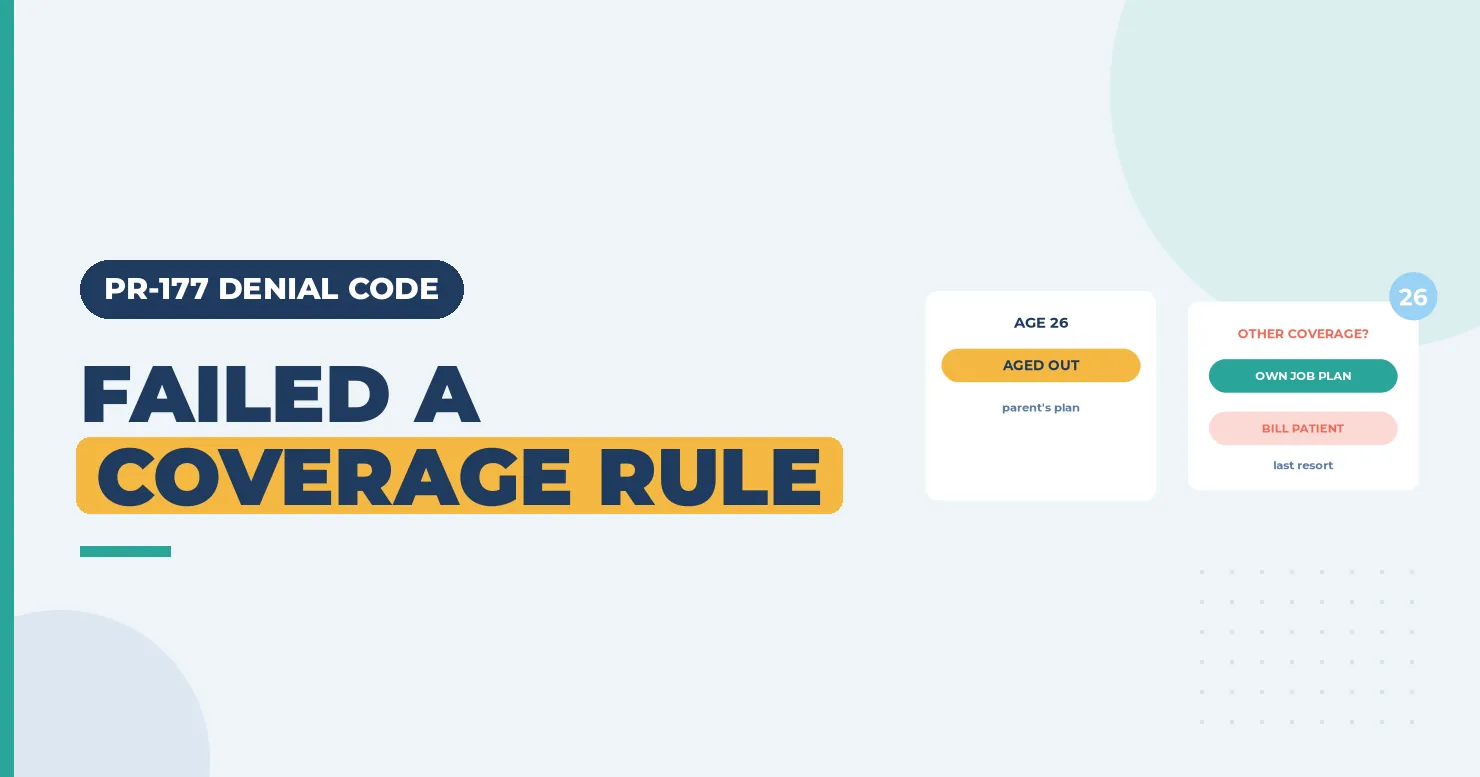
PR-177 says the patient didn’t meet the plan’s rules for being covered, at least not for this claim. It is different from a simple no-coverage-on-file denial. The payer knows the person, but something about them fails an eligibility test: a dependent who has aged out, a student who isn’t enrolled, a program that requires a qualifying condition or income level. The PR group puts the amount on the patient, yet the best outcome is usually finding the coverage they do qualify for. (Primary source: X12 Claim Adjustment Reason Codes)
In brief: CARC 177 reads “Patient has not met the required eligibility requirements.” Find out which requirement failed, then check whether the patient has other coverage, such as their own employer plan. If the claim used the wrong subscriber or relationship, correct it and bill the right plan. Bill the patient only when no coverage applies.
Part of our denial codes library. Written by Manikandan J, CPC, CRCR, who has worked eligibility denials for hospital patient access teams. Published 22 October 2026. Last updated: 22 October 2026. Code wording quoted word for word from X12.
Official CARC 177 description
| Field | X12 text |
|---|---|
| Code | 177 |
| Description | “Patient has not met the required eligibility requirements.” |
| Start | 06/30/2005 |
| Last modified | 09/30/2007 |
Source: X12 Claim Adjustment Reason Codes, checked 22 October 2026.
Key terms behind CARC 177
An eligibility requirement is a rule a person must meet to be covered, such as age, relationship, enrollment status or income. A dependent is someone covered under another person’s plan, like a child or spouse. The subscriber (or insured) is the person who holds the coverage.
HealthCare.gov explains that young adults can generally stay on a parent’s plan until they turn 26. After that, the dependent eligibility requirement fails, and claims to the parent’s plan draw denials like PR-177.
Common causes of PR-177
- Dependent aged out. For example, a child turned 26 and the parent’s plan ended dependent coverage.
- Relationship not covered. The plan doesn’t cover the relationship on the claim, such as a grandchild.
- Program rules not met. A program requires a condition, age or income level the patient doesn’t meet.
- Wrong subscriber on the claim. The patient has their own coverage, but the claim billed a family member’s plan.
Example scenario (fictional names), part 1
PR-177 Denial Example: What Happened
Zoe Martinez works patient access follow-up at Clearwater Valley Hospital. A 26-year-old came to the ED with an ankle sprain (S93.401A). Registration found the patient in the system from an old visit and billed the mother’s plan, Pinehurst Health, a fictional insurer, with the patient listed as the subscriber’s child.
The 835 showed CAS*PR*177 and remark LQ*HE*N30, “Patient ineligible for this service.” The patient had turned 26 in July. At the visit, the patient had also mentioned a new job.
Was the patient uninsured, or was there another plan to bill? Keep reading, or jump to how the PR-177 denial was resolved.
Remark codes often paired with CARC 177
| RARC | X12 wording | What it tells you |
|---|---|---|
| N30 | “Patient ineligible for this service.” | The patient failed an eligibility rule |
| N130 | “Consult plan benefit documents/guidelines for information about restrictions for this service.” | The plan documents list the rule |
| N155 | “Alert: Our records do not indicate that other insurance is on file. Please submit other insurance information for our records.” | The plan doesn’t know of other coverage |
See the X12 RARC list for the full set.
How to fix a PR-177 denial
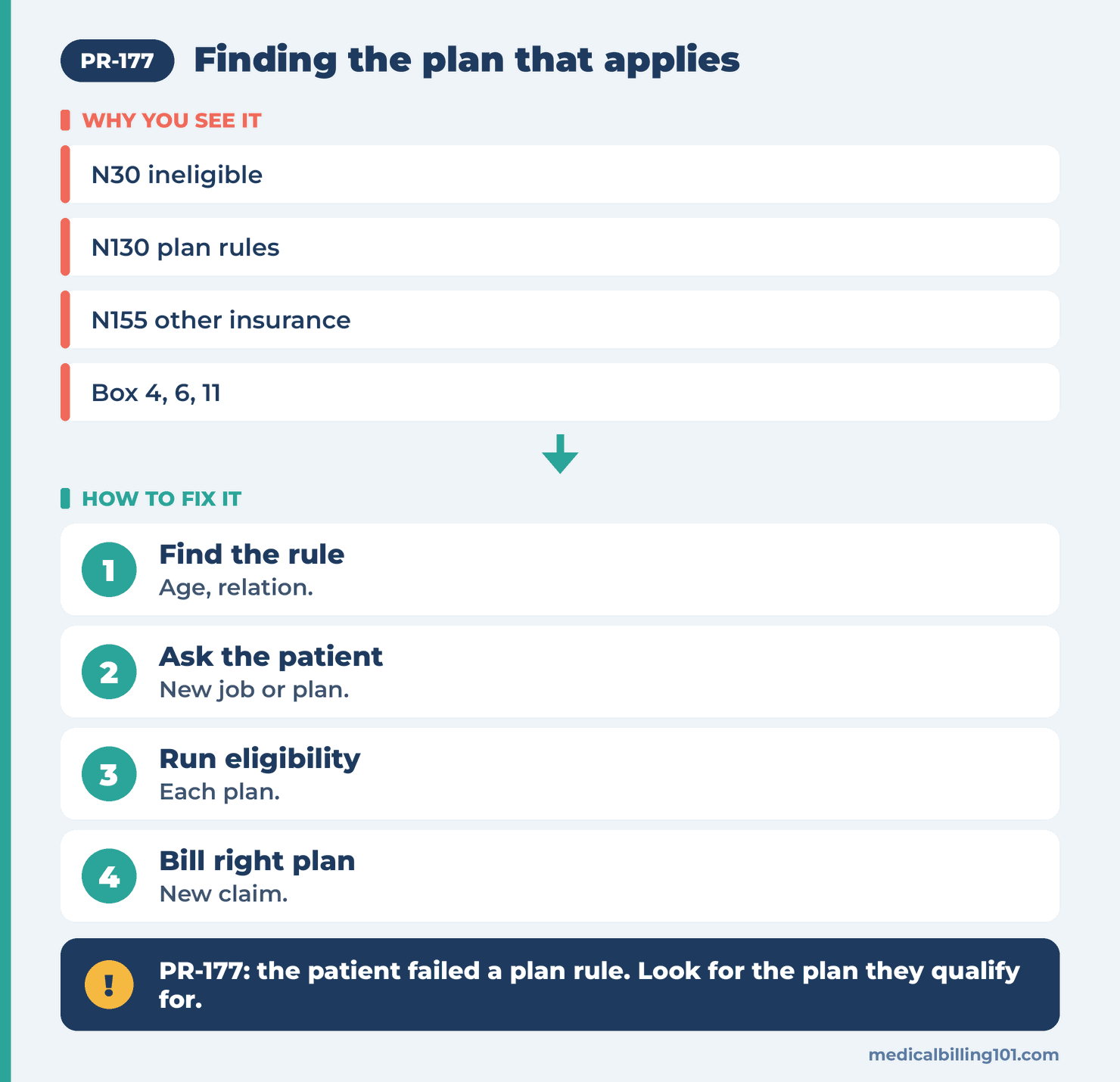
- Identify the failed rule. Read the remark and the plan’s eligibility rules. Age, relationship and enrollment are the usual suspects.
- Ask the patient about other coverage. A new job, a spouse’s plan, a marketplace plan or Medicaid may apply.
- Run eligibility for each plan for the date of service.
- If another plan covers the date, update registration with the right subscriber and relationship, and send a new claim to that plan.
- If the original plan made an error, such as a wrong birth date on file, ask it to correct its record and reprocess.
- If no coverage applies, bill the patient and offer financial assistance screening.
Example scenario (fictional names), part 2
How the PR-177 Denial Was Resolved
Zoe called the patient, who had started a job in August with coverage from Lakemont Benefits, a fictional employer plan, effective 1 September. Eligibility for the ED date came back active, with the patient as the subscriber.
Fix: she updated registration and sent a new claim to Lakemont. On the CMS-1500 for the ED physician, Box 4 now named the patient as the insured, Box 6 showed self, and Box 1a carried the Lakemont ID. The hospital’s UB-04 got the same changes in FL 50, FL 58, FL 59 and FL 60.
Outcome: Lakemont paid both claims. Zoe asked registration to confirm the subscriber at every visit for patients who have turned 26 since their last visit.
Names and details are illustrative; no real patient data.
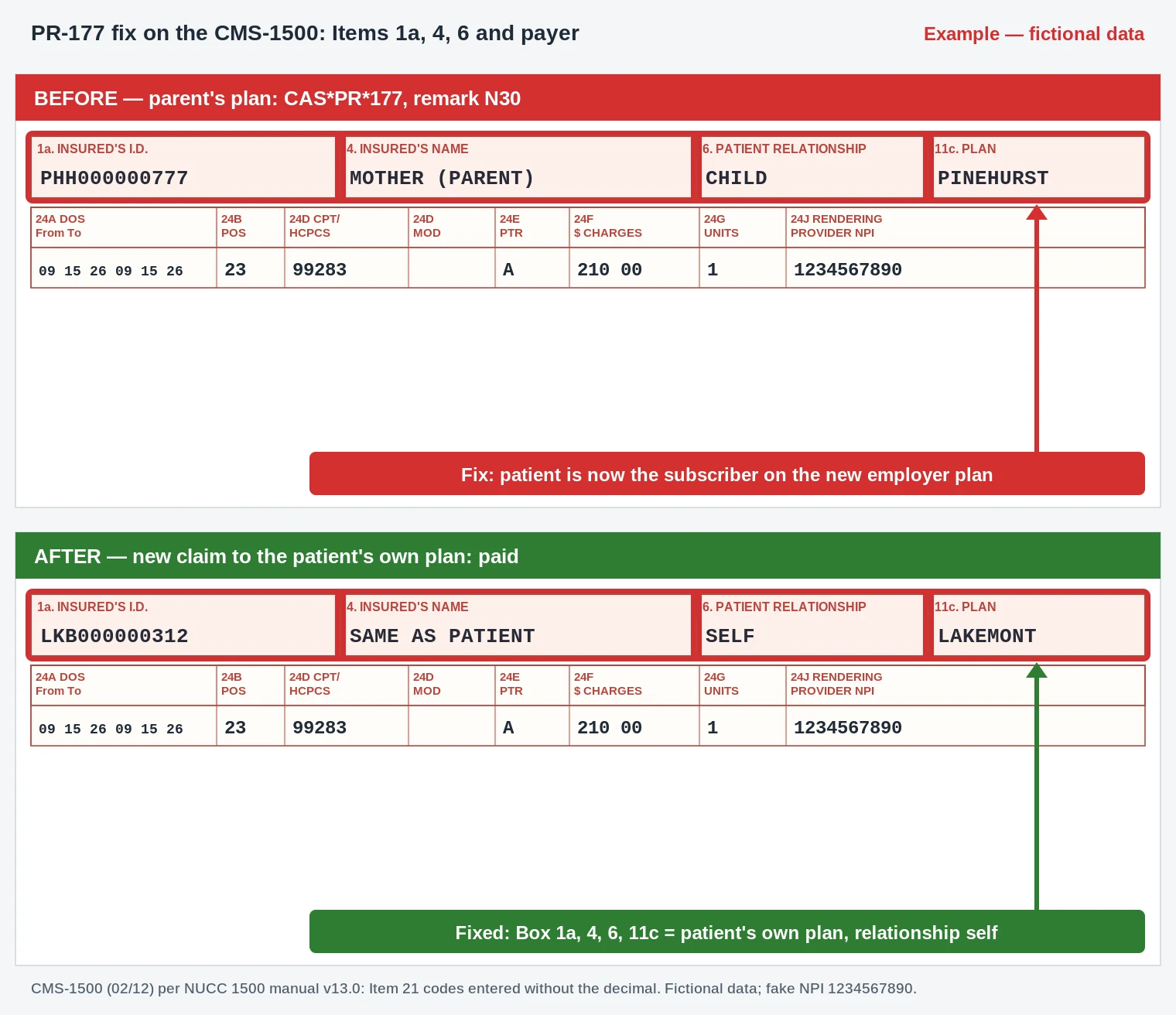
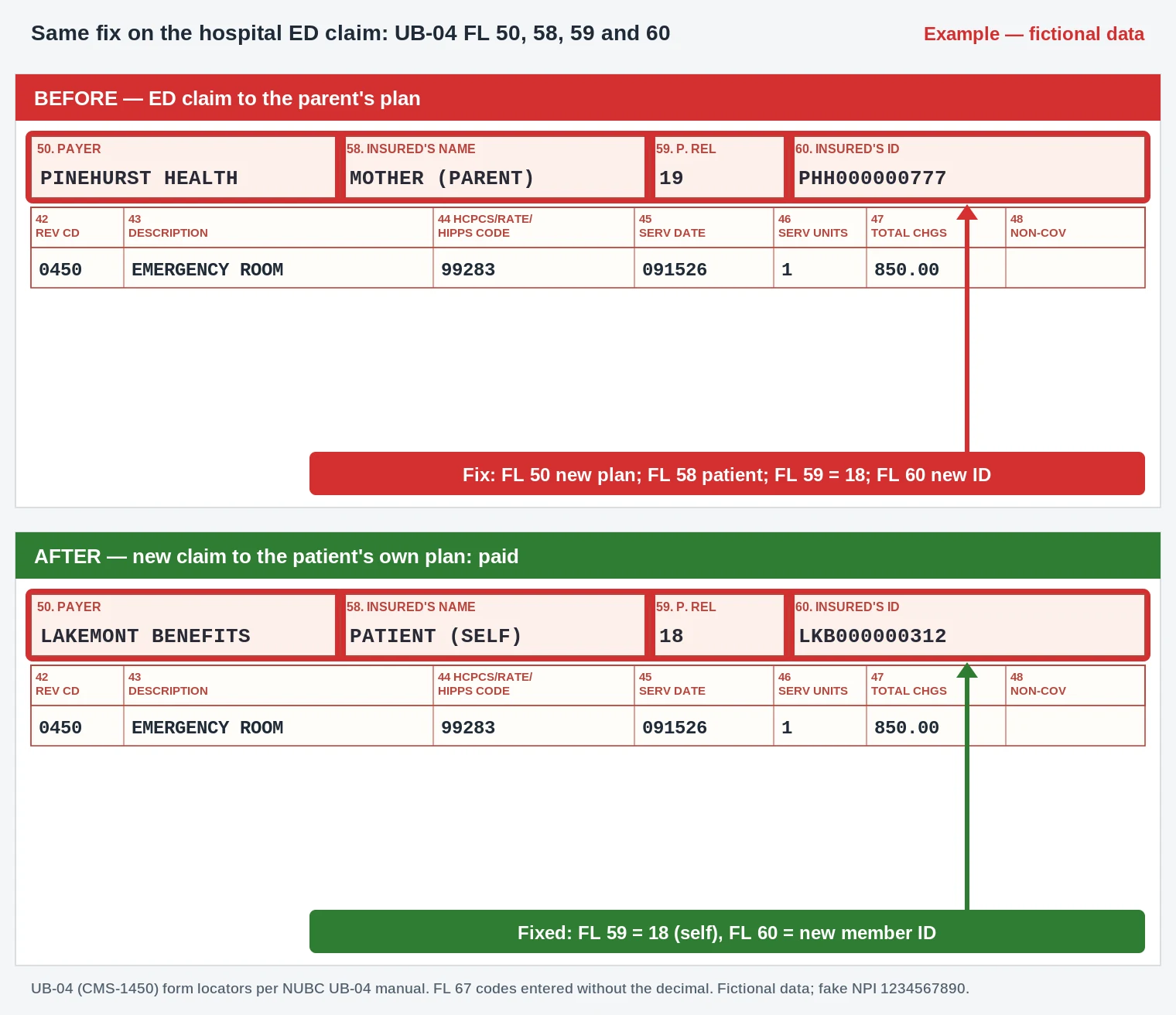
- Box 1a / FL 60: the parent’s member ID replaced with the patient’s own Lakemont ID.
- Box 4 / FL 58: insured is now the patient, not the parent.
- Box 6 / FL 59: relationship changed from child to self (UB-04 code 19 to 18).
- Box 11c / FL 50: payer changed to the employer plan active on the date of service. This is a new claim, so Box 22 stays blank and the type of bill stays 0131.
Worked example (illustrative)
A college student is covered under a parent’s plan that requires full-time enrollment for dependents over a certain age. The student drops to part time and a clinic claim draws PR-177. The student is eligible for the university’s own health plan, which they enrolled in at the start of the term. The clinic bills that plan and gets paid. Rules like these vary by plan and state, so the plan document matters.
PR-177 vs similar codes
| Code | What it means | Main difference |
|---|---|---|
| PR-177 | Eligibility requirements not met | Person fails a coverage rule |
| PR-178 | Spend-down requirements not met | Medicaid spend-down not met yet |
| PR-179 | Waiting requirements not met | Waiting period not over |
| CO-27 | Expenses incurred after coverage terminated | Coverage ended |
| CO-31 | Patient cannot be identified as our insured | Not found at all |
Patient access checklist
- Confirm the subscriber and relationship at every visit.
- Flag dependents who have turned 26 since the last visit.
- Ask about new jobs and new plans.
- Run eligibility before billing, not after a denial.
Recap
PR-177 means the patient failed a plan eligibility rule. Find the rule, ask about other coverage, and bill the plan the patient does qualify for, with the right subscriber and relationship. Bill the patient only when no coverage applies.
FAQ
What does denial code PR-177 mean?
The patient didn’t meet the plan’s eligibility requirements for the claim, such as age, relationship or enrollment.
Can I bill the patient for PR-177?
Only after you’ve checked for other coverage. The PR group allows it, but another plan may owe the claim.
What’s the most common cause of PR-177?
Dependents who have aged out or no longer meet the plan’s dependent rules are common causes.
Do I send a corrected claim or a new claim?
A new claim to the plan that covers the patient. A corrected claim goes only to the plan that processed the original.
Which claim fields change when the patient is now the subscriber?
On the CMS-1500, Boxes 1a, 4, 6, 7 and 11. On the UB-04, FL 50, 58, 59 and 60.
How is PR-177 different from CO-27?
CO-27 means coverage ended. PR-177 means the person doesn’t meet a rule for being covered.
Sources
How we checked: each code quote on this page was matched word for word with the X12 CARC and RARC lists on 22 October 2026.
- X12, Claim Adjustment Reason Codes (CARC 177, 178, 179, 27, 31). Accessed 22 Oct 2026.
- X12, Remittance Advice Remark Codes (N30, N130, N155). Accessed 22 Oct 2026.
- HealthCare.gov, Coverage for young adults under 26. Accessed 22 Oct 2026.
Last updated: 22 October 2026 · Educational content; not legal advice.