
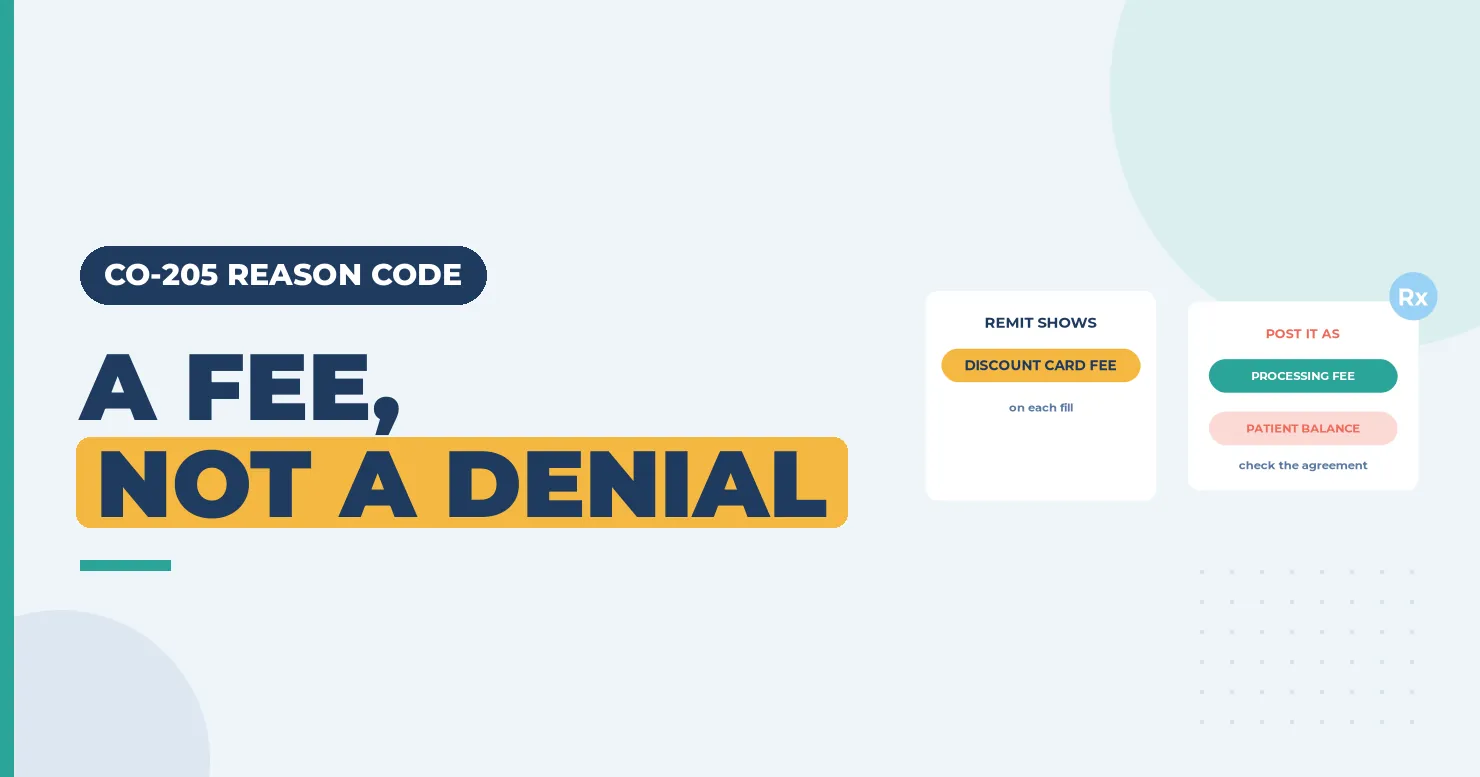
CO-205 is a fee, not a denial. It shows up on pharmacy remittances when a prescription was filled through a discount card program. The program or its processor takes a processing fee for each claim, and the remittance reports that fee with CARC 205. Pharmacies see it most. The work is in posting it correctly and checking it against the pharmacy’s agreement with the program. (Primary source: X12 Claim Adjustment Reason Codes)
In brief: CARC 205 reads “Pharmacy discount card processing fee”. Post the amount as a contractual fee, not as a patient balance or a claim denial. Compare it with the fee in your discount card agreement, and dispute it with the processor if it doesn’t match.
Part of our denial codes library. Written by Manikandan J, CPC, CRCR, who has reconciled remittances for retail and clinic pharmacies. Published 22 October 2026. Last updated: 22 October 2026. Code wording quoted word for word from X12.
Official CARC 205 description
| Field | X12 text |
|---|---|
| Code | 205 |
| Description | “Pharmacy discount card processing fee” |
| Start | 07/09/2007 |
Source: X12 Claim Adjustment Reason Codes, checked 22 October 2026.
How discount card programs work
A discount card program is a cash-price arrangement, not insurance. The patient shows a card and pays a discounted price. A processor is the company that runs the card program and handles each claim. The pharmacy agrees to the discounted price and, under many agreements, pays the processor a fee per claim. That processing fee is what CARC 205 reports. Pharmacy claims go through the NCPDP standard, not the CMS-1500 or UB-04, as the CMS transactions overview explains.
Example scenario (fictional names), part 1
CO-205 Denial Example: What Happened
Rebecca Shaw reconciles payments for Corner Street Pharmacy. The pharmacist, Dr. Marcus Feld, filled a generic blood pressure prescription for a cash-paying patient using a discount card. The pharmacy’s remittance from Sunvale Rx Savings, a fictional discount card processor, showed CAS*CO*205 with remark LQ*HE*N381, “Alert: Consult our contractual agreement for restrictions/billing/payment information related to these charges.”
The fee on the line was higher than the flat fee Rebecca expected. Her posting software had also put it in the patient balance.
Was the fee right, and who was supposed to absorb it? Keep reading, or jump to how the CO-205 denial was resolved.
Why reason code 205 appears
- Per-claim processing fees. For example, a flat fee for each discount card claim, taken from the payment or billed later.
- Tiered fees. Some agreements charge more for brand drugs or higher-cost fills.
- Fee changes. The processor updated its fee schedule, and the pharmacy’s system still expects the old amount.
- Posting setup. CARC 205 isn’t mapped, so the software treats it as patient balance or a denial.
How to post and check a CO-205 fee
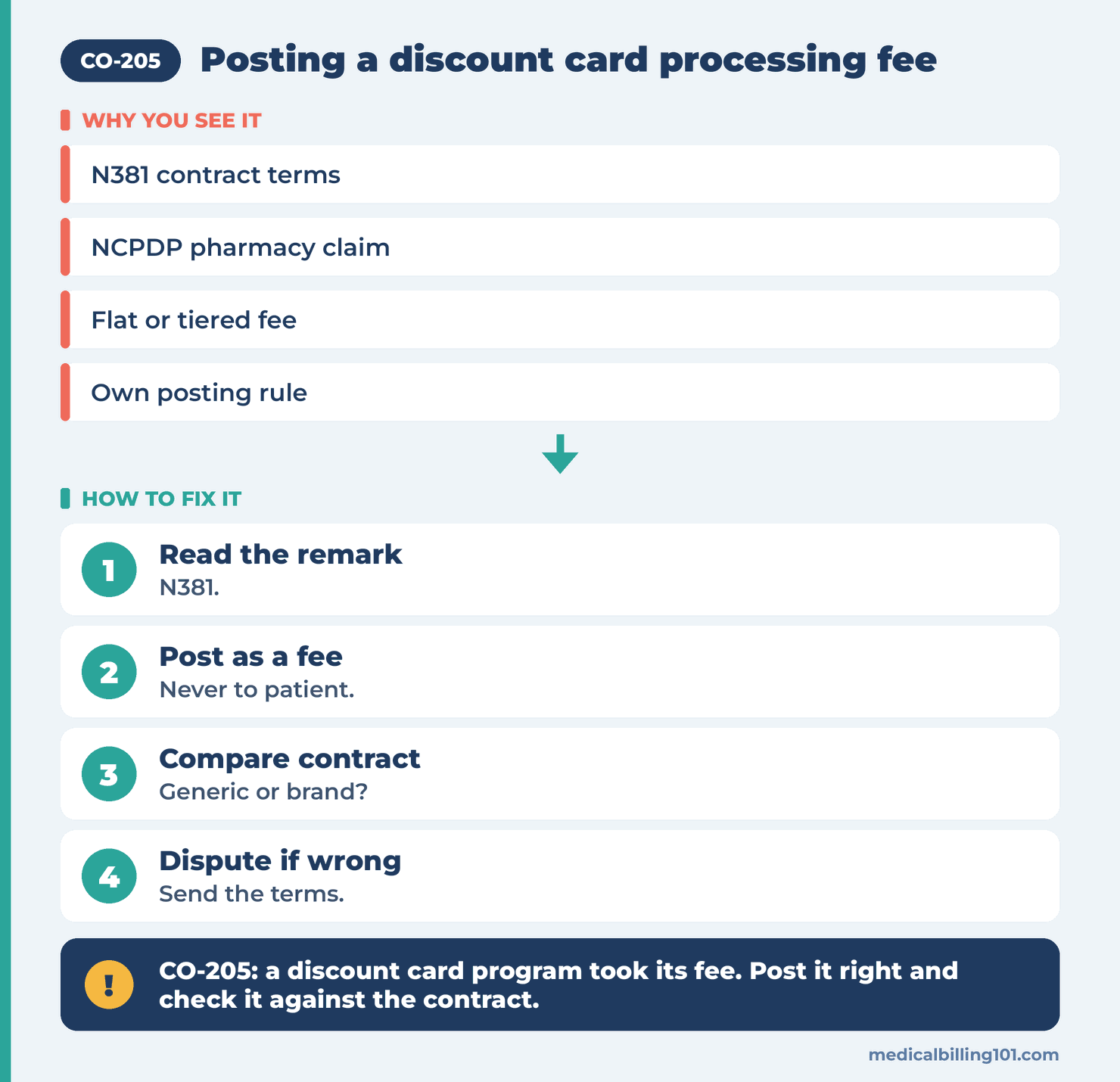
- Read the remark. N381 points you to the contract with the processor.
- Post it as a fee. Use a contractual or processing-fee adjustment. With group code CO, never move it to the patient.
- Compare the agreement. Check the fee schedule for that drug type and date.
- Dispute a wrong fee. Send the processor the claim details and the agreement page that shows the right fee.
- Map the code. Set CARC 205 to its own posting rule so it never lands in patient balance.
Example scenario (fictional names), part 2
How the CO-205 Denial Was Resolved
Rebecca pulled the Sunvale agreement. It had a flat fee for generic fills and a higher fee for brand drugs. The claim had been flagged as a brand fill because the pharmacy’s system sent the wrong product type for that generic.
Fix: no claim form change applied, because this is a pharmacy claim. Rebecca posted the fee as a processing-fee adjustment and removed it from the patient balance. She asked Sunvale to reprice the fee at the generic rate, with the agreement page attached, and fixed the product setting.
Outcome: Sunvale refunded the difference on the next remittance. Corner Street mapped CARC 205 to its own posting rule.
Names and details are illustrative; no real patient data.
Why there’s no CMS-1500 or UB-04 visual here
Discount card fills are pharmacy claims sent through the NCPDP standard, not on the CMS-1500 or UB-04. The fix was a posting change and a fee dispute, so no medical claim form field applies.
CO-205 vs related codes
| Code | What it says | Key difference |
|---|---|---|
| CO-205 | Pharmacy discount card processing fee | Program fee |
| CO-45 | Charge exceeds the fee schedule or contracted amount | Normal contractual reduction |
| CO-59 | Multiple or concurrent procedure rules | Procedure reduction |
| CO-B13 | Previously paid | Payment already made |
Recap
CO-205 is a pharmacy discount card processing fee. Post it as a contractual fee, never as patient balance. Compare it with your agreement, dispute it with the processor when it’s wrong, and give the code its own posting rule.
FAQ
What does CO-205 mean?
It reports a pharmacy discount card processing fee taken from or charged against the payment.
Is CO-205 a denial?
No. It’s a fee. The prescription was processed.
Can the pharmacy bill the patient for the CO-205 fee?
No. With group code CO, the fee stays with the pharmacy under its agreement.
Why is the fee different from claim to claim?
Many agreements use tiered fees, such as different amounts for generic and brand drugs.
Do medical practices see CARC 205?
Rarely. It’s mainly used on pharmacy remittances for discount card claims.
Sources
How we checked: each code quote on this page was matched word for word with the X12 CARC and RARC lists on 22 October 2026.
- X12, Claim Adjustment Reason Codes (CARC 205, 45, 59, B13). Accessed 22 Oct 2026.
- X12, Remittance Advice Remark Codes (N381). Accessed 22 Oct 2026.
- CMS, HIPAA transaction standards overview. Accessed 22 Oct 2026.
Last updated: 22 October 2026 · Educational content; not legal advice.