
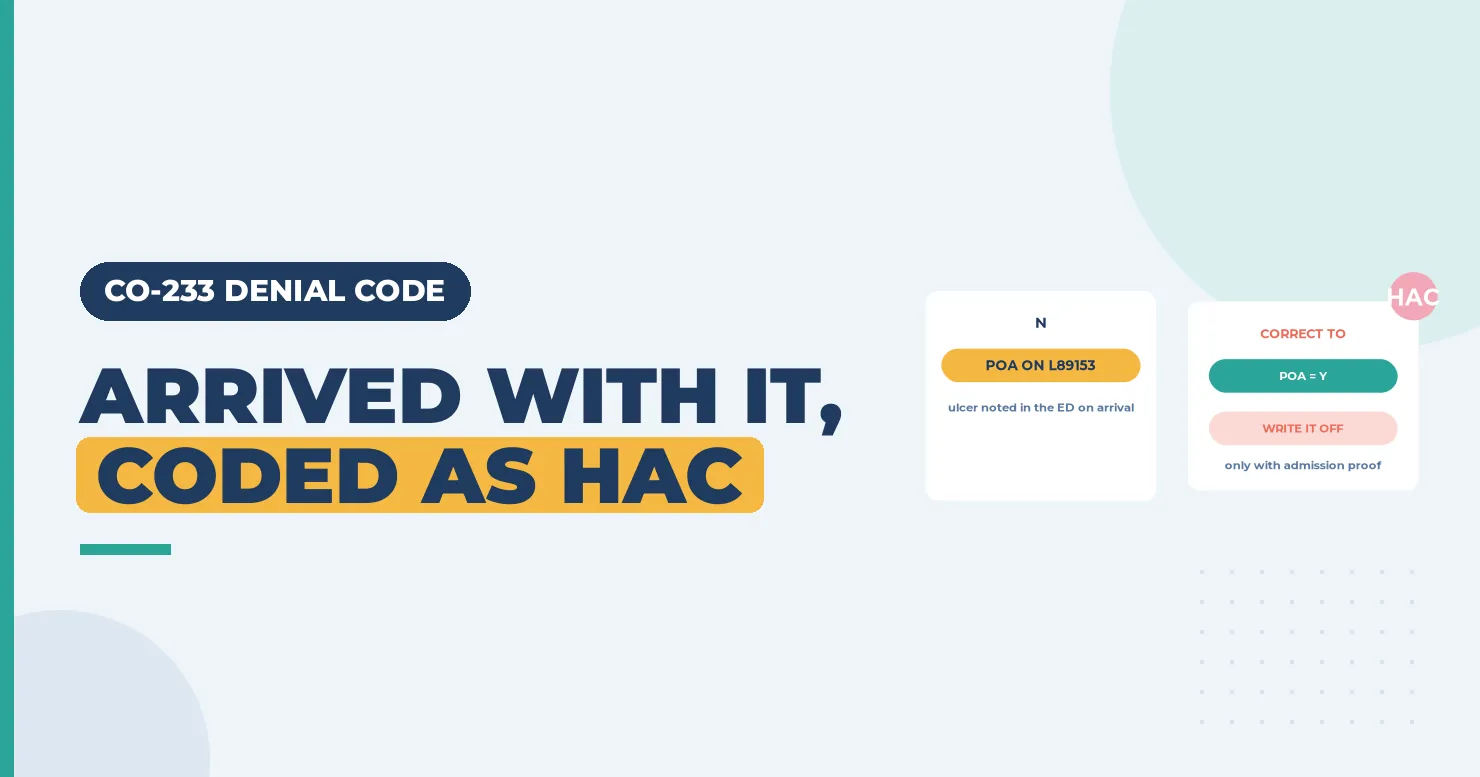
Payers will not pay extra for harm that happened in the hospital. CO-233 is how they take out charges tied to a hospital-acquired condition (HAC) or a preventable medical error. The payer learns about the condition from your own claim, through the present on admission (POA) indicator. So a single wrong letter can make a condition the patient arrived with look like one your staff caused. (Primary source: X12 Claim Adjustment Reason Codes)
In brief: CARC 233 reads “Services/charges related to the treatment of a hospital-acquired condition or preventable medical error.” Check the POA indicator on every secondary diagnosis against the admission documentation. If the condition was present at admission and the indicator says N, send a replacement claim with Y. If it truly developed in the hospital, the adjustment stands.
Part of our denial codes library. Written by Manikandan J, CPC, CRCR, who has reviewed POA indicator errors with inpatient coding and CDI teams. Published 23 October 2026. Last updated: 23 October 2026. Code wording quoted word for word from X12.
What does CO-233 mean?
| Field | Value |
|---|---|
| Code | 233 |
| Description | “Services/charges related to the treatment of a hospital-acquired condition or preventable medical error.” |
| Start | 01/24/2010 |
Source: X12 Claim Adjustment Reason Codes, checked 23 October 2026.
A hospital-acquired condition (HAC) is a condition that was not present when the patient was admitted and that payers treat as reasonably preventable. Medicare’s list includes, for example, stage 3 and 4 pressure ulcers, falls with injury, and catheter-associated urinary tract infections; CMS keeps it on its HAC page. The present on admission (POA) indicator is a one-letter flag on each diagnosis: Y means present at admission, N means not present, U means not enough documentation, and W means clinically undetermined.
Remark N434 reads “Missing/Incomplete/Invalid Present on Admission indicator.” It often appears when the POA field is blank or invalid.
Why CO-233 happens
- A real hospital-acquired condition. Such as a fall with a fracture during the stay.
- A wrong N indicator. The condition was in the admission notes, but the coder keyed N.
- Late documentation. For instance, a wound noted by nursing on arrival but not by the doctor until day three.
- A missing indicator. Blank POA fields can trigger N434 and the payer’s default rules.
Example scenario (fictional names), part 1
CO-233 Denial Example: What Happened
Grace Chen is a coding auditor at Mercy Ridge Medical Center. A pneumonia stay (J18.9, entered as J189) came back with CAS*CO*233. The payer removed the extra payment tied to a stage 3 sacral pressure ulcer (L89.153, entered as L89153).
On the UB-04, the POA indicator next to L89153 in FL 67A was N. The patient had been sent in from a nursing home.
Was the ulcer really acquired in the hospital? Keep reading, or jump to how the CO-233 denial was resolved.
How to fix a CO-233 adjustment
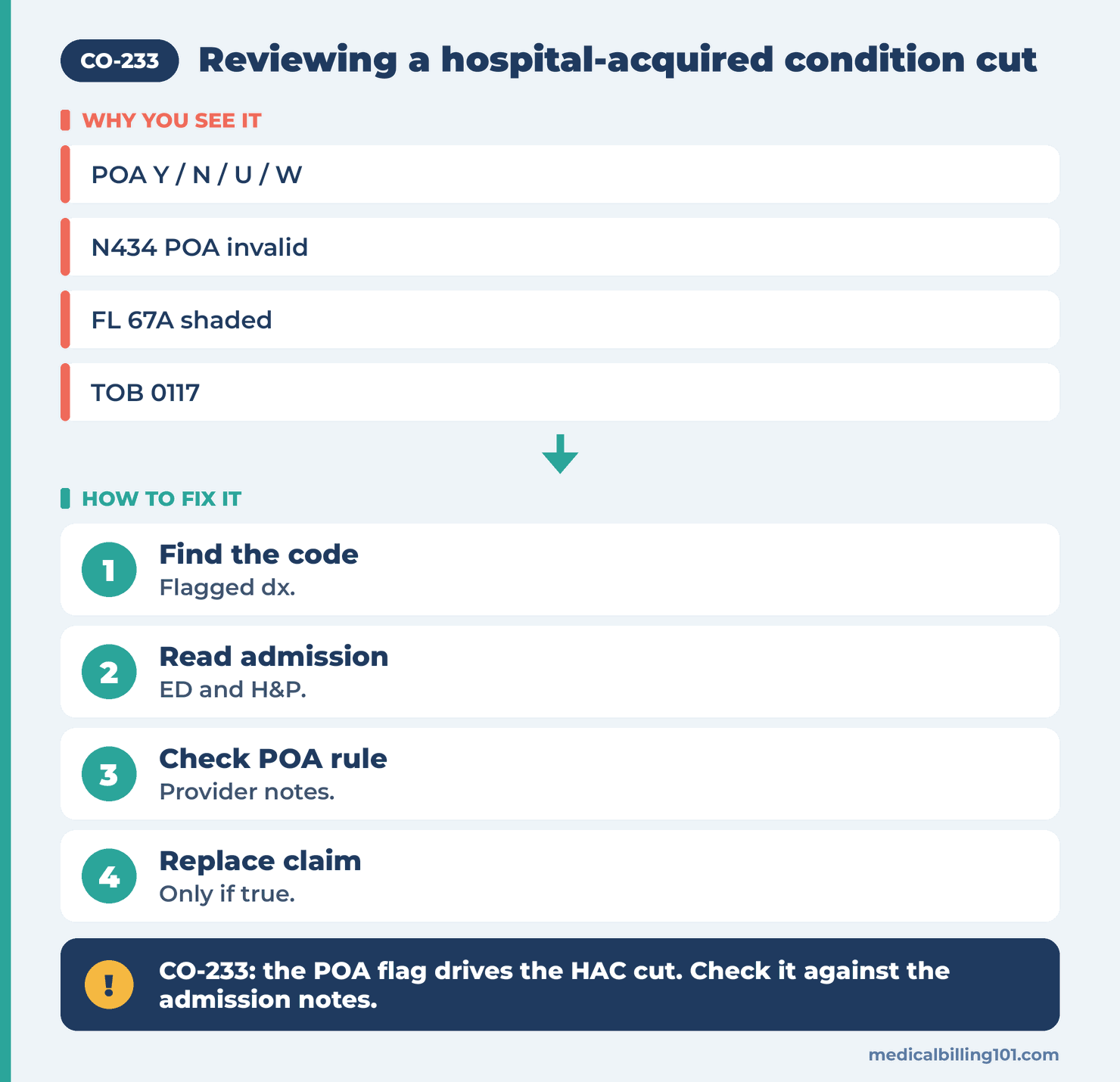
- List the flagged diagnosis. Find which code the payer tied to the HAC.
- Read the admission record. For example, the ED note, the H&P and the admission skin assessment.
- Check the POA rules. The ICD-10-CM guidelines say POA is based on provider documentation; query the doctor if it is unclear.
- Correct the indicator if the record shows the condition at admission, and send a replacement claim (type of bill 0117).
- Accept true HACs. If the condition began during the stay, do not change the indicator; route the case to quality review.
The claim form section below shows the field change.
Example scenario (fictional names), part 2
How the CO-233 Denial Was Resolved
Grace pulled the ED note and the admitting doctor’s H&P. Both described a stage 3 sacral wound on arrival from the nursing home.
Fix: She corrected the POA indicator for L89153 in FL 67A from N to Y and sent a replacement claim, type of bill 0117, with the original claim number in FL 64.
Outcome: The payer reprocessed the stay with the ulcer counted as present on admission and restored the payment. Mercy Ridge added a POA review for every pressure ulcer code before claims drop.
Names and details are illustrative; no real patient data.
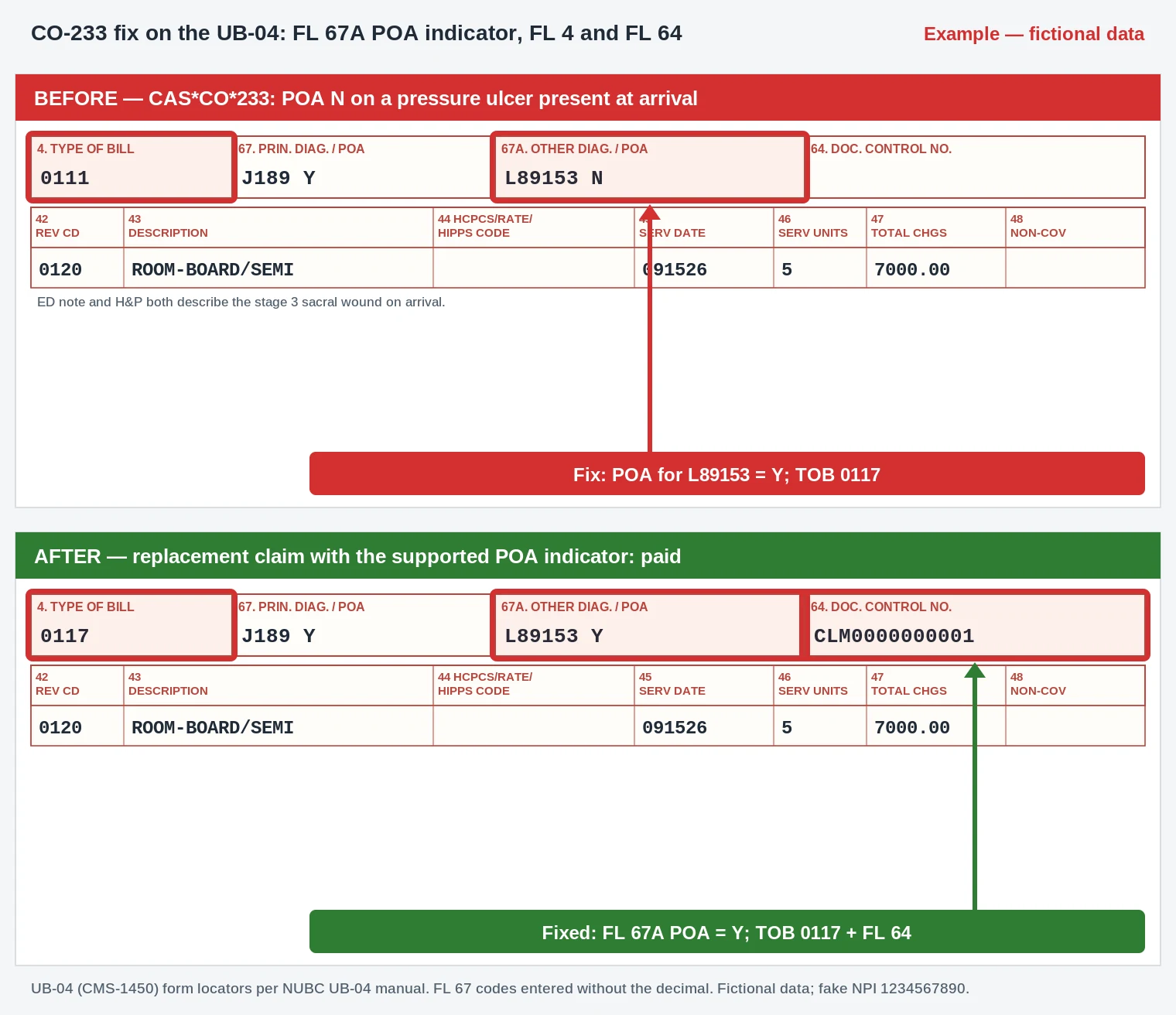
CMS-1500 not shown: present on admission indicators exist only on the inpatient UB-04 (FL 67 shaded field); the CMS-1500 has no POA field.
- FL 67A (shaded POA field): POA indicator for L89.153 (entered as L89153) changed from N to Y, supported by the ED note and H&P.
- FL 4 + FL 64: type of bill 0117 (inpatient replacement) with the original claim number.
- FL 67: principal diagnosis J18.9 (entered as J189) with POA Y is unchanged.
- CMS-1500: no equivalent box; POA indicators are inpatient facility only.
CO-233 compared with related codes
| Code | Meaning | Fix |
|---|---|---|
| CO-233 | Hospital-acquired condition | Check the POA indicator |
| CO-16 | Missing information | Add the missing data |
| CO-50 | Not medically necessary | Necessity appeal |
| CO-11 | Diagnosis inconsistent | Fix the diagnosis |
For audit risk around inpatient coding, see our OIG audit triggers guide.
FAQ
What does CO-233 mean?
The payer removed charges tied to treating a hospital-acquired condition or a preventable medical error.
What is a POA indicator?
A flag on each diagnosis showing whether the condition was present at admission: Y, N, U or W.
Can I change N to Y to get paid?
Only if the admission documentation shows the condition was present. Changing it without support is a compliance risk.
Does CO-233 apply to physician claims?
It is tied to inpatient facility claims and POA reporting, which exist only on the UB-04.
Can the patient be billed?
No. Group code CO keeps the amount with the hospital.
Sources
How we checked: each code quote on this page was matched word for word with the X12 CARC and RARC lists on 23 October 2026.
- X12, Claim Adjustment Reason Codes (CARC 233). Accessed 23 Oct 2026.
- X12, Remittance Advice Remark Codes (N434). Accessed 23 Oct 2026.
- CMS, Hospital-Acquired Conditions. Accessed 23 Oct 2026.
- CMS, Acute Inpatient PPS. Accessed 23 Oct 2026.
Last updated: 23 October 2026 · Educational content; not legal advice.