
CO-240 is a newborn edit. The payer compares the weight-based diagnosis code on a baby’s claim with the birth weight reported on the same claim, and the two do not agree. It shows up most on NICU and nursery bills, where the weight drives the DRG. The fix is almost always a one-digit coding change, but only after the chart confirms which number is right. (Primary source: X12 Claim Adjustment Reason Codes)
In brief: CARC 240 reads “The diagnosis is inconsistent with the patient’s birth weight.” Check the birth weight in grams in the delivery record, compare it with the P07 code range and value code 54 on the UB-04, correct whichever is wrong, and send a replacement claim.
Part of our denial codes library. Written by Manikandan J, CPC, CRCR, who has reviewed newborn and NICU facility claims for health plans. Published 23 October 2026. Last updated: 23 October 2026. Code wording quoted word for word from X12.
What does CO-240 mean?
| Field | Value |
|---|---|
| Code | 240 |
| Description | “The diagnosis is inconsistent with the patient’s birth weight. Usage: Refer to the 835 Healthcare Policy Identification Segment (loop 2110 Service Payment Information REF), if present.” |
| Start | 06/03/2012 |
| Last modified | 07/01/2017 |
Source: X12 Claim Adjustment Reason Codes, checked 23 October 2026.
CO-240 flags a mismatch between a weight-based diagnosis and the reported weight. P07 codes are the ICD-10-CM codes for low birth weight and prematurity; each P07.0 and P07.1 code covers a gram range, for example P07.16 covers 1750-1999 grams. Value code 54 is the UB-04 code for newborn birth weight in grams, reported in FL 39-41 under NUBC rules.
The payer may also add M76: “Missing/incomplete/invalid diagnosis or condition.”
Common causes of CO-240
- The wrong gram range. For example, a 1,850 gram baby coded P07.15 instead of P07.16.
- A typo in value code 54. Such as 1580 entered for 1850.
- Weight in pounds. For instance, a weight converted wrong from pounds and ounces.
- A discharge weight used. The code must reflect birth weight, not the weight recorded at discharge or transfer, even when the baby gained weight during a long NICU stay.
Example scenario (fictional names), part 1
CO-240 Denial Example: What Happened
Priya Nair codes inpatient claims for Riverbend Women’s Hospital. A 12 day NICU stay for a premature baby came back with CAS*CO*240 and no payment.
The claim reported value code 54 with 1850 grams, while the diagnosis list included P07.15, and the DRG grouper had used that weight code to assign the newborn DRG.
Which number is wrong: the code or the weight? Keep reading, or jump to how the CO-240 denial was resolved.
How to fix CO-240
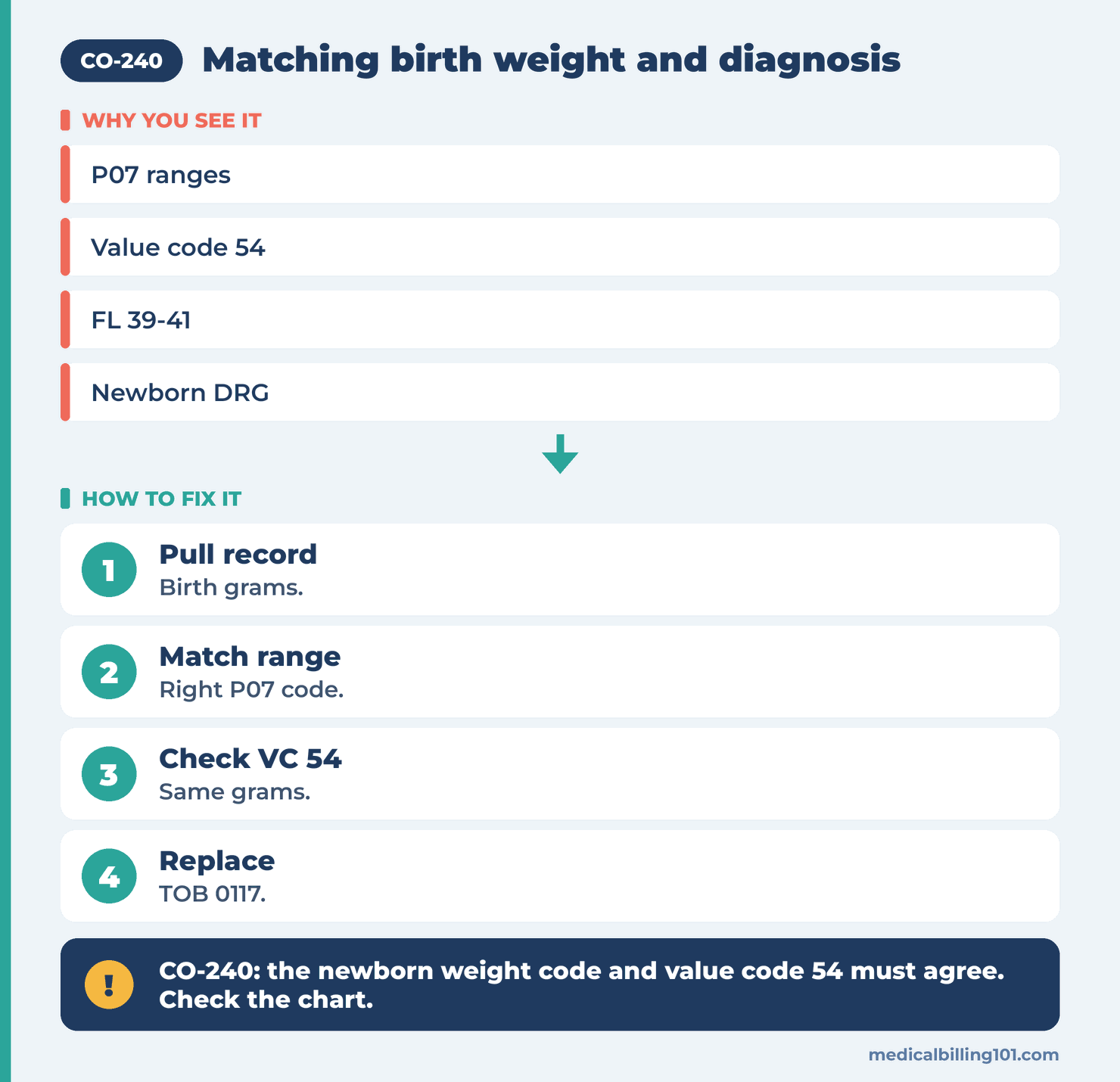
- Pull the delivery record. Find the birth weight in grams as documented by the delivering clinician or nursery staff, not a later weight taken during the admission.
- Match the code range. Pick the P07 code whose range includes that weight. The CMS ICD-10 page links the current code files.
- Check value code 54. It must hold the same weight in grams, without decimals or unit conversions, because the payer’s edit compares the two values directly.
- Regroup the claim. A corrected weight code may change the newborn DRG assignment and the expected reimbursement, so review the new grouper result before billing.
- Send a replacement claim. Use type of bill 0117 with the original claim number.
Example scenario (fictional names), part 2
How the CO-240 Denial Was Resolved
Priya checked the delivery documentation, which recorded 1,850 grams, so the value code was accurate and the coder had selected the 1500-1749 gram category by mistake.
Fix: She changed P07.15 to P07.16 in FL 67A, regrouped the stay and sent a 0117 replacement claim.
Outcome: The claim paid at the right newborn DRG. Riverbend added a pre-bill edit that compares P07 codes with value code 54.
Names and details are illustrative; no real patient data.
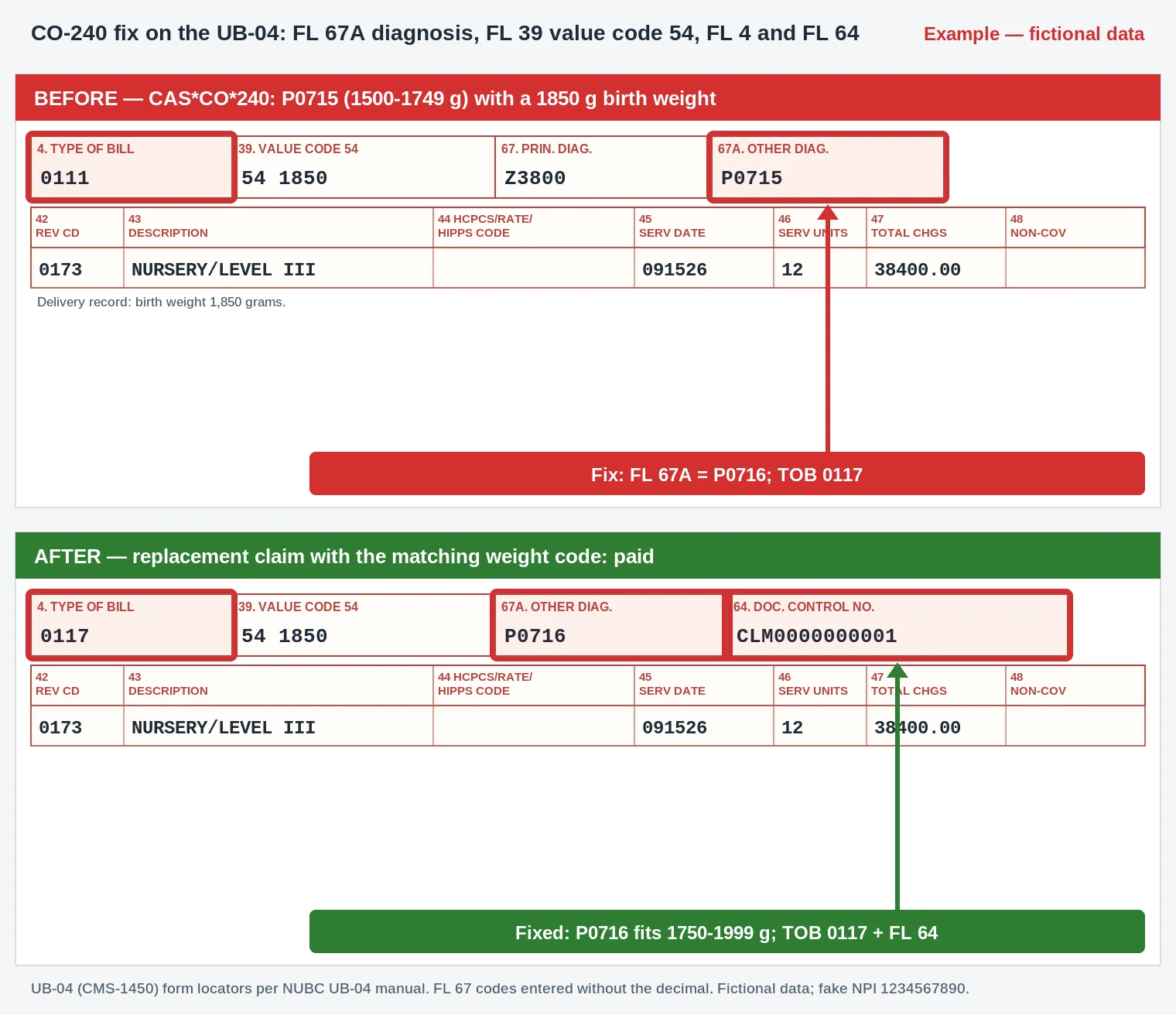
CMS-1500 not shown: birth weight is reported only on the UB-04 (value code 54 in FL 39-41); the CMS-1500 has no birth weight field.
- FL 67A: P07.15 (entered as P0715, 1500-1749 grams) changed to P07.16 (entered as P0716, 1750-1999 grams) to match the delivery record.
- FL 39-41: value code 54 with 1850 grams is unchanged; it was already right.
- FL 4 + FL 64: type of bill 0117 (inpatient replacement) with the original claim number.
- FL 67: principal diagnosis Z38.00 (entered as Z3800) is unchanged.
- CMS-1500: no equivalent box; birth weight is a facility claim field.
CO-240 compared with nearby codes
| Code | Meaning | Where to look |
|---|---|---|
| CO-240 | Diagnosis vs birth weight | P07 code and value code 54 |
| CO-11 | Diagnosis vs procedure | Diagnosis pointers |
| CO-16 | Missing information | Remark code |
| CO-4 | Procedure vs modifier | Modifiers |
FAQ
What does CO-240 mean?
The newborn’s weight-based diagnosis does not match the birth weight on the claim.
Where is birth weight reported?
On the UB-04, birth weight is reported with value code 54 in form locators 39 through 41, always expressed in grams.
Does CO-240 apply to professional claims?
Rarely. The CMS-1500 has no birth weight field, so the edit runs on facility claims.
Can I bill the parents for CO-240?
No. Group code CO means the hospital fixes and rebills.
Should I use birth weight or gestational age?
Code both when documented. When both are listed, ICD-10-CM guidelines put the birth weight code first.
Sources
How we checked: each code quote on this page was matched word for word with the X12 CARC and RARC lists on 23 October 2026.
- X12, Claim Adjustment Reason Codes (CARC 240). Accessed 23 Oct 2026.
- X12, Remittance Advice Remark Codes (M76). Accessed 23 Oct 2026.
- CMS, ICD-10 Codes. Accessed 23 Oct 2026.
- NUBC, National Uniform Billing Committee. Accessed 23 Oct 2026.
Last updated: 23 October 2026 · Educational content; not legal advice.