
CO-258 shows up when the payer’s files say the patient was in jail on the date of service. Most plans do not pay for care given to people in jail. The jail or a government agency pays instead. Many CO-258 denials are wrong, though. The patient may have been let out. He may be on probation or parole. (Primary source: X12 Claim Adjustment Reason Codes)
In brief: CARC 258 reads “Claim/service not covered when patient is in custody/incarcerated. Applicable federal, state or local authority may cover the claim/service.” Check where the patient was on the service date. If held, bill the jail or agency. If not, send proof of release and ask the payer to look again.
Part of our denial codes library. Written by Manikandan J, CPC, CRCR, who has worked custody-related Medicare denials for hospital emergency departments. Published 24 October 2026. Last updated: 24 October 2026. Code wording quoted word for word from X12. Read about the author and our editorial policy, or contact us to report an error.
CO-258 definition
| Field | Value |
|---|---|
| Code | 258 |
| Description | “Claim/service not covered when patient is in custody/incarcerated. Applicable federal, state or local authority may cover the claim/service.” |
| Start | 11/01/2013 |
Source: X12 Claim Adjustment Reason Codes, checked 24 October 2026.
Key terms: A CARC is a Claim Adjustment Reason Code from the X12 list, and it says why a line was paid differently than billed. A RARC is a Remittance Advice Remark Code that adds detail to the CARC. The group code is the two-letter prefix on the adjustment; CO means contractual obligation: the provider owns the balance and it cannot be billed to the patient.
Methodology: the code wording above is copied from the X12 list, and each fix step below links to the payer or CMS page it comes from.
Who counts as in custody for Medicare
The Medicare rule is 42 CFR 411.4. It changed in late 2024. It now lists who is and is not in custody.
| In custody | Not in custody |
|---|---|
| Held in a jail or prison | Out on bail before trial |
| Out on medical leave | On parole |
| Escaped | On probation |
| Held in a mental health unit by court order | At home on detention, or in a halfway house |
Medicare can pay for someone in custody only in rare cases. Local law must make the person pay. The jail must also bill and collect from everyone the same way.
Example scenario (fictional names), part 1
CO-258 Denial Example: What Happened
Leah Brandt bills for Pine Ridge Medical Center, a fictional hospital. A Medicare patient came to the emergency room with chest pain on 3 September.
The claim came back with CAS*CO*258. The patient had been released on probation in July, but Medicare’s records still showed him in custody.
How does Leah get this claim paid? Keep reading, or jump to how the CO-258 denial was resolved.
Common reasons for CO-258
- Patient really was held. The jail or prison pays for the care.
- Old data. For example, a release date never reached Medicare.
- Status that is not custody. Probation, parole and bail do not count under the Medicare rule.
- Wrong match. Another person’s jail record was linked to the member.
Resolving a CO-258 denial
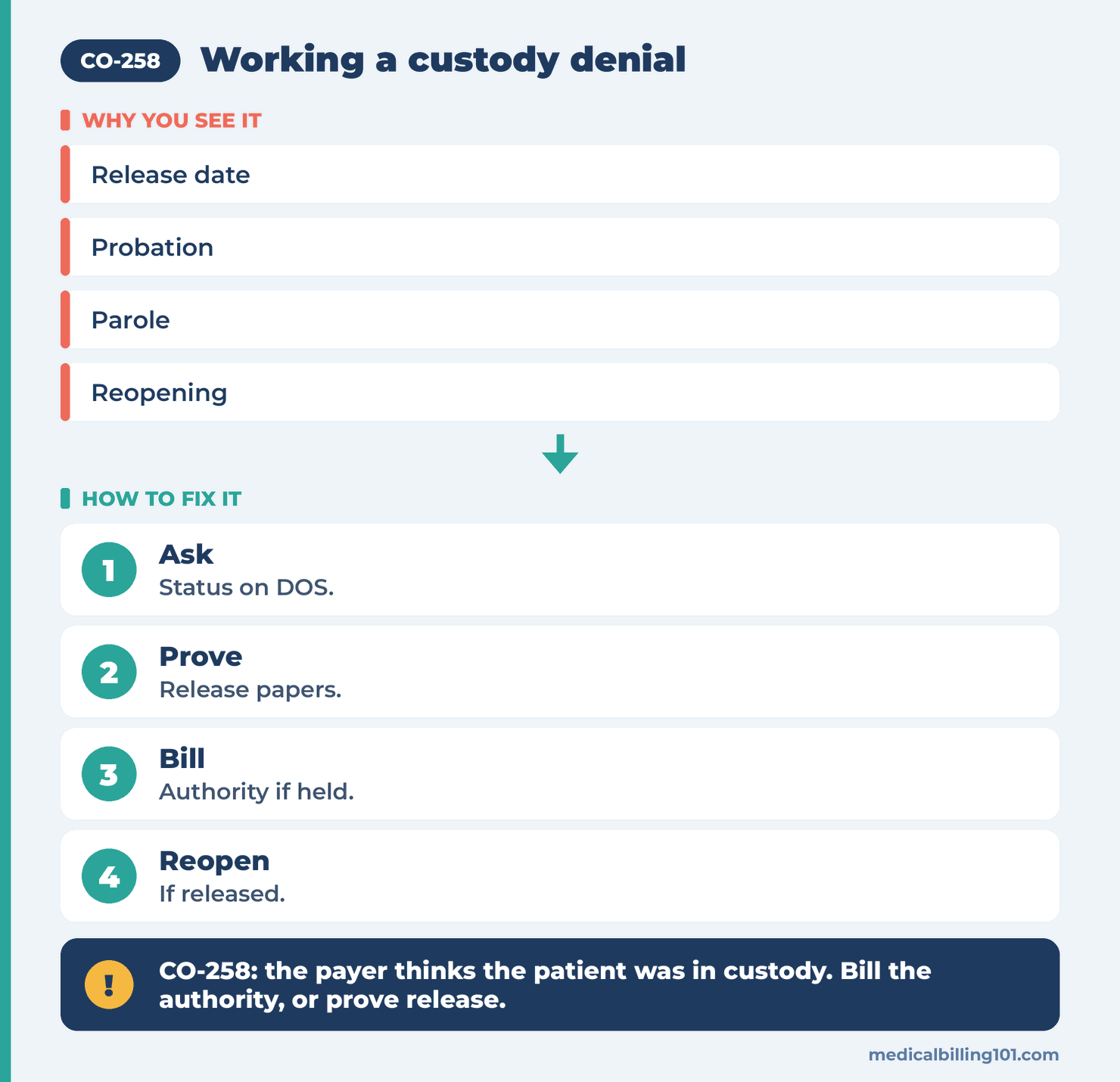
- Ask the patient. Find out where they were on the service date. If they were let out, get the date.
- Get proof. Use a release paper, a probation or parole order, or a letter from the court.
- If held: bill the jail or agency under its rules for outside care.
- If not held: send the proof to the payer and ask for a reopening or appeal. Ask the patient to tell Social Security too.
- Note the account. Write down the facts so the next claim is not denied too.
Example scenario (fictional names), part 2
How the CO-258 Denial Was Resolved
Leah got a copy of the patient’s probation order showing release on 18 July.
Fix: She sent the order to the Medicare contractor and asked for a reopening. She also asked the patient to tell Social Security he was out.
Outcome: The claim was paid. The hospital now asks about recent release at check-in.
Names and details are illustrative; no real patient data.
CO-258 and nearby eligibility denials
| Code | Main issue | Typical fix |
|---|---|---|
| CO-258 | Patient in custody on service date | Bill the authority, or prove release |
| CO-27 | Coverage ended | Check eligibility |
| CO-109 | Wrong payer | Send to the right payer |
| CO-96 | Non-covered charge | Check coverage rules |
FAQ
What does CO-258 mean?
The payer thinks the patient was in jail or prison on the service date, so it will not pay.
Who pays for care for people in jail?
Usually the jail or the agency that holds the person. Check its rules for outside care.
Is a person on probation in custody?
Not under the Medicare rule. Probation, parole and pretrial release are listed as not in custody.
Can I bill the patient for CO-258?
No. The CO group means the provider must sort it out with the payer or the jail.
How do I fix wrong custody records?
Send proof of release to the payer. Ask the patient to tell Social Security.
Sources
How we checked: the code quote and the custody rule on this page were matched with the source text on 24 October 2026.
- X12, Claim Adjustment Reason Codes (CARC 258). Accessed 24 Oct 2026.
- eCFR, 42 CFR 411.4. Accessed 24 Oct 2026.
- CMS, Medicare Claims Processing Manual, chapter 1. Accessed 24 Oct 2026.
Last updated: 24 October 2026 · Educational content; not legal advice.
Related denial codes
- OA-257: Claim Pended in the Grace Period
- CO-254: Send It to the Medical Plan
- CO-270: Bill the Patient's Dental Plan
- CO-239: Rebill Separate Claims by Coverage Period
- PR-238: Coverage Ended Partway Through the Claim
- CO-224: Patient Identity Compromised
- PR-204: Not Covered Under the Patient's Current Benefit Plan
- PR-200: Expenses During Lapse in Coverage