
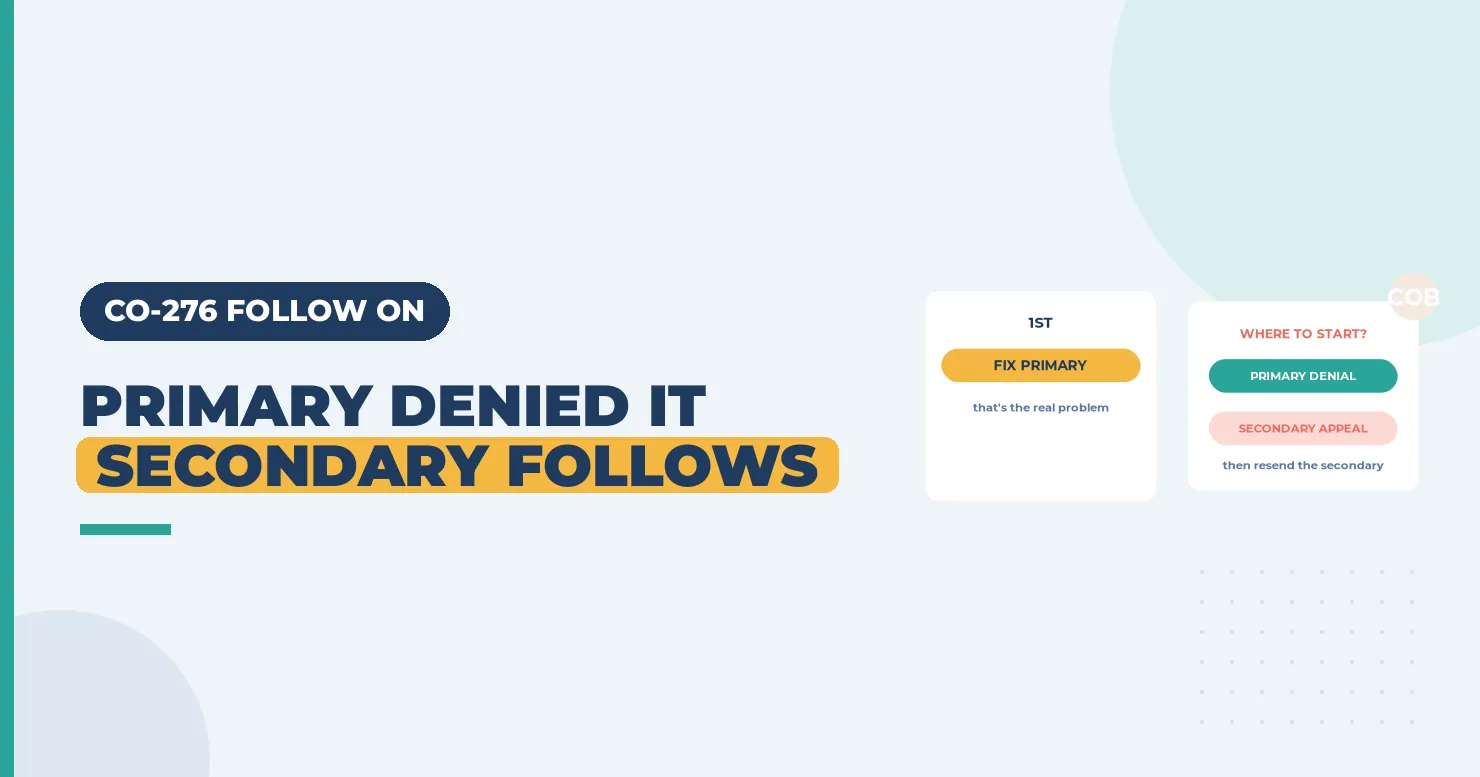
CO-276 is a follow-on denial. The first plan said no to a service. Now the second plan says no too. It is just going along with the first plan. So the fix is almost always on the first plan’s side, not the second claim. (Primary source: X12 Claim Adjustment Reason Codes)
In brief: CARC 276 reads “Services denied by the prior payer(s) are not covered by this payer.” Work the primary plan’s denial first. If it gets paid on appeal, resend the secondary with the new primary data.
Part of our denial codes library. Written by Manikandan J, CPC, CRCR, who has worked primary and secondary denial chains for hospital and physician billing teams. Published 26 October 2026. Last updated: 26 October 2026. Code wording quoted word for word from X12. Read about the author and our editorial policy, or contact us to report an error.
X12 entry
| Field | Value |
|---|---|
| Code | 276 |
| Description | “Services denied by the prior payer(s) are not covered by this payer.” |
| Start | 11/01/2015 |
Source: X12 Claim Adjustment Reason Codes, checked 26 October 2026.
Key terms: A CARC is a Claim Adjustment Reason Code from the X12 list, and it says why a line was paid differently than billed. A RARC is a Remittance Advice Remark Code that adds detail to the CARC. The group code is the two-letter prefix on the adjustment; CO means contractual obligation: the provider owns the balance and it cannot be billed to the patient.
Methodology: the code wording above is copied from the X12 list, and each fix step below links to the payer or CMS page it comes from.
Example scenario (fictional names), part 1
CO-276 Denial Example: What Happened
Ivan Cole bills for Westfield Imaging, a fictional imaging center in Arizona. A patient with a locked, painful right knee (M25561) had a same-day MRI without contrast, billed as 73721. Her primary plan, a fictional employer plan, denied the line with CAS*CO*197 and remark M62, a missing authorization code.
Ivan sent the secondary claim with the primary’s $0 payment. The second plan, also fictional, returned CAS*CO*276 with remark LQ*HE*N36. That is a CO-276 denial code, and no money came from either plan.
Should Ivan appeal to the secondary plan, or work the primary first? Keep reading, or jump to how the CO-276 denial was resolved.
Why the secondary plan follows the primary
- The same reason applies to both. For example, a missing auth or missing records is a problem for both plans. Under coordination of benefits, the second plan pays only after the first plan decides (HealthCare.gov COB definition).
- Plan rules. Many second plans pay only on what the first plan allowed.
- Not a benefit. If the first plan says the service isn’t covered, the second may say the same.
- A fixable error. Often the first denial was a billing slip that can still be fixed.
Working the denial chain
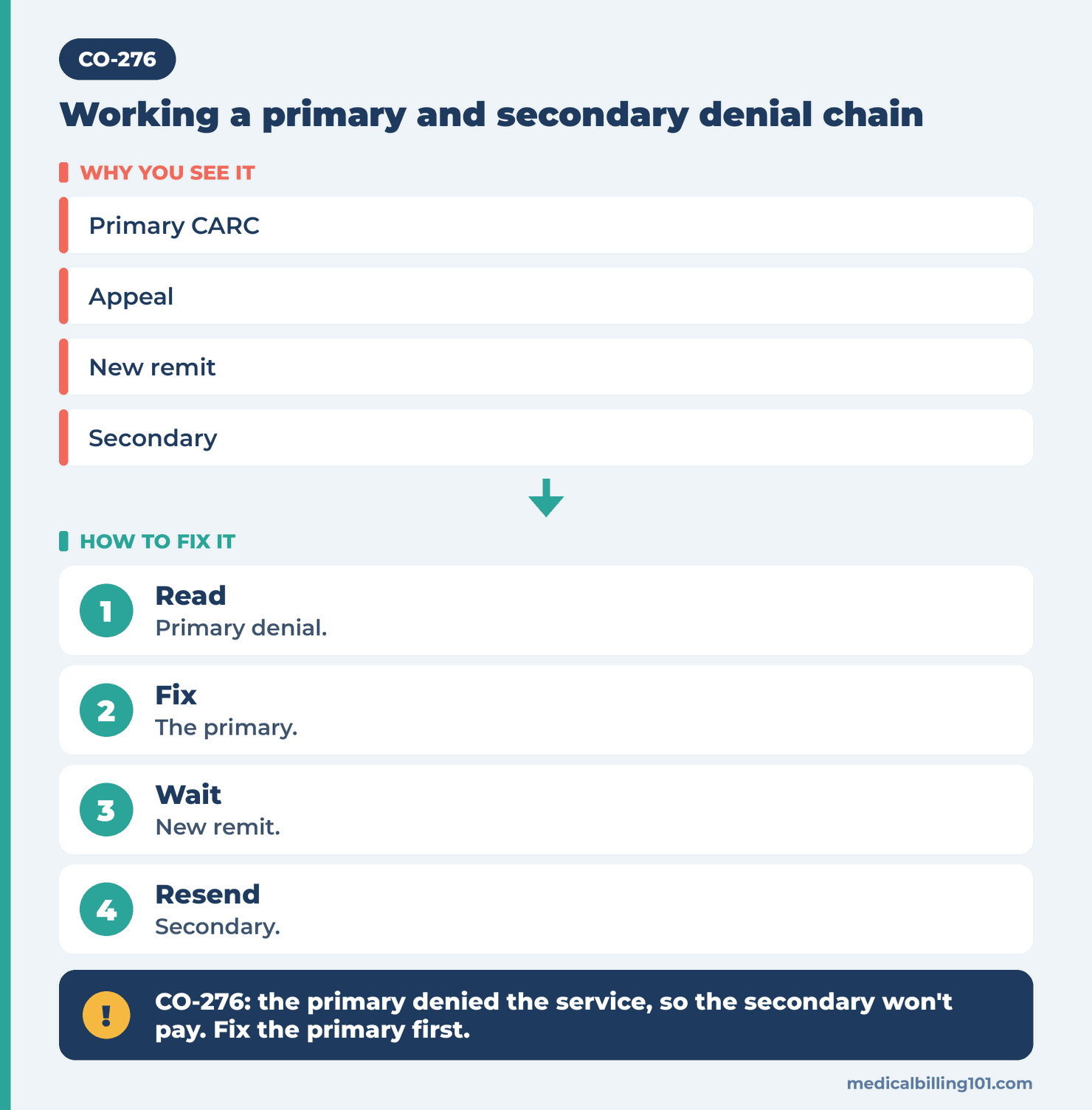
- Read the primary denial. Find its CARC and RARC. That’s the real problem. The secondary often adds N36, which tells you the primary’s rules come first (X12 RARC list).
- Fix the primary. Correct the claim, add the auth, or appeal with records.
- Wait for the new primary remit. It shows the paid amount and patient share.
- Resend the secondary. Send the secondary claim with the new primary paid amount and adjustments. For Medicare as primary or secondary, CMS explains payer order on its COB overview.
- Appeal the secondary only if its rules differ. If it covers what the first plan does not, appeal with its terms.
Authorization denials like the one in Ivan’s case are covered on our CO-197 page. For coordination order, see CO-22.
Claim form note
No claim form visual is shown. CO-276 is fixed by working the primary denial, so the secondary claim doesn’t need a field change on its own.
Example scenario (fictional names), part 2
How the CO-276 Denial Was Resolved
Ivan read N36, “Claim must meet primary payer’s processing requirements before we can consider payment.” The secondary was right, so the problem sat with the primary.
- The ordering note said the knee was locked and the scan was urgent.
- The ordering office had called the primary that morning, but no auth was issued before the scan.
Fix: Ivan filed a primary appeal with the ordering note and the call reference. The primary granted a retro authorization and reprocessed the original claim, so no claim field changed.
Outcome: The primary paid and left a patient share. Ivan resent the secondary with the new 835 data, and it paid most of that share. Westfield now confirms urgent auths before same-day scans.
Names and details are illustrative; no real patient data.
Related codes
| Code | Meaning | Where to start |
|---|---|---|
| CO-276 | Primary denied, secondary follows | The primary denial |
| PR-275 | Secondary won’t cover cost share | Bill the patient |
| CO-197 | No prior authorization | Get the authorization |
| OA-23 | Prior payer adjudication impact | Check the math |
FAQ
What does CO-276 mean?
The secondary plan won’t pay for a service because the primary plan denied it.
Should I appeal CO-276 to the secondary?
Not first. Fix the first plan’s denial, then send the second claim again.
Can the patient be billed for CO-276?
Not for a CO amount. Check the contract and the primary denial’s group code.
When can the secondary pay anyway?
When its own terms cover a service the first plan does not.
How is CO-276 different from PR-275?
PR-275 is about the primary’s leftover cost share. CO-276 is about a service the primary denied in full.
Sources
How we checked: the code quote on this page was matched word for word with the X12 CARC list on 26 October 2026, and the N36 and M62 remarks with the X12 RARC list.
- X12, Claim Adjustment Reason Codes (CARC 276). Accessed 25 Oct 2026.
- X12, Remittance Advice Remark Codes (RARC N36, M62). Accessed 25 Oct 2026.
- HealthCare.gov, Coordination of benefits. Accessed 25 Oct 2026.
- CMS, Coordination of Benefits overview. Accessed 25 Oct 2026.
Last updated: 26 October 2026 · Educational content; not legal advice.