
The PR-8 denial code says the payer could not match the procedure to the provider type or specialty on the claim, and it moved the balance to the patient. Most of the time the root cause is a taxonomy code: missing, outdated, or belonging to someone other than the clinician who did the work. (Primary source: X12 Claim Adjustment Reason Codes)
In brief: reason code 8 reads “The procedure code is inconsistent with the provider type/specialty (taxonomy).” A PR group on this code is unusual. Fix the taxonomy and resend before any patient statement, and confirm with the payer that the member truly owes it.
Part of our denial codes library. Written by Manikandan J, CPC, CRCR, who has corrected taxonomy and rendering-provider errors on multispecialty and hospital outpatient claims. Published 29 October 2026. Last updated: 29 October 2026. Code wording quoted word for word from X12. Read about the author and our editorial policy, or contact us to report an error.
What X12 says about CARC 8
| Field | Value |
|---|---|
| Code | 8 |
| Description | “The procedure code is inconsistent with the provider type/specialty (taxonomy).” |
| Usage note | Refer to the 835 Healthcare Policy Identification Segment (loop 2110 REF), if present |
| Start | 01/01/1995 (last modified 07/01/2017) |
| Group on this page | PR, patient responsibility |
Source: X12 Claim Adjustment Reason Codes, checked 29 October 2026.
Key terms: A taxonomy code is the 10-character NUCC code that describes a provider’s type and specialty, such as 133V00000X for a registered dietitian (NUCC taxonomy code set). The rendering provider is the clinician who performed the service. The PR group means the plan assigned the balance to the member instead of writing it off under contract.
Methodology: the CARC and RARC quotes are copied from the X12 lists, and the claim field locations come from the NUCC and CMS manuals linked below.
Why a PR group here deserves a second look
A provider-type edit is usually a provider problem. That is why most payers send this reason as CO-8, which keeps the patient out of it. When the same reason arrives as PR-8, the plan is saying the member’s benefit does not cover that service from that kind of provider. For example, a plan may cover nutrition counseling only from a registered dietitian, not from a physician or nurse.
| You see | What it usually means | Patient bill? |
|---|---|---|
| CO-8 | Wrong or missing taxonomy, provider owns it | No |
| PR-8 | Benefit limited to certain provider types | Only after you confirm the claim was right |
| PR-8 with N95 | “This provider type/provider specialty may not bill this service.” | Check the rendering provider first |
| PR-8 with N808 | “Not covered for this provider type / provider specialty.” | Ask the payer which provider types qualify |
If your claim listed the wrong clinician or the wrong taxonomy, the plan judged the wrong provider. Billing the patient for that would be billing them for your data error.
Where the taxonomy sits on each claim
| Claim | Rendering or billing taxonomy | Qualifier |
|---|---|---|
| CMS-1500 paper | Box 24J shaded (line rendering), Box 33b (billing) | ZZ in the shaded 24I and in 33b |
| 837P electronic | PRV segment in loop 2310B (rendering) or 2000A (billing) | PXC |
| UB-04 paper | FL 81CC, billing provider taxonomy | B3 |
| 837I electronic | PRV segment in loop 2000A | PXC |
The NUCC field rules are in the NUCC 1500 claim form instructions. For the facility side, see the UB-04 field list in the Medicare Claims Processing Manual, chapter 25.
Example scenario (fictional names), part 1
PR-8 Denial Example: What Happened
Priya Nandakumar bills for Cedar Hollow Internal Medicine, a fictional group that employs a registered dietitian. A fictional commercial plan paid nothing on CPT 97802, initial medical nutrition therapy, for a patient with type 2 diabetes (E11.9). The 835 showed:
CAS*PR*8*96.00LQ*HE*N95
The line listed the supervising internist as rendering provider, with no line-level taxonomy. The practice system had already moved $96 to the patient’s balance.
Was the visit really not covered, or did the claim name the wrong clinician? Keep reading, or jump to how it was resolved. Keep reading, or jump to how the PR-8 denial was resolved.
How to work a PR-8 denial
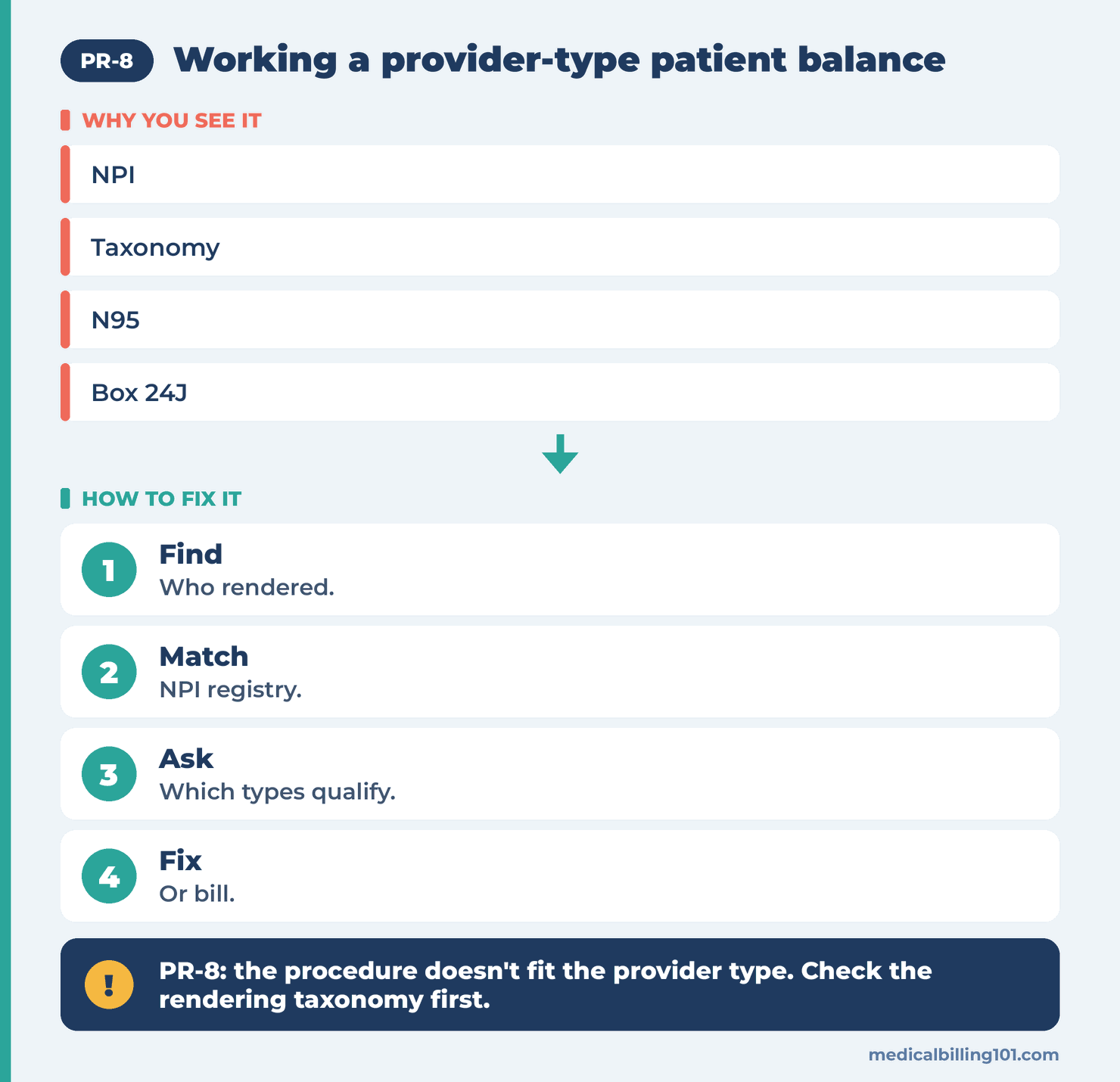
Who actually did the service? Pull the note and find the signing clinician. Then look up that person’s NPI and primary taxonomy in the NPPES NPI Registry.
Does the claim match? Compare the NPI in Box 24J and the shaded taxonomy with the registry. A group taxonomy in Box 33b alone may not tell the plan who rendered the line.
Is the payer file current? If the clinician added a specialty, the payer’s enrollment record may still show the old one. Update it before you resend.
Does the benefit cover this provider type at all? Call the plan and ask which taxonomies qualify for the code. Note the rep’s name and reference number.
Then decide. Send a corrected claim with frequency code 7 if the claim data was wrong. Bill the patient only if the data was correct, the benefit truly excludes that provider type, and the patient was told before the visit.
Medicare and enrollment
Medicare matches the taxonomy and specialty on the claim with the provider’s enrollment record. CMS publishes the crosswalk between Medicare specialty codes and NUCC taxonomy codes (CMS taxonomy crosswalk). A clinician who is not enrolled for a service type cannot fix that with a claim edit, and a patient bill without a valid notice is risky.
Example scenario (fictional names), part 2
How the PR-8 Denial Was Resolved
Priya opened the chart. The registered dietitian had performed and signed the session, not the internist. The plan’s benefit covered MNT from a dietitian, so the PR-8 denial code reflected the claim data rather than a true exclusion.
Fix: she sent a corrected claim with frequency code 7. Box 24J now carried the dietitian’s NPI, with qualifier ZZ in the shaded 24I and taxonomy 133V00000X in the shaded 24J. The E11.9 diagnosis and the 97802 code stayed the same.
Outcome: the plan paid the line, and Priya reversed the $96 patient charge before the next statement run. She also added a rule that flags 97802 and 97803 when the rendering taxonomy is not a dietitian code.
Names and details are illustrative; no real patient data.
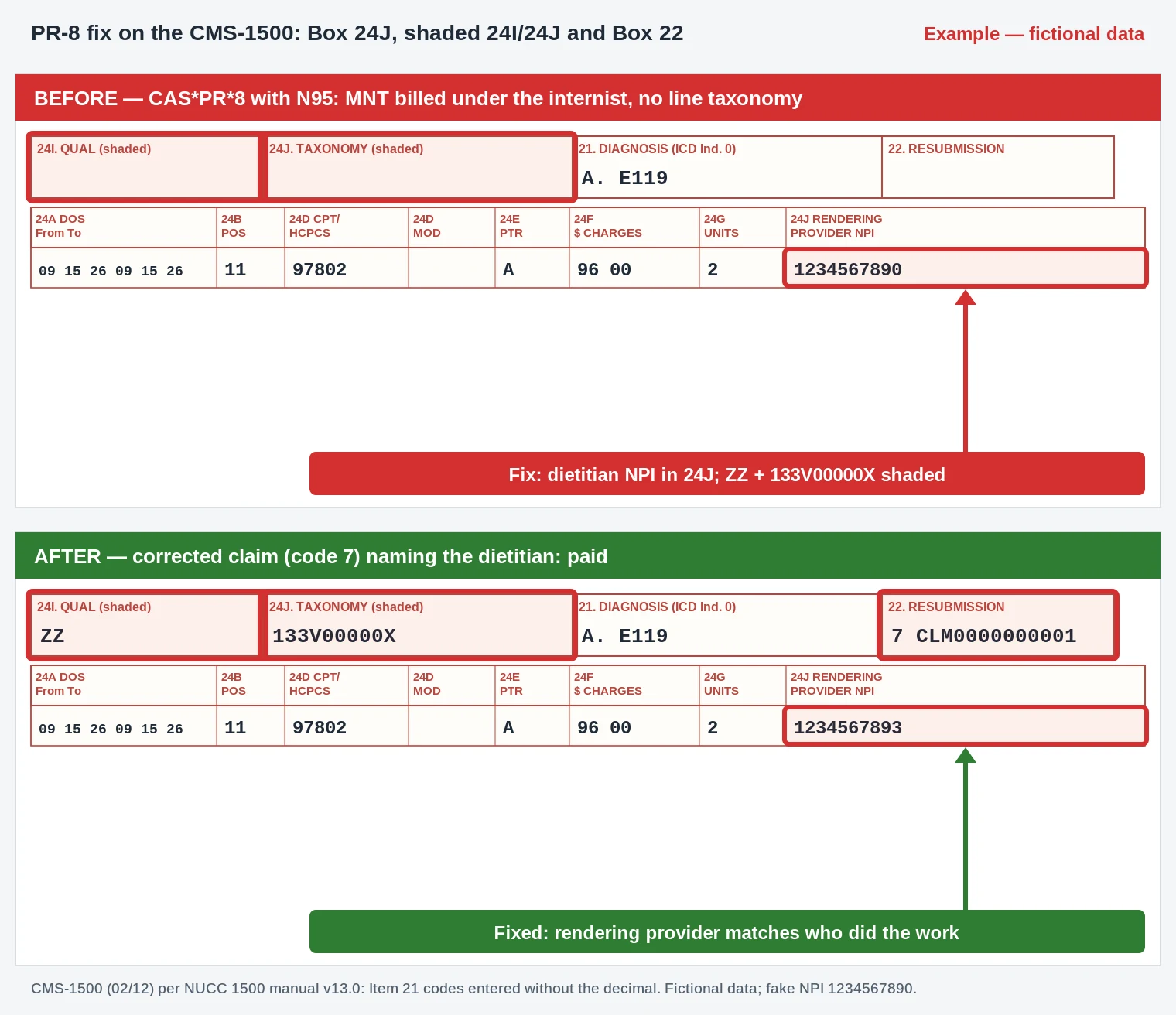
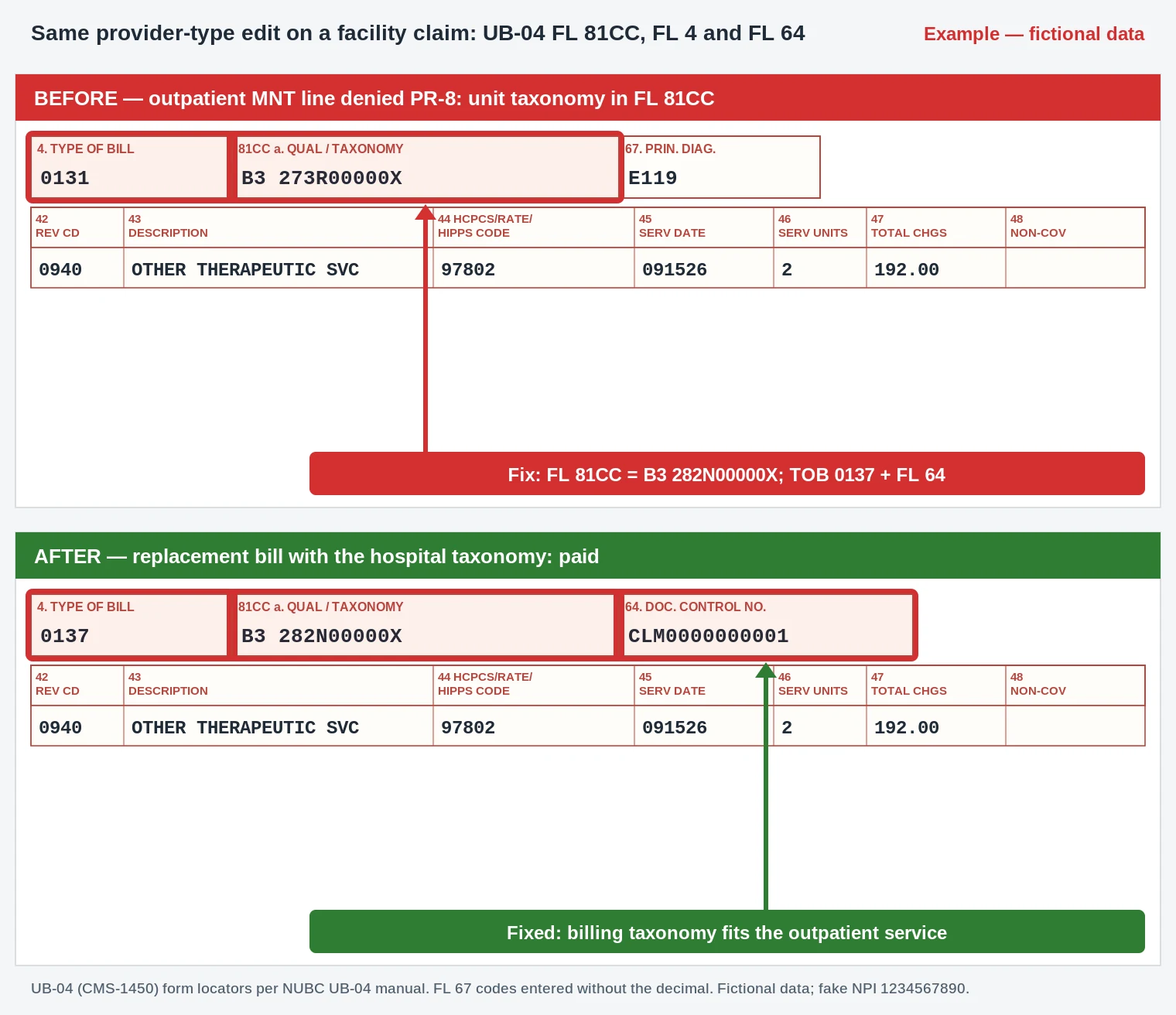
- Box 24J / FL 81CC: the rendering NPI changed to the dietitian (sample 1234567893); on the UB-04, taxonomy 273R00000X changed to 282N00000X.
- Box 24I and 24J shaded: qualifier ZZ and taxonomy 133V00000X (registered dietitian) added.
- Box 24D / FL 44: CPT 97802, two units, unchanged.
- Box 21 / FL 67: E11.9 (entered as E119) is unchanged.
- Box 22 / FL 4 + FL 64: frequency code 7, or type of bill 0137, with the original claim number.
Prevention tips
- Keep each clinician’s NPI and taxonomy in the scheduling template, not only the billing setup.
- Re-check the NPPES record when a provider adds a credential or a specialty.
- Hold patient statements on any PR-8 line until a biller reviews it.
- Ask payers for their provider-type rules on services such as therapy, nutrition and behavioral health.
Related codes
| Code | Meaning |
|---|---|
| CO-8 | Same mismatch, provider owns it |
| CO-170 | Payment denied when performed or billed by this type of provider |
| CO-185 | Rendering provider not eligible for this service |
| PR-6 | Age mismatch billed to the patient |
FAQ
What does PR-8 mean?
The procedure code did not fit the provider type or taxonomy, and the plan assigned the balance to the patient.
What causes denial code 8 most often?
A missing or wrong rendering taxonomy, or a claim that names the wrong clinician.
Which remark codes come with CARC 8?
N95 and N808 are common. N288 points to a missing or invalid rendering taxonomy.
Can I bill the patient for PR-8?
Only if the claim data was correct, the benefit excludes that provider type, and the patient was told beforehand.
Where do I put the taxonomy on a CMS-1500?
In the shaded part of Box 24J, with qualifier ZZ in the shaded part of Box 24I.
Sources
How we checked: the CARC 8, N95 and N808 wording was compared word for word with the X12 lists on 29 October 2026.
- X12, Claim Adjustment Reason Codes (CARC 8). Accessed 29 Oct 2026.
- X12, Remittance Advice Remark Codes (N95, N808, N288). Accessed 29 Oct 2026.
- NUCC, Health Care Provider Taxonomy code set. Accessed 29 Oct 2026.
- NUCC, 1500 claim form instructions. Accessed 29 Oct 2026.
- CMS, NPPES NPI Registry. Accessed 29 Oct 2026.
- CMS, Medicare provider and supplier taxonomy crosswalk. Accessed 29 Oct 2026.
- CMS, Medicare Claims Processing Manual, chapter 25. Accessed 29 Oct 2026.
Last updated: 29 October 2026 · Educational content; not legal advice.
Related denial codes
- CO-8: Procedure Code vs Provider Type
- CO-12: Diagnosis Inconsistent With Provider Type
- CO-B7: Provider Not Certified or Eligible on the Date of Service
- CO-9: Diagnosis Inconsistent With the Patient’s Age
- CO-7: Procedure or Revenue Code Inconsistent With the Patient’s Gender
- PR-6: Age Mismatch Billed to the Patient
- PR-10: Diagnosis and Sex Conflict, Patient Share
- CO-6: Procedure or Revenue Code Inconsistent With the Patient’s Age