
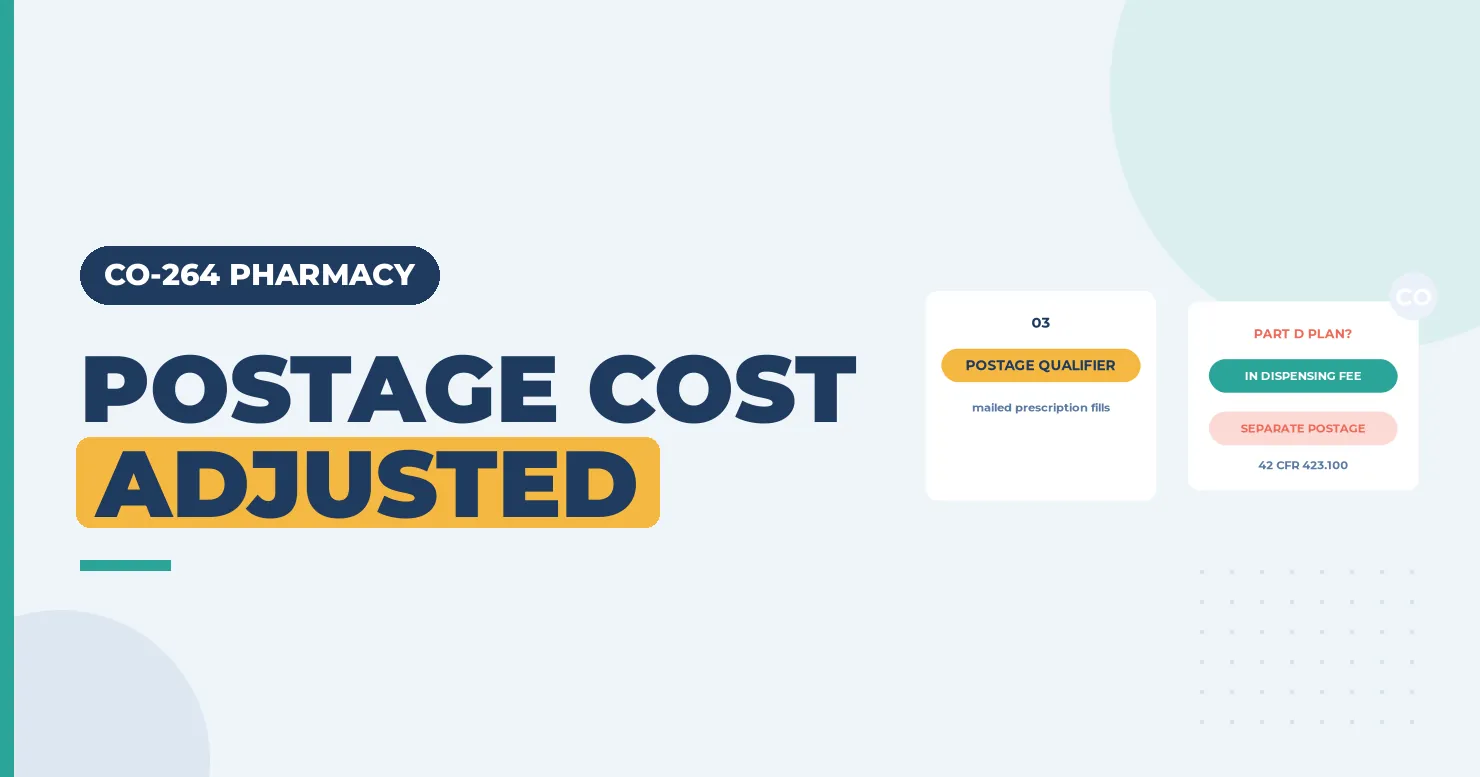
The CO-264 denial code means a plan reduced or refused the postage cost a pharmacy billed on a mailed prescription. The drug and dispensing fee usually pay, and only the postage line is cut. The fix is to confirm the plan’s postage rule, write off the amount as contractual, and stop billing it where the contract does not pay it. (Primary source: X12 Claim Adjustment Reason Codes)
In brief: reason code 264 reads “Adjustment for postage cost. Usage: To be used for pharmaceuticals only.” Medicare Part D counts delivery in the dispensing fee. So a separate postage charge rarely pays. The CO group means the patient cannot be billed for it.
Part of our denial codes library. Written by Manikandan J, CPC, CRCR, who has reconciled mail-order pharmacy remits and postage write-offs for retail and specialty pharmacy teams. Published 3 November 2026. Last updated: 3 November 2026. Code wording quoted word for word from X12. Read about the author and our editorial policy, or contact us to report an error.
What does denial code CO-264 mean?
Denial code CO-264 means the plan adjusted the postage cost on a pharmacy claim. The pharmacy sent postage as an other amount with qualifier 03. The plan did not pay all of it. CO puts that amount on the pharmacy as a contractual write-off, not on the patient.
| Field | Value |
|---|---|
| Code | 264 |
| Description | “Adjustment for postage cost. Usage: To be used for pharmaceuticals only.” |
| Start | 11/01/2014 |
| Last modified | 07/01/2017 |
Source: X12 Claim Adjustment Reason Codes, checked 3 November 2026. On the NCPDP D.0 claim, postage is qualifier 03 in field 479-H8, and the amount goes in 480-H9 (Nebraska Medicaid D.0 payer sheet).
Methodology: the code wording is copied from the X12 list, and the field and rule details come from the payer sheet and eCFR pages cited below.
Key terms: A CARC is a Claim Adjustment Reason Code that says why a line paid differently than billed. The group code is the two-letter prefix. CO means contractual obligation, so the pharmacy owns the balance.
CO-264 vs OA-264: what is the difference?
CO-264 and OA-264 use the same reason, a postage cost cut. CO-264 tells you the write-off comes from your pharmacy contract. OA-264 is a plain other adjustment with no contract claim attached. Neither one makes the patient owe the postage, and both are posted against the pharmacy.
| Version | What the plan is saying | What you do |
|---|---|---|
| CO-264 | Your contract does not pay this postage | Post a contractual write-off |
| OA-264 | Postage adjusted for another reason | Post it, then check the payer sheet |
In my remit reviews, OA-264 showed up mostly on secondary pharmacy claims. CO-264 was the common one on Part D mail-order fills.
Why do plans cut pharmacy postage?
Plans cut pharmacy postage because most contracts pay delivery through the dispensing fee. The Part D rule in 42 CFR 423.100 lists delivery and special packaging among dispensing fee costs (eCFR, 42 CFR 423.100). So a Part D plan expects postage to be inside that fee.
Commercial and Medicaid plans write their own rules. For example, a payer sheet may mark 480-H9 as not used. Another may accept postage only for listed home delivery programs.
Example scenario (fictional names), part 1
CO-264 Denial Example: What Happened
Darnell Hughes handles billing for Ridgeline Mail Pharmacy, a fictional mail-order pharmacy. It mails 90-day maintenance fills, such as blood pressure and statin refills, by first-class mail. Each claim to one Part D plan carried $6.50 postage with qualifier 03.
The plan paid the drug and the dispensing fee. The 835 showed CAS*CO*264*6.50 on every mailed fill. After two months, about 600 fills had $3,900 in unpaid postage.
Should Darnell appeal each line, or is this a cost the pharmacy carries? Keep reading, or jump to how it was resolved. Keep reading, or jump to how the CO-264 denial was resolved.
Postage, shipping or delivery: which code comes back?
The qualifier you send decides which code comes back. Postage for mailed fills is qualifier 03 and CARC 264. Carrier shipping is qualifier 02 and CARC 263. Local delivery is qualifier 01 and CARC 262. Changing the qualifier does not make a cost payable.
| Cost | NCPDP qualifier (479-H8) | CARC |
|---|---|---|
| Local delivery by staff or courier | 01 | CO-262 |
| Carrier shipping, such as overnight cold-chain | 02 | CO-263 |
| Postage for mailed fills | 03 | CO-264 |
How do I fix a CO-264 adjustment?
To fix a CO-264 adjustment, first check whether the plan ever pays postage. Most plans do not, so the fix is a clean write-off and a billing rule change. Appeal only when your contract or payer sheet names a postage allowance. Keep the drug and dispensing fee lines as they are.
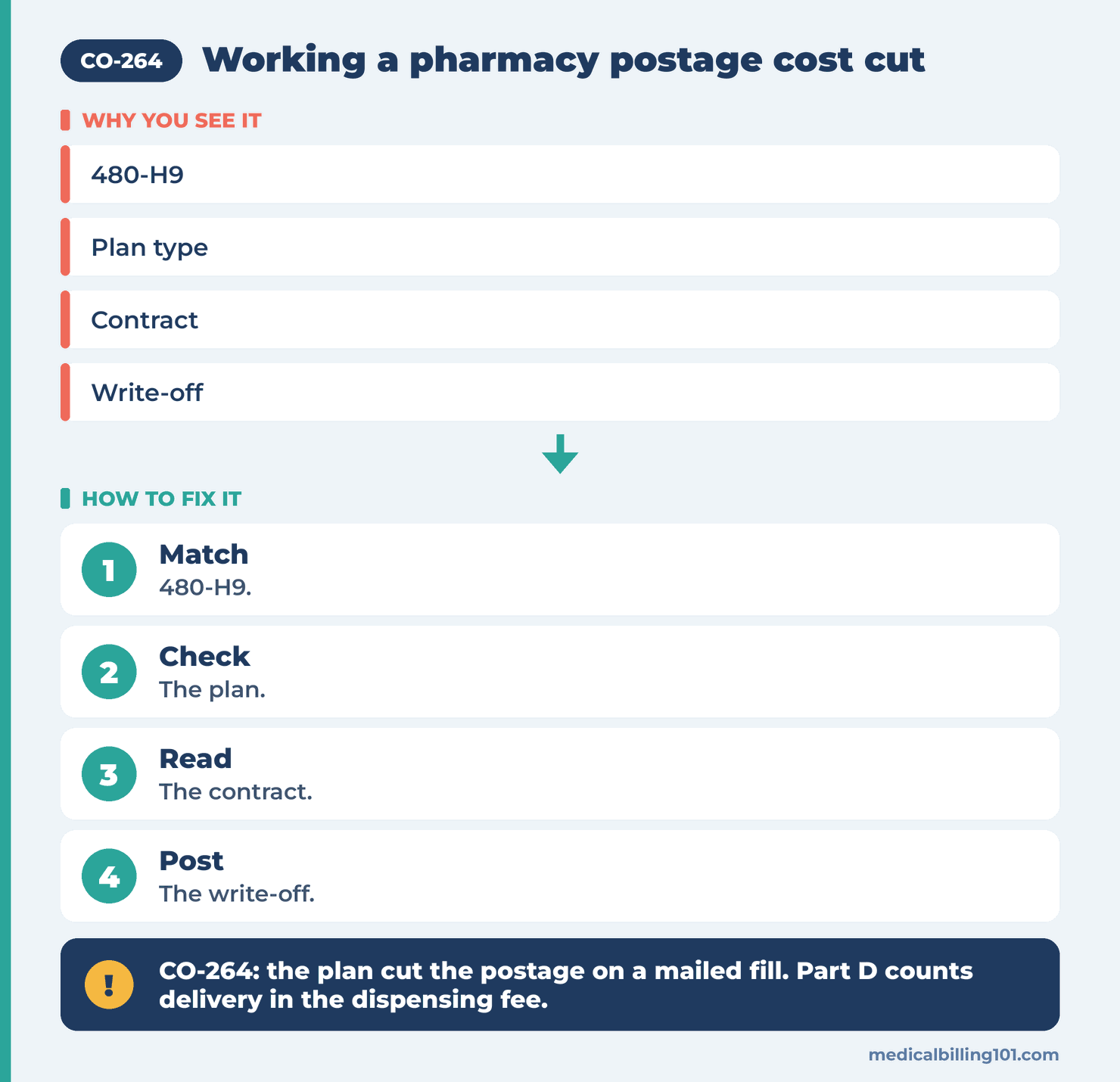
- Match the line. The CO-264 amount should equal the 480-H9 postage you sent with qualifier 03.
- Check the plan type. For Part D, treat postage as part of the dispensing fee.
- Read the payer sheet and contract. Look for a mail-order or home delivery allowance.
- Post the write-off. CO means the patient cannot be billed this amount.
- Stop the default. Turn off postage on plans that never pay it.
Claim form note
No claim form visual is shown here. CARC 264 is for pharmaceuticals only. Postage is claimed on the NCPDP pharmacy claim, so there is no CMS-1500 box or UB-04 form locator to fix.
Example scenario (fictional names), part 2
How the CO-264 Denial Was Resolved
Darnell pulled the Part D network agreement. It set one mail-order dispensing fee and had no postage term. The payer sheet listed 480-H9 as not used for that plan.
Fix: he posted the $3,900 as a contractual write-off. He turned off the postage charge in the billing profile for that plan.
Outcome: new remits came back with no CO-264 lines. Darnell kept postage only for one commercial plan whose contract pays it. He also used the postage cost data at the next dispensing fee review.
Names and details are illustrative; no real patient data.
Names and details are illustrative; no real patient data.
Can the pharmacy bill the patient for CO-264 postage?
No, the pharmacy cannot bill the patient for a CO-264 amount on that claim. CO means the contract assigns the cost to the pharmacy. A separate patient delivery fee is a different matter. It depends on your network contract and state law, so check both before you offer one.
Related codes
| Code | Meaning |
|---|---|
| CO-263 | Shipping cost adjustment |
| CO-262 | Delivery cost adjustment |
| CO-91 | Dispensing fee adjustment |
FAQ
What does CO-264 mean?
The plan reduced or refused the postage cost on a mailed pharmacy claim.
Does Medicare Part D pay postage separately?
Usually not. The Part D rule counts delivery in the dispensing fee.
Which field carries postage on the claim?
480-H9 holds the amount, with qualifier 03 in 479-H8.
Is CO-264 the same as CO-263?
No. CARC 263 is shipping cost. CARC 264 is postage cost.
Can CO-264 appear on a medical claim?
No. X12 limits CARC 264 to pharmaceuticals only.
Sources
How we checked: the CARC 264 quote was matched word for word with the X12 CARC list on 3 November 2026, and the dispensing fee text with the eCFR.
- X12, Claim Adjustment Reason Codes (CARC 264). Accessed 3 Nov 2026.
- eCFR, 42 CFR 423.100 (dispensing fees definition). Accessed 3 Nov 2026.
- Nebraska Medicaid, NCPDP D.0 payer specification. Accessed 3 Nov 2026.
- X12, Claim Adjustment Group Codes. Accessed 3 Nov 2026.
Last updated: 3 November 2026 · Educational content; not legal advice.
Related denial codes
- CO-265: Pharmacy Administrative Cost Adjustment
- CO-263: Pharmacy Shipping Cost Adjustment
- CO-266: Compound Preparation Cost Adjustment
- CO-262: Pharmacy Delivery Cost Adjustment
- CO-211: NDC Not Eligible for Rebate
- CO-205: Pharmacy Discount Card Processing Fee
- CO-188: Covered Only When Used per FDA Recommendations
- CO-176: Prescription Is Not Current