
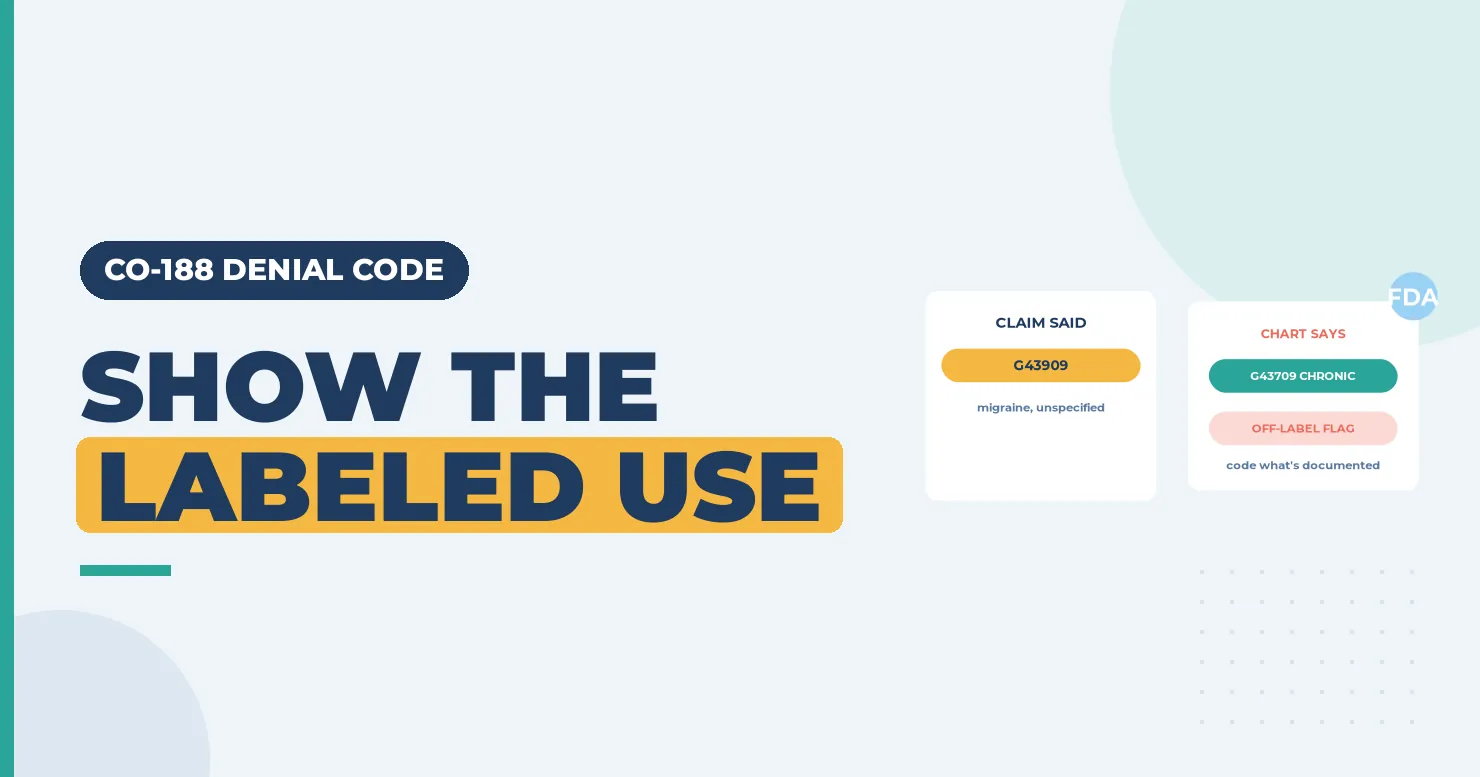
CO-188 means the payer only covers this drug, device or procedure when it’s used the way the FDA approved it, and the claim didn’t show that use. Most of the time it’s an off-label flag: the diagnosis on the claim isn’t one of the labeled indications. Sometimes the use really is off-label. Other times the diagnosis code was too vague and hid an approved use. (Primary source: X12 Claim Adjustment Reason Codes)
In brief: CARC 188 reads “This product/procedure is only covered when used according to FDA recommendations.” Compare the diagnosis with the product label. If the record supports a labeled indication, code it precisely and send a corrected claim. If the use is truly off-label, check the plan’s off-label policy and appeal with compendia or literature support.
Part of our denial codes library. Written by Manikandan J, CPC, CRCR, who has worked drug coverage denials for neurology and infusion practices. Published 22 October 2026. Last updated: 22 October 2026. Code wording quoted word for word from X12.
Official CARC 188 description
| Field | X12 text |
|---|---|
| Code | 188 |
| Description | “This product/procedure is only covered when used according to FDA recommendations.” |
| Start | 06/30/2005 |
Source: X12 Claim Adjustment Reason Codes, checked 22 October 2026.
What FDA recommendations means here
The FDA label is the approved prescribing information for a drug or device. It lists the indications, doses and patient groups the FDA approved. Off-label use is any use outside that label, such as a different condition, dose or age group. Doctors may prescribe off-label, as the FDA explains, but a plan doesn’t have to pay for it. You can read current labels on DailyMed.
Example scenario (fictional names), part 1
CO-188 Denial Example: What Happened
Olivia Chen bills for Cedar Hollow Neurology. Dr. Rafael Moreno gave a patient onabotulinumtoxinA injections for headache prevention: 64615 for the injections and J0585 for 155 units of the drug. The claim to Larkspur Health Plan, a fictional commercial plan, listed migraine, unspecified (G43.909).
The 835 showed CAS*CO*188 on both lines with remark LQ*HE*N130, “Consult plan benefit documents/guidelines for information about restrictions for this service.” Larkspur’s policy covered the drug for headache prevention only in chronic migraine.
Did the patient not qualify, or did the claim fail to say what the chart did? Keep reading, or jump to how the CO-188 denial was resolved.
Common reasons for reason code 188
- Vague diagnosis code. For example, an unspecified code hides the labeled indication the chart documents.
- Truly off-label use. The condition treated isn’t on the label.
- Dose or frequency outside the label. Units on the claim exceed the labeled dose, or the interval is too short.
- Wrong patient group. The label limits the product by age or by earlier treatment failure.
- Device used outside its clearance. A device billed for a use the FDA didn’t clear or approve.
How to fix a CO-188 denial
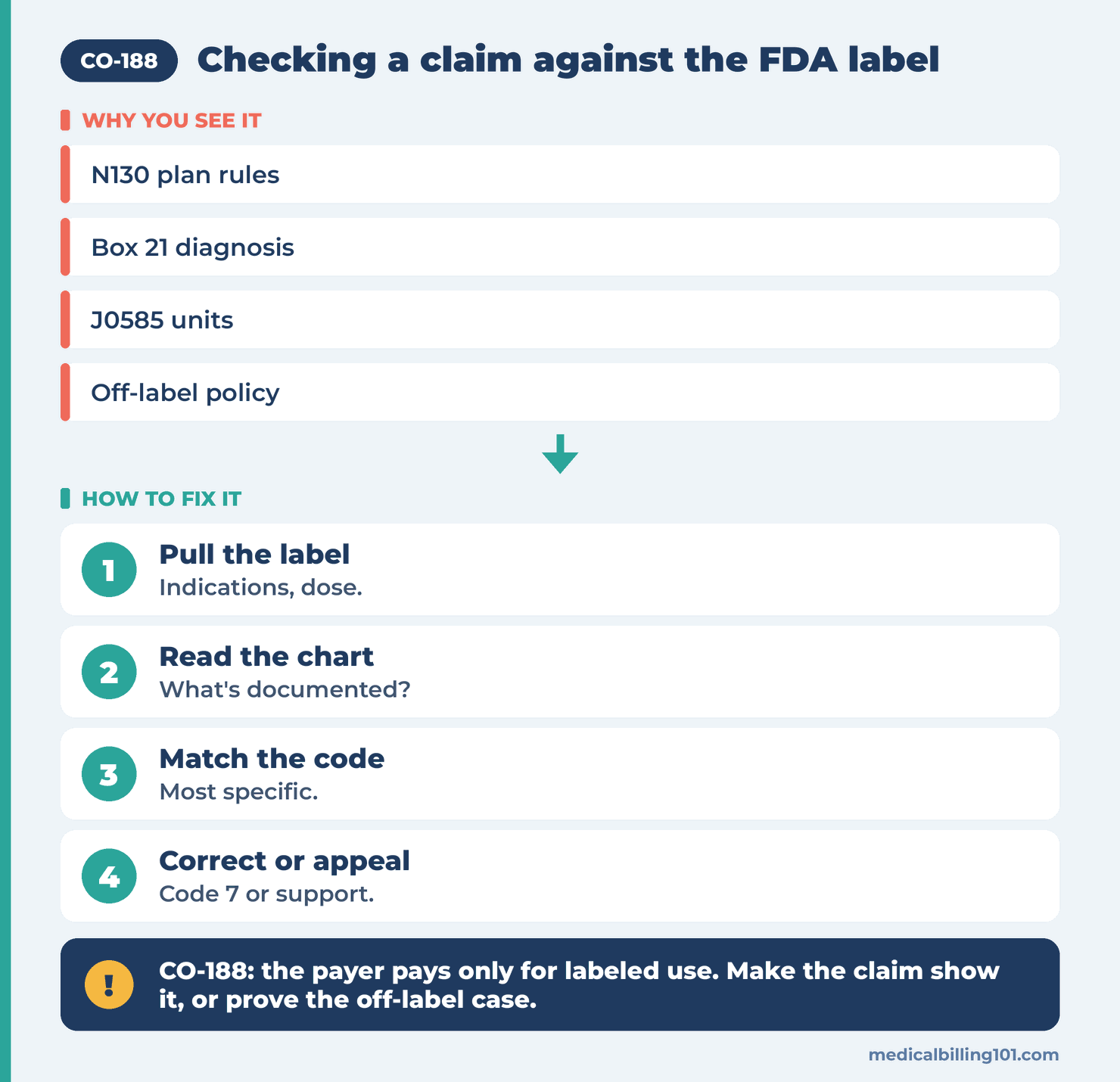
- Pull the label. Find the indications and dosing for the exact product and NDC.
- Read the chart. Look for the documented condition, the number of headache days or other criteria, and earlier treatments.
- Match the code to the record. If the chart supports a labeled indication, the diagnosis code must say so. Code to the highest specificity.
- Check the units. Make sure the units match the dose given and the label, and report any discarded drug the way the plan requires.
- Send a corrected claim with frequency code 7 and the original claim number in Box 22.
- If the use is off-label, read the plan’s off-label policy. Many accept support from drug compendia or peer-reviewed studies. Appeal with that support and a letter of medical necessity.
Example scenario (fictional names), part 2
How the CO-188 Denial Was Resolved
Olivia read Dr. Moreno’s notes. He had documented 18 headache days a month for over three months, with migraine features on most of them. That met the definition of chronic migraine, which is a labeled indication for this drug. The claim had used the unspecified code because the order set defaulted to it.
Fix: a corrected claim with Box 22 code 7, the original claim number and G43.709 (chronic migraine without aura, not intractable, without status migrainosus) in Box 21 for both lines.
Outcome: Larkspur paid 64615 and J0585. The practice removed the unspecified code from the injection order set.
Names and details are illustrative; no real patient data.
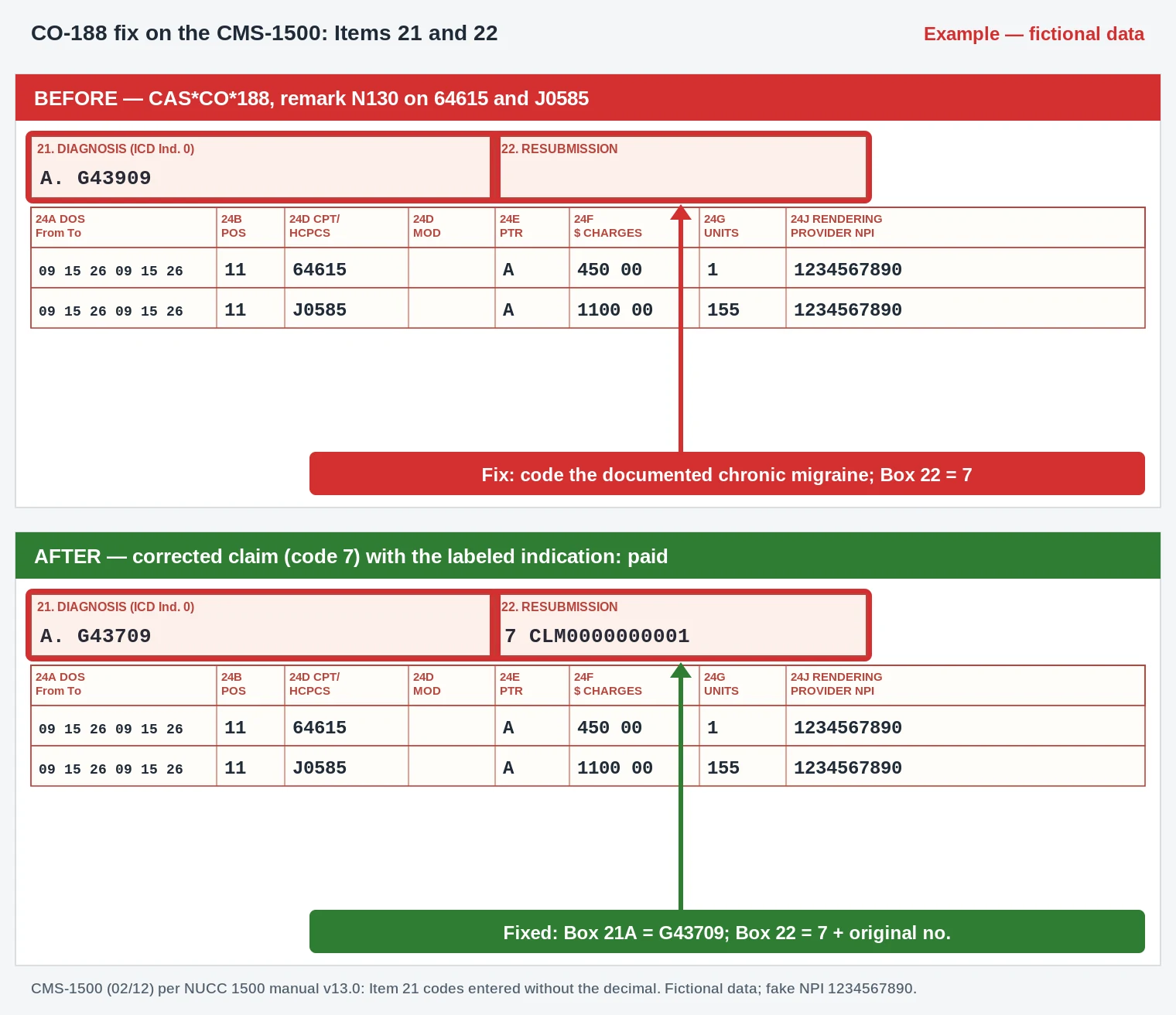
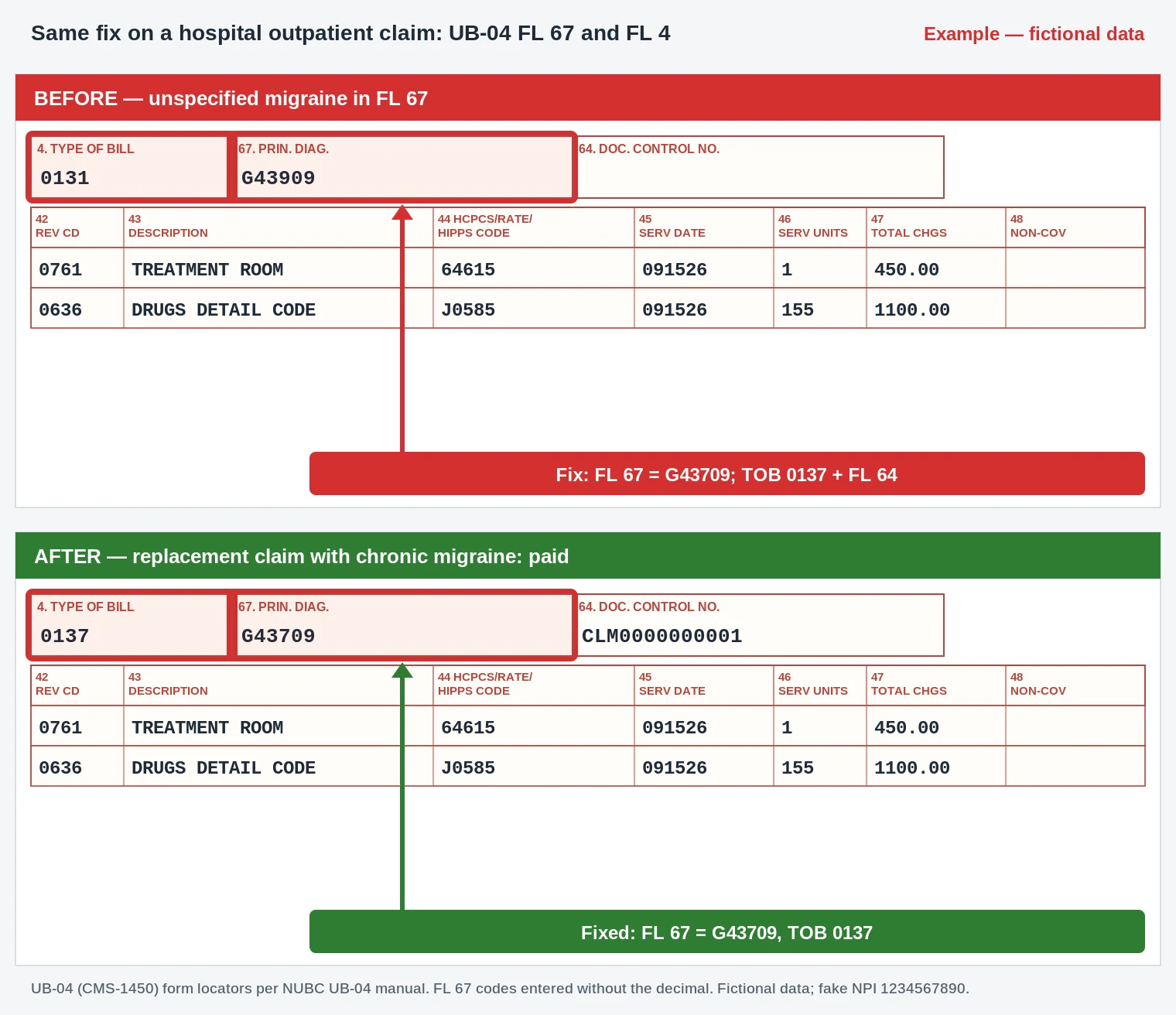
- Box 21A / FL 67: G43.909 (migraine, unspecified) changed to G43.709 (chronic migraine), entered without the decimal as G43709.
- Box 22 / FL 4 + FL 64: frequency code 7 with the original claim number (type of bill 0137).
- Box 24D / FL 44: 64615 and J0585 x 155 units are unchanged (revenue codes 0761 and 0636 on the UB-04).
CARC 188 vs related coverage codes
| Code | What it says | Difference |
|---|---|---|
| CO-188 | Covered only when used per FDA recommendations | Label-based limit |
| CO-50 | Not deemed a medical necessity | Clinical need not shown |
| CO-11 | Diagnosis inconsistent with the procedure | Code pairing problem |
| CO-96 | Non-covered charge(s) | Excluded from the plan |
Prevention checklist
- Build diagnosis pick lists for high-cost drugs from the product label.
- Block unspecified codes on drug orders where the label needs a specific condition.
- Check plan off-label policies before giving a costly drug off-label.
- Get prior authorization when the plan requires it, and match the claim to it.
Recap
CO-188 means the payer covers the product only for labeled use, and the claim didn’t show one. Compare the diagnosis and units with the label. Correct the claim when the chart supports a labeled indication. Appeal with compendia or study support when the use is truly off-label.
FAQ
What does denial code CO-188 mean?
The payer covers the drug, device or procedure only when it’s used according to FDA recommendations, and the claim didn’t show that.
Is off-label use always denied?
No. Many plans cover off-label use supported by drug compendia or published studies. Check the plan policy.
Which diagnosis box matters for CO-188?
Box 21 on the CMS-1500 and FL 67 on the UB-04. The pointer in Box 24E must link the drug line to the right code.
Can a wrong dose cause CO-188?
Yes. Units well above the labeled dose can be flagged as use outside the FDA recommendations.
Can I bill the patient for a CO-188 line?
Not with group code CO. Some plans let you bill the patient only if they signed a valid waiver before the service.
Sources
How we checked: each code quote on this page was matched word for word with the X12 CARC and RARC lists on 22 October 2026.
- X12, Claim Adjustment Reason Codes (CARC 188, 50, 11, 96). Accessed 22 Oct 2026.
- X12, Remittance Advice Remark Codes (N130). Accessed 22 Oct 2026.
- FDA, Understanding unapproved use of approved drugs off label. Accessed 22 Oct 2026.
- NLM, DailyMed drug labels. Accessed 22 Oct 2026.
- CMS, ICD-10 code sets. Accessed 22 Oct 2026.
Last updated: 22 October 2026 · Educational content; not legal advice.
Related denial codes
- CO-176: Prescription Is Not Current
- CO-175: Prescription Is Incomplete
- PR-202: Non-Covered Personal Comfort or Convenience Services
- CO-174: Service Was Not Prescribed Prior to Delivery
- CO-173: Service or Equipment Was Not Prescribed by a Physician
- PR-204: Not Covered Under the Patient's Current Benefit Plan
- CO-205: Pharmacy Discount Card Processing Fee
- CO-169: Alternate Benefit Has Been Provided