
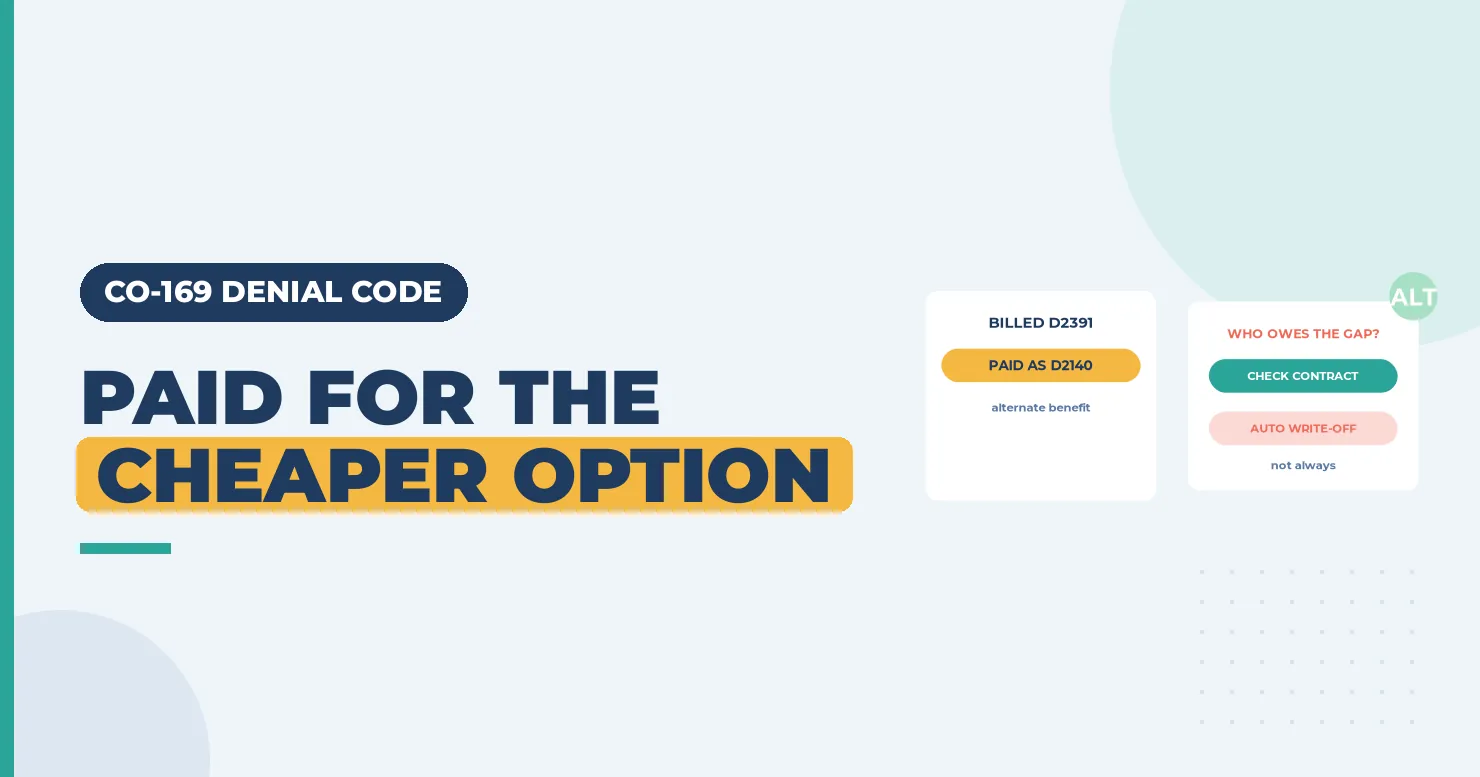
CO-169 means the plan didn’t pay for the exact service you billed. It paid the benefit for a different, usually less costly, service that it treats as an acceptable alternative. Dental offices see this most: a tooth-colored filling on a back tooth paid at the silver filling rate, or a crown paid as a large filling. The difference between the two benefits is where all the questions come from: can you bill the patient for it, or must you write it off? (Primary source: X12 Claim Adjustment Reason Codes)
In brief: CARC 169 reads “Alternate benefit has been provided.” Check the plan’s alternate benefit clause and your contract. With group CO, the reduced amount is usually a write-off under the contract. With group PR, the patient owes the difference. If the alternate benefit doesn’t fit the clinical facts, appeal with records.
Part of our denial codes library. Written by Manikandan J, CPC, CRCR, who has worked dental and medical remits for multi-location group practices. Published 22 October 2026. Last updated: 22 October 2026. Code wording quoted word for word from X12.
Official CARC 169 description
| Field | X12 text |
|---|---|
| Code | 169 |
| Description | “Alternate benefit has been provided.” |
| Start | 06/30/2005 |
| Last modified | 09/30/2007 |
Source: X12 Claim Adjustment Reason Codes, checked 22 October 2026.
Key terms behind CARC 169
An alternate benefit is a plan rule that pays for a different service than the one performed, often the least costly one the plan considers adequate. Dental plans often call it a least expensive alternative treatment (LEAT) clause. The benefit difference is the gap between what the plan would have paid for the billed service and what it paid for the alternate.
The American Dental Association maintains the CDT code set used on dental claims. HealthCare.gov’s dental coverage page explains how dental benefits are sold separately or bundled with health plans, which shapes how these clauses work.
Where CARC 169 shows up
- Posterior composite fillings. For example, D2391 (one-surface resin on a back tooth) paid at the D2140 amalgam rate.
- Crowns. A crown paid as a large filling when the plan decides the tooth could be restored without one.
- Bridges and implants. An implant paid as a bridge or partial denture benefit.
- Medical claims, less often. A plan may pay a standard device or drug benefit in place of a premium one.
Example scenario (fictional names), part 1
CO-169 Denial Example: What Happened
Noor Haddad runs insurance at Brookline Family Dental. A patient had a one-surface tooth-colored filling on a lower molar (D2391) for decay. The claim went to Tidewater Dental Plan, a fictional dental carrier, on the ADA claim form.
The 835 paid less than Brookline expected. It showed CAS*CO*169 for part of the fee with remark LQ*HE*N156, “Alert: The patient is responsible for the difference between the approved treatment and the elective treatment.” The front desk didn’t know whether to bill the patient, because the group code was CO.
Did the patient owe the difference, or did the contract make Brookline write it off? Keep reading, or jump to how the CO-169 denial was resolved.
Remark codes often paired with CARC 169
| RARC | X12 wording | What it tells you |
|---|---|---|
| N156 | “Alert: The patient is responsible for the difference between the approved treatment and the elective treatment.” | The difference may move to the patient |
| N130 | “Consult plan benefit documents/guidelines for information about restrictions for this service.” | The plan’s alternate benefit clause applies |
| N381 | “Alert: Consult our contractual agreement for restrictions/billing/payment information related to these charges.” | Your contract decides who owes what |
See the X12 RARC list for the full set.
How to work a CO-169 adjustment

- Read the group code and remark. CO points to your contract; PR or remark N156 points toward the patient.
- Read the plan clause. Find the alternate benefit or LEAT language in the benefit summary.
- Read your contract. Some contracts let you bill the patient the difference between the alternate fee and your contracted fee for the billed service. Others don’t.
- Recalculate. Patient share = their coinsurance on the alternate benefit, plus the allowed difference if the contract permits.
- Appeal if clinically wrong. If the alternate wasn’t a real option, such as a filling where the tooth needed a crown, send X-rays and notes.
- Tell patients before treatment. A pre-treatment estimate shows the alternate benefit before the work is done.
Example scenario (fictional names), part 2
How the CO-169 Denial Was Resolved
Noor read Brookline’s Tidewater contract. It allowed the office to collect from the patient the difference between the amalgam allowance and the contracted fee for the composite, when the plan applied an alternate benefit and the patient had signed a financial consent. The patient had signed one at the visit.
Fix: Noor posted the CO-169 amount as a transfer to patient responsibility under the contract, not as a write-off, and sent a statement explaining the alternate benefit.
Outcome: the patient paid the difference. Brookline now runs pre-treatment estimates for posterior composites on Tidewater plans, so patients see the alternate benefit before the appointment. Nothing on the claim form needed to change.
Names and details are illustrative; no real patient data.
Worked example (illustrative)
A patient needs a crown on a cracked molar (D2740). The plan applies an alternate benefit and pays as if a large filling had been placed. The dentist believes the tooth would fracture without a crown. The office appeals with the pre-operative X-ray, an intraoral photo of the crack and a note explaining why a filling wasn’t adequate. The plan reviews the records and pays the crown benefit.
CO-169 vs similar codes
| Code | What it means | Main difference |
|---|---|---|
| CO-169 | Alternate benefit has been provided | Paid a different service’s benefit |
| CO-45 | Charge exceeds contracted amount | Fee reduced, same service |
| CO-96 | Non-covered charges | Service not covered at all |
| CO-150 | Information submitted doesn’t support this level of service | Paid at a lower level of the same service |
Checklist
- Alternate benefit clauses are noted for each dental plan.
- Contracts are checked for whether the difference can be billed.
- Financial consent forms are signed before elective upgrades.
- Pre-treatment estimates are sent for common alternate-benefit services.
- Appeals include images and notes when the alternate wasn’t clinically adequate.
Recap
CO-169 means the plan paid the benefit for a different service, usually a cheaper one. Your contract and the plan clause decide who owes the difference. Post it correctly, tell patients up front with pre-treatment estimates, and appeal when the alternate wasn’t a real clinical option.
FAQ
What does CO-169 mean?
The plan paid an alternate benefit, usually for a less costly service, instead of the service billed.
Can I bill the patient for CO-169?
Only if your contract allows it and the patient agreed. Remark N156 often signals the difference is the patient’s.
Is CO-169 only for dental claims?
It’s most common on dental claims, but medical plans can use it for alternate device or drug benefits.
What is a LEAT clause?
A least expensive alternative treatment clause, which pays the cheaper adequate option’s benefit.
Can I appeal an alternate benefit?
Yes. Send images and notes showing the alternate wasn’t adequate for the patient.
Do I need to correct the claim for CO-169?
Usually not. The claim was right; the plan’s benefit rule changed the payment.
Sources
How we checked: each code quote on this page was matched word for word with the X12 CARC and RARC lists on 22 October 2026.
- X12, Claim Adjustment Reason Codes (CARC 169, 45, 96, 150). Accessed 22 Oct 2026.
- X12, Remittance Advice Remark Codes (N156, N130, N381). Accessed 22 Oct 2026.
- American Dental Association, CDT code set. Accessed 22 Oct 2026.
- HealthCare.gov, Dental coverage. Accessed 22 Oct 2026.
Last updated: 22 October 2026 · Educational content; not legal advice.