
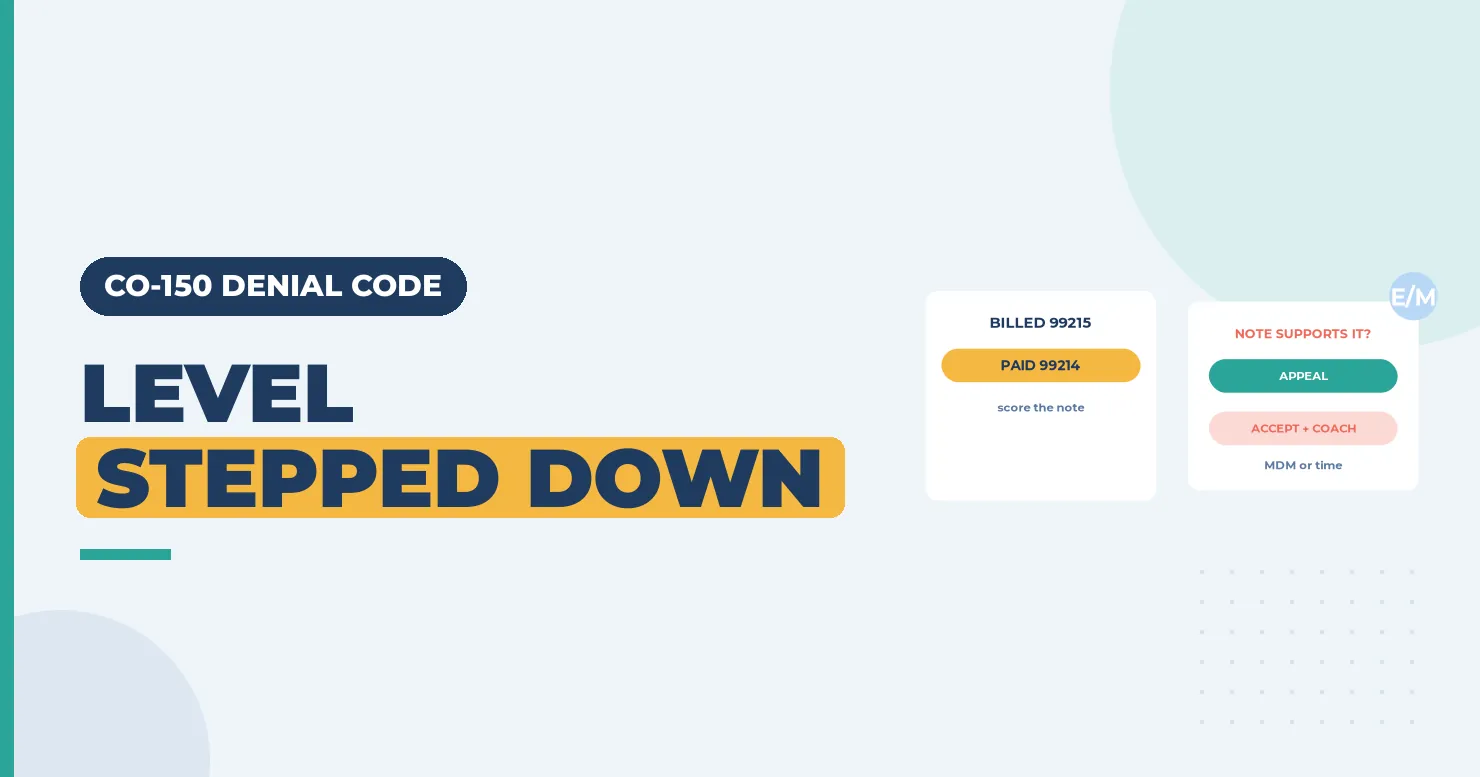
CO-150 is a level-of-service dispute. The payer reviewed the claim, and often the visit note, and decided the service you billed is higher than the records show. It shows up most on office and hospital E/M visits, where the level depends on medical decision making or time. The payer may deny the line or pay it at a lower level. The CO group means you can’t bill the patient the difference. Your choices are to accept a lower level the note really supports, or to appeal with a clear breakdown that proves the level you billed. (Primary source: X12 Claim Adjustment Reason Codes)
In brief: CARC 150 reads “Payer deems the information submitted does not support this level of service.” Score the note yourself against the current E/M rules. If it supports the billed level, appeal with that scoring. If not, accept or correct, and fix the habit behind it.
Part of our denial codes library. Written by Manikandan J, CPC, CRCR, who has audited E/M levels and written level-of-service appeals for primary care and specialty groups. Published 21 October 2026. Last updated: 21 October 2026. Code wording quoted word for word from X12.
Reason code 150 in the X12 list
| Field | X12 text |
|---|---|
| Code | 150 |
| Description | “Payer deems the information submitted does not support this level of service.” |
| Start | 10/31/2002 |
| Last modified | 09/30/2007 |
Source: X12 Claim Adjustment Reason Codes, checked 21 October 2026.
How E/M levels are chosen in 2026
Medical decision making is the measure of how complex the clinician’s thinking was: the problems addressed, the data reviewed and the risk of the treatment plan. Total time is all the time the clinician spent on the patient that day, face to face or not. For office visits, the level is set by one or the other, not by how long the history or exam was.
| Office visit | MDM level | Typical problems and risk |
|---|---|---|
| 99213 | Low | Two or more stable chronic illnesses, low risk |
| 99214 | Moderate | A chronic illness getting worse, or prescription drug management |
| 99215 | High | A severe flare, or a decision about hospital care |
The AMA E/M guidelines set the rules. CMS explains how Medicare applies them in its E/M services guide.
Example scenario (fictional names), part 1
CO-150 Denial Example: What Happened
Samuel Ortiz is the coding lead at Fairhaven Internal Medicine. Dr. Leah Abernathy billed 99215 for a patient with COPD with acute exacerbation (J44.1) and heart failure (I50.32). She changed two inhalers, started prednisone and talked about sending the patient to the hospital.
The remit from Coastal Plains Health, a fictional commercial plan, paid the visit at the 99214 rate. It showed CAS*CO*150 for the difference and remark LQ*HE*N22, “Alert: This procedure code was added/changed because it more accurately describes the services rendered.”
Was the plan right to step the visit down? Keep reading, or jump to how the CO-150 denial was resolved.
Remark codes you may see with CARC 150
| RARC | X12 wording |
|---|---|
| N22 | “Alert: This procedure code was added/changed because it more accurately describes the services rendered.” |
| M127 | “Missing patient medical record for this service.” |
| N188 | “The approved level of care does not match the procedure code submitted.” |
N22 means the plan changed your code. M127 means it wants the note first. See the X12 RARC page for others.
How to review and appeal a CO-150
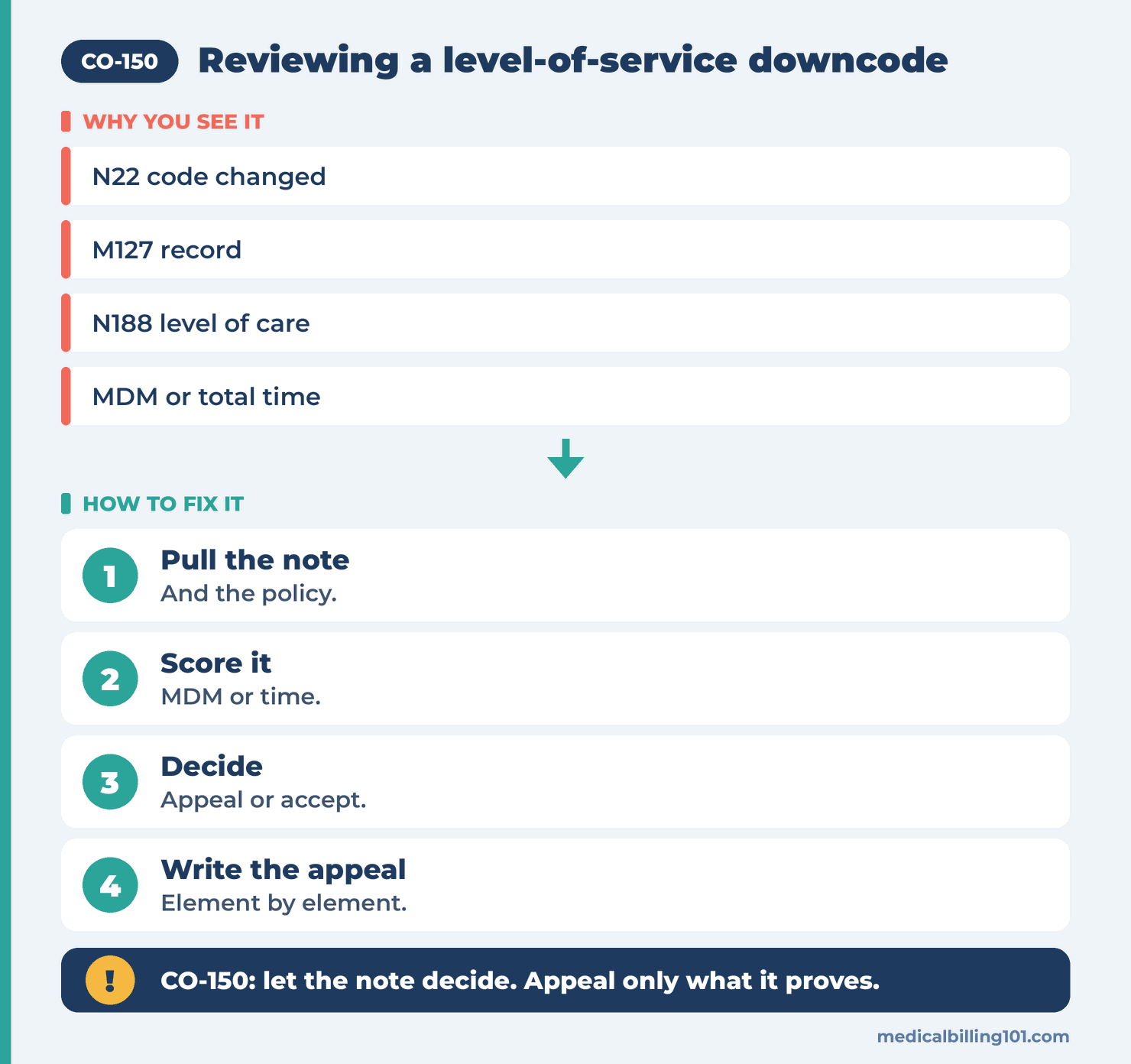
- Pull the note and the payer’s policy. Some plans use their own E/M review tools, so read the policy.
- Score the note yourself. Count the problems, data and risk, or add up the documented time.
- Compare your level with the paid level. For example, a decision about hospital care is high risk, which supports 99215 with high MDM.
- Decide. If the note supports your level, appeal. If it doesn’t, accept the change and coach the clinician.
- Write a short appeal. List each MDM element with the line in the note that shows it. Attach the note.
- Watch for patterns. A plan that steps down many visits may be using an automated edit you can challenge as a group.
Example scenario (fictional names), part 2
How the CO-150 Denial Was Resolved
Samuel scored the note. The COPD flare was a chronic illness with severe worsening. The note clearly recorded the talk about hospital care, which counts as high risk. That met high MDM.
Fix: he wrote a one-page appeal that matched each MDM element to a quote from the note, and attached the note itself.
Outcome: the plan reversed the change and paid 99215. Samuel shared the appeal as a model with the other coders and added a short MDM line to the visit template.
Names and details are illustrative; no real patient data.
Worked example (illustrative)
Consider a dermatology visit billed as 99214 for one stable chronic rash with a refill of a cream. The plan pays it at 99213 with CO-150. The coder scores the note: one stable chronic illness with prescription drug management. That fits moderate risk, but the problem side is low. Under the two-of-three rule, the visit may still support 99213, so the coder accepts the change and gives the clinician feedback.
Common reasons for CO-150 on E/M visits
- Copied-forward notes. Long text that doesn’t show today’s thinking.
- Time billed without a total. The note must state the total time.
- Risk not written down. Talk of surgery or hospital care that isn’t in the note doesn’t count.
- Payer-specific tools. Some plans use their own level rules, so check the policy.
Related codes
- CO-50: not deemed a medical necessity by the payer.
- CO-11: diagnosis inconsistent with the procedure.
- CO-151: information doesn’t support this many or this frequency of services.
- CO-97: payment included in another service.
Recap
CO-150 means the payer thinks the records don’t support the level you billed. Score the note against the current E/M rules or documented time. Appeal with a clear element-by-element breakdown when it supports your level. Accept and coach when it doesn’t.
FAQ
What does denial code CO-150 mean?
The payer says the records don’t support the level billed. It reads “Payer deems the information submitted does not support this level of service.”
Can I bill the patient after a CO-150 downcode?
No. The CO group means the difference is a provider adjustment unless an appeal changes it.
How do I appeal reason code 150?
Score the note, then send a short letter matching each MDM element or the total time to the note, with the note attached.
Does CARC 150 only apply to E/M codes?
No, but E/M visits are the most common. It can apply to any service with levels.
What does N22 mean with CO-150?
The plan changed your code to one it thinks fits the services better.
Can time support a higher level?
Yes, for office visits, if the note states the total time spent that day.
Sources
How we checked: each code quote on this page was matched word for word with the X12 CARC and RARC lists on 21 October 2026.
- X12, Claim Adjustment Reason Codes (CARC 150, 11, 50, 97, 151). Accessed 21 Oct 2026.
- X12, Remittance Advice Remark Codes (N22, M127, N188). Accessed 21 Oct 2026.
- AMA, CPT evaluation and management. Accessed 21 Oct 2026.
- CMS MLN, Evaluation and management services guide. Accessed 21 Oct 2026.
Last updated: 21 October 2026 · Educational content; not legal advice.