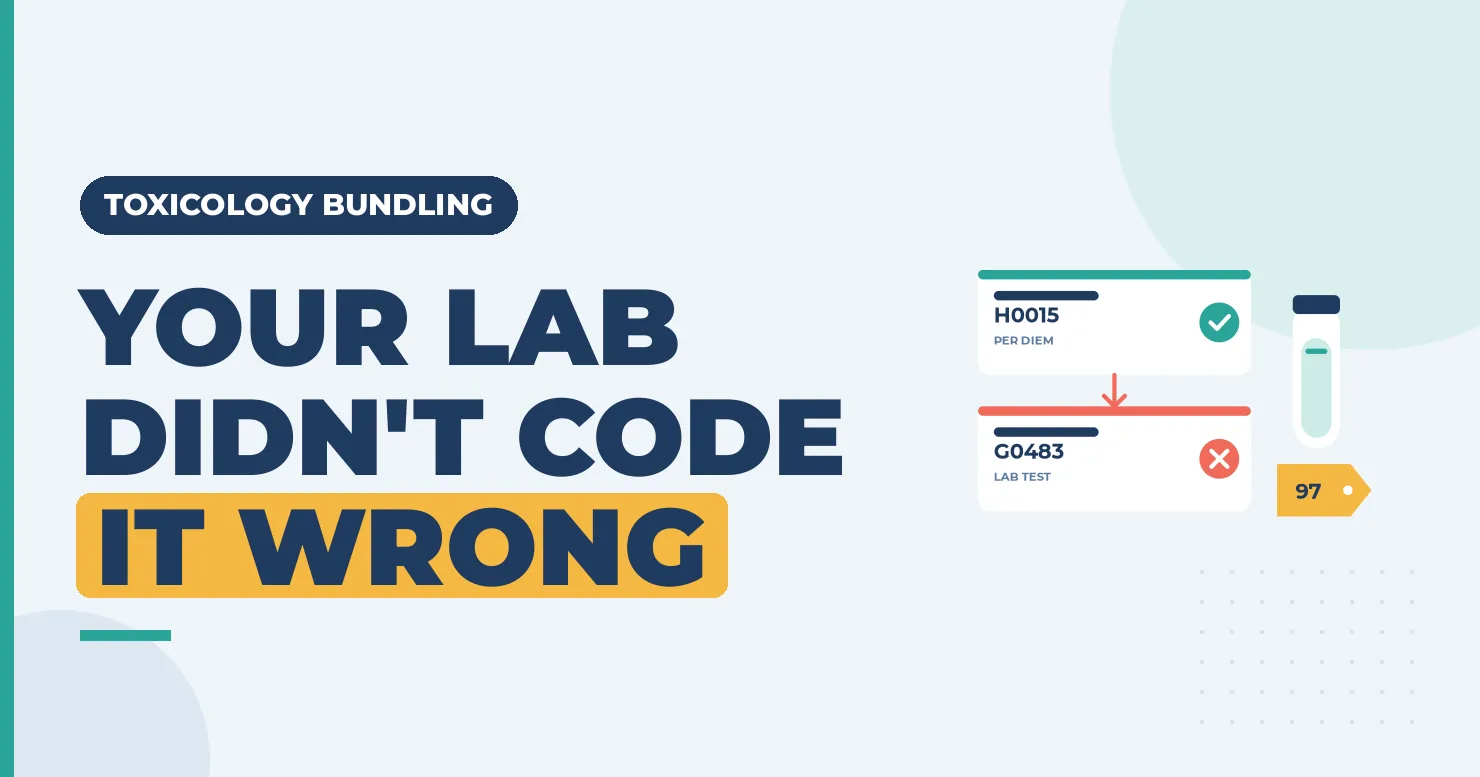
A toxicology bundling denial on G0483, 80307, or G0480 to G0482 usually means the payer folded your lab test into the treatment facility’s per diem. Fix it by confirming the patient’s program, getting the payer’s written policy, and billing the facility when its rate includes drug testing.
Your lab did not code the claim wrong. The payer matched your test to a program code like H0015, S9480, S0201, or H0035 on another provider’s claim. This guide shows why it happens and how an independent lab responds.
TL;DR: Intensive outpatient, partial hospitalization, and residential programs are often paid one daily rate. Many plans say that rate covers lab work, including drug tests. When the program bills its per diem, your separate toxicology claim denies. Appeal only when the plan’s policy does not bundle your test.
Written by Manikandan J, CPC, CRCR, a certified coder and revenue cycle specialist. Published 11 November 2026. Last updated: 11 November 2026.
Table of Contents
Why is the payer bundling our toxicology codes?
The payer is bundling your toxicology codes because the patient’s treatment program is paid a daily all-inclusive rate. Many plans say that rate covers lab tests. When the facility bills H0015, S9480, S0201, or H0035 for the same day, your 80307 or G0483 line is treated as already paid.
Per diem bundling is a payer rule that treats one daily program rate as payment for every service that day. HCPCS G0483 is the definitive drug test code for 22 or more drug classes. CARC 97 is the remit code for a service included in another paid service.
This is not an NCCI edit. NCCI procedure-to-procedure edits compare codes billed by the same provider. Here the payer compares two different providers’ claims for one patient and one date.
The remit usually shows CARC 97. That code means the test is part of the pay for another service. Some plans use the CO-234 denial code instead, which says the procedure is not paid separately.
The hard part is that the lab is blind here. It sees only its own order form. It never sees what the program billed, so the denial feels random.
What do 80305-80307 and G0480-G0483 cover?
CPT 80305, 80306, and 80307 are presumptive drug class screens, billed once per date of service. HCPCS G0480 to G0483 are definitive drug tests, billed by the number of drug classes tested per day. G0483 is the highest tier, covering 22 or more drug classes.
| Code | Test type | What it describes |
|---|---|---|
| 80305 | Presumptive | Read by direct optical observation only, such as cups or dipsticks |
| 80306 | Presumptive | Read by instrument-assisted direct optical observation |
| 80307 | Presumptive | Instrument chemistry analyzers, such as immunoassay or mass spectrometry |
| G0480 | Definitive | 1 to 7 drug classes, per day |
| G0481 | Definitive | 8 to 14 drug classes, per day |
| G0482 | Definitive | 15 to 21 drug classes, per day |
| G0483 | Definitive | 22 or more drug classes, per day |
All seven codes report once per patient per day. So a second unit, or two presumptive codes on one date, will deny for frequency. That is a separate problem from per diem bundling.
Which facility codes pull lab tests into a per diem?
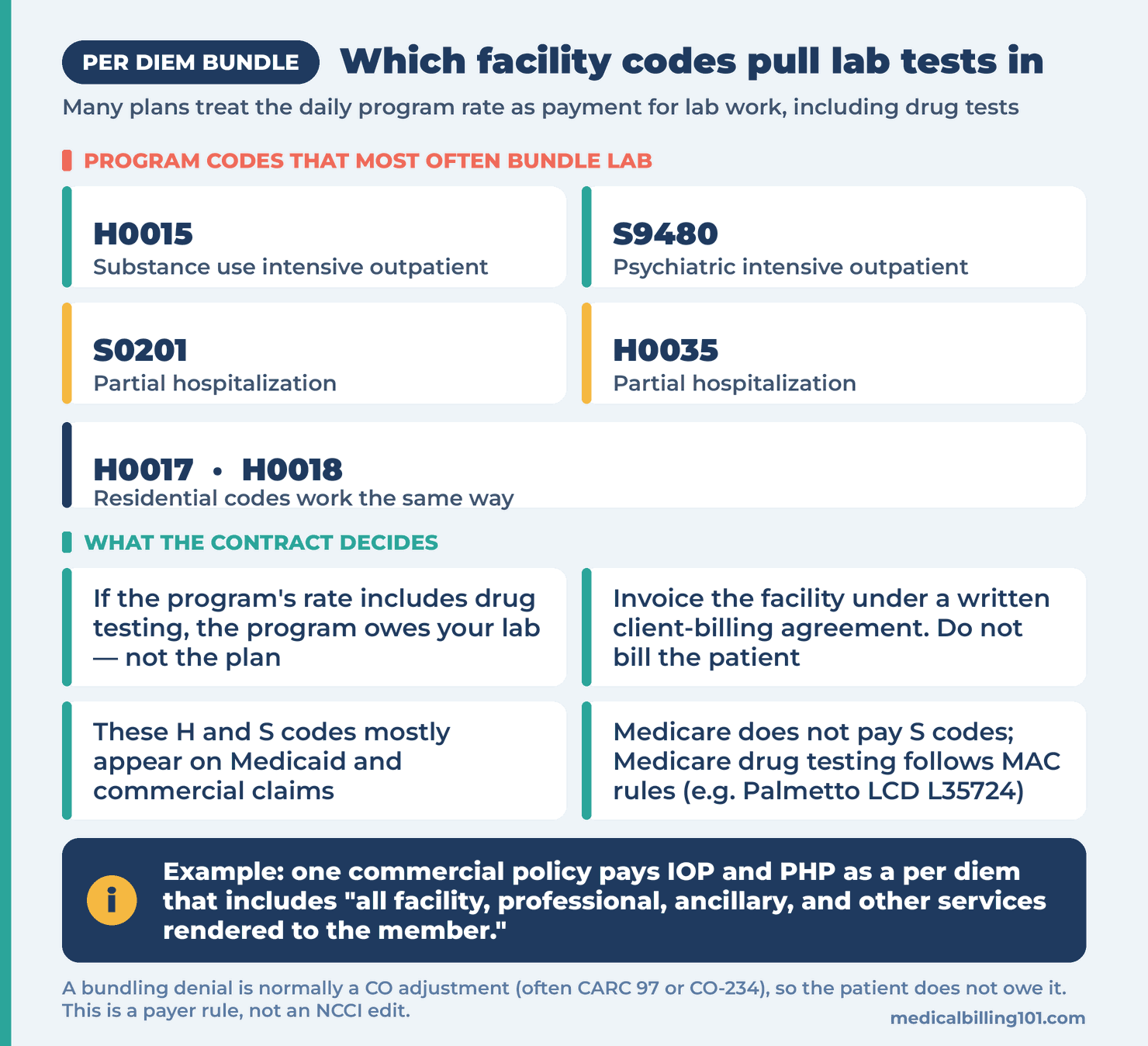
H0015, S9480, S0201, and H0035 are the program codes that most often pull lab tests into a per diem. H0015 is substance use intensive outpatient. S9480 is psychiatric intensive outpatient. S0201 and H0035 are partial hospitalization. Residential codes H0017 and H0018 work the same way.
Blue Cross NC’s commercial policy is a clear example. It pays IOP and PHP as a per diem. That rate includes “all facility, professional, ancillary, and other services rendered to the member.” Your lab test is an ancillary service under that language.
Neighborhood Health Plan of Rhode Island goes further. Its drug testing policy says presumptive testing is not payable when it is part of a substance use program with an all-inclusive bundled rate.
So the key question is not your coding. It is the contract between the payer and the program. If the program’s rate includes drug testing, the program owes your lab, not the plan.
These H and S codes mostly appear on Medicaid and commercial claims. Medicare does not pay S codes, and Medicare drug testing follows MAC rules such as the Palmetto GBA urine drug testing LCD L35724.
Can definitive testing bundle with your own presumptive test?
Yes, definitive testing can bundle with your own presumptive test under some plan policies. Anthem’s New York commercial policy C-12004 is one example. When a POS 81 lab bills instrumented presumptive testing the same day, only 1 to 7 definitive classes (G0480) pay separately.
Under that policy, G0481, G0482, and G0483 are not separately paid when billed with same-day presumptive testing. The policy also says specimen validity testing is never billed separately. No modifier overrides that edit.
Check the remit before you assume a per diem issue. A G0483 denial with a paid 80307 points to a same-lab rule. A denial of every line points to the facility’s per diem.
How should a lab respond to a toxicology bundling denial?
A lab should respond to a toxicology bundling denial by first naming the exact edit. Call the payer and ask which claim and policy caused the bundle. Then decide between billing the facility, sending a corrected claim, or filing an appeal with the policy text.
- Pull the remit and note the CARC, RARC, and any policy number on the line.
- Ask the payer whether another provider billed a per diem for that date. Ask for the policy name.
- Ask the ordering facility which level of care the patient was in. Ask whether its contract rate includes lab work.
- If the rate includes lab work, invoice the facility under a written client-billing agreement. Do not bill the patient.
- If the policy does not bundle your test, appeal. Attach the policy text, the order, and the medical necessity note.
For the appeal letter, our appeal letter generator builds a clean draft. Use the timely filing calculator to track the appeal window. If the remit says “not paid separately,” the CO-234 guide walks through it.
In lab billing work, I have seen these denials stop only after the lab and the treatment program signed a client-bill agreement for each payer.
How do you prevent these denials at intake?
You prevent these denials at intake by asking the ordering facility two questions on every new account. Is the patient in IOP, PHP, or residential care? Does the payer contract include lab testing in the daily rate? Flag those payers before the first specimen arrives.
- Add a “level of care” field to the requisition.
- Keep a payer grid that shows which plans bundle lab into program rates.
- Route bundled payers to client billing from day one.
- Bill one presumptive code and one definitive code per date. Match the class count to the report.
Good checks at the front desk help here. See our medical necessity documentation guide for what an order should show. The CO-16 guide helps when the denial is about missing claim data instead.
3-step checklist
- Read the remit and ask the payer which claim and policy bundled your toxicology codes.
- Confirm the patient’s level of care and whether the program’s rate includes lab testing.
- Bill the facility under a client-bill agreement, or appeal with the policy text if it does not apply.
FAQ
Why is G0483 denying as bundled for a lab?
G0483 often denies as bundled because the patient’s treatment program billed a per diem, such as H0015 or S0201, that the plan says includes lab testing. Some plans also bundle 8 or more definitive classes with same-day presumptive testing.
Is toxicology bundling an NCCI edit?
No. NCCI edits compare codes billed by the same provider. Per diem bundling compares the lab’s claim with another provider’s program claim for the same patient and date.
Can an independent lab bill the patient for bundled drug tests?
Usually not. A bundling denial is normally a CO adjustment, so the patient does not owe it. The lab should bill the facility if the facility’s rate includes lab testing.
Does modifier 59 fix a toxicology bundling denial?
No. Modifier 59 does not override per diem bundling. Policies such as Anthem’s C-12004 also state that no modifier overrides their drug testing bundle edit.
How many units of 80307 or G0483 can you bill per day?
One. The presumptive codes 80305 to 80307 and the definitive codes G0480 to G0483 are each reported once per patient per date of service.
Sources
My methodology was simple. I read each payer policy and the Medicare article line by line, then matched them to the codes on the denied claim. Plan contracts differ, so confirm your payer’s current policy before you appeal.
- Blue Cross NC, Commercial Reimbursement Policy: Facility Behavioral Health (PHP, IOP, RTC per diem). Accessed 11 Nov 2026.
- Anthem (New York commercial), Reimbursement Policy C-12004: Drug Screen Testing – Professional, effective 10/23/2025. Accessed 11 Nov 2026.
- Neighborhood Health Plan of Rhode Island, Drug Testing Payment Policy. Accessed 11 Nov 2026.
- CMS Medicare Coverage Database, LCD L35724: Urine Drug Testing (Palmetto GBA). Accessed 11 Nov 2026.
- CMS Medicare Coverage Database, Billing and Coding: Urine Drug Testing (A54799). Accessed 11 Nov 2026.
- CMS, National Correct Coding Initiative (NCCI) Edits. Accessed 11 Nov 2026.
Read about the author, or contact us with a question. See our editorial policy.
Last updated: 11 November 2026 · Educational content for U.S. billers. Payer policies vary by plan, so check the plan’s current policy.