This modifier 25 vs 59 helper asks a few questions about your claim and suggests the right modifier. It covers 25, 57, 59, XE, XS, XP, XU and anatomic modifiers, and it tells you when no modifier is allowed, with the reason from the 2026 NCCI Policy Manual and CMS MLN guidance.
What needs the modifier?
Answer the questions on the left. You will see the suggested modifier, the reasons and the CMS source for each one.
Rules: NCCI Policy Manual for Medicare Services, 2026, Chapter 1, Sections D and E; CMS MLN1783722, April 2026; CMS MLN006764, May 2026. CPT is a registered trademark of the American Medical Association. This helper is a guide, not coding advice.
Key takeaways
- Modifier 25 goes on an E/M code. Modifier 59 never does.
- Use XE, XP, XS or XU instead of 59 whenever one fits.
- Different code descriptors or different diagnoses do not justify 59.
- No modifier bypasses an NCCI edit with indicator 0.
What is the difference between modifier 25 and 59?
Modifier 25 is for a significant, separately identifiable E/M service on the same day as a procedure. Modifier 59 is for a distinct procedure or service, other than an E/M, that is not normally reported with another one on the same day. So 25 goes on the E/M code, and 59 goes on a procedure code (NCCI Policy Manual 2026, Ch. 1).
Both are NCCI PTP-associated modifiers. Both need a medical record that supports them. The modifier 59 vs 25 question usually comes down to one test: is the service an E/M visit or not?
What do modifiers XE, XS, XP and XU mean?
The X{EPSU} modifiers are 4 more specific versions of modifier 59, effective January 1, 2015. CMS asks you to use them instead of 59 whenever one fits (CMS MLN1783722).
| Modifier | CMS definition | Typical use |
|---|---|---|
| XE | Separate encounter. A service that is distinct because it occurred during a separate encounter. | A second visit on the same date of service. |
| XS | Separate structure. A service that is distinct because it was performed on a separate organ or structure. | Different organs or anatomic regions. |
| XP | Separate practitioner. A service that is distinct because it was performed by a different practitioner. | Another practitioner did the service. |
| XU | Unusual non-overlapping service. A service that is distinct because it does not overlap usual components of the main service. | A diagnostic test that led to, or followed, a treatment. |
When is modifier 25 correct?
Modifier 25 is correct when the E/M goes above and beyond the usual work of a minor or XXX procedure. The global period of the procedure decides which modifier, if any, the E/M can carry (NCCI Policy Manual 2026, Ch. 1).
| Global period | E/M on the same day | Modifier |
|---|---|---|
| 090 (major surgery) | The visit decided on the surgery. | 57 |
| 090 (major surgery) | Other pre-op work for the surgery. | None. It is in the global payment. |
| 000 or 010 (minor) | Only the decision to do the procedure. | None. |
| 000 or 010 (minor) | A significant, separately identifiable E/M. | 25 |
| XXX | A separate E/M above the inherent work of the procedure. | 25 |
The diagnosis can be the same for both services. A new patient alone does not justify the E/M. Medicare also does not pay G2211 with an E/M billed with modifier 25, except on the same day as an AWV, a vaccine administration or a Part B preventive service (CMS MLN006764). Check the visit level in the E/M level calculator before you add modifier 25.
When should you use XS instead of 59?
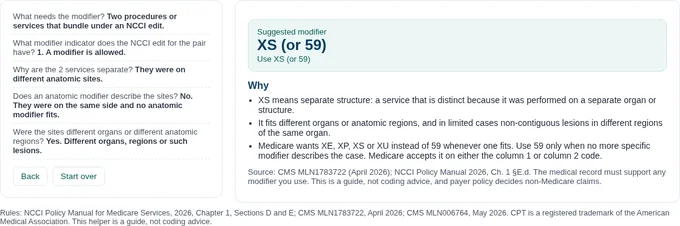
Use XS when the 2 procedures were on different organs or different anatomic regions and no anatomic modifier fits. Anatomic modifiers come first. Procedures on opposite sides of the body get RT and LT, not 59 or XS (CMS MLN1783722).
For example, CMS says 11102 and 17000 can take 59 or XS when they were at different sites on the same side of the body. Contiguous structures in one organ or region are a single site. The nail, nail bed and nearby soft tissue of one toe are one site, and so are the retina and choroid of one eye.
When do 59, XE and XU apply in the same encounter?
CMS allows 3 limited cases where 2 services in the same encounter are separate because they are separated in time and do not overlap (CMS MLN1783722):
- Timed codes in separate time blocks: use 59 or XE. For example, 10 minutes of 97140, 15 minutes of 97750, then 5 more minutes of 97140.
- A diagnostic test that led to the treatment: use 59 or XU, when the test came first, decided the treatment and was not otherwise required.
- A diagnostic test after the treatment ended: use 59 or XU, when it was not a required, common or expected follow-up.
What are the most common modifier 59 mistakes?
The most common mistake is using 59 because the 2 codes describe different procedures. The codes in an edit pair usually describe different procedures, so that alone never justifies 59 or XU (NCCI Policy Manual 2026, Ch. 1). Other mistakes include:
- Using 59 or an X modifier because the diagnoses differ. Different diagnoses are not enough.
- Adding a modifier to a pair with NCCI indicator 0. No modifier bypasses it.
- Putting 59 on an E/M code instead of 25.
- Expecting 22, 76 or 77 to bypass an edit. They are not NCCI PTP-associated modifiers.
When a 59 claim still denies, I check whether an anatomic modifier would have described the sites first. Read why Blue Cross denied nerve block codes even with modifier 59, and see the CO-4 denial code page for missing or wrong modifiers.
What do modifier helper examples look like?
These answer paths are test cases we ran. Each result matches the CMS rule cited.
| Scenario | Suggested modifier |
|---|---|
| E/M with a 010-day procedure, separate problem documented | 25 |
| E/M that decided on a 090-day surgery | 57 |
| E/M that only decided on a minor procedure | None |
| 2 procedures on different shoulders | RT and LT |
| 2 procedures on different organs, same side | XS (or 59) |
| Separate encounter, no more specific modifier | XE (or 59) |
| Pair with NCCI indicator 0 | None |
| Codes chosen because the diagnoses differ | None |
An E/M bundled with an X-ray is a common 25 question. Read why Aetna denied 99213 billed with an X-ray. For global period rules, see our global surgical package guide.
How do you use the modifier helper?
- Pick what needs the modifier: an E/M visit, or 2 bundled procedures.
- Answer each question from the medical record. Use Back to change an answer.
- Read the suggested modifier and the reasons with the CMS source.
- Check the pair in the NCCI edit checker and the units in the MUE lookup.
How did we test this modifier helper?
We tested the helper with 29 checks before we published it. The checks walk every answer path to its result and compare it with the rule in the 2026 NCCI Policy Manual or the CMS MLN booklet. We also tested the Back and Start over buttons and the mobile layout.
Think a path gives the wrong answer? Contact us with the scenario, and we will check it.
Frequently asked questions
Is this modifier helper free?
Yes. It is free and needs no sign-up. Your answers stay in your browser.
Can modifier 59 go on an E/M code?
No. Modifier 59 should not be appended to an E/M service. A separate E/M on the same day as a procedure uses modifier 25.
Should I use XS or 59?
Use XS when the services were on a separate organ or structure. CMS asks for XE, XP, XS or XU instead of 59 whenever one fits.
Does modifier 25 need a different diagnosis?
No. The E/M service and the procedure can share the same diagnosis. The record must show a significant, separately identifiable E/M service.
Do modifiers 22, 76 or 77 bypass an NCCI edit?
No. They are not NCCI PTP-associated modifiers, so they do not bypass a PTP edit.
Which code gets modifier 59 or XS?
Medicare accepts modifiers 59, XE, XP, XS and XU on either the column 1 or the column 2 code of the edit pair.
Sources
- CMS, NCCI Policy Manual for Medicare Services, Chapter 1, General Correct Coding Policies, Sections D and E (revised January 1, 2026).
- CMS, MLN1783722, Proper Use of Modifiers 59, XE, XP, XS & XU (April 2026).
- CMS, MLN006764, Evaluation and Management Services (May 2026): HCPCS code G2211 and modifier 25.
- CMS, Medicare NCCI Policy Manual (2026) index.
This modifier helper is an educational guide, not coding or legal advice. It suggests a modifier from your answers only. The medical record and payer policy decide the final claim.