
The CO-287 denial code means the patient had a referral, but the billed visit went beyond it. Usually the visit count ran out or the end date passed. The fix is to get an extended or new referral from the primary care office, then send a corrected claim with that referral number. (Primary source: X12 Claim Adjustment Reason Codes)
In brief: CARC 287 means the referral was used up. CARC 288 means there was never a referral on file. With CO, the provider owns the balance, so do not send the patient a bill for the extra visits.
Part of our denial codes library. Written by Manikandan J, CPC, CRCR, who has cleaned up referral-count denials for physical therapy and behavioral health clinics. Published 13 November 2026. Last updated: 13 November 2026. Code wording quoted word for word from X12. Read about the author and our editorial policy, or contact us to report an error.
What does denial code CO-287 mean?
Denial code CO-287 means the plan found a valid referral on file, then compared it with your claim. The service fell outside what the referral allowed. Reason code 287 most often hits the first visit after the last approved one.
| Field | Value |
|---|---|
| Code | 287 |
| Description | “Referral exceeded” |
| Group codes | No X12 group restriction; CO is the most common |
| Start | 11/01/2017 |
Source: X12 Claim Adjustment Reason Codes, checked 13 November 2026.
Methodology: the code wording is copied from the X12 list, and the claim form fields follow the NUCC and NUBC instructions cited below.
Key terms: A referral is written approval from the patient’s primary care provider to see a specialist (HealthCare.gov). The referral scope is what it covers: visit count, date range and specialty. CO means contractual obligation, so the provider carries the denied line.
CO-287 vs OA-287: what is the difference?
CO-287 means an HMO or managed care plan you contract with enforced its referral limits on your claim. OA-287 reports the same overrun without a contract basis, which you may see from a plan you do not contract with. In both versions, the patient is not named as the payer of the balance.
| Version | Who carries the line | Typical setting |
|---|---|---|
| CO-287 | Provider, under the HMO or managed care contract | Therapy series, specialist follow-ups, behavioral health sessions |
| OA-287 | No contract basis named | Out-of-network specialist or a secondary plan |
If you ever see PR-287, the plan has placed the overrun on the member. Read your network agreement before you bill the patient.
Why did the referral run out?
The referral runs out when the care plan grows but nobody updates the paperwork. Therapy is the classic case, such as a knee rehab plan that adds weeks after a slow recovery. The referral allows a set number of visits, the therapist adds weeks, and the next claim crosses the line.
Dates cause the rest. For example, a referral may expire after 90 days, even with visits left. A plan can also reject a visit with a different specialty or provider group than the referral names. Some payers add N335, “Missing/incomplete/invalid referral date.”
Example scenario (fictional names), part 1
CO-287 Denial Example: What Happened
Ines Moreau bills for Brookfield Physical Therapy. Physical therapist Tom Albright treated a patient with right knee pain, M25.561, entered as M25561. The fictional HMO referral from Dr. Ruth Carver, the primary care doctor, allowed eight visits.
The care plan added four more weeks. Visit nine went out with 97110-GP and 97140-GP and the same referral number in Box 23.
The 835 came back with CAS*CO*287 on both lines. Visits one to eight had been paid.
Was the referral wrong, or just too small? Keep reading, or jump to how it was resolved. Keep reading, or jump to how the CO-287 denial was resolved.
How do I fix a CO-287 denial?
To fix a CO-287 denial, check the referral against the claim, then close the gap. Count the visits used and check the dates and specialty. If the care was needed, ask the primary care office for an extension. Then send a corrected claim with the updated referral number.
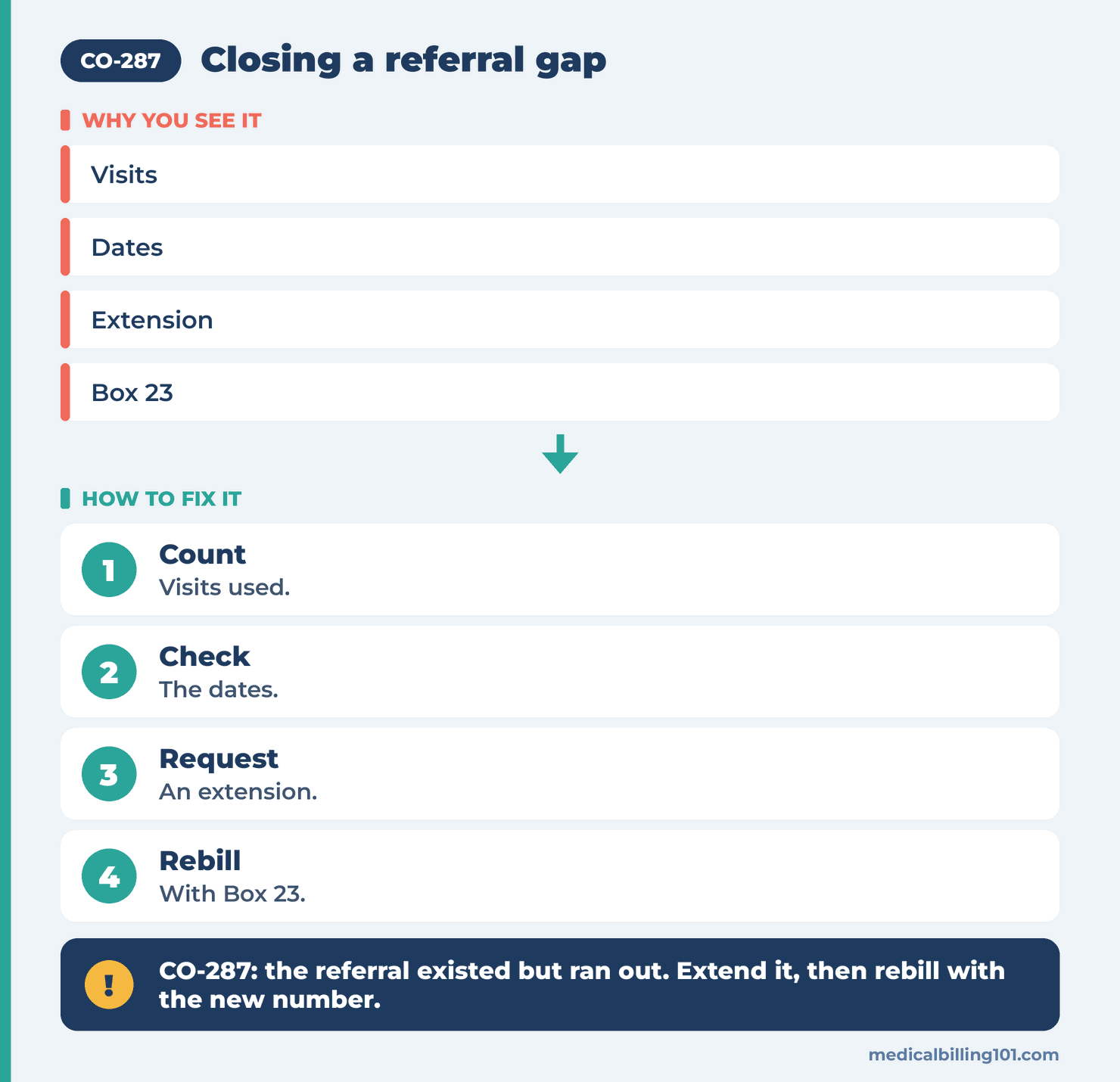
- Visit count: compare paid visits with the number allowed.
- Date range: confirm each date of service falls inside the referral dates.
- Provider match: confirm the referral names your specialty or group.
- Extension: ask the primary care office to request more visits from the plan, with the progress note.
- Rebill: send frequency code 7, the original claim number in Box 22 and the new number in Box 23.
If the plan refuses a retro extension, appeal with the clinical notes. Some plans allow it only within a set number of days, so check the provider manual first.
Example scenario (fictional names), part 2
How the CO-287 Denial Was Resolved
Ines opened the plan portal. The referral showed eight visits approved and eight visits used, so visit nine had no cover.
Fix: she sent the therapist’s progress note to the primary care office the same day. The office asked the plan for eight more visits. The plan issued an extended referral that covered the new date range. Ines sent a corrected claim with frequency code 7, the original claim number in Box 22 and the new referral number in Box 23.
Outcome: the plan paid visit nine. Ines now gets an alert two visits before any referral runs out.
Names and details are illustrative; no real patient data.
Names and details are illustrative; no real patient data.
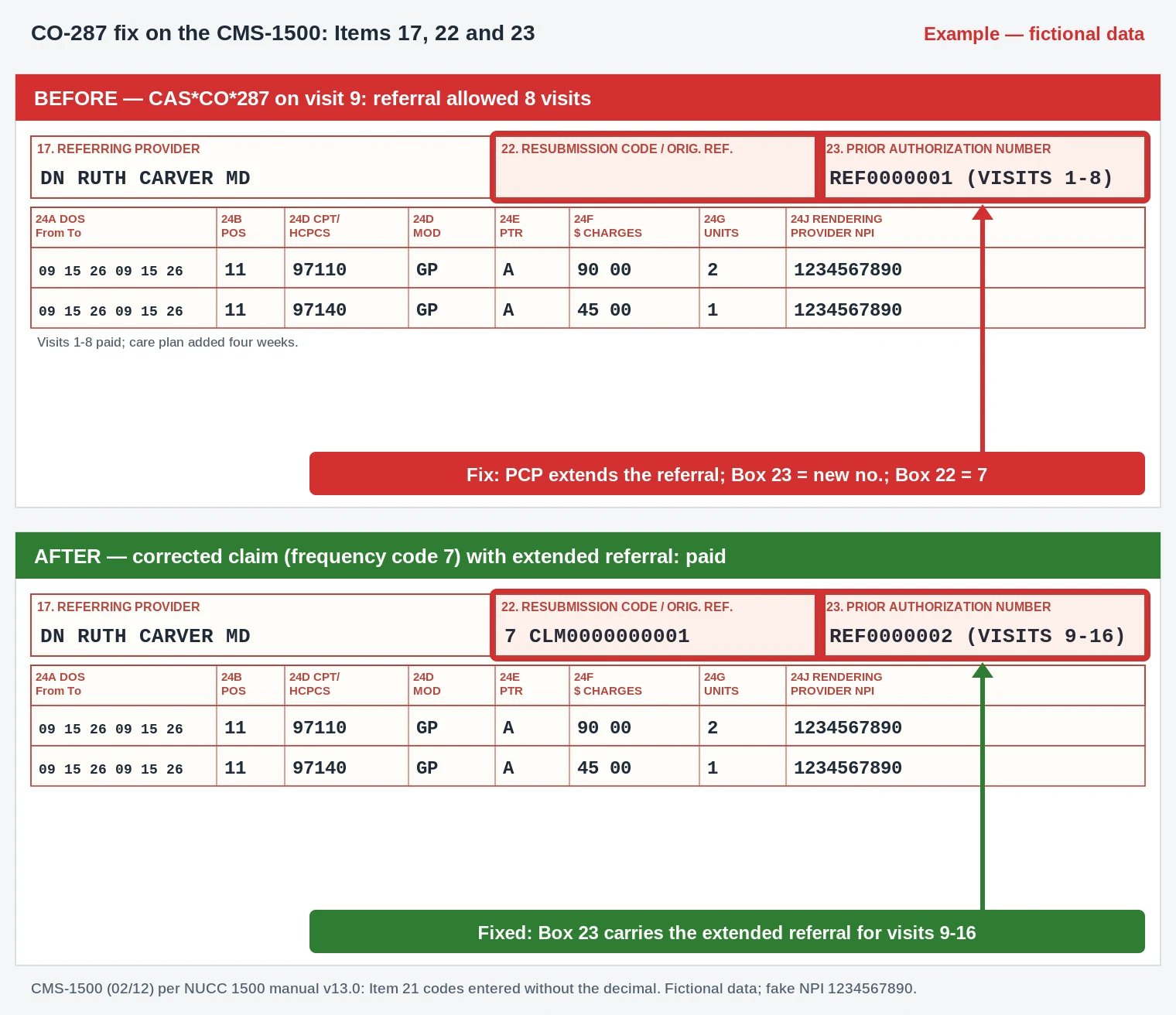
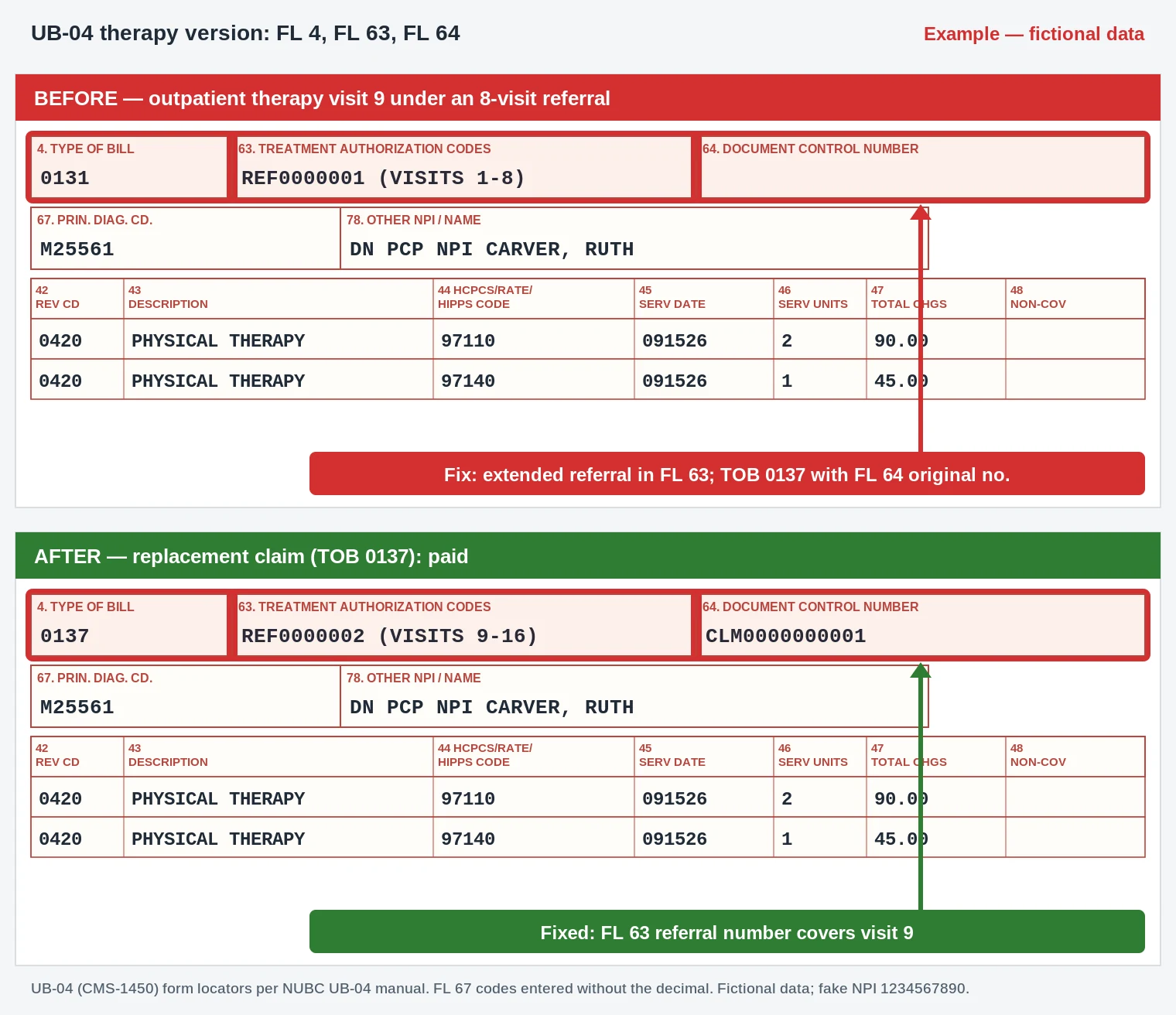
- Box 23 / FL 63: the used-up referral (visits 1-8) was replaced with the extended referral number for visits 9-16.
- Box 17 / FL 78: Dr. Ruth Carver stays as the referring provider with qualifier DN.
- Box 22 / FL 4 + FL 64: frequency code 7 with the original claim number (bill type 0137 on the UB-04).
- Box 24D / FL 44: 97110-GP and 97140-GP and M25.561 (entered as M25561) are unchanged.
Is CO-287 the same as CO-198?
No, CO-287 is not the same as CO-198. CARC 287 is about a referral from the primary care provider. CO-198 is about a prior authorization from the plan that the service exceeded. Many HMOs use both tools, as the HealthCare.gov HMO definition explains. Check which document the denied line was tied to before you fix it.
Can I bill the patient for CO-287?
No, you cannot bill the patient for CO-287 lines. CO means the contract keeps the denied amount with the provider. Tracking referral limits is usually part of the in-network provider’s job. For instance, the NUCC instructions place the referral number in Box 23, so the claim is checked against it. Get the extension or appeal instead.
Related codes
| Code | Meaning |
|---|---|
| CO-197 | Precertification or authorization absent |
| CO-198 | Precertification or authorization exceeded |
| CO-243 | Services not authorized by network or primary care providers |
| CO-284 | Authorization valid but does not apply to the billed service |
FAQ
What does CO-287 mean?
The patient had a referral, but the billed service went past its visits, dates or scope.
Is CO-287 the same as CO-288?
No. CO-288 means no referral was on file. CO-287 means one existed but ran out.
Where does the referral number go on the CMS-1500?
Box 23 holds the referral number. Box 17 names the referring provider with qualifier DN.
Can a referral be extended after the visit?
Some plans allow a retro extension within a set time. Check the provider manual.
Does the patient owe a CO-287 amount?
No. CO keeps the denied amount with the provider.
Sources
How we checked: the CARC 287 quote was matched word for word with the X12 CARC list on 13 November 2026, and N335 with the X12 RARC list.
- X12, Claim Adjustment Reason Codes (CARC 287, 288, 198). Accessed 13 Nov 2026.
- X12, Remittance Advice Remark Codes (N335). Accessed 13 Nov 2026.
- NUCC, 1500 claim form instructions (Items 17, 22, 23). Accessed 13 Nov 2026.
- HealthCare.gov, referral definition. Accessed 13 Nov 2026.
- HealthCare.gov, HMO definition. Accessed 13 Nov 2026.
Last updated: 13 November 2026 · Educational content; not legal advice.