
CO-198 means there was an authorization, but the claim went past it. The patient had more visits, more units or more days than the payer approved, or the service fell after the approval ended. It’s different from having no authorization at all. The fix usually starts with the payer’s utilization team, not the claim: get the extra visits approved, then rebill them with the new number. (Primary source: X12 Claim Adjustment Reason Codes)
In brief: CARC 198 reads “Precertification/notification/authorization/pre-treatment exceeded.” Compare the approved visits, units and dates with what was billed. Ask the payer for an extension or a retro review for the extra services. Then send a corrected claim with the new authorization in Box 23 (or UB-04 FL 63).
Part of our denial codes library. Written by Manikandan J, CPC, CRCR, who has managed authorization tracking for outpatient therapy and behavioral health clinics. Published 22 October 2026. Last updated: 22 October 2026. Code wording quoted word for word from X12.
Official CARC 198 description
| Field | X12 text |
|---|---|
| Code | 198 |
| Description | “Precertification/notification/authorization/pre-treatment exceeded.” |
| Start | 10/31/2006 |
| Last modified | 05/01/2018 |
Source: X12 Claim Adjustment Reason Codes, checked 22 October 2026.
What an authorization limits
An authorization is the payer’s advance approval for a service. It’s not open-ended. Most approvals set a visit or unit limit, which is the number of sessions or billing units allowed, and a date span, which is the window when those visits can happen. Some also limit the provider or the place of service. CARC 198 means the claim went over one of these limits. HealthCare.gov’s preauthorization entry gives the plain-language view.
Example scenario (fictional names), part 1
CO-198 Denial Example: What Happened
Kevin Tran tracks authorizations for Harbor Point Physical Therapy. A patient with right shoulder impingement (M75.41) had an authorization for 12 visits from Maplewood Health, a fictional commercial plan. The therapist, Dr. Rachel Stein, found the patient needed more work on strength and added two visits.
Visits 13 and 14 were billed with 97110-GP and 97140-GP and the original authorization number in Box 23. The 835 showed CAS*CO*198 on both dates with remark LQ*HE*N54, “Claim information is inconsistent with pre-certified/authorized services.”
Could the two extra visits still be paid? Keep reading, or jump to how the CO-198 denial was resolved.
Common causes of reason code 198
- Visit count exceeded. For example, therapy goes past the approved number of sessions before an extension is asked for.
- Units exceeded. More units of a timed code than the approval allows per visit or in total.
- Dates outside the span. Services after the authorization end date, even if visits remain.
- Higher level than approved. A higher-intensity code than the one approved, such as a longer session code.
- Tracking gaps. The clinic’s counter didn’t include visits billed under another provider in the same group.
How to fix a CO-198 denial
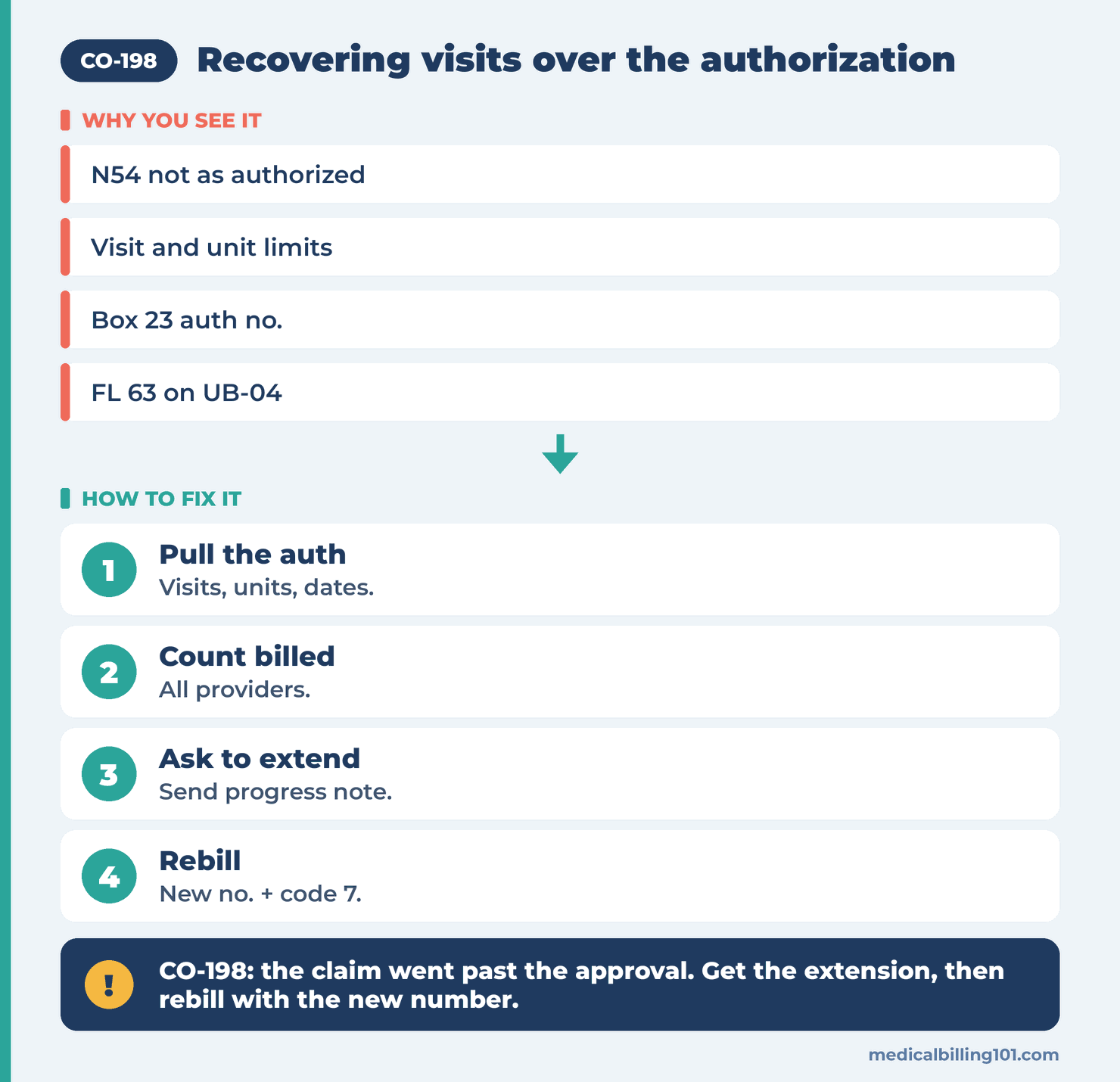
- Pull the authorization. Note the approved codes, visits, units and dates.
- Count what was billed. Include every visit under that authorization, across all providers.
- Ask for an extension or retro review. Send the progress note that shows why more care was needed. Some plans allow retro requests within a set number of days.
- Get the new number. An extension often comes with a new authorization number or a revised span.
- Send a corrected claim with frequency code 7, the original claim number in Box 22 and the new number in Box 23.
- If the payer refuses, appeal with the clinical notes, or write off the extra visits if the patient can’t be billed under the contract.
Example scenario (fictional names), part 2
How the CO-198 Denial Was Resolved
Kevin checked the authorization log. The 12 approved visits were used up before visit 13. Dr. Stein’s progress note at visit 12 showed the patient still couldn’t lift her arm overhead, and it set new goals.
Fix: Kevin sent a retro extension request with that note. Maplewood approved four more visits under a new number. He then sent a corrected claim with Box 22 code 7, the original claim number and the new authorization in Box 23.
Outcome: Maplewood paid visits 13 and 14. Harbor Point now flags each authorization when two visits remain, so extensions go in before the limit.
Names and details are illustrative; no real patient data.
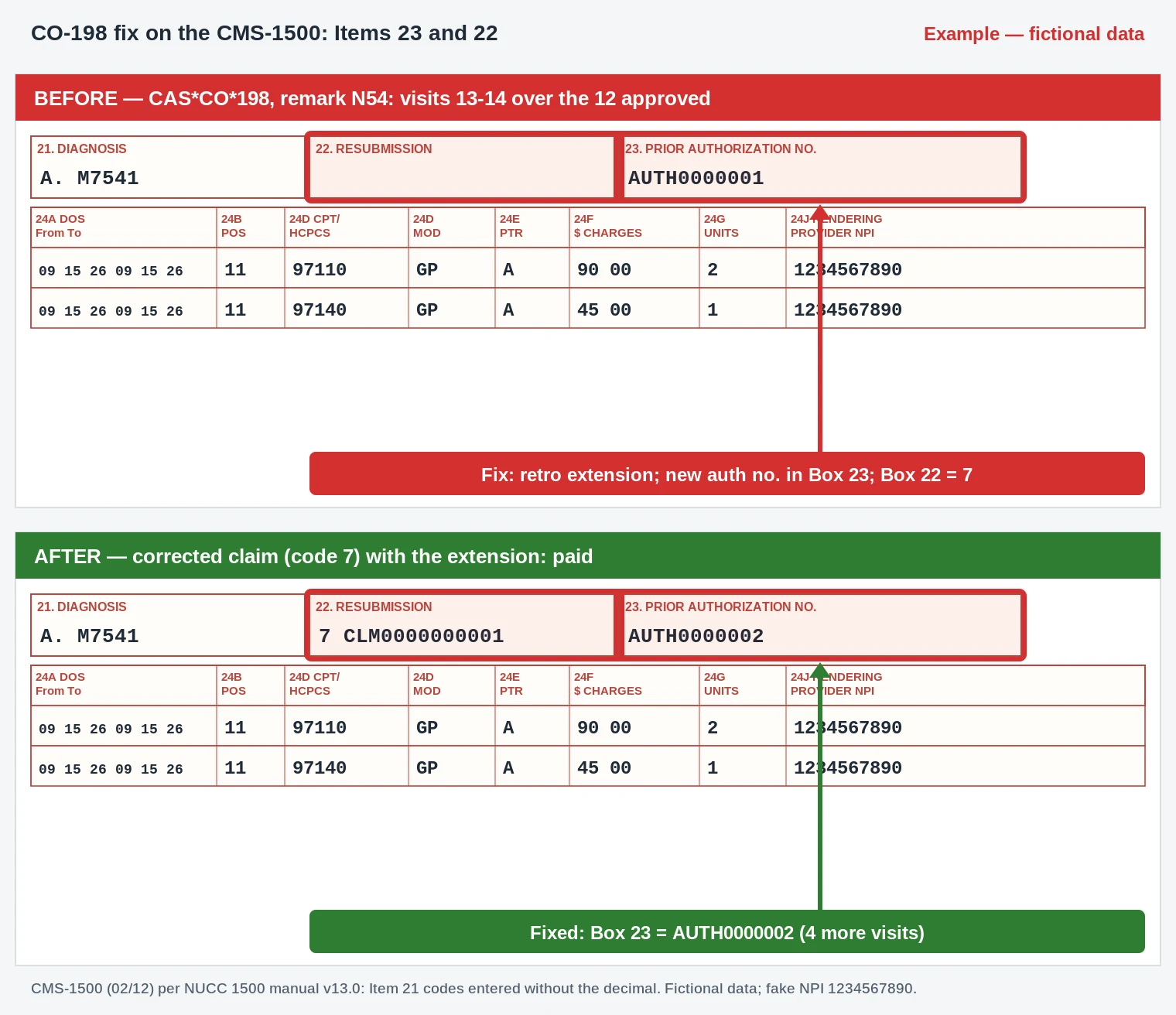
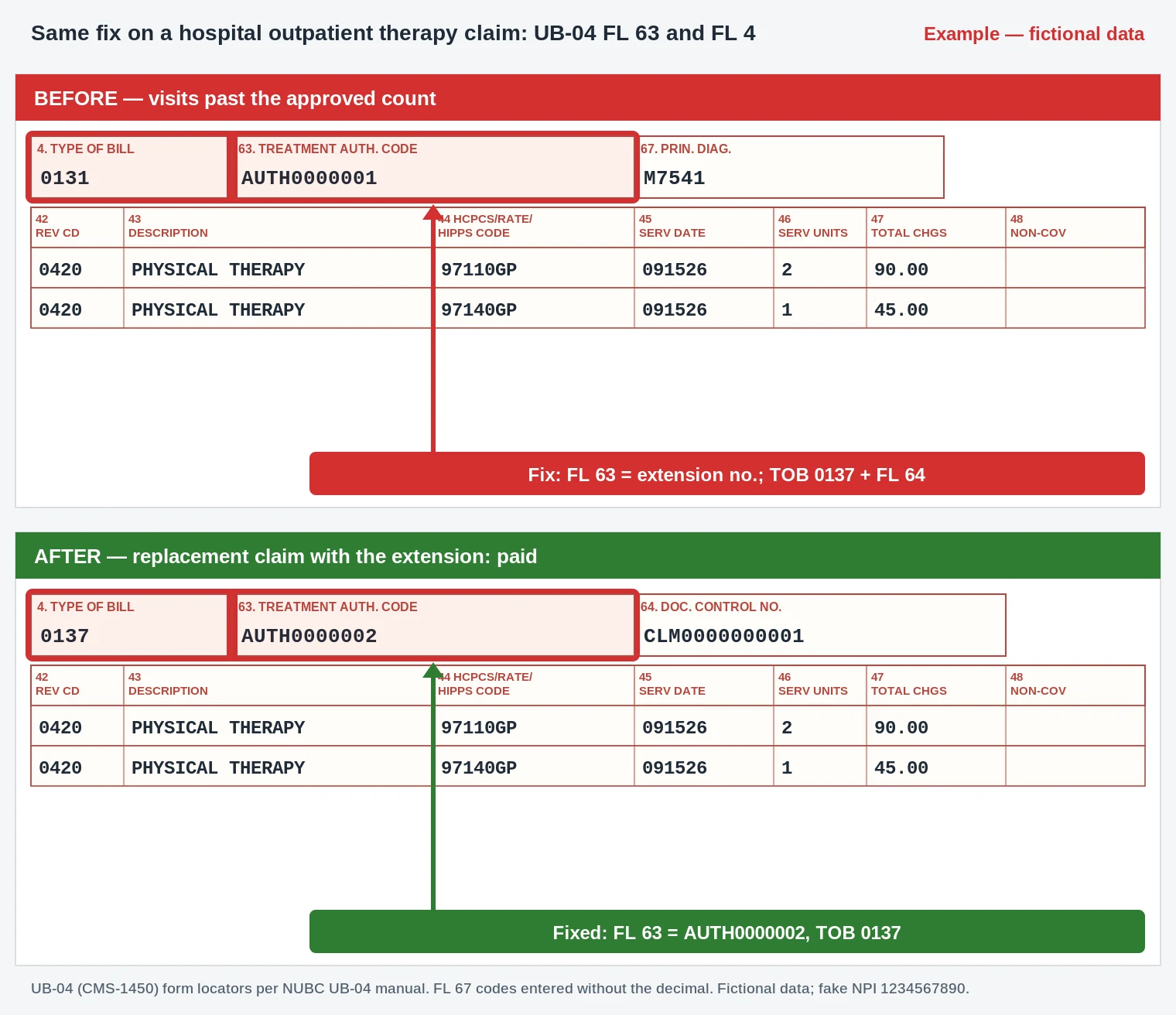
- Box 23 / FL 63: the used-up authorization (12 visits) replaced with the extension approved for 4 more visits (placeholder AUTH0000002).
- Box 22 / FL 4 + FL 64: frequency code 7 with the original claim number (type of bill 0137).
- Box 24D / FL 44: 97110-GP x 2 and 97140-GP with M75.41 (entered as M7541) are unchanged.
When the extra units or days were medically necessary and the payer refuses a retro update, start the appeal in the appeal letter generator and attach the original authorization plus the notes that justify the overage.
CO-198 vs other authorization codes
| Code | What it says | Key difference |
|---|---|---|
| CO-198 | Authorization exceeded | Approval existed, claim went past it |
| CO-197 | Authorization absent | No approval on file |
| CO-15 | Authorization number missing, invalid or doesn’t apply | Number problem |
| PR-119 | Benefit maximum reached | Plan limit, not authorization limit |
Check whether PR-119 is your issue by comparing the plan’s yearly visit limit with the authorization limit. They are different counts.
Prevention checklist
- Track used and remaining visits for every authorization, across all providers in the group.
- Set an alert when two visits or one week remain.
- Send extension requests with the latest progress note before the limit.
- Check the authorized codes and units, not just the visit count.
Recap
CO-198 means the claim went past an existing authorization. Compare the approved visits, units and dates with the claim. Get an extension or retro approval with the clinical notes, then send a corrected claim with the new authorization number in Box 23 or FL 63.
FAQ
What does denial code CO-198 mean?
The payer says the services billed exceeded the precertification, notification or authorization that was approved.
How is CO-198 different from CO-197?
CO-197 means no authorization was on file. CO-198 means there was one, but the claim went past its limits.
Can I get a retro authorization for extra visits?
Some plans allow it within a set number of days. Send the progress note that shows why more care was needed.
Where does the authorization number go on the claim?
Box 23 on the CMS-1500 and FL 63 on the UB-04.
Can I bill the patient for visits over the limit?
Not for a CO amount. Group code CO keeps it with the provider unless the contract allows a signed waiver.
Sources
How we checked: each code quote on this page was matched word for word with the X12 CARC and RARC lists on 22 October 2026.
- X12, Claim Adjustment Reason Codes (CARC 198, 197, 15, 119). Accessed 22 Oct 2026.
- X12, Remittance Advice Remark Codes (N54). Accessed 22 Oct 2026.
- HealthCare.gov, Preauthorization. Accessed 22 Oct 2026.
- NUCC, 1500 Claim Form instructions. Accessed 22 Oct 2026.
Last updated: 22 October 2026 · Educational content; not legal advice.
Related denial codes
- CO-197: Precertification or Authorization Absent
- CO-210: Authorization Received Too Late
- CO-183: Referring Provider Not Eligible to Refer
- PR-242: Services Not Provided by Network or Primary Care Providers
- CO-243: Services Not Authorized by the PCP
- CO-279: Services Not From a Preferred Network Provider
- CO-284: Authorization Does Not Match the Billed Service
- CO-95: Plan Procedures Not Followed