
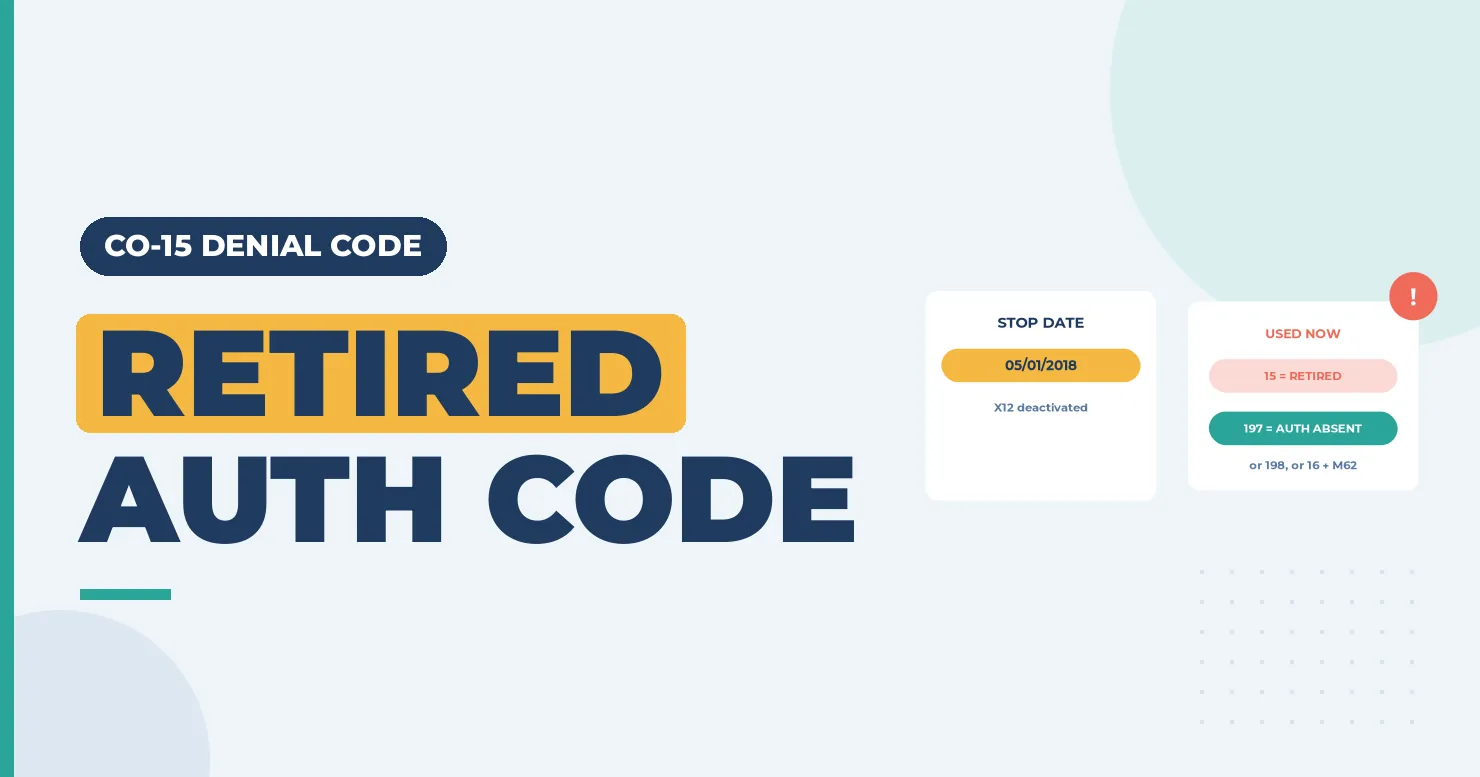
CO-15 is the remit code that told a provider the authorization number on the claim was missing, wrong, or didn’t match the service or the provider. X12 deactivated reason code 15 on 1 May 2018, so a payer using current code lists shouldn’t send it on new claims. You may still meet it on older remits, in legacy accounts receivable, or from a payer whose code tables were never updated. The fix is the same either way: get the right authorization onto the right claim line. (Primary source: X12 Claim Adjustment Reason Codes).
In brief: CO-15 means the authorization number was missing, invalid, or didn’t apply to the billed service or provider. It’s a retired code, stopped on 05/01/2018. Payers now usually report these problems with CARC 197 (authorization absent), CARC 198 (authorization exceeded) or CARC 16 with a remark code such as M62. To fix a CO-15, confirm the authorization exists, check it covers this provider, code, units and dates, and send a corrected claim with the number in the right field.
Part of our denial codes library. Written by Manikandan J, CPC, CRCR, who has worked authorization and denial queues for payers and billing companies. Published 20 October 2026. Last updated: 20 October 2026. Code wording is quoted word for word from X12.
Official X12 record for CARC 15
| Field | Official X12 text |
|---|---|
| Description | “The authorization number is missing, invalid, or does not apply to the billed services or provider.” |
| Start | 01/01/1995 |
| Last modified | 11/01/2017 |
| Stop | 05/01/2018 |
Source: X12 Claim Adjustment Reason Codes, checked 20 October 2026.
A deactivated code is a code X12 has given a stop date. After that date, payers shouldn’t use it on new remittances. The record stays on the X12 list so older remits can still be read.
Denial code 15, CARC 15 and reason code 15
Whether a portal says denial code 15, a remit shows CARC 15, or a colleague says reason code 15, it’s the same retired X12 code. With the CO group, the contract keeps the amount with the provider, so you can’t move it to the patient.
Why you might still see CO-15 in 2026
- Old accounts receivable. Claims from before May 2018 can still sit in reports, audits or legal holds.
- Payer code tables. Some smaller plans, third-party administrators and state programs map their own denial reasons to old CARCs.
- Paper EOB conversions. Some vendors turn paper explanations of benefits into 835 files with outdated mappings.
- Practice system labels. Your own denial dictionary may still show 15 for a reason the payer sent differently.
If a payer sends CO-15 on a new claim, log it and ask the payer which current code it means. That record helps if you ever need to escalate.
What replaced CARC 15 in practice
X12 records don’t name a single successor for 15. Current remits usually split the old meaning across these codes:
| Problem | Current CARC | Common remark |
|---|---|---|
| No authorization on file | CO-197, precertification absent | N54 or M62 |
| Authorized visits or units used up | CO-198, precertification exceeded | N54 |
| Number missing or unreadable on the claim | CO-16, claim lacks information | M62 |
| Referral from the network or PCP missing | CO-243, services not authorized by network/primary care providers | N630 |
Remark wording: M62 is “Missing/incomplete/invalid treatment authorization code.” N54 is “Claim information is inconsistent with pre-certified/authorized services.” Source: X12 RARC list.
Where the authorization number goes on the claim
An authorization number is the reference a payer issues when it approves a service ahead of time. On an electronic professional or institutional claim (837), it goes in the claim-level REF segment with qualifier G1 for prior authorization. Referral numbers use qualifier 9F. On a paper CMS-1500 it goes in item 23. On a UB-04 it goes in form locator 63. Getting the field right matters as much as getting the number right.
How to fix a CO-15 line
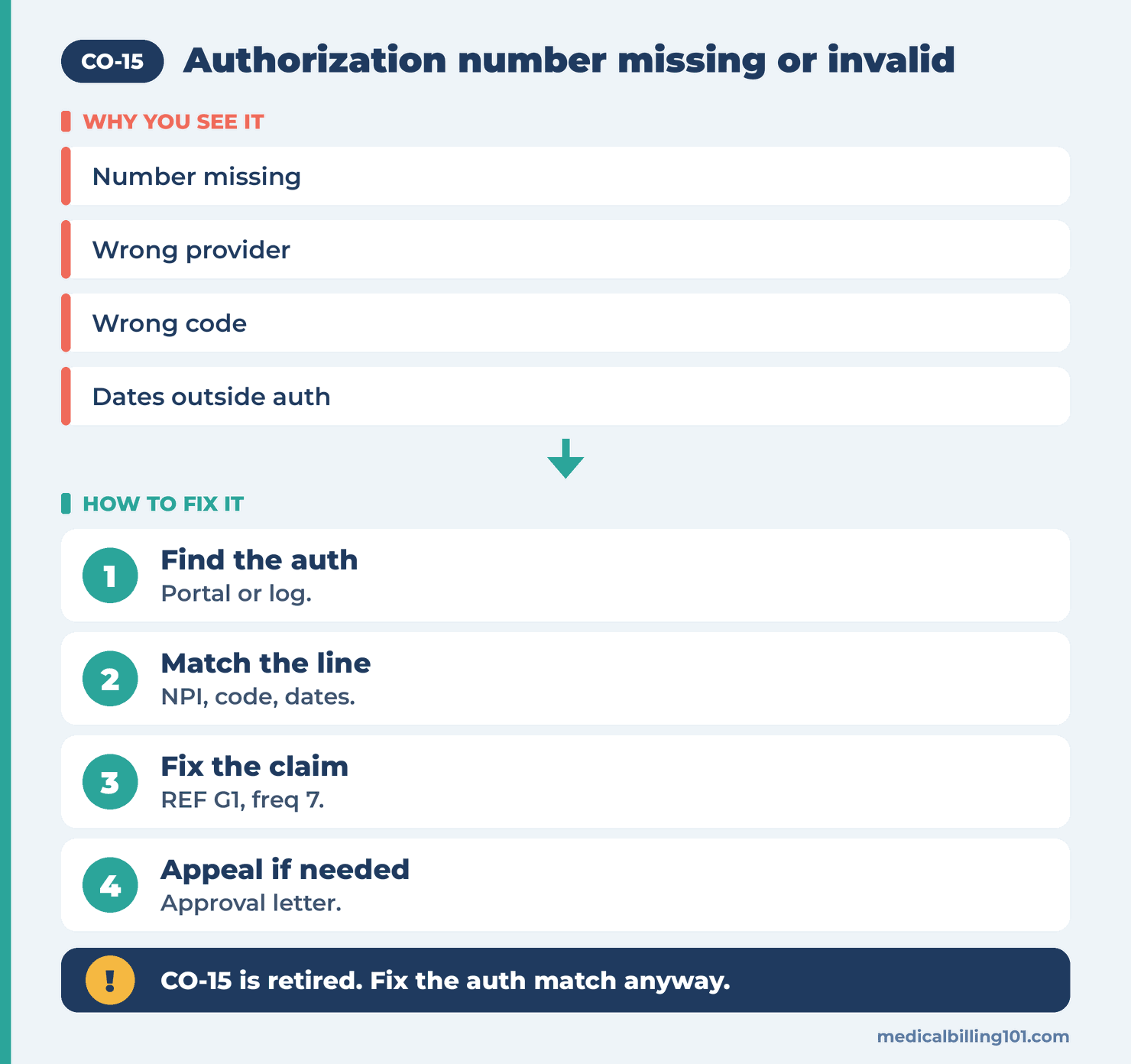
- Pull the authorization record from the payer portal or your auth log.
- Match the details. For example, check the rendering or facility NPI, the CPT or HCPCS code, the units and the date range.
- Fix the field. Put the number in REF G1 (837) or item 23 (CMS-1500).
- Send a corrected claim with frequency code 7 and the original claim number.
- Get an update if the auth was approved under another provider or code, then rebill.
- Appeal with the approval letter if the number was right and the payer missed it.
Common mismatches behind authorization denials
| Mismatch | Example | Fix |
|---|---|---|
| Wrong provider | Auth under the group, claim under a new physician | Ask the payer to add the rendering provider |
| Wrong code | Auth for 72148 (MRI without contrast), claim for 72158 | Ask for an updated auth before rebilling |
| Dates outside the window | Auth ended on the 15th, service on the 18th | Request a retro extension if the plan allows |
| Units over the limit | 12 therapy visits approved, 14 billed | Bill approved units, appeal the rest |
| Auth for another plan | Number from the old Medicaid plan after a switch | Get a new auth from the current plan |
Worked example (illustrative)
A 2017 imaging claim surfaces in an audit with CAS*CO*15*820.00. The biller finds the approval letter. The auth was issued for CPT 70551, a brain MRI without contrast, but the claim billed 70553, with and without contrast. The radiologist’s report supports contrast. The biller files an appeal with the report and the letter and asks the payer to accept the closely related code. Consider how the same case would look today. A current remit would most likely show CO-198 or CO-197 with remark N54, but the fix would be the same.
Prevention checklist
- [ ] Check authorization needs at scheduling, such as for imaging, surgery, therapy and infusions.
- [ ] Store the auth number, code, units, dates and provider in one place.
- [ ] Re-check the auth when the order changes on the day of service.
- [ ] Map REF G1 in your billing system and test it on a sample claim.
- [ ] Track remaining units for multi-visit authorizations.
- [ ] Update your denial dictionary so retired codes point to current ones.
Related denial codes
- CO-197: precertification or authorization absent.
- CO-16: claim lacks information needed for adjudication.
- CO-50: not deemed a medical necessity.
- CO-27: expenses incurred after coverage ended.
- Full CARC and RARC list for code lookups.
- Denial codes hub for every code we cover.
Key takeaways
CO-15 is a retired X12 code for a missing, invalid or mismatched authorization number. It stopped on 1 May 2018, so new remits normally use 197, 198 or 16 with a remark. When you do see it, treat it as an authorization mismatch. Match the auth to the provider, code, units and dates, fix the claim field, and appeal with the approval letter if the payer was wrong.
FAQ
What does CO-15 mean?
It means the authorization number was missing, invalid, or didn’t apply to the billed service or provider.
Is CARC 15 still active?
No. X12 lists a stop date of 05/01/2018 for reason code 15.
What code replaced CO-15?
X12 doesn’t name one. Payers now use codes such as CO-197, CO-198 or CO-16 with remark M62 or N54.
Where does the prior authorization number go on an 837?
In the claim-level REF segment with qualifier G1. Referral numbers use qualifier 9F.
Can I bill the patient for CO-15?
No. The CO group means the amount stays with the provider under the contract.
Can I appeal a CO-15 denial?
Yes. Send the approval letter and show that the auth covers the provider, code and dates billed.
Sources
How we checked: every code quote on this page was compared word for word with the X12 CARC and RARC lists on 20 October 2026.
- X12, Claim Adjustment Reason Codes (CARC 15, 16, 197, 198, 243). Accessed 20 Oct 2026.
- X12, Remittance Advice Remark Codes (M62, N54, N630). Accessed 20 Oct 2026.
- CMS, Medicare Claims Processing Manual, Ch. 26, Completing the CMS-1500. Accessed 20 Oct 2026.
Last updated: 20 October 2026 · This page is educational and doesn’t replace payer contracts or coding rules.