
The CO-279 denial code means the plan says the service did not come from a provider in the member’s preferred or narrow network. The provider may be contracted with the payer, just not in this plan’s smaller network. The fix is to check which provider and site the claim named, correct any wrong location, or appeal with a network exception. (Primary source: X12 Claim Adjustment Reason Codes)
In brief: CARC 279 is a network limit code. X12 says to use it when a member’s plan limits the network, such as contracted providers who are not in a narrow network. With CO, the provider absorbs the amount and cannot bill the patient.
Part of our denial codes library. Written by Manikandan J, CPC, CRCR, who has worked narrow network denials for multi-site physician groups and hospital outpatient departments. Published 10 November 2026. Last updated: 10 November 2026. Code wording quoted word for word from X12. Read about the author and our editorial policy, or contact us to report an error.
What does denial code CO-279 mean?
Denial code CO-279 means the plan matched the provider or location on the claim against the member’s network and found no match. Narrow network plans use a smaller list than the payer’s full network. CO puts the denied amount on the provider under the contract.
| Field | Value |
|---|---|
| Code | 279 |
| Description | “Services not provided by Preferred network providers.” |
| Usage | Use this code when there are member network limitations. For example, using contracted providers not in the member’s ‘narrow’ network. |
| Start | 11/01/2016 |
| Last modified | 07/01/2017 |
Source: X12 Claim Adjustment Reason Codes, checked 10 November 2026.
Key terms: A narrow network is a smaller provider list tied to one plan. A preferred provider is one the plan contracts with at better terms for members (HealthCare.gov glossary). CO means contractual obligation, so the provider owns the balance.
Methodology: the code wording is copied from the X12 list, and the claim form fields follow the NUCC and NUBC instructions cited below.
CO-279 vs OA-279: what is the difference?
CO-279 says your contract with the payer puts the out-of-network amount on you. OA-279 says the line was cut for the same network reason, but without a contract basis, for example when you have no agreement with that payer at all. Neither lets you bill the patient on that line.
| Version | Who owns the balance | Typical setting |
|---|---|---|
| CO-279 | Provider, under the payer contract | Contracted with the payer, but outside this plan’s narrow network |
| OA-279 | Not assigned by contract | No agreement with the payer, or a coordination case |
| PR-279 | Patient, under the plan terms | Member chose a non-preferred provider and the plan allows billing |
PR-279 is different from both. Check your contract before you treat PR-279 as billable.
Why do plans send CARC 279?
Plans send CARC 279 when the provider, the site, or the NPI on the claim is not on the member’s network list. Many groups have more than one location, and a plan may contract only some of them. So a wrong service location on the claim can look like an out-of-network visit.
Other causes include a new clinician who is not loaded in the narrow network yet, and a referral to a site the plan never added. Federal rules ask Marketplace plans to keep adequate networks (45 CFR 156.230). They do not require a plan to include every location.
Example scenario (fictional names), part 1
CO-279 Denial Example: What Happened
Keisha Monroe codes for Riverbend Orthopedics, which has a main office and a satellite office. A patient on a fictional commercial plan with a narrow network saw Dr. Paul Wren at the main office for right knee pain. The claim listed 99213 with M25.561, entered as M25561.
The practice system defaulted Box 32 to the satellite office. The 835 came back with CAS*CO*279 and N130, “Consult plan benefit documents/guidelines for information about restrictions for this service.” Dr. Wren was in the narrow network.
So why did the plan say the visit was out of network? Keep reading, or jump to how it was resolved. Keep reading, or jump to how the CO-279 denial was resolved.
How do I fix a CO-279 denial?
To fix a CO-279 denial, first confirm whether the denial is about the provider, the site, or the plan. Check the member’s plan network list for the rendering provider and the service location. If the claim named the wrong site or NPI, send a corrected claim. If it was right, appeal only with a valid exception.
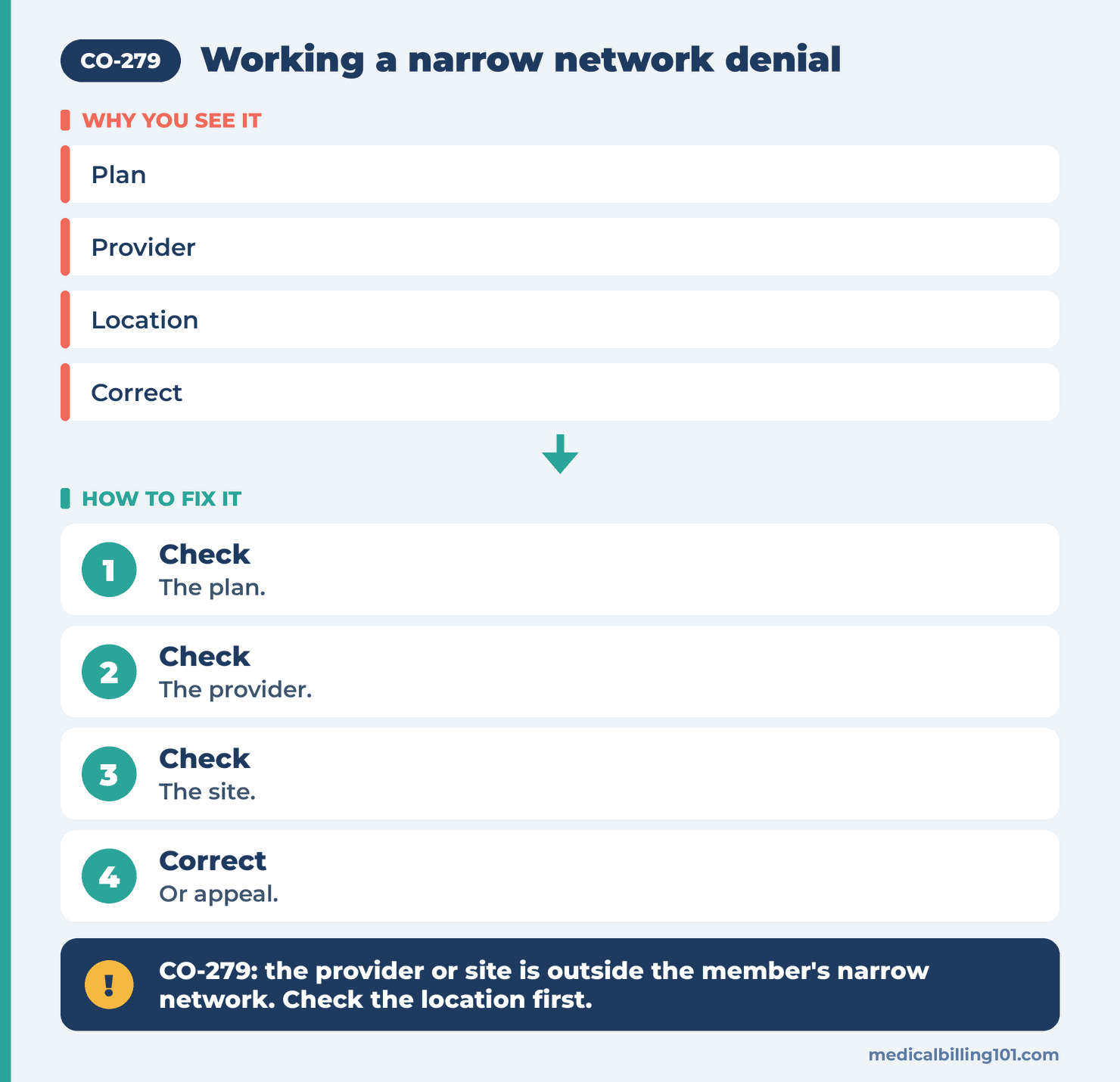
- Check the plan, not just the payer. Narrow networks are plan specific.
- Check the rendering provider. Make sure the clinician is loaded in that network.
- Check the location. Compare Box 32 or FL 1 with where the visit happened.
- Correct or appeal. Send frequency code 7 for a wrong field, or request a network exception.
- Fix the default. Update location and scheduling defaults per plan.
Example scenario (fictional names), part 2
How the CO-279 Denial Was Resolved
Keisha compared the claim with the visit note. The visit happened at the main office, but Box 32 named the satellite office. Only the main office was in the narrow network.
Fix: she sent a corrected claim with frequency code 7 in Box 22, the original claim number, and the main office in Box 32 and 32a.
Outcome: the plan reprocessed the visit and paid it at the network rate. Keisha then changed the scheduling rule so the location follows the room the visit was booked in.
Names and details are illustrative; no real patient data.
Names and details are illustrative; no real patient data.
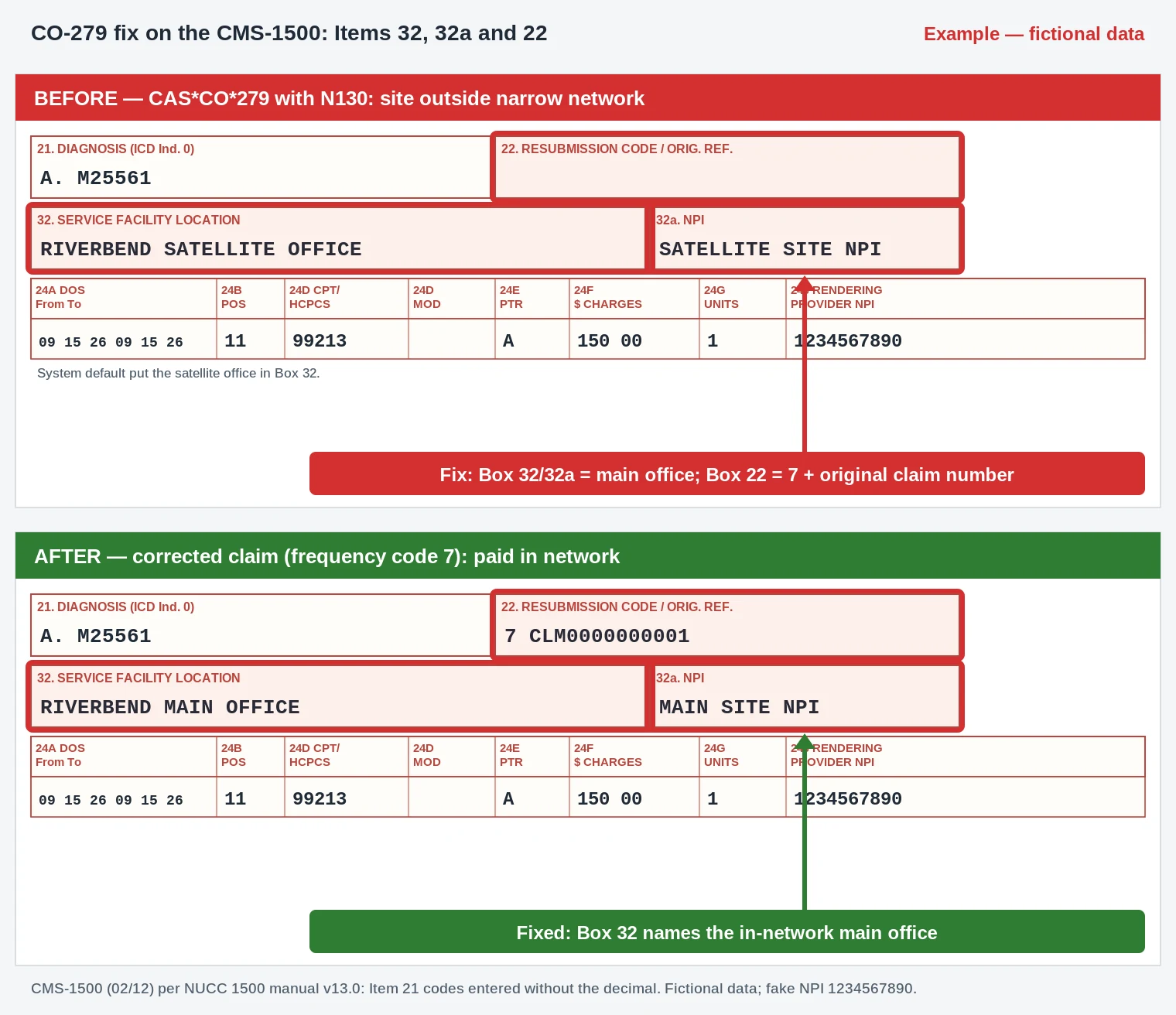
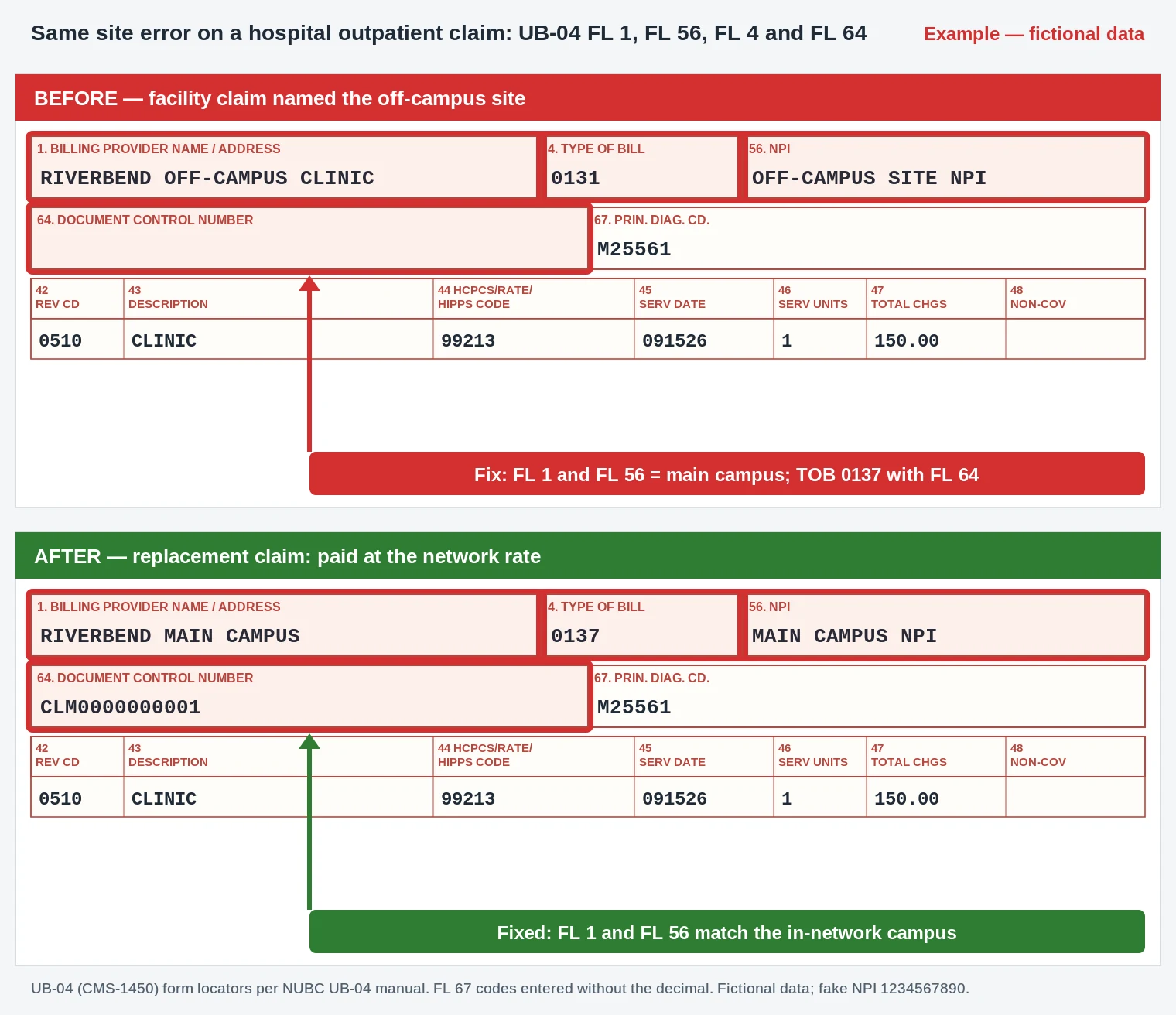
- Box 32 / 32a (CMS-1500): satellite office replaced with the main office where the visit happened, which is in the narrow network.
- FL 1 / FL 56 (UB-04): the facility name and NPI changed to the in-network main campus.
- Box 22 / FL 4 + FL 64: frequency code 7 with the original claim number (bill type 0137 on the UB-04).
- Box 21 / FL 67: M25.561 (entered as M25561) and 99213 are unchanged.
When is a CO-279 denial not fixable?
A CO-279 denial is not fixable by a corrected claim when the claim was right and the provider really is outside the plan’s narrow network. Then your options are a network exception or a contract change. Exceptions often apply to emergencies or to services no network provider offers.
For example, if no in-network surgeon does a rare procedure nearby, ask for a gap exception before the service. After the fact, appeal with the referral and proof that no network option existed. The appeal letter generator can help you draft it.
Can I bill the patient for CO-279?
No, you cannot bill the patient for a CO-279 amount. CO means your contract with the payer assigns the amount to you. If the patient agreed in writing before the visit, check your contract and state law first. Many payer contracts still forbid billing the member for a CO adjustment.
Related codes
| Code | Meaning |
|---|---|
| PR-242 | Services not provided by network or primary care providers |
| CO-197 | Precertification, authorization or notification absent |
| CO-16 | Claim lacks information needed for adjudication |
FAQ
What does CO-279 mean?
The service did not come from a provider or site in the member’s preferred network.
Is CO-279 the same as CO-242?
No. CARC 242 is a general network or primary care limit. CARC 279 is for plan network limits, such as narrow networks.
Can a wrong service location cause CO-279?
Yes. If Box 32 or FL 1 names a site outside the network, the plan may deny it.
Should I send a corrected claim for CO-279?
Only when a provider, NPI or location field was wrong. Otherwise appeal.
Does the patient owe a CO-279 amount?
No. CO puts the amount on the provider under the contract.
Sources
How we checked: the CARC 279 quote and usage note were matched word for word with the X12 CARC list on 10 November 2026, and N130 with the X12 RARC list.
- X12, Claim Adjustment Reason Codes (CARC 279, 242). Accessed 10 Nov 2026.
- X12, Remittance Advice Remark Codes (N130). Accessed 10 Nov 2026.
- eCFR, 45 CFR 156.230 (network adequacy standards). Accessed 10 Nov 2026.
- HealthCare.gov, network definition. Accessed 10 Nov 2026.
- HealthCare.gov, preferred provider definition. Accessed 10 Nov 2026.
- NUCC, 1500 claim form instructions (Items 22, 32, 32a). Accessed 10 Nov 2026.
Last updated: 10 November 2026 · Educational content; not legal advice.