

CO-210 means the payer says the pre-certification or authorization reached it too late. The service may have been approved, but the payer’s clock says the request or the admission notice missed its deadline. Because the group code is CO, the patient is not billed. Your job is to prove the notice was on time, or show why the late notice should be accepted. (Primary source: X12 Claim Adjustment Reason Codes)
In brief: CARC 210 reads “Payment adjusted because pre-certification/authorization not received in a timely fashion”. Pull the date and time the request was sent, compare it with the plan’s notice window, check that the claim carries the right authorization number, then correct the claim or appeal with proof.
Part of our denial codes library. Written by Manikandan J, CPC, CRCR, who has worked late-notice and retro-authorization denials for hospitals and specialty groups. Published 23 October 2026. Last updated: 23 October 2026. Code wording quoted word for word from X12.
What the X12 code list says
| Field | X12 text |
|---|---|
| Code | 210 |
| Description | “Payment adjusted because pre-certification/authorization not received in a timely fashion” |
| Start | 07/09/2007 |
Source: X12 Claim Adjustment Reason Codes, checked 23 October 2026.
Notice what the code does not say. It does not say the authorization is missing. That is CO-197. It does not say the service was outside the approved dates or units either. CARC 210 is only about timing.
Example scenario (fictional names), part 1
CO-210 Denial Example: What Happened
Grace Whitfield bills for Ridgeview Medical Center, a small community hospital. A patient came through the emergency room on a Saturday night with pneumonia (J18.9) and was admitted. The admitting nurse faxed the admission notice to Harborline Health, a fictional commercial plan, early Sunday morning.
The 835 came back with CAS*CO*210 on the whole claim and remark LQ*HE*N385, “Notification of admission was not timely according to published plan procedures.”
The fax log showed the notice went out within the plan’s window.
So why did the payer think it was late? Keep reading, or jump to how the CO-210 denial was resolved.
Common reasons payers send CARC 210
- The notice window was missed. Many plans want an urgent admission reported within one business day. A weekend admission reported on Tuesday can miss it.
- The request went to the wrong place. A fax to an old number, or a portal request to the wrong plan, may never get a timestamp.
- The claim points to a different authorization. If the claim carries an older auth number, the payer compares its dates, not the new one.
- The service was scheduled, not urgent. Elective surgery usually needs approval before the date of service. Asking the day after is late.
- The service changed. If the planned procedure changed in the room, the payer may treat the new code as a late request.
Tip: The remark code matters. M62, “Missing/incomplete/invalid treatment authorization code.”, points to the number on the claim. N385 points to the notice itself.
Fixing a CO-210 denial: a decision path

- Was the notice really late? If yes, read the plan’s late-notice policy. Some plans allow a retro review when the delay was outside your control, such as an unconscious patient.
- Was it on time? Gather proof: the fax confirmation, the portal screenshot with a timestamp, or the call reference number.
- Is the right auth number on the claim? Check CMS-1500 Box 23, or UB-04 FL 63 on a facility claim. A wrong number makes an on-time request look late.
- Then act. Send a corrected claim (frequency code 7) when the claim data was wrong. Appeal with the proof when the claim was right and the payer’s date was wrong.
Example scenario (fictional names), part 2
How the CO-210 Denial Was Resolved
Grace opened the claim and found the problem in FL 63. The registration system had pulled the authorization number from the patient’s outpatient visit two months earlier. Harborline compared that old approval’s dates with the admission and flagged the notice as late.
Fix: Grace sent a replacement claim, type of bill 0117, with the new inpatient authorization number in FL 63 and the original claim number in FL 64. She kept the fax confirmation ready in case the plan asked for it.
Outcome: Harborline matched the claim to the Sunday notice and reprocessed it. Grace asked registration to clear old auth numbers at each new encounter.
Names and details are illustrative; no real patient data.
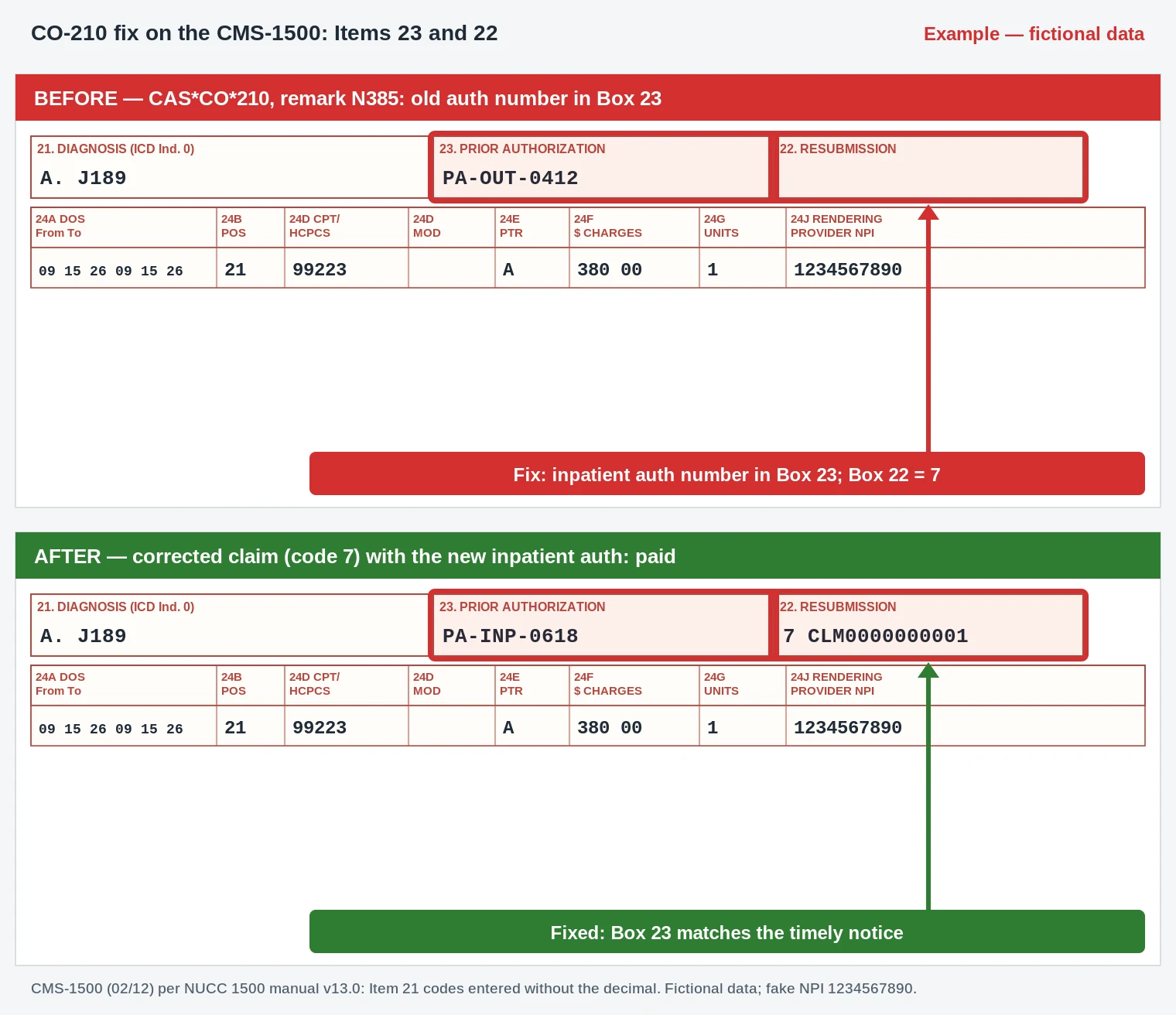
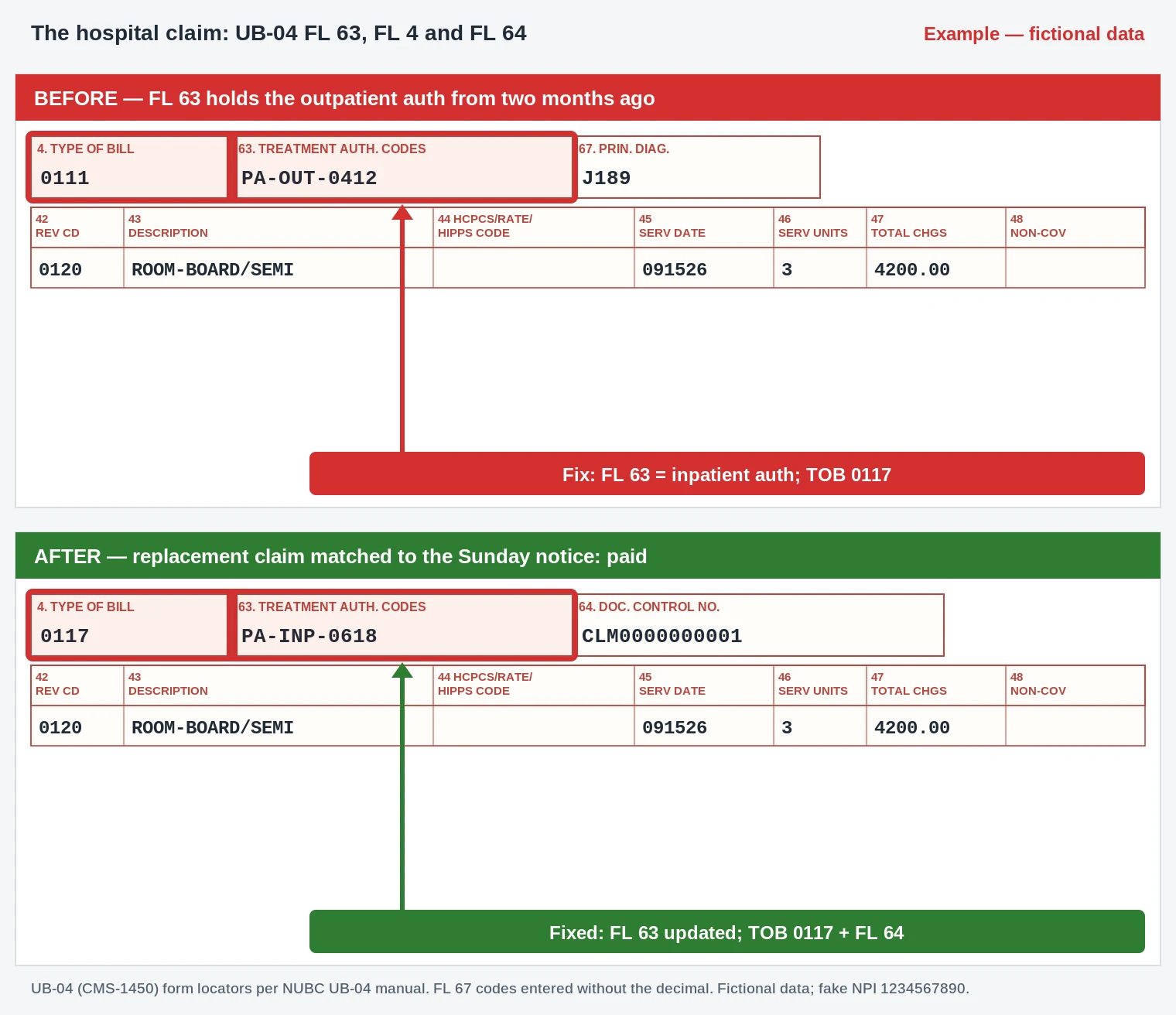
- Box 23 / FL 63: old outpatient authorization PA-OUT-0412 replaced with the inpatient authorization PA-INP-0618 (fictional numbers).
- Box 22 / FL 4 + FL 64: frequency code 7 with the original claim number (type of bill 0117 on the inpatient bill).
- Box 21 / FL 67: J18.9 (entered as J189) is unchanged.
When an appeal is the better route
An appeal makes sense when the claim data is correct and the payer’s timestamp is wrong. Keep it short:
- the date and time you sent the notice, with proof attached;
- the plan rule you followed, quoted from the provider manual;
- any reason for a delay, such as a patient who could not give insurance details on arrival.
Use our appeal letter generator for the structure, and check the deadline with the timely filing calculator.
CO-210 compared with other authorization codes
| Code | Plain meaning | What to check |
|---|---|---|
| CO-210 | Auth or notice received late | Timestamp and plan window |
| CO-197 | Auth absent | Was any auth obtained? |
| CO-15 | Auth number missing or invalid | Box 23 / FL 63 |
| CO-39 | Auth denied when requested | Medical necessity review |
| CO-198 | Precertification exceeded | Approved days or units |
For the front-end process, see our prior authorization checklist for surgery.
Preventing late-notice denials
- Put each plan’s notice window on the admission screen, with weekend rules.
- Send notices through the portal when you can. Portals give a timestamp.
- Clear the authorization field at every new encounter so old numbers do not carry over.
- Track CO-210 by payer each month. A cluster often means one wrong fax number.
FAQ
What does CO-210 mean?
The payer says the pre-certification or authorization was not received in a timely fashion.
Is CO-210 the same as no authorization?
No. CO-210 is about timing. A missing authorization is usually CO-197.
Can I bill the patient for a CO-210 denial?
No. The CO group code means the amount is the provider’s responsibility under the contract.
What proof helps a CO-210 appeal?
A fax confirmation, portal timestamp or call reference that shows the notice was sent on time.
Which claim field holds the authorization number?
Box 23 on the CMS-1500 and FL 63 on the UB-04.
Sources
How we checked: each code quote on this page was matched word for word with the X12 CARC and RARC lists on 23 October 2026.
- X12, Claim Adjustment Reason Codes (CARC 210, 197, 15). Accessed 23 Oct 2026.
- X12, Remittance Advice Remark Codes (N385, M62). Accessed 23 Oct 2026.
- NUCC, 1500 Claim Form Reference Instruction Manual. Accessed 23 Oct 2026.
Last updated: 23 October 2026 · Educational content; not legal advice.