
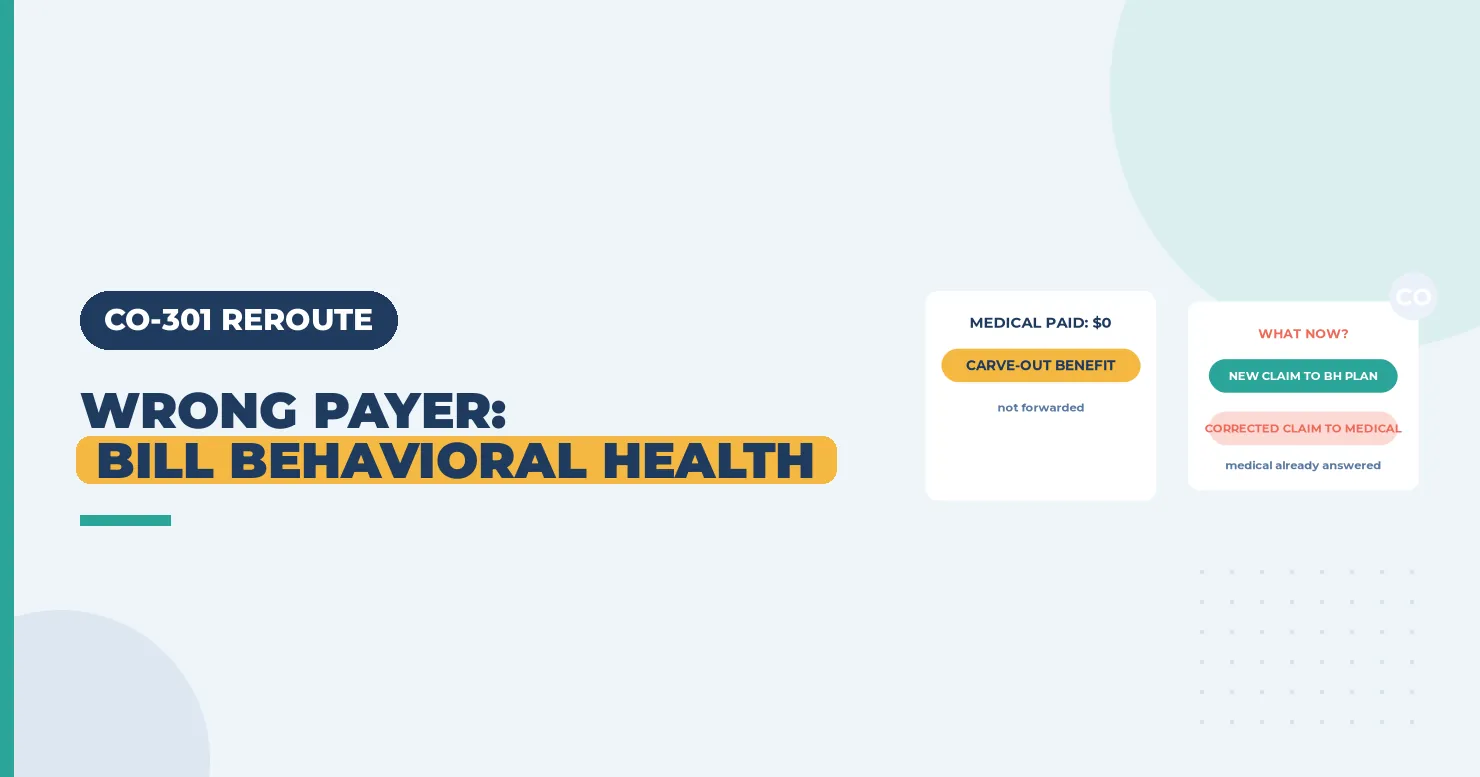
The CO-301 denial code means the medical plan has no benefit for this service and wants you to bill the behavioral health plan. Nothing was forwarded. Get the patient’s behavioral health member ID and payer ID, then file a new claim with that plan. (Primary source: X12 Claim Adjustment Reason Codes)
In brief: CARC 301 is a wrong-payer notice for mental health or substance use care. The service and the codes may be fine. Only the payer is wrong, and the next step is yours.
Part of our denial codes library. Written by Manikandan J, CPC, CRCR, who has rerouted psychiatry and counseling claims to carve-out plans for outpatient groups. Published 16 November 2026. Last updated: 16 November 2026. Code wording quoted word for word from X12. Read about the author and our editorial policy, or contact us to report an error.
What does denial code CO-301 mean?
Denial code CO-301 means the medical plan paid zero because a separate behavioral health plan covers the service. Reason code 301 tells you to send the claim there yourself. It is common on psychotherapy, psychiatric evaluations and substance use programs under carve-out benefits.
| Field | Value |
|---|---|
| Code | 301 |
| Description | “Claim received by the Medical Plan, but benefits not available under this plan. Submit these services to the patient’s Behavioral Health Plan for further consideration.” |
| Group codes | No X12 group restriction; CO and OA both appear |
| Start | 07/01/2019 |
| Twin code | CARC 300 when the medical plan forwarded the claim for you |
Source: X12 Claim Adjustment Reason Codes, checked 16 November 2026.
Methodology: the code wording is copied from the X12 list, and the claim form steps follow the NUCC instructions cited below.
Key terms: A behavioral health plan is the company that pays mental health and substance use claims. A carve-out is that benefit run apart from the medical plan. CO is the contractual obligation group code.
CO-301 vs OA-301: what is the difference?
Both tell you the same thing: this payer is the wrong one. The group code only changes how the medical zero is labeled.
| Version | How the medical zero is labeled | Next step |
|---|---|---|
| CO-301 | Contract adjustment; never a patient balance | New claim to the behavioral health plan |
| OA-301 | Other adjustment; no liability named | New claim to the behavioral health plan |
Why does the medical plan send me to a behavioral health plan?
The medical plan sends you elsewhere because the patient’s mental health and substance use benefits sit with another company. Employers often buy them separately. The patient’s card may list a second phone number or logo for that plan. Front desks often scan only one side of it.
The diagnosis drives the routing. F-codes, such as F33.1 or F41.1, with therapy or psychiatric codes point to the carve-out. The CMS mental health parity page explains that these benefits must still be comparable to medical ones.
Example scenario (fictional names), part 1
CO-301 Denial Example: What Happened
- Practice: Harborview Psychiatry Group, an outpatient practice.
- Biller: Lionel Okafor. Clinician: Dr. Renata Vasquez, MD.
- Visit: a 60-minute psychotherapy session for recurrent depression.
- Claim: 90837 with diagnosis F331, sent on a CMS-1500 to the patient’s medical plan, a fictional commercial plan.
- 835:
CAS*CO*301with zero paid and remark codeN418. That remark reads “Misrouted claim. See the payer’s claim submission instructions.”
Which payer should Lionel bill now, and does anything change besides the payer? Keep reading, or jump to how it was resolved. Keep reading, or jump to how the CO-301 denial was resolved.
How do I fix a CO-301 denial?
To fix a CO-301 denial, send a brand-new claim to the behavioral health plan. Do not send a corrected claim to the medical plan. Update the member ID, the plan name and the payer ID. Check the carve-out’s network and authorization rules before you submit, because they often differ.
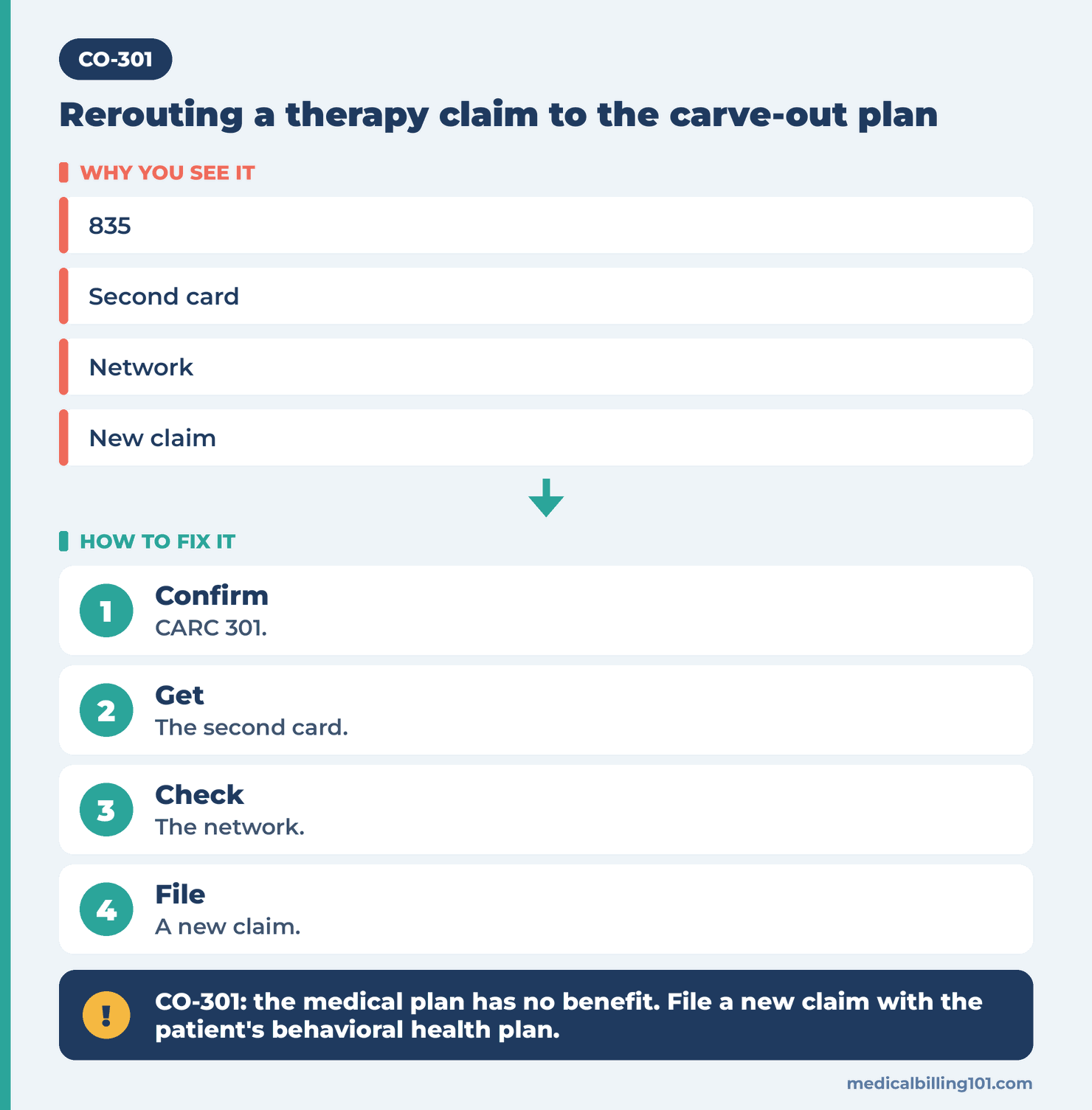
| Step | What to do | Why it matters |
|---|---|---|
| 1. Confirm the code | Read CARC 301, not 300 | 300 means the claim was already forwarded |
| 2. Get the second card | Ask the patient or call the medical plan | You need the carve-out member ID |
| 3. Check the network | Confirm the clinician is enrolled with the carve-out | Out-of-network rules may differ |
| 4. File a new claim | Box 1a member ID, Box 11c plan name, new payer ID | Box 22 stays blank |
| 5. Watch the clock | Send it soon and keep the medical remit | Timely filing still applies |
Example scenario (fictional names), part 2
How the CO-301 Denial Was Resolved
Lionel called the patient, who found a second card from her employer’s behavioral health vendor. He checked that vendor’s portal. Dr. Vasquez was in network, and outpatient therapy needed no approval.
Fix: Lionel filed a new claim to the behavioral health plan. He put its member ID in Box 1a and its plan name in Box 11c. The code 90837 and diagnosis F33.1 stayed the same, and Box 22 stayed blank.
Outcome: the behavioral health plan paid the session less the patient’s copay. Lionel added a second-card question to new-patient intake.
Names and details are illustrative; no real patient data.
Names and details are illustrative; no real patient data.
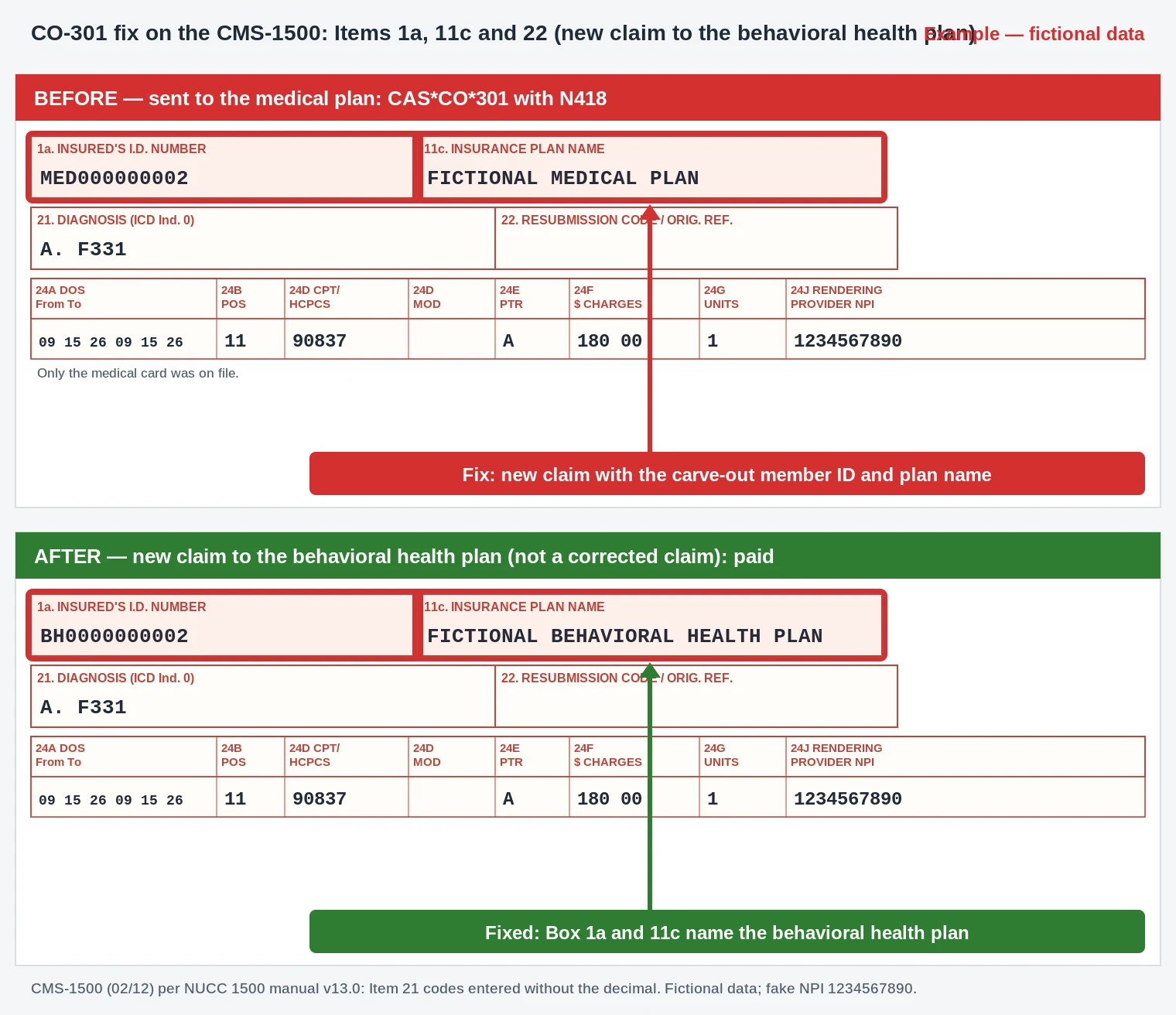
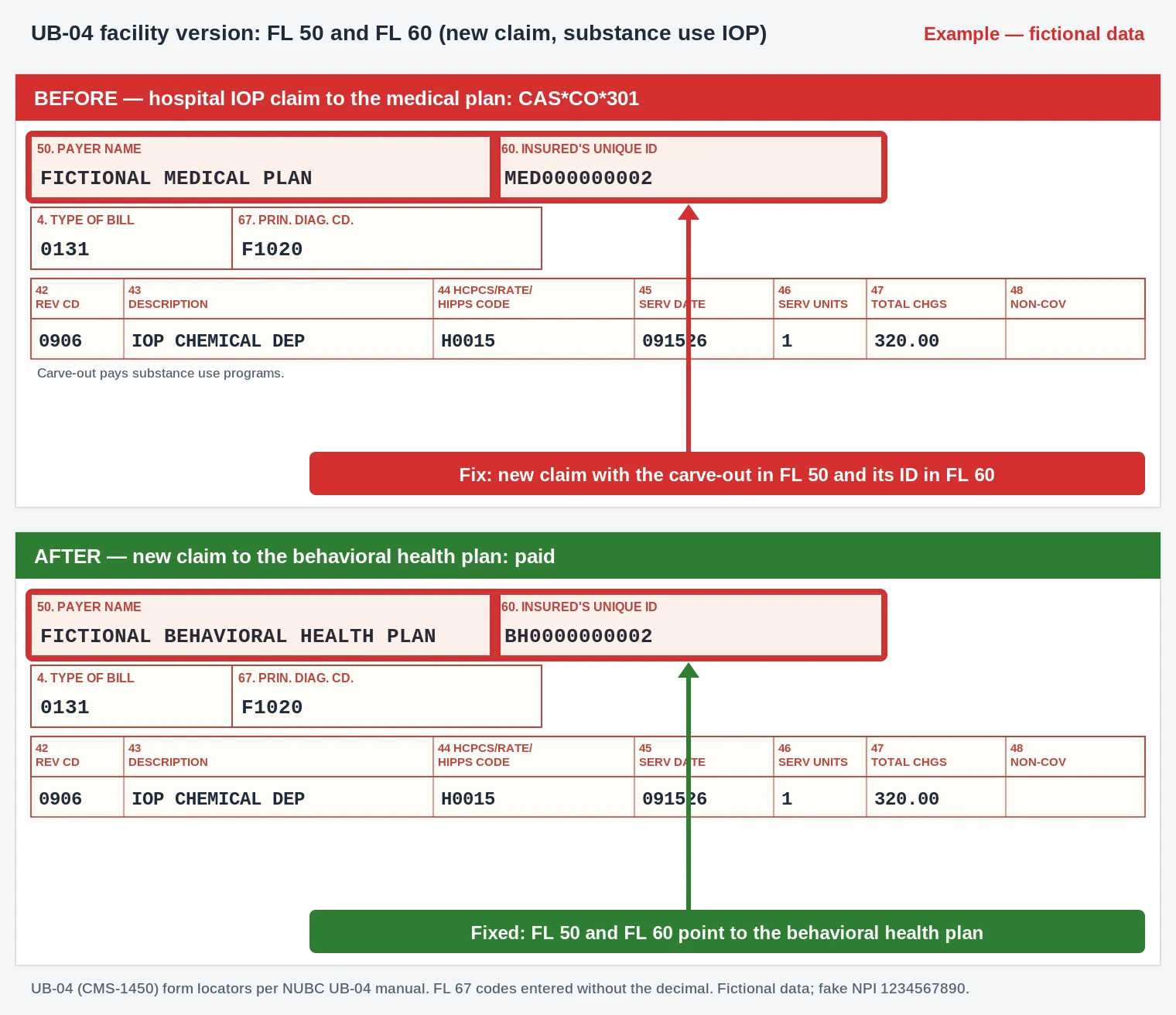
- Box 1a / FL 60: the medical member ID was replaced with the behavioral health plan member ID.
- Box 11c / FL 50: the payer changed to the behavioral health plan, and the claim went to that plan’s payer ID.
- Box 22 / FL 4: left blank on the CMS-1500 and kept as original bill type 0131 on the UB-04, because this is a new claim to a different payer.
- Box 21 / FL 67: F33.1 (entered as F331) and F10.20 (entered as F1020) are unchanged, as are 90837 and 0906 with H0015.
Can I bill the patient for CO-301?
No, not for the medical plan’s zero. Bill the behavioral health plan first. The patient owes only what that plan’s remit shows, such as a copay or deductible. If the patient refuses to share the second card, follow your financial policy, and document each request.
Does a CO-301 claim still meet timely filing?
It depends on the behavioral health plan, so act fast. Its filing limit starts from the date of service, not from the medical denial. Some plans accept the medical remit as proof of an earlier attempt, such as an appeal letter with the 835 attached. A late claim can deny as CO-29. The NUCC 1500 instructions explain Box 1a and Box 11c.
Related codes
| Code | Meaning |
|---|---|
| CO-300 | Medical plan forwarded the claim to the behavioral health plan |
| CO-297 | Medical plan says submit to the vision plan |
| CO-270 | Medical plan says submit to the dental plan |
| CO-109 | Service not covered by this payer; send to the correct payer |
FAQ
What does CO-301 mean?
The medical plan has no benefit and wants the service billed to the behavioral health plan.
Did the medical plan forward my CO-301 claim?
No. CARC 301 means you send it. CARC 300 means the plan forwarded it.
Is a CO-301 refile a corrected claim?
No. It is a new claim to a different payer, so Box 22 stays blank.
Which group code comes with CARC 301?
X12 sets no restriction. CO and OA both appear on these routing notices.
Does the patient owe the CO-301 amount?
No. Bill the behavioral health plan first; any patient share comes from that plan.
Sources
How we checked: the CARC 301 quote was matched word for word with the X12 CARC list on 16 November 2026, and N418 with the X12 RARC list.
- X12, Claim Adjustment Reason Codes (CARC 301, 300, 29). Accessed 16 Nov 2026.
- X12, Remittance Advice Remark Codes (N418). Accessed 16 Nov 2026.
- NUCC, 1500 claim form instructions. Accessed 16 Nov 2026.
- NUBC, UB-04 data specifications. Accessed 16 Nov 2026.
- CMS, Mental Health Parity and Addiction Equity Act. Accessed 16 Nov 2026.
Last updated: 16 November 2026 · Educational content; not legal advice.