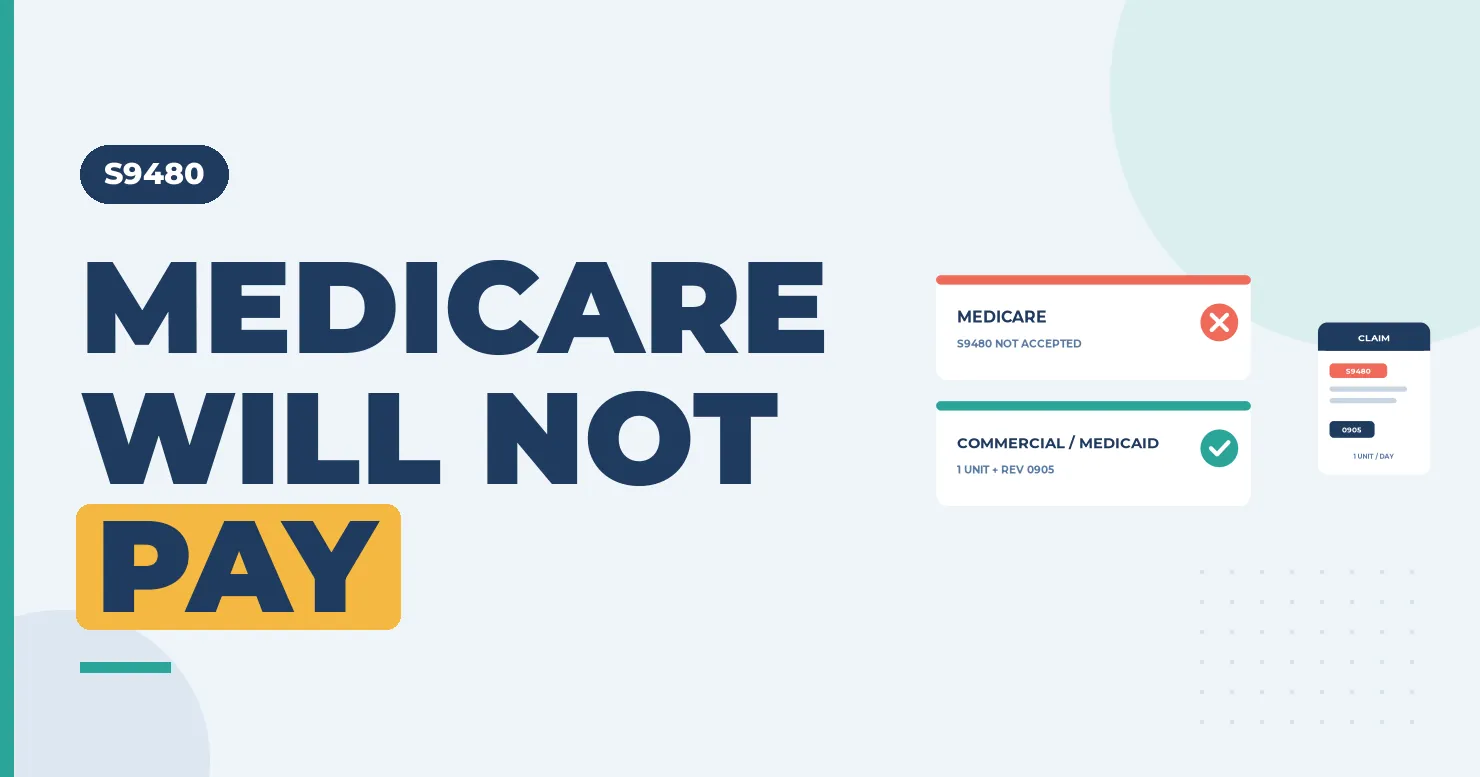
S9480 billing pays mental health IOP per day. Many commercial plans and Medicaid programs pay an intensive outpatient program (IOP) this way. Medicare does not accept S9480 at all.
The fix: confirm the payer accepts S9480, then bill one unit per IOP day on a UB-04 with revenue code 0905. Medicare IOP uses condition code 92 and a separate code for each service.
TL;DR: S9480 means intensive outpatient psychiatric services, per diem. It is a payer-specific S code, so your contract and payer policy are the guidelines. Most payers want one unit per day, revenue code 0905 on a UB-04, prior authorization and at least 9 hours a week for adults. Medicare pays IOP only to hospitals, CAHs, CMHCs, FQHCs and RHCs, never under S9480.
Written by Manikandan J, CPC, CRCR, a certified coder and revenue cycle specialist. Published 19 November 2026. Last updated: 19 November 2026.
Table of Contents
What is HCPCS code S9480?
S9480 is the HCPCS code for intensive outpatient psychiatric services, per diem. One unit covers one program day. The daily rate bundles the therapy, assessment and care coordination done that day. You do not bill those services on their own lines.
S codes are temporary national codes made for private payers. They have no CPT-style coding guidelines. Instead, each payer’s policy and your contract set the rules. Point32Health, for example, says S codes are for private payer use and are paid only per your provider agreement.
An intensive outpatient program (IOP) is structured mental health treatment. It is more intense than routine outpatient therapy but less intense than partial hospitalization. So the first step is not coding. It is getting each payer’s IOP policy and fee schedule in writing.
Does Medicare pay S9480 for intensive outpatient programs?
No. Medicare does not pay S codes. Since January 1, 2024, Medicare covers IOP as its own benefit, but only from hospital outpatient departments, critical access hospitals, community mental health centers, FQHCs and RHCs. Opioid treatment programs can also furnish IOP for opioid use disorder. A telehealth-only practice cannot bill Medicare IOP.
CMS explains the benefit in MLN Matters MM13222. Medicare IOP claims carry these items:
- Condition code 92 on every IOP claim.
- Bill type 013x for hospitals, 076x for CMHCs and 085x for CAHs.
- A revenue code and HCPCS or CPT code for each service, such as 0914 for individual therapy and 0915 for group therapy.
- Physician certification and a plan of care showing at least 9 hours of services per week.
FQHCs and RHCs bill IOP with revenue code 0905 and condition code 92, per MLN Matters MM13264. The First Coast IOP billing page lists the full revenue code table.
| Item | S9480 (commercial and Medicaid) | Medicare IOP benefit |
|---|---|---|
| Code on the claim | S9480, 1 unit per day | CPT/HCPCS code per service |
| Revenue code | 0905 (psychiatric IOP) | 0905, 0914, 0915, 0916 and others |
| Condition code | Per payer | 92 on every claim |
| Who can bill | Per payer contract and license | HOPD, CAH, CMHC, FQHC, RHC only |
| Hours | Often 9+ per week for adults | 9+ per week in the plan of care |
How do you bill S9480 for a mental health IOP?
Bill S9480 with one unit for each day the patient attends. On a UB-04, pair it with revenue code 0905. Do not add separate psychotherapy or group therapy lines for the same day. The per diem already pays for them.
Use this order for each claim:
- Prior authorization: get the approved start date, number of days and review date.
- Claim form: use the form the payer names for your provider type, UB-04 or CMS-1500.
- Line detail: revenue code 0905, S9480, 1 unit and the date of service.
- Diagnosis: the mental health ICD-10-CM code that supports IOP level of care.
- Hours: keep a daily attendance log with start and stop times.
A CareSource Marketplace IOP policy shows a typical setup, though that 2022 policy is now archived. It called S9480 a bundled payment, required revenue code 0905 on UB-04 claims and required prior authorization after 5 visits per calendar year. It also paid at the group level, so no rendering provider is needed.
How does Medicaid pay S9480 for IOP?
Many state Medicaid programs pay S9480 as a bundled per diem. The rate, hour rules and claim form differ by state. Always use your own state’s provider manual and the managed care plan’s policy, since the plan often handles the authorization.
South Carolina is a clear example. Its SCDHHS IOP bulletin added S9480 with revenue code 905 from October 1, 2024. Adults need 9 to 19 hours a week, and children 6 to 19 hours. The fee-for-service rate was $207.52 per diem.
Vermont’s DVHA PHP and IOP billing guidance warns against billing the bundle plus separate services. It allows UB-04 or CMS-1500 billing based on provider type. For crisis codes on Medicaid claims, see our CPT 90839 and 90840 Medicaid denial answer.
Can S9480 be billed for a virtual IOP?
Only if the payer covers virtual IOP in its policy or your contract. No national rule makes S9480 telehealth-eligible for commercial plans. Ask each payer whether virtual IOP is covered and which place of service and modifier it wants.
Get the answer in writing, with the representative’s name and a reference number. Many payers credential virtual IOP as a separate program, so a standard therapy contract may not cover it. A wrong place of service is a common reason these claims deny. Our telehealth phone follow-up answer covers audio-only limits.
Example scenario (fictional, for illustration only)
S9480 billing example: what happened
Riverbend Behavioral Health starts a virtual adult IOP. Biller Tanya Brooks sends a week of claims for patient “M.K.” with S9480 plus 90853 group therapy each day. The commercial plan pays nothing. The remit shows CO-97 on the 90853 lines and CO-197 on S9480.
Tanya finds two problems. The group therapy is part of the S9480 per diem, and no authorization was on file. She removes the 90853 lines, gets a retro authorization, and rebills S9480 with revenue code 0905, 1 unit per day. The corrected claims pay at the contract per diem.
Which denials hit S9480 IOP claims?
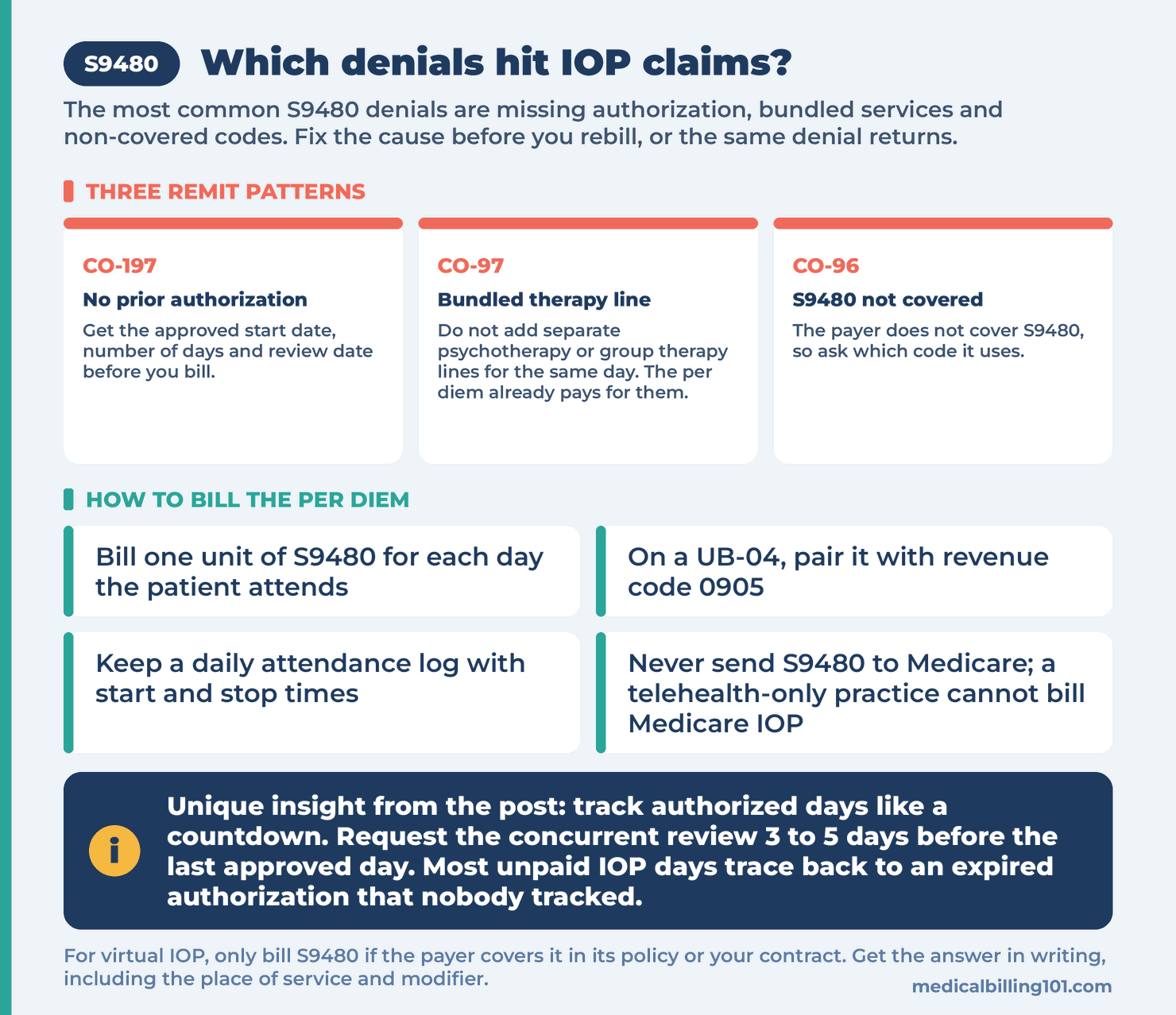
The most common S9480 denials are missing authorization, bundled services and non-covered codes. Each one has a clear remit pattern. Fix the cause before you rebill, or the same denial returns.
- CO-197: no prior authorization. See our CO-197 denial guide.
- CO-97: a therapy line billed with S9480 is part of the per diem. See our CO-97 denial code answer.
- CO-96: the payer does not cover S9480, so ask which code it uses.
In my AR work, most unpaid IOP days traced back to an expired authorization that nobody tracked.
Track authorized days like a countdown. Request the concurrent review 3 to 5 days before the last approved day. Use our timely filing calculator to set rebill deadlines.
3-step checklist
- Get each payer’s IOP policy, fee schedule and virtual IOP rules in writing.
- Bill S9480 with revenue code 0905, 1 unit per day, and no separate therapy lines.
- Track authorized days and weekly hours, and never send S9480 to Medicare.
FAQ
What revenue code goes with S9480?
Revenue code 0905, intensive outpatient services, psychiatric. Payers such as South Carolina Medicaid and CareSource pair S9480 with 0905 on UB-04 claims.
How many units of S9480 can I bill per day?
One. S9480 is a per diem code, so one unit covers one program day. The bundled rate includes the therapy and services given that day.
Can I bill S9480 to Medicare?
No. Medicare does not pay S codes. Medicare IOP is billed by hospitals, CAHs, CMHCs, FQHCs and RHCs with condition code 92 and a code for each service.
How many hours a week does an IOP need?
Many payers require at least 9 hours a week for adults. South Carolina Medicaid requires 9 to 19 hours for adults and 6 to 19 hours for children.
Can I bill individual therapy with S9480 on the same day?
Usually not. The S9480 per diem bundles therapy given that day, and separate lines often deny as CO-97. Check the payer policy for any listed exceptions.
Sources
My methodology was simple. I checked CMS MLN Matters MM13222 and MM13264, the First Coast IOP billing page, the SCDHHS and Vermont DVHA Medicaid IOP guidance, a CareSource IOP policy and Point32Health’s S code rule.
- CMS, MLN Matters MM13222, condition code 92 for IOP (linked above). Accessed 19 Nov 2026.
- CMS, MLN Matters MM13264, IOP for FQHCs and RHCs (linked above). Accessed 19 Nov 2026.
- First Coast Service Options, IOP billing requirements (linked above). Accessed 19 Nov 2026.
- SCDHHS, IOP and PHP coverage bulletin (linked above). Accessed 19 Nov 2026.
- Vermont DVHA, PHP and IOP billing guidance (linked above). Accessed 19 Nov 2026.
- CareSource, Kentucky Marketplace IOP policy AD-0965, effective 2022, archived 2023 (linked above). Accessed 19 Nov 2026.
- Point32Health, General Coding and Claims Editing policy (linked above). Accessed 19 Nov 2026.
Read about the author, or contact us with a question. See our editorial policy.
Last updated: 19 November 2026 · Educational content for U.S. billers. Check each payer’s current rules.