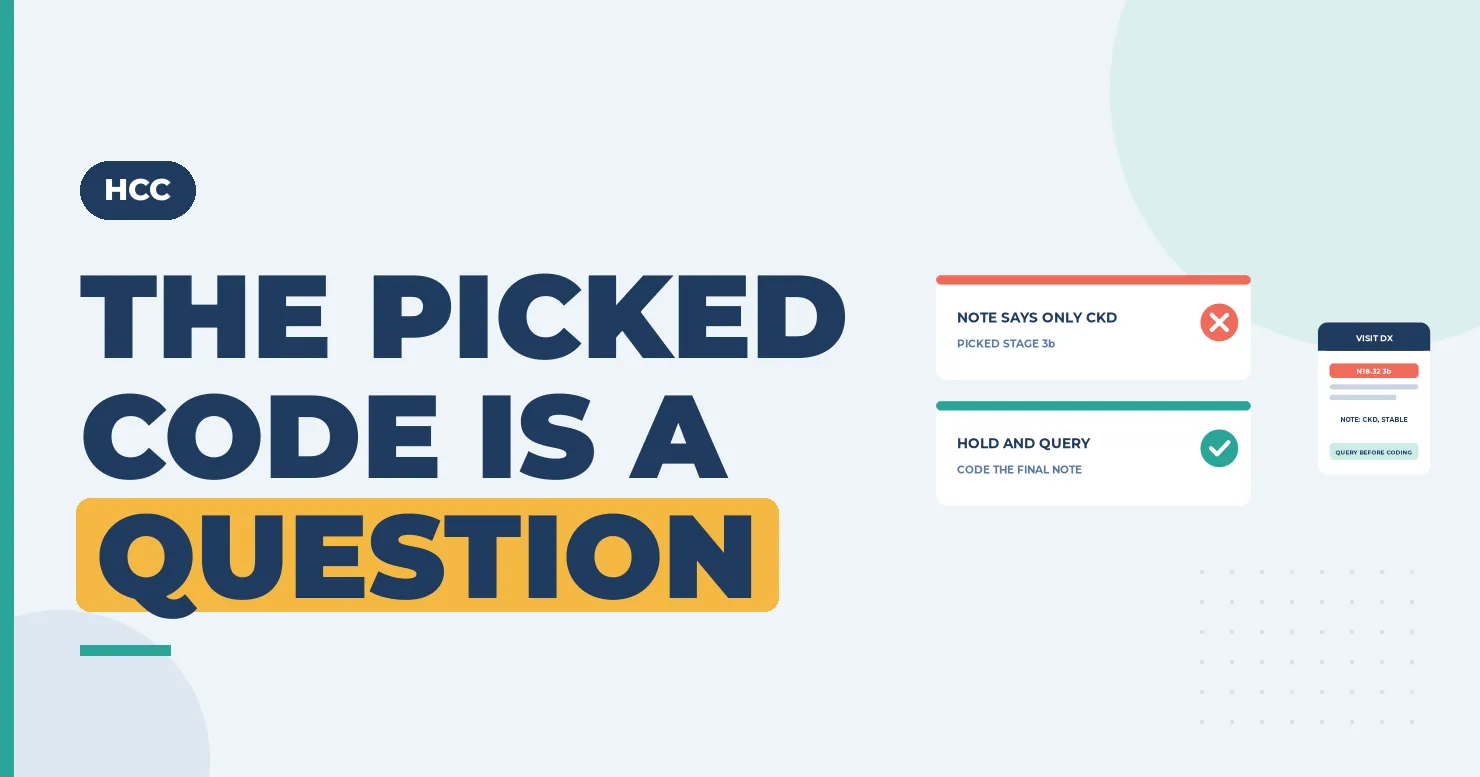
A risk adjustment code vs documentation mismatch means the diagnosis code is more specific than the note supports. Do not report the higher code until the provider fixes the note or answers a query.
The fix: compare every assigned code with the full note. If they conflict, send the provider a compliant, non-leading query before the claim or encounter goes out.
TL;DR: A provider’s diagnostic statement is enough to code from. But the record must not conflict. If the narrative says “CKD” and the picked code says stage 3b, that is conflicting documentation. The ICD-10-CM guidelines say to query the provider. MEAT or TAMPER shows a condition was addressed. It does not prove the stage, type or severity.
Written by Manikandan J, CPC, CRCR, a certified coder and revenue cycle specialist. Published 22 November 2026. Last updated: 22 November 2026.
Table of Contents
What happens when the assigned code doesn’t match the note documentation?
When the assigned code doesn’t match the note, the record is in conflict. The coder should not pick the side that pays more. The safe step is to query the provider and code from the clarified note.
The FY 2027 ICD-10-CM Official Guidelines cover this in Section I.A.19. A provider’s statement that a condition exists is sufficient for code assignment. The same section adds one line: if there is conflicting medical record documentation, query the provider.
Risk adjustment is how CMS pays Medicare Advantage plans more for members with costlier conditions. Diagnosis codes drive that payment, so each one must match the record.
The guidelines also say the entire record should be reviewed. So a coder reads the history, assessment, plan and visit diagnosis together. One field cannot overrule the rest of the note.
Example scenario (fictional names), part 1
Risk adjustment coding example: what happened
Denise Albright reviews charts before submission for Lakeshore Senior Care, a fictional primary care practice. Dr. Omar Castellanos saw a patient on a fictional Medicare Advantage plan. He billed 99214.
His visit diagnosis list showed N18.32 (CKD stage 3b) and I50.32 (chronic diastolic heart failure). His narrative said only “CKD, stable, labs reviewed” and “heart failure, no edema, continue current diuretic.”
Both conditions had clear monitoring and treatment in the note. The coding lead said that was enough to keep both codes.
Was meeting MEAT enough to report stage 3b and diastolic heart failure? Keep reading, or jump to how the case was resolved.
Is the EHR visit diagnosis part of the provider’s documentation?
Yes, a visit diagnosis the provider picks and signs is part of the record. But it is not stronger than the narrative. If the two disagree, the record is unclear, and unclear records do not hold up in review.
CMS auditors look at this closely. The RADV Medical Record Reviewer Guidance tells reviewers to check problem lists against the current encounter. They ask whether a condition was changed or replaced by a related condition with different specificity.
The same guidance says lists of code numbers without narratives are not acceptable. It treats claims data that pre-populate conditions on a case-by-case basis. It also quotes AHA Coding Clinic, First Quarter 2012, page 6. That answer says providers should not list a code number instead of a written diagnostic statement.
So a diagnosis picked from an EHR search box is weak support when the narrative says less. For example, “CKD stage 3b” in the picker with “CKD, stable” in the assessment is a mismatch.
Treat that picked code as a question, not an answer.
Does MEAT or TAMPER support a more specific code?
No. MEAT is an audit checklist that shows a condition was monitored, evaluated, assessed or treated. TAMPER is a similar checklist. They support that the condition was addressed. They do not show the stage, type or severity of that condition.
Specificity has to come from the provider’s words. Here is how the three common mismatches play out under the CMS-HCC V28 model. HCC numbers come from the CMS 2027 initial ICD-10-CM mappings.
| Narrative says | Code the narrative supports | Code that was picked | V28 HCC effect |
|---|---|---|---|
| CKD, no stage | N18.9 (no V28 HCC) | N18.32, CKD stage 3b | Adds HCC 328 |
| CHF, no type | I50.9 (HCC 226) | I50.32, chronic diastolic heart failure | Same HCC 226 |
| Dementia, no severity | F03.90 (HCC 127) | F03.B11, unspecified dementia, moderate, with agitation | Moves to HCC 126 |
Note the heart failure row. The HCC does not change, yet the code is still wrong if the note does not say chronic diastolic. Accuracy matters even when payment does not move.
What do the ICD-10-CM guidelines say about conflicting documentation?
The guidelines say to query the provider when documentation conflicts. They also tell coders to use the unspecified code when severity or stage is not documented. Both rules apply to the three examples above.
- Section I.A.19: the provider’s statement is sufficient, but conflicting documentation needs a query.
- Section I.B.14: for items such as BMI or laterality, conflicting notes from the same or different clinicians go to the patient’s provider as a query.
- Section I.C.5.d: dementia severity needs the provider’s clinical judgment. If severity is not documented, assign unspecified severity.
- Section I.C.14.a.1: CKD is classified by stage. Stage 3 is N18.30 to N18.32.
A default code is not a failure. Section I.A.18 says to assign the default code when a condition has no added detail. For “CHF” alone, that is I50.9.
What does CMS require for risk adjustment diagnoses?
CMS requires every risk adjustment diagnosis to be documented in the medical record from a face-to-face visit. It must also be coded under the ICD-10-CM guidelines. A code the note does not support fails that test.
That rule sits in Section 40 of Medicare Managed Care Manual Chapter 7. Under 42 CFR 422.310(e), plans and their providers must send medical records to validate risk adjustment data. The rule warns of penalties for false data.
42 CFR 422.311 sets the RADV audit process. CMS may extrapolate contract-level findings for payment year 2018 and later. One unsupported pattern can repeat across thousands of members.
The OIG has the same focus. Its Medicare Advantage high-risk diagnosis code toolkit says about 70 percent of the high-risk codes it audited were not supported. Our list of OIG audit triggers in medical billing covers other patterns.
In AR follow-up, the records requests I dreaded most were the ones where the claim and the note told two different stories.
How do you fix a code that doesn’t match the note?
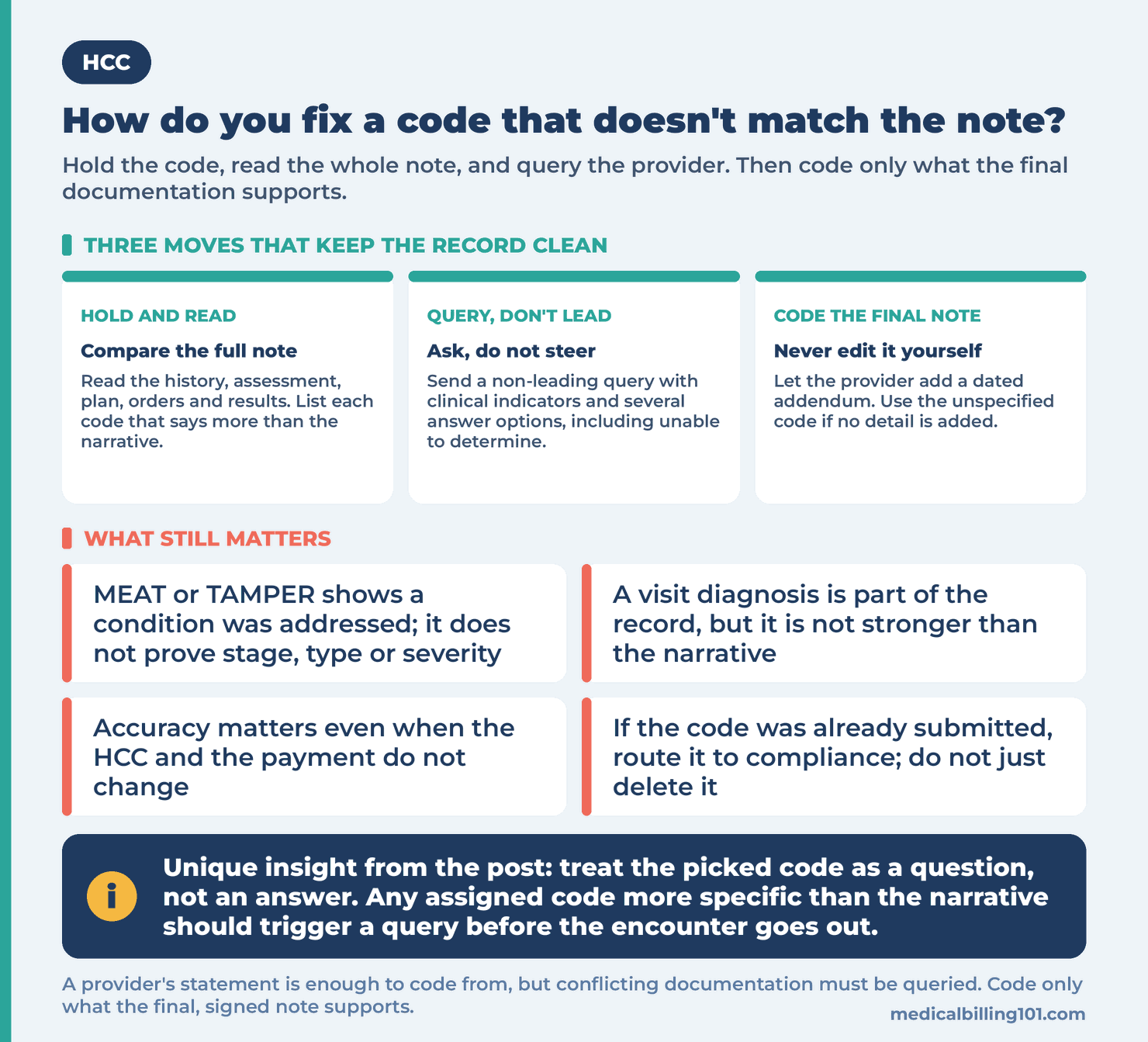
Hold the code, read the whole note, and query the provider. Then code only what the final documentation supports. If the code was already submitted, route it to your compliance team for correction.
- Read the history, assessment, plan, orders and results for the date of service.
- List each code where the picked diagnosis says more than the narrative.
- Send a non-leading query with the clinical indicators and several answer options.
- Let the provider add a dated addendum per your late-entry policy. Never edit the note yourself.
- Code from the final note. Use the unspecified code if no detail is added.
- Track repeat patterns by provider, and give short feedback each month.
A provider query is a written question that asks the provider to clarify the record. The AHIMA/ACDIS compliant query practice brief lists conflicting documentation as a reason to query. It also says queries must be non-leading, and query titles should not mention reimbursement. Our guide to medical necessity documentation shows what reviewers expect to read.
For a past date already submitted to a plan, do not just delete the code yourself. 42 CFR 422.310(g) lets plans submit data to correct overpayments after the final deadline. Your compliance team owns that step.
Example scenario (fictional names), part 2
How the risk adjustment case was resolved
Denise held the claim and read the full chart. Recent kidney labs and a prior heart echo report were in the record, but the note never named a stage or a type.
She sent Dr. Castellanos two non-leading queries. Each one listed the lab and echo findings, then offered several answer choices, including “unable to determine.”
He added a dated addendum the same week. It named chronic diastolic heart failure based on the echo, and CKD stage 3a, not 3b. Denise billed I50.32 and N18.31 instead of N18.32.
The coding lead then retired the “MEAT is enough” rule. Now any picked code more specific than the narrative triggers a query.
Names and details are illustrative; no real patient data.
Is coding from the provider’s picked code an acceptable practice?
Coding from the picked code is acceptable only when the rest of the note agrees with it. Accepting it when the narrative says less is an organization’s own risk choice. No official source endorses it.
Medicare Advantage plans keep changing their review rules too. See our summary of 2027 Medicare Advantage plan changes.
Annual visits are where many chronic conditions get captured. Our post on how annual wellness visits are audited and documented pairs well with this review. To check the visit level too, try the E/M level calculator.
3-step checklist
- Compare each assigned code with the full narrative, not just the visit diagnosis list.
- Query the provider when the code is more specific than the words in the note.
- Code from the final, signed note, and use the unspecified code when detail is missing.
FAQ
What if the assigned code doesn’t match the note documentation?
Treat it as conflicting documentation. Hold the code and send the provider a non-leading query. Code only what the final note supports.
Is the EHR visit diagnosis enough to support an HCC?
Only if the rest of the note agrees with it. If the narrative is less specific, query the provider before reporting the specific code.
Does MEAT support a higher-specificity code?
No. MEAT shows a condition was addressed. The stage, type or severity must be written by the provider in the note.
What code do you use for CKD with no stage documented?
Use N18.9, chronic kidney disease, unspecified. Under the CMS-HCC V28 model, N18.9 does not map to a payment HCC.
Can a provider fix the note after a query?
Yes. The provider can add a dated addendum under your late-entry policy. A coder should never change the note.
Sources
My methodology was simple. I checked the official coding guidelines, CMS manuals and regulations, the CMS model mappings, the OIG toolkit and the AHIMA/ACDIS query brief.
- CMS and NCHS, ICD-10-CM Official Guidelines for Coding and Reporting FY 2027, Sections I.A.18, I.A.19, I.B.14, I.C.5.d and I.C.14.a (linked above). Accessed 22 Nov 2026.
- CMS, Contract-Level RADV Medical Record Reviewer Guidance, January 2020 (linked above). Accessed 22 Nov 2026.
- CMS, 2027 Initial ICD-10-CM Mappings and V28 model software labels (linked above). Accessed 22 Nov 2026.
- CMS, Medicare Managed Care Manual, Chapter 7, Section 40 (linked above). Accessed 22 Nov 2026.
- 42 CFR 422.310 and 422.311 (linked above). Accessed 22 Nov 2026.
- HHS OIG, Toolkit A-07-23-01213, December 2023 (linked above). Accessed 22 Nov 2026.
- AHIMA and ACDIS, Guidelines for Achieving a Compliant Query Practice, 2022 update (linked above). Accessed 22 Nov 2026.
Read about the author, or contact us with a question. See our editorial policy.
Last updated: 22 November 2026 · Educational content for U.S. coding and billing teams. Plan contracts and internal policies may add stricter rules.