
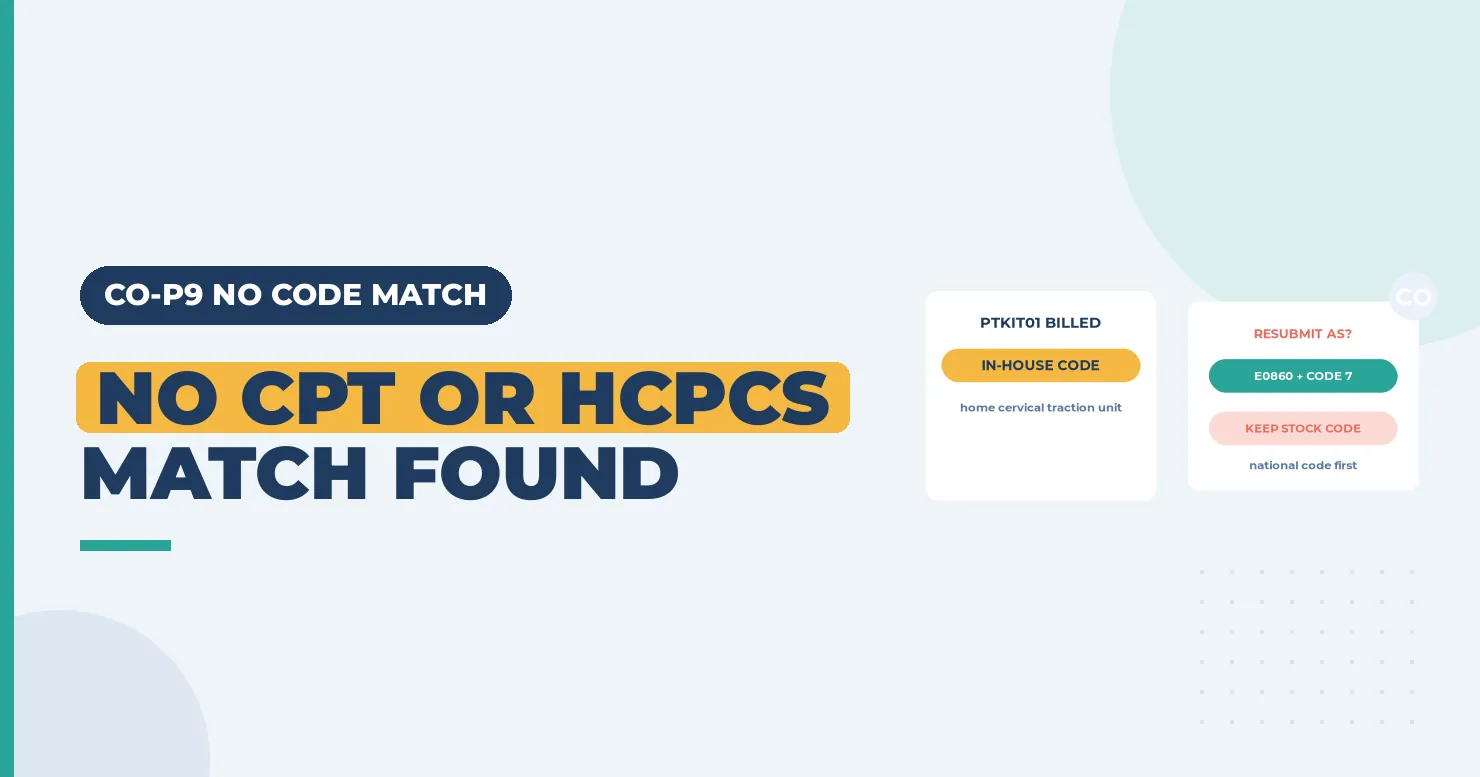
The CO-P9 denial code means a workers’ comp or auto payer could not match the service you billed to any CPT or HCPCS code. Most often the claim carried an in-house charge code or an unlisted code with no description. Find the real code for the service, or bill an unlisted code with a clear narrative, then resubmit. (Primary source: X12 Claim Adjustment Reason Codes)
In brief: reason code P9 is a code-set problem on a property and casualty claim. Search HCPCS Level II and CPT for the service first. If nothing fits, use the right unlisted or miscellaneous code, add a narrative, and attach the note or invoice.
Part of our denial codes library. Written by Manikandan J, CPC, CRCR, who has cleaned up charge masters and recoded auto injury and comp claims for therapy, chiropractic and hospital outpatient clients. Published 22 November 2026. Last updated: 22 November 2026. Code wording quoted word for word from X12. Read about the author and our editorial policy, or contact us to report an error.
What does denial code CO-P9 mean?
Denial code CO-P9 says the payer found no CPT or HCPCS code that describes the billed service. Only property and casualty payers send it: workers’ comp carriers, auto and no-fault insurers, and liability payers. Health plans use other codes, such as CARC 181 or CARC 16 with remark M51, for the same kind of problem.
| Field | Value |
|---|---|
| Code | P9 |
| Description | “No available or correlating CPT/HCPCS code to describe this service. To be used for Property and Casualty only.” |
| Group codes | No X12 group restriction; CO is the usual pairing |
| Start | 11/01/2013; replaces code 230 |
| Common remarks | M51 or N350 |
Source: X12 Claim Adjustment Reason Codes, checked 22 November 2026.
Methodology: the code wording is copied from the X12 list. The narrative rule for unlisted codes comes from the NUCC manual cited below.
Key terms: An in-house charge code is a code your billing system uses internally, not a national code. An unlisted code is a CPT or HCPCS code for a service with no specific code. A by-report service is one the payer prices from a written report.
CO-P9 vs OA-P9: does the group change the fix?
The correction stays identical, but responsibility for the balance differs. CO-P9 keeps the line with your practice, so do not invoice the injured patient. OA-P9 tends to show up when a second auto or health payer repeats the first payer’s coding decision. Fix the code once, then rebill each payer in order.
| Group | Who holds the amount | First step |
|---|---|---|
| CO-P9 | Your practice | Recode the line and resubmit to the same carrier |
| OA-P9 | Not assigned by the payer | Correct the primary claim, then rebill the second payer with the new result |
Example scenario (fictional names), part 1
CO-P9 Denial Example: What Happened
Dev Malhotra handles billing at Ridgeline Spine and Rehab, a physical therapy clinic with many auto injury patients. A patient hurt in a rear-end crash had neck pain, S16.1XXA. The therapist gave her an over-the-door cervical traction unit for home use.
The practice system sent the unit as PTKIT01, its own stock code. The auto carrier’s remittance came back with CAS*CO*P9 and remark M51, “Missing/incomplete/invalid procedure code(s).” Nothing paid on that line.
Is there a national code for this item, or does it need an unlisted code? Keep reading, or jump to how the CO-P9 denial was resolved.
Why would a payer find no matching code?
Three situations explain almost every P9 denial. The claim carried a proprietary code instead of a national code, or it used an unlisted code without a narrative, so the payer could not identify the service. Occasionally the service genuinely has no code, and the payer expects a descriptive report.
| What was billed | What the payer saw | Fix |
|---|---|---|
| In-house or stock code, like PTKIT01 | No CPT or HCPCS match | Replace it with the national code |
| Unlisted code with no description | No way to match the service | Add a ZZ narrative and the note |
| Real service with no national code | No code to price | Bill the unlisted code by report, per the payer or state rules |
| Code deleted before the date of service | Invalid code | Use the code valid on that date, as with CARC 181 |
How do I fix a CO-P9 denial?
To fix a CO-P9 denial, find the national code that describes the service. Use an unlisted code only when no specific code exists. Do not pick a code that pays more but describes something else.
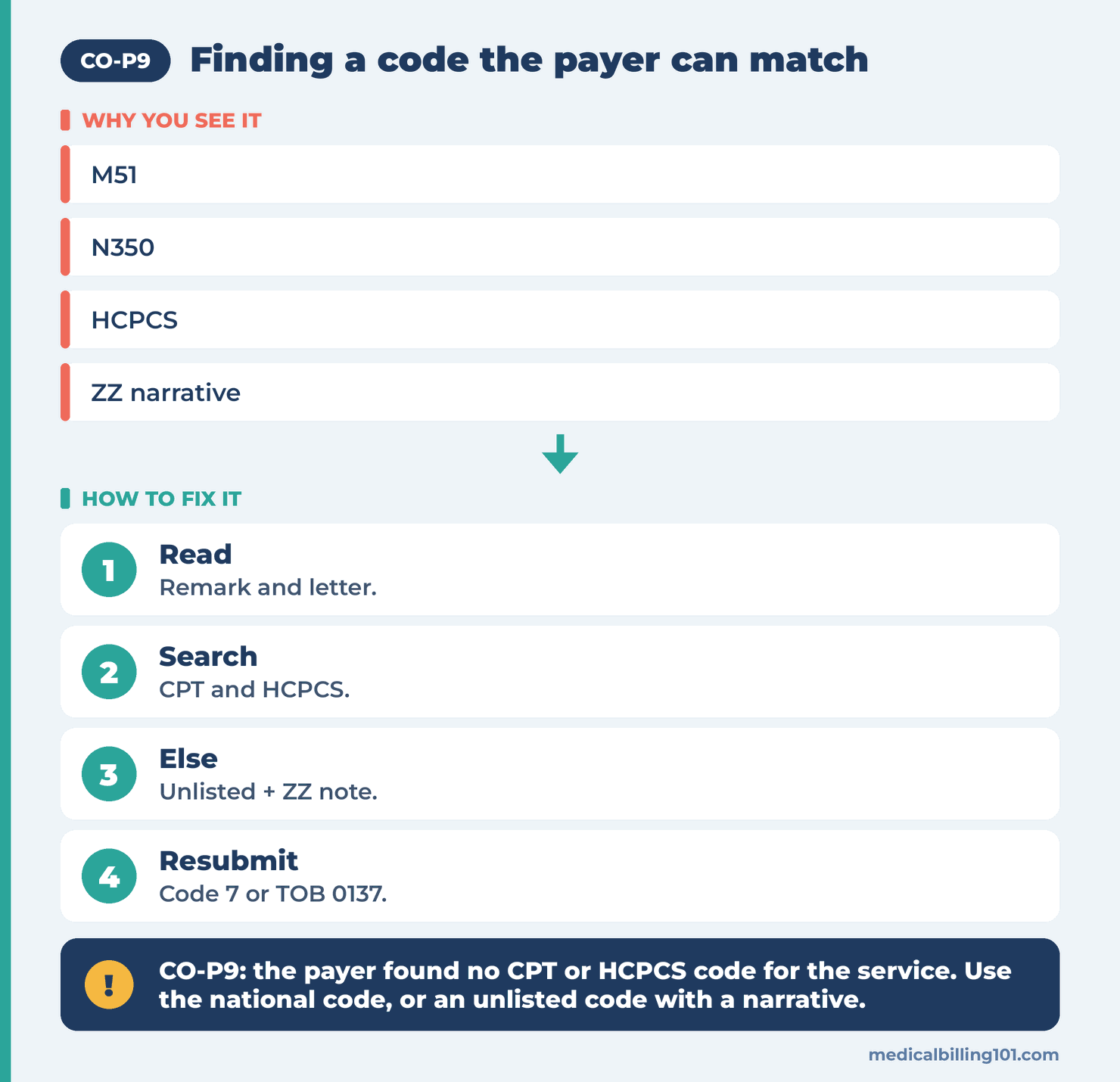
| Step | Action | Where to check |
|---|---|---|
| 1 | Read the remark code and the carrier’s letter | 835 and explanation of review |
| 2 | Search for a specific code | CMS HCPCS page and your CPT book |
| 3 | If none fits, choose the unlisted or miscellaneous code | Same code family as the service |
| 4 | Add a ZZ narrative in the shaded part of Item 24 | NUCC 1500 manual |
| 5 | Resubmit as a corrected bill with records or the invoice | Box 22 code 7, or bill type 0137 |
Example scenario (fictional names), part 2
How the CO-P9 Denial Was Resolved
Dev searched the HCPCS Level II directory and located E0860, traction equipment, overdoor, cervical. That description matched the equipment the therapist dispensed, so no unlisted code was necessary.
Fix: Dev sent a corrected bill with Box 22 code 7 and the original claim number. Box 24D changed from PTKIT01 to E0860 with modifier NU for new equipment. S16.1XXA (entered as S161XXA) stayed linked.
Outcome: the carrier paid the line under its fee schedule. Dev then mapped every stock code in the system to a HCPCS code, so no in-house code leaves the clinic again.
Names and details are illustrative; no real patient data.
Names and details are illustrative; no real patient data.
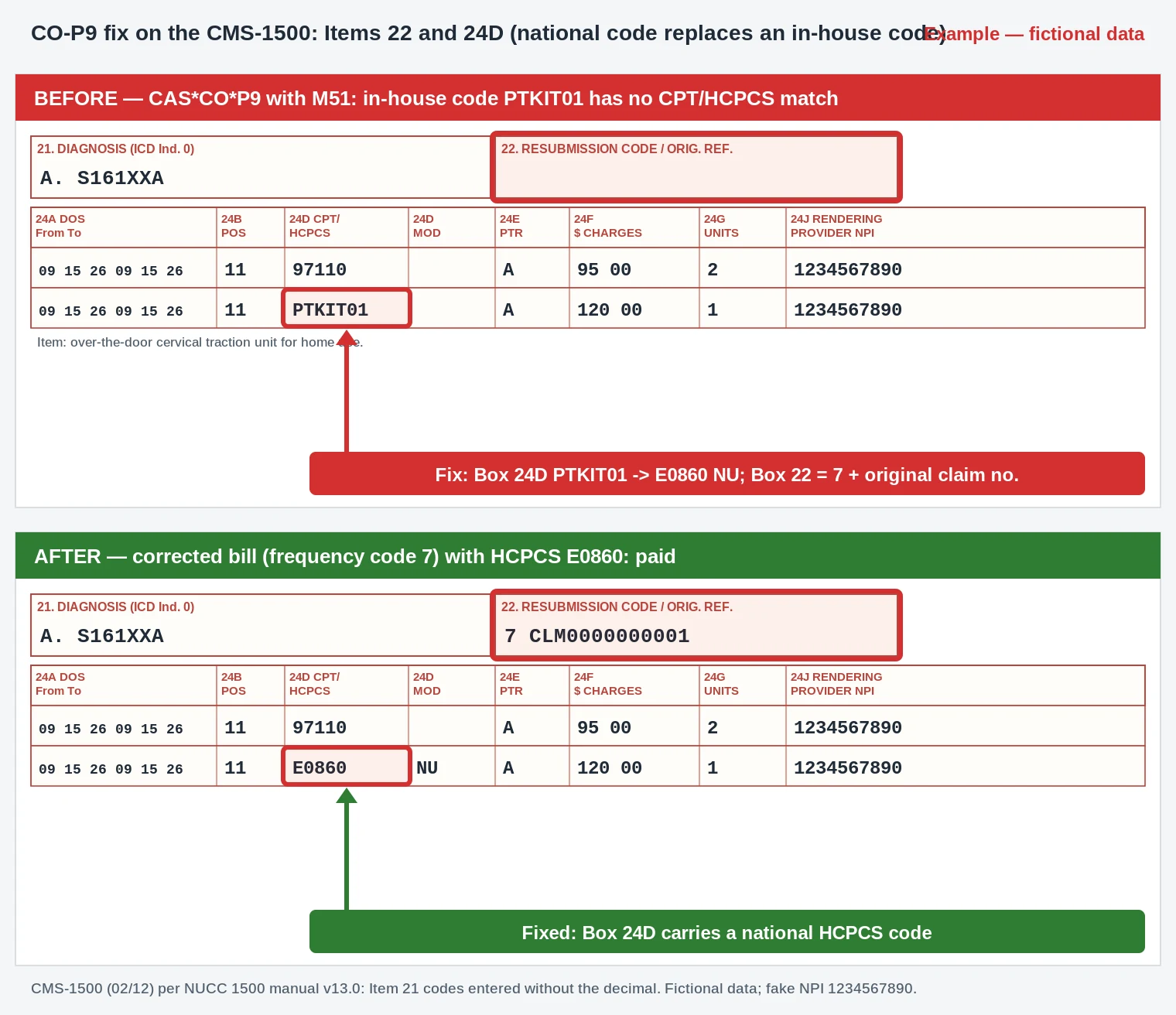
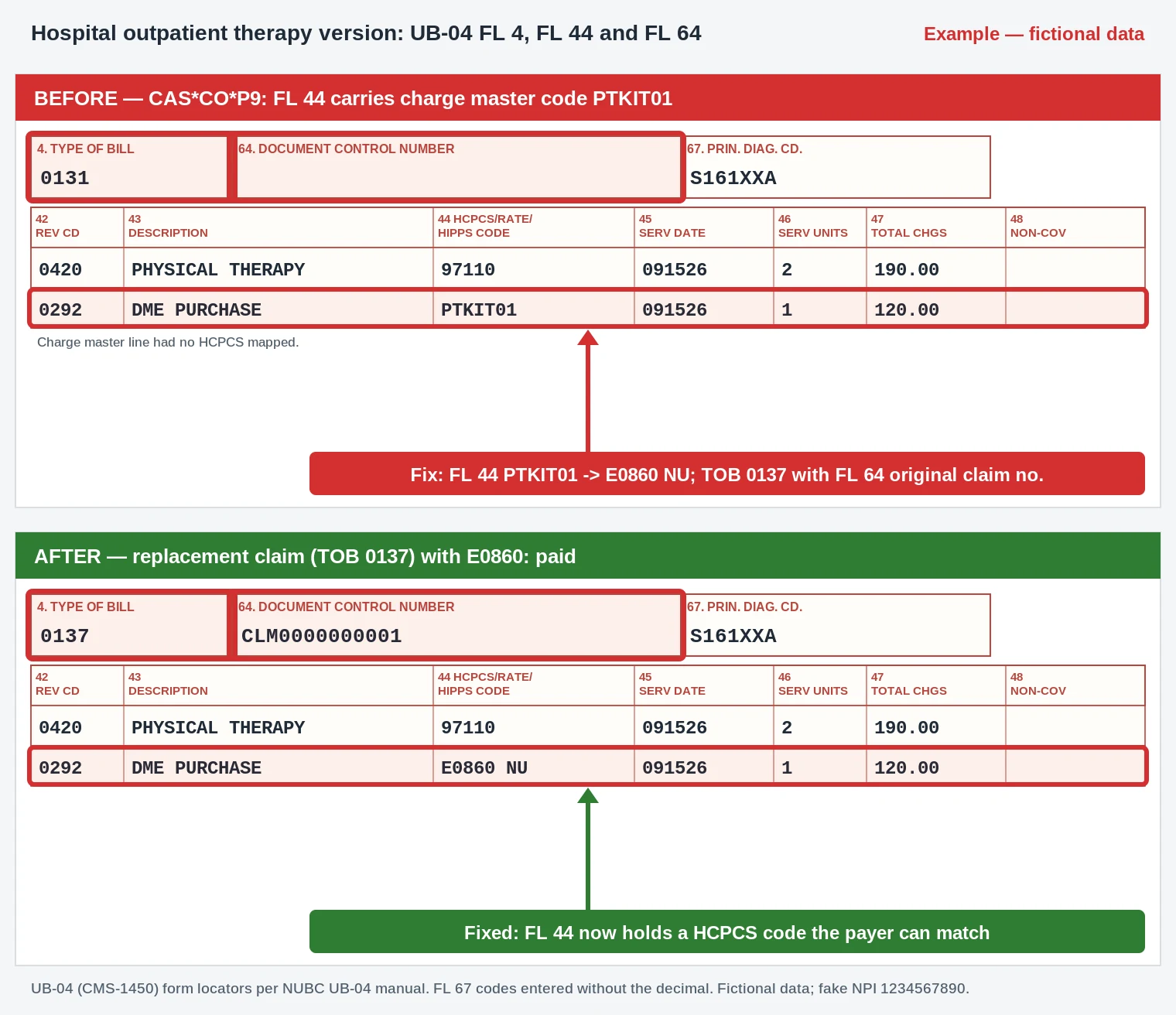
- Box 24D / FL 44: in-house code PTKIT01 replaced by HCPCS E0860 (traction equipment, overdoor, cervical) with modifier NU for new equipment.
- Box 22 / FL 4 + FL 64: frequency code 7 with the original claim number (bill type 0137 on the UB-04).
- If no national code fits: bill the unlisted code, such as E1399, with qualifier ZZ and a short narrative in the shaded part of Item 24.
- Box 21 / FL 67: S16.1XXA (entered as S161XXA) and the 97110 line are unchanged.
When should I use an unlisted code for CARC P9?
Use an unlisted code only when CPT and HCPCS have no specific code for the service. Pick the unlisted code from the right family, such as E1399 for miscellaneous durable medical equipment. Add a short ZZ narrative, attach the note or invoice, and expect the payer to price the line by report.
Can I bill the patient for a CO-P9 line?
No. The CO group assigns the amount to your practice, and comp statutes and most auto injury regulations also restrict what an injured patient can be charged. Treat CO-P9 as a coding correction: recode the line, resubmit it, and keep the patient out of the billing.
Related codes
| Code | Meaning |
|---|---|
| CO-P7 | Billed code is not in the fee schedule the payer uses |
| CO-181 | Procedure code was invalid on the date of service |
| CO-16 | Claim lacks information or has a submission or billing error |
| M51 | Missing, incomplete or invalid procedure code |
| CO-4 | Procedure code is inconsistent with the modifier used |
FAQ
What does CO-P9 mean?
The comp or auto payer found no CPT or HCPCS code that describes the service you billed, so the line did not pay.
How is CARC P9 different from CARC P7?
P9 means no national code matches the service. P7 means a real code was billed, but the payer’s fee schedule does not list it.
What remark codes come with P9?
M51 often appears for an invalid code. N350 appears when an unlisted or by-report code lacks a description.
Where does the narrative go on the CMS-1500?
In the shaded line of Item 24, starting with qualifier ZZ, per the NUCC manual.
Is P9 used by Medicare or health plans?
No. X12 limits CARC P9 to property and casualty payers, such as comp and auto insurers.
Sources
How we checked: the CARC P9 quote was matched word for word with the X12 CARC list on 22 November 2026. M51 and N350 were checked on the X12 RARC list.
- X12, Claim Adjustment Reason Codes (CARC P9, P7, 181, 16, 4). Accessed 22 Nov 2026.
- X12, Remittance Advice Remark Codes (M51, N350). Accessed 22 Nov 2026.
- CMS, Healthcare Common Procedure Coding System (HCPCS). Accessed 22 Nov 2026.
- NUCC, 1500 claim form reference instruction manual. Accessed 22 Nov 2026.
Last updated: 22 November 2026 · Educational content; not legal advice.