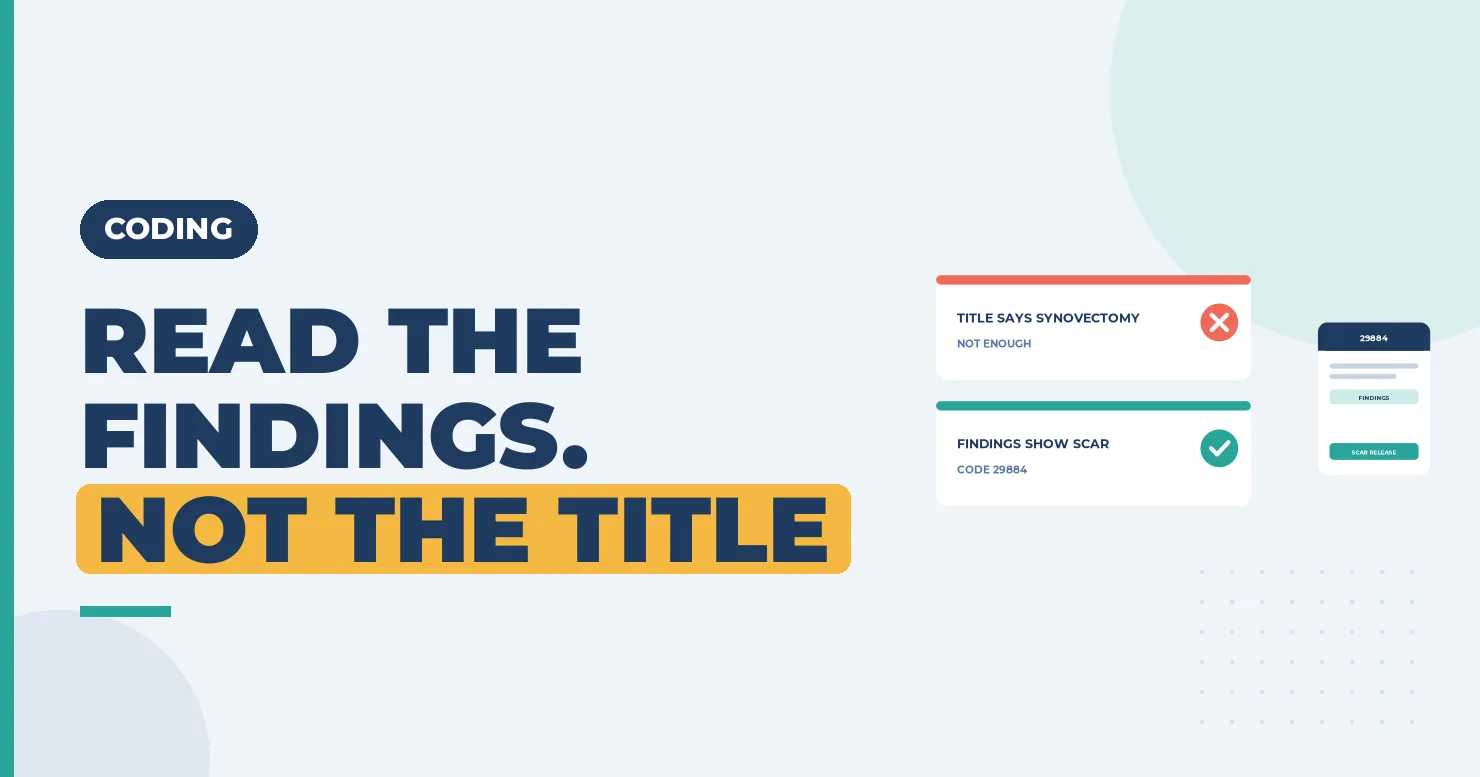
29884 vs 29876 comes down to what the surgeon removed and why. Scar bands and adhesions point to 29884.
The fix: code 29884 when the note shows scar release, not synovial disease, even if it says “major synovectomy.” If the wording conflicts, query the surgeon before you bill.
TL;DR: CPT 29884 is knee arthroscopy with lysis of adhesions, with or without manipulation. CPT 29876 is a major synovectomy in two or more compartments. Taking down scar after an ACL reconstruction is adhesion work. A major synovectomy treats diseased synovium. Do not bill both on the same knee without a clear, separate reason.
Written by Manikandan J, CPC, CRCR, a certified coder and revenue cycle specialist. Published 24 November 2026. Last updated: 24 November 2026.
Table of Contents
Which knee arthroscopy code is correct: 29884 or 29876?
Use 29884 when the main work is releasing scar tissue and adhesions inside the knee. Use 29876 when the surgeon removes diseased synovial lining from two or more compartments. The label in the procedure title does not decide it. The findings and the work described in the op note do.
CPT 29884 is a surgical knee arthroscopy with lysis of adhesions, with or without manipulation. CPT marks it as a separate procedure. CPT 29876 is a surgical knee arthroscopy with a major synovectomy of two or more compartments.
The synovium is the thin lining of the joint that makes joint fluid. Arthrofibrosis is stiff scar tissue that forms inside a joint, often after surgery. A cyclops lesion is a nodule of scar in front of a reconstructed ACL.
Example scenario (fictional names), part 1
29884 vs 29876 example: what happened
Marisol Etxeberria codes for Cedar Hollow Sports Medicine, a fictional orthopedic group in Oregon. Dr. Henrik Valdes scoped a right knee that had stiffened months after an ACL reconstruction.
His op note listed “major synovectomy and notchplasty.” The findings described dense scar in the gutters, the suprapatellar pouch and the notch. Marisol billed 29876-RT and 29884-RT with M24.661 to a fictional commercial plan.
The 835 paid 29876 and showed CAS*CO*97 on 29884 with remark M15. One line paid, so was the claim right?
Which code really matched the surgery? Keep reading, or jump to how the case was resolved.
Is removing scar tissue after ACL surgery a lysis of adhesions or a synovectomy?
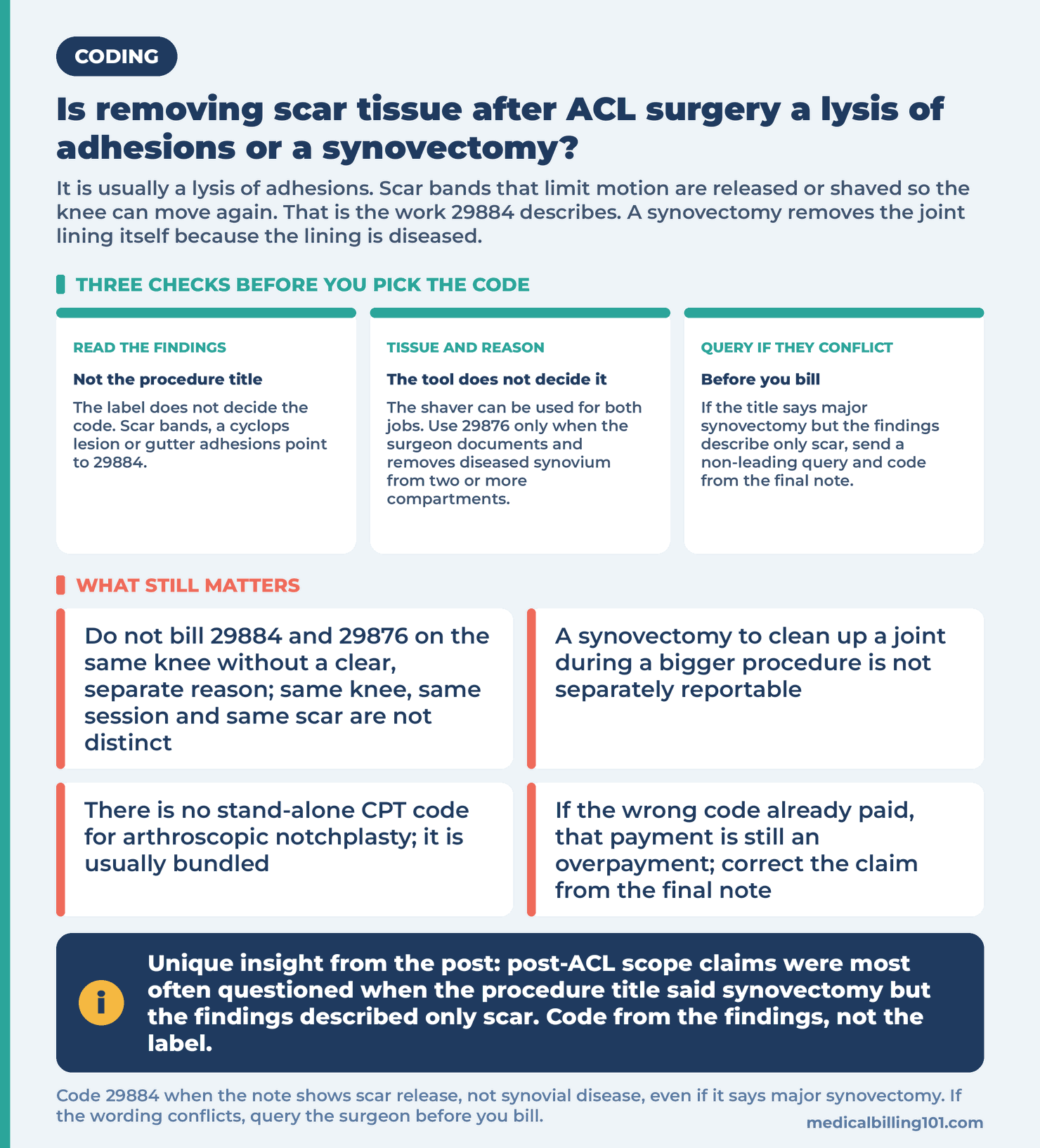
It is usually a lysis of adhesions. Scar bands that limit motion are released or shaved so the knee can move again. That is the work 29884 describes. A synovectomy removes the joint lining itself because the lining is diseased.
Debriding a cyclops lesion, freeing the gutters and clearing the suprapatellar pouch all fit adhesion release. The surgeon may use a shaver for both jobs. The tool does not change the code. The tissue and the reason do.
In my years on payer and provider billing teams, post-ACL scope claims were most often questioned when the procedure title said synovectomy but the findings described only scar.
When does a knee scope support 29876 major synovectomy?
29876 fits when the surgeon documents synovial disease and removes that lining from at least two compartments. For example, the surgeon may describe a thickened, inflamed lining from inflammatory arthritis or a proliferative synovial condition. The note should name the compartments and describe the abnormal synovium.
The NCCI Policy Manual, Chapter IV, Section E.8, describes 29876 as a major synovectomy of two or three compartments. It adds that a synovectomy to “clean up” a joint during a bigger procedure is not separately reportable.
So yes, the note should describe abnormal synovium. A phrase like “following my synovectomy” with no synovial findings will not hold up well in a records review.
Can you bill 29884 and 29876 on the same knee?
Usually not. The 2026 Medicare NCCI procedure-to-procedure edits pair 29876 as column 1 with 29884 as column 2, citing the CPT separate procedure definition. The modifier indicator is 1. A modifier only applies when the two services were truly distinct.
You can check the current pair on the CMS NCCI PTP edits page, or use our NCCI edit checker.
The same knee, same session and same scar are not distinct. Adding 59 or XS there unbundles the service. Our answer on bundled codes and modifier 59 explains when a modifier is fair.
| Item. | CPT 29884. | CPT 29876. |
|---|---|---|
| Main work. | Release of scar and adhesions, with or without manipulation. | Removal of diseased synovium, two or more compartments. |
| Typical findings. | Arthrofibrosis, scar bands, cyclops lesion after ACL surgery. | Thickened or inflamed lining from synovial disease. |
| NCCI pair. | Column 2 to 29876. | Column 1 over 29884. |
| Global period. | 90 days. | 90 days. |
| 2026 facility total RVUs. | 17.55. | 18.41. |
The global days and RVUs come from the CMS 2026 physician fee schedule relative value files (RVU26D). The small gap is one more reason not to pick 29876 by habit. Both codes carry the same 90-day global, so post-op visits are included either way.
How do you code the notchplasty during a 29884 knee scope?
No CPT code describes a stand-alone arthroscopic notchplasty. It is usually treated as part of the main knee procedure. An unlisted code, 29999, is possible only when the notchplasty was real, separate work and the op note proves it.
The NCCI Policy Manual, Chapter I, Section T, says to use an unlisted code when no code accurately describes the service. It also says never to report a “best fit” code that does not match the work.
Expect a records request on 29999. Our guide on when to use unlisted CPT codes shows how to support it with a comparable code and a clear narrative.
Which diagnosis code fits arthrofibrosis of the knee?
The FY 2027 ICD-10-CM Index sends Arthrofibrosis, joint, to Ankylosis. Ankylosis of the knee is M24.66-, so a right knee is M24.661. Use this when the surgeon documents arthrofibrosis or a stiff, scarred knee.
If the surgeon links the scar to the prior ACL surgery, guideline I.B.16 applies. A complication code needs a documented cause-and-effect link between the care and the condition. Query the surgeon when that link is unclear.
The rule is in the FY 2027 ICD-10-CM Official Guidelines. Do not add a synovitis code unless the surgeon documents synovitis.
How do you query the surgeon about 29884 vs 29876?
Send a short, open, non-leading query. Quote the conflicting lines from the note and ask the surgeon to clarify what tissue was removed and why. Do not suggest a code or a payment result.
- Quote the procedure title (“major synovectomy”) and the findings (scar, adhesions, cyclops lesion).
- Ask: “Please clarify the tissue removed and its condition in each compartment.”
- Offer open choices, such as scar and adhesions, abnormal synovium, both, or other.
- Ask for an addendum if the op note needs to change. Then code from the final note.
For more on what reviewers look for, see our guide to medical necessity documentation.
How do you fix a claim that billed both 29884 and 29876?
Start with the op note, not the remittance. If the work was adhesion release, the correct claim is 29884 alone, even if 29876 already paid. A payment on the wrong code is still an overpayment.
- Read the CARC and RARC. A CO-97 denial with M15 means the plan bundled one line into the other.
- Compare the findings with each code. Query the surgeon if the note conflicts.
- Send a corrected claim (frequency code 7) with the code the final note supports.
- Appeal only when the note truly supports both services in different compartments. Our appeal letter generator can help draft it.
Example scenario (fictional names), part 2
How the 29884 vs 29876 case was resolved
Marisol started with the remark code. M15 reads, “Separately billed services/tests have been bundled as they are considered components of the same procedure.” The CO-97 denial code made sense, because the NCCI pair bundles 29884 into 29876.
Then she reread the findings. Every step described scar and adhesions, with no abnormal lining. She sent Dr. Valdes an open query. His addendum confirmed scar release only, with no synovial disease.
Fix: she sent a corrected claim (frequency code 7) with 29884-RT alone and M24.661. The notchplasty stayed bundled.
Outcome: the plan reprocessed the claim and adjusted the earlier 29876 payment. CARC 97 was right, but the paid line was the wrong one.
Names and details are illustrative; no real patient data.
Do commercial payers follow the same 29884 and 29876 rules?
Often, but not always. Many commercial plans run NCCI-style bundling edits, and some add their own surgical policies. Check the plan’s current payment policy, and whether the scope needed prior authorization.
The CPT definitions do not change by payer. Code the tissue the surgeon removed and the reason, then let the edits follow. For a related orthopedic coding choice, see our answer on 27438 vs 27599 for patellofemoral arthroplasty.
3-step checklist
- Read the findings: scar and adhesions point to 29884, diseased synovium to 29876.
- Query the surgeon when the procedure title and findings disagree.
- Bill one code per knee unless the note proves distinct work, and keep the notchplasty bundled or unlisted.
FAQ
What is the difference between CPT 29884 and 29876?
29884 is knee arthroscopy with lysis of adhesions, with or without manipulation. 29876 is a major synovectomy of two or more compartments. Scar release points to 29884, diseased synovium to 29876.
Is scar removal after ACL reconstruction coded 29876?
Usually not. Releasing scar bands, a cyclops lesion or gutter adhesions is lysis of adhesions, which is 29884. Use 29876 only when the surgeon documents and removes diseased synovium.
Can 29884 and 29876 be billed together?
Usually not on the same knee. Medicare NCCI bundles 29884 into 29876. A modifier fits only when the note proves truly distinct work.
Is there a CPT code for arthroscopic notchplasty?
No. A stand-alone notchplasty has no specific code. It is usually bundled, and 29999 is possible only when the op note proves separate work.
What ICD-10 code is used for knee arthrofibrosis?
The FY 2027 Index sends arthrofibrosis to ankylosis. Ankylosis of the knee is M24.66-, so a right knee is M24.661.
Sources
My methodology was simple. I checked two NCCI Policy Manual chapters, the 2026 Medicare PTP edit file, the 2026 physician fee schedule RVU file and the FY 2027 ICD-10-CM guidelines and index.
- CMS, Medicare NCCI Policy Manual 2026, Chapter IV, Section E (linked above). Accessed 24 Nov 2026.
- CMS, Medicare NCCI Policy Manual 2026, Chapter I, Section T (linked above). Accessed 24 Nov 2026.
- CMS, Medicare NCCI practitioner PTP edits, 2026 Q4 file v323r0, pairs 29876/29884, 29876/29875 and 29884/29870 (linked above). Accessed 24 Nov 2026.
- CMS, PFS Relative Value File RVU26D, rows 29876, 29884 and 29999 (linked above). Accessed 24 Nov 2026.
- CDC/NCHS, ICD-10-CM FY 2027 Official Guidelines, Section I.B.16 (linked above), and the FY 2027 Index entries Arthrofibrosis and Ankylosis, knee. Accessed 24 Nov 2026.
- X12, Claim Adjustment Reason Code 97 and Remittance Advice Remark Code M15 (code lists). Accessed 24 Nov 2026.
Read about the author, or contact us with a question. See our editorial policy.
Last updated: 24 November 2026 · Educational content for U.S. coding and billing teams. Code descriptions are plain-language summaries; check the current CPT code set for full wording.