
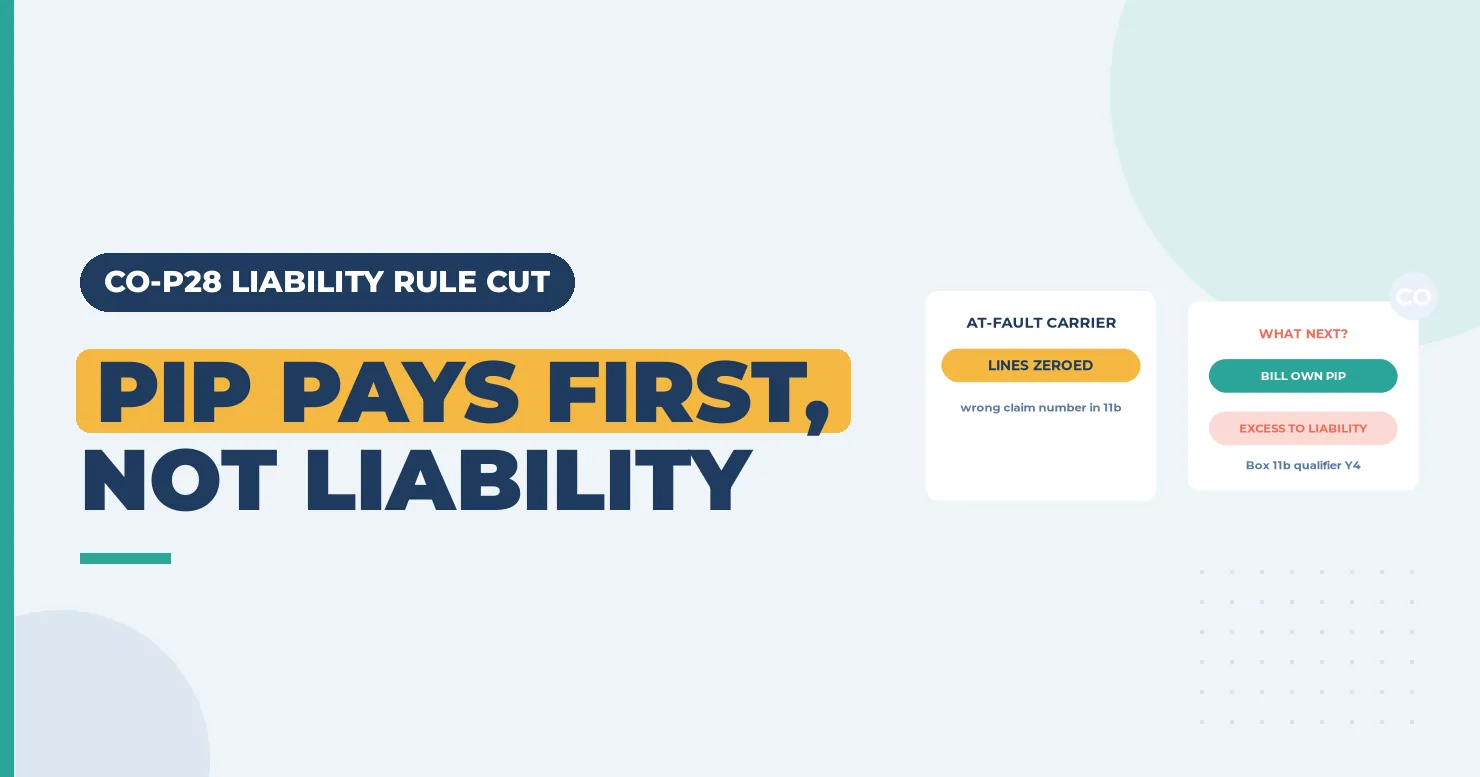
The CO-P28 denial code means an auto payer cut or zeroed your payment under the Liability Coverage Benefits rules of a state, or under its own payment policy. P27 is the denial version of this code. P28 is the adjustment version: the payer processed the bill, then reduced it because a law says someone else pays first. In a no-fault state, that someone is usually the patient’s own auto insurer. (Primary source: X12 Claim Adjustment Reason Codes)
In brief: reason code P28 tells you the liability side of an auto claim is not the first payer for this bill. Find the patient’s own personal injury protection (PIP) policy, bill it as a new claim, and send the liability carrier only the part that goes past the PIP limit.
Part of our denial codes library. Written by Manikandan J, CPC, CRCR, who has worked auto injury accounts for spine and orthopedic clients and sorts PIP from liability at intake. Published 27 November 2026. Last updated: 27 November 2026. Code wording quoted word for word from X12. Read about the author and our editorial policy, or contact us to report an error.
What does denial code CO-P28 mean?
Denial code CO-P28 says the payment was adjusted under liability coverage rules for auto claims. X12 limits it to Property and Casualty Auto. At the claim level, the payer must send the insurance policy number segment (REF with qualifier IG) when a state rule applies. At the line level, it must send the healthcare policy identification segment.
| Field | Value |
|---|---|
| Code | P28 |
| Description | “Payment adjusted based on the Liability Coverage Benefits jurisdictional regulations and/or payment policies.” |
| Use | Property and Casualty Auto only |
| Group codes | No X12 group restriction; CO is the usual pairing |
| Start | 11/01/2017 |
| Remark codes | Vary by payer; read the line-level remark |
Source: X12 Claim Adjustment Reason Codes, checked 27 November 2026.
Methodology: the code wording is copied from the X12 list. The example uses Michigan’s no-fault law, read in the Michigan Compiled Laws on the state legislature site. Other no-fault states order their payers in their own way.
Key terms: Liability coverage is the part of the at-fault driver’s policy that pays for harm to other people. PIP is the injured person’s own no-fault medical coverage. The REF IG segment is the 835 field that holds the policy number the payer used.
CO-P28 vs OA-P28: read the policy number before the group
With CO-P28, the payer treats the cut as a rule the provider must follow, so the patient is not billed for it. OA-P28 can also appear, since X12 sets no group limit for this code. In both cases the REF IG policy number on the 835 is the real clue. It tells you whose policy the payer looked at, and that tells you who should pay next.
| Group | What it suggests | First move |
|---|---|---|
| CO-P28 | Provider-side adjustment under a liability rule | Find the first payer the law names |
| OA-P28 | Other adjustment, owner unclear | Read the remark and call the adjuster |
Example scenario (fictional names), part 1
CO-P28 Denial Example: What Happened
Dana Kowalski handles accident billing at Great Lakes Spine and Joint, a physician office in Michigan. Dr. Omar Haddad saw a teacher hurt in a rear-end crash. He billed 99203 and a lumbar x-ray, 72100, with S33.5XXA (entered as S335XXA).
The front desk took the claim number from the other driver’s insurer, a fictional carrier called Northshore Mutual. The 835 came back with every line adjusted to zero and CAS*CO*P28. The REF IG segment showed the at-fault driver’s policy, not the teacher’s.
Why would the at-fault driver’s insurer pay nothing at all? Keep reading, or jump to how the CO-P28 denial was resolved.
What causes a CARC P28 liability adjustment?
Most P28 cuts come from payer order rules, not from coding errors. For example, a no-fault state may say the injured person’s own policy pays medical bills first. Here is what to check.
| Cause | What it looks like |
|---|---|
| No-fault state rule | The liability carrier pays only costs above the PIP limit |
| Wrong claim number | Box 11b holds the at-fault driver’s claim number |
| PIP limit not yet used | Nothing is owed by liability until PIP is exhausted |
| Coverage choice | The patient picked a lower PIP limit or opted out |
| Payer policy | The carrier pays the claimant, not the provider |
Michigan is a clear example. MCL 500.3135 abolishes tort liability for most auto injury costs. Section 3(c) keeps it only for allowable expenses above the PIP limit the patient chose. MCL 500.3114 says a PIP policy covers the person named in it, a spouse, and relatives in the same household. So the teacher’s own auto insurer pays first.
How do I fix a CO-P28 denial?
To fix CO-P28, find the first payer the state law names, and send that payer a new claim. Do not send a corrected claim to the liability carrier; it already applied the rule.
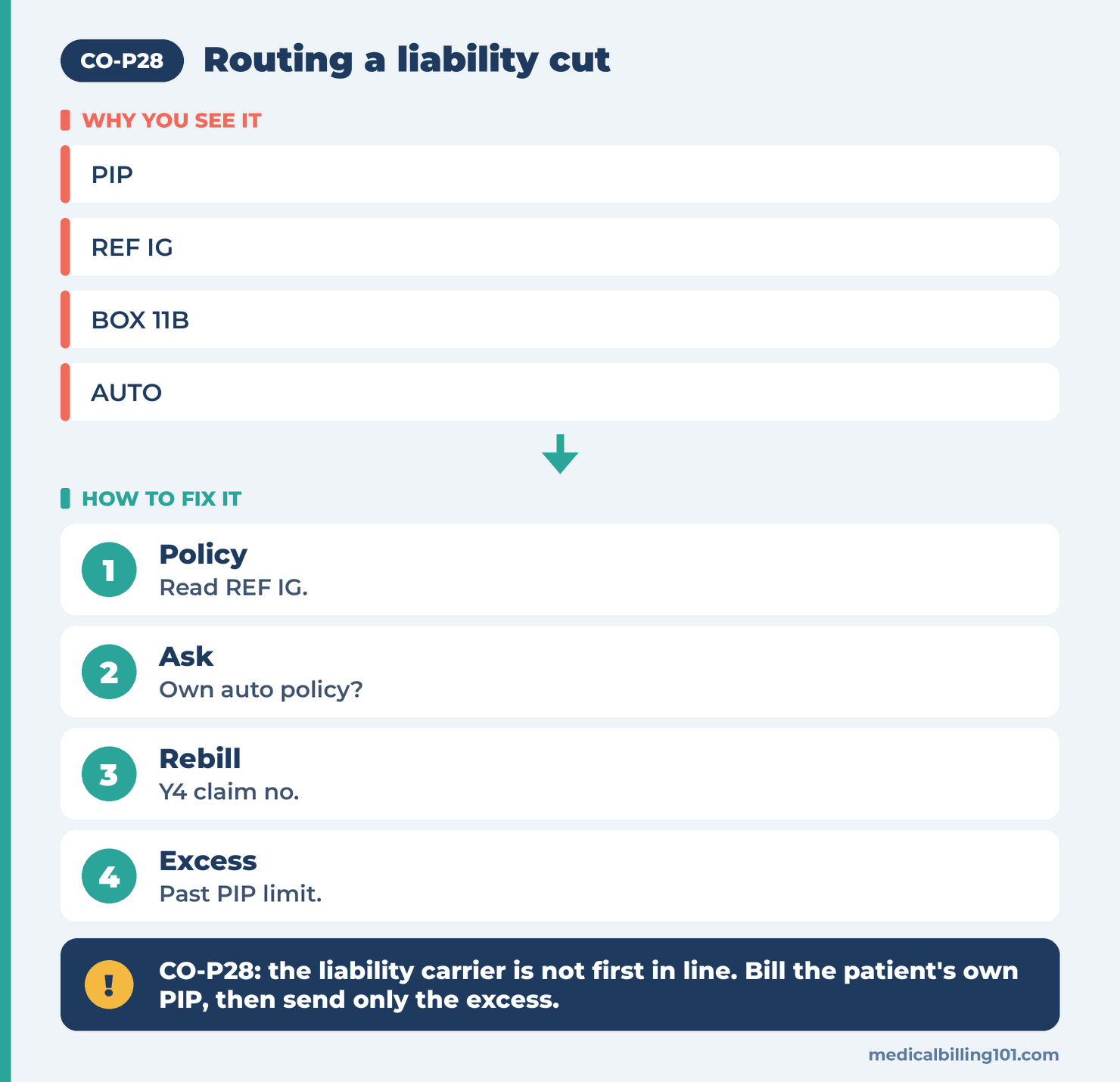
| Step | Action | Where to check |
|---|---|---|
| 1 | Read the REF IG policy number on the 835 | Loop 2100 of the remit |
| 2 | Ask the patient for their own auto policy | Intake form or a call |
| 3 | Get a PIP claim number from that insurer | Claim line of the patient’s carrier |
| 4 | Send a new claim with that number | Box 11b qualifier Y4, Box 11c plan name |
| 5 | Keep Box 10b YES with the state | Auto accident field |
| 6 | Track the PIP limit; bill liability only for the excess | PIP payment history |
NUCC says Box 11b holds the property and casualty claim number with qualifier Y4. See the NUCC 1500 instructions. Since this is a claim to a new payer, Box 22 stays blank.
Example scenario (fictional names), part 2
How the CO-P28 Denial Was Resolved
Dana called the teacher, who had her own auto policy with a fictional carrier named Pinewood Auto. Its claim line opened a PIP claim the same day. Michigan law put that policy first, and the bill had gone to the wrong one.
Fix: Dana sent a new CMS-1500 to Pinewood Auto. Box 11b held qualifier Y4 and the PIP claim number, and Box 11c named the plan. Box 10b stayed YES with state MI.
Outcome: the PIP carrier processed both lines under its fee rules. Dana then added a PIP question to the accident intake form, so the right claim number is taken at check-in.
Names and details are illustrative; no real patient data.
Names and details are illustrative; no real patient data.
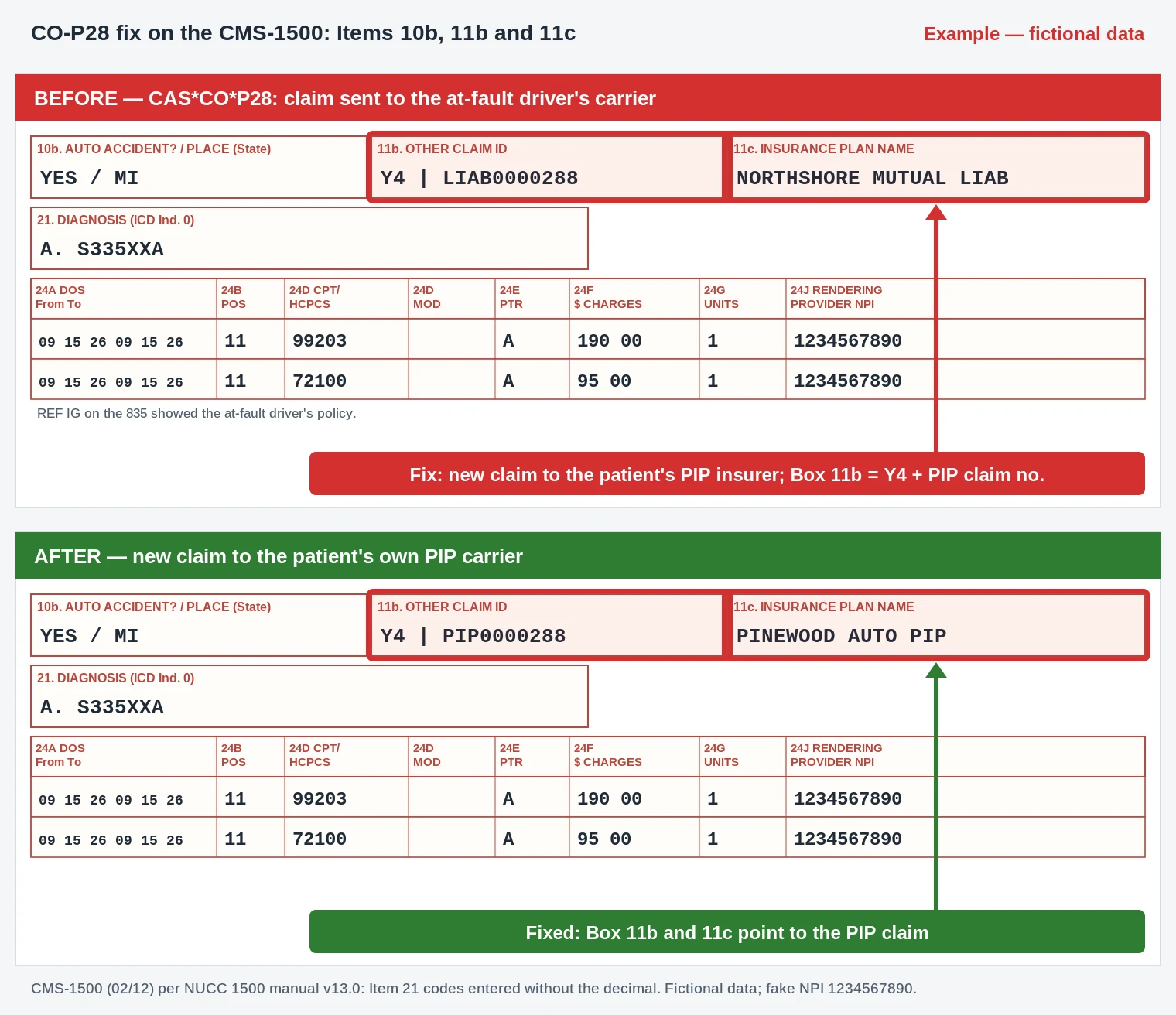
- Box 11b: qualifier Y4 now carries the PIP claim number from the patient’s own auto insurer, not the at-fault driver’s liability claim number.
- Box 11c: the plan name changes to the patient’s PIP coverage; this is a new claim to a new payer, so Box 22 stays blank.
- Box 10b / Box 21 / Box 24D: YES with state MI, S33.5XXA (entered as S335XXA), 99203 and 72100 are unchanged.
- UB-04: not shown; the physician office bills only on the CMS-1500.
Can I bill the patient for a P28 adjustment?
Not while a PIP claim is open. The CO group puts the cut on the provider side, and the patient’s own policy should be billed next. If PIP pays less than the full charge, your state’s PIP rules decide what the patient can owe.
Related codes
| Code | Meaning |
|---|---|
| CO-P27 | Payment denied under liability coverage rules |
| CO-P21 | Payment denied under PIP rules |
| CO-P22 | Payment adjusted under PIP rules |
| CO-P23 | PIP fee schedule adjustment |
| CO-P10 | Payment reduced to zero due to litigation |
FAQ
What does CO-P28 mean?
An auto payer adjusted the bill under liability coverage rules. Often a no-fault law says another payer goes first.
How is CARC P28 different from P27?
P27 denies payment under liability rules. P28 adjusts the payment, which can mean a partial cut or a zero line.
Who pays first in a Michigan auto injury?
Usually the injured person’s own PIP policy. The at-fault driver’s liability coverage pays allowable costs above the PIP limit.
Which box holds the auto claim number?
Box 11b, with qualifier Y4 on the left and the property and casualty claim number on the right.
Should I send a corrected claim to the liability carrier?
No. Send a new claim to the PIP insurer. Go back to the liability carrier only for costs above the PIP limit.
Sources
How we checked: the CARC P28 quote was matched word for word with the X12 CARC list on 27 November 2026. The payer order rules were read in sections 3135 and 3114 of the Michigan Insurance Code.
- X12, Claim Adjustment Reason Codes (CARC P28, P27, P21, P22, P23, P10). Accessed 27 Nov 2026.
- Michigan Legislature, MCL 500.3135, tort liability limits. Accessed 27 Nov 2026.
- Michigan Legislature, MCL 500.3114, which PIP policy applies. Accessed 27 Nov 2026.
- NUCC, 1500 Claim Form Instructions. Accessed 27 Nov 2026.
Last updated: 27 November 2026 · Educational content; not legal advice.