
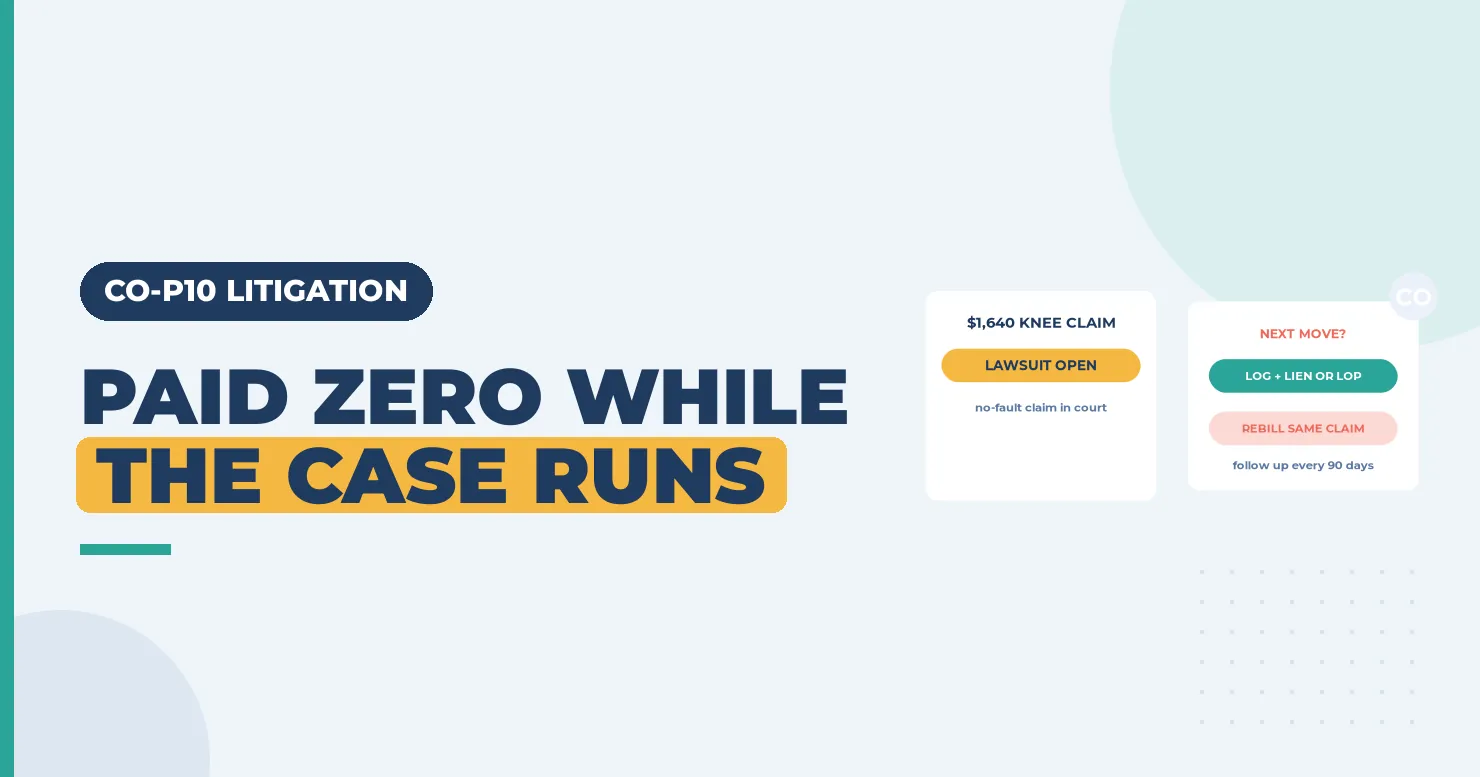
The CO-P10 denial code means a property and casualty payer cut your payment to zero because a lawsuit about the claim is still open. The claim is not closed for good. Log the case, reach the attorneys, protect your filing and lien rights, and follow up when the case ends. (Primary source: X12 Claim Adjustment Reason Codes)
In brief: reason code P10 is a pause tied to a court case, not a coding error. Do not rebill the same claim. Get the claim number and both attorneys’ contacts, send your itemized bill and records, and check whether your state lets you file a lien.
Part of our denial codes library. Written by Manikandan J, CPC, CRCR, who has tracked litigated auto and comp accounts for orthopedic, imaging and physical therapy practices. Published 22 November 2026. Last updated: 22 November 2026. Code wording quoted word for word from X12. Read about the author and our editorial policy, or contact us to report an error.
What does denial code CO-P10 mean?
Denial code CO-P10 says the payer will pay nothing for now because the claim is part of a lawsuit. The payer promises more information when the case ends. Only property and casualty payers send it, which means comp carriers, auto insurers and liability insurers.
| Field | Value |
|---|---|
| Code | P10 |
| Description | “Payment reduced to zero due to litigation. Additional information will be sent following the conclusion of litigation. To be used for Property and Casualty only.” |
| Group codes | No X12 group restriction; CO is the usual pairing |
| Start | 11/01/2013; replaces code 244 |
| Common remark | Often none; read the payer’s letter |
Source: X12 Claim Adjustment Reason Codes, checked 22 November 2026.
Methodology: the code wording is copied from the X12 list. The collection steps reflect common practice, and the lien example comes from the Texas statute cited below; lien and billing rules differ by state.
Key terms: Litigation is a lawsuit, here over the injury, the coverage or the bill. A lien is a legal claim on a future settlement, where state law allows one. A letter of protection is an attorney’s written promise to pay your bill from any recovery.
CO-P10 vs OA-P10: who holds the zero?
CO-P10 leaves the balance with your practice while the case runs. You should not bill the injured patient, and many comp and no-fault laws forbid it. OA-P10 assigns the amount to no one; it often appears on a second payer’s remittance. In both cases, payment depends on how the lawsuit ends.
| Group | Who holds the balance | What to watch |
|---|---|---|
| CO-P10 | Your practice, until the case ends | Your lien or protection letter, and the payer’s follow-up |
| OA-P10 | No one named | Whether another payer can pay while the case is open |
Example scenario (fictional names), part 1
CO-P10 Denial Example: What Happened
Priya Holt manages accounts at Lakeview Orthopedic Group. A patient hurt in a car crash had a right knee meniscus tear, S83.211A. The surgeon billed a visit and an MRI read to the patient’s auto insurer under its no-fault coverage.
The remittance paid zero with CAS*CO*P10. A cover letter said the patient had sued the insurer over the claim. The balance was $1,640, and the patient was due for surgery.
Can Priya bill the patient, bill again, or only wait? Keep reading, or jump to how the CO-P10 denial was resolved.
Why does a lawsuit stop the payment?
A payer sends CARC P10 when a court case could change what it owes. For example, the patient may have sued the insurer, the insurer may be contesting coverage, or another driver’s fault may be disputed. Until a judge or settlement decides, the payer withholds payment that the outcome could cancel.
How do I protect my balance on a CO-P10 claim?
Treat a CO-P10 line as a long-term account, such as any balance that waits on a settlement. The claim itself was billed correctly, so a corrected claim will not help. Your work is tracking, documentation and protecting your legal rights.
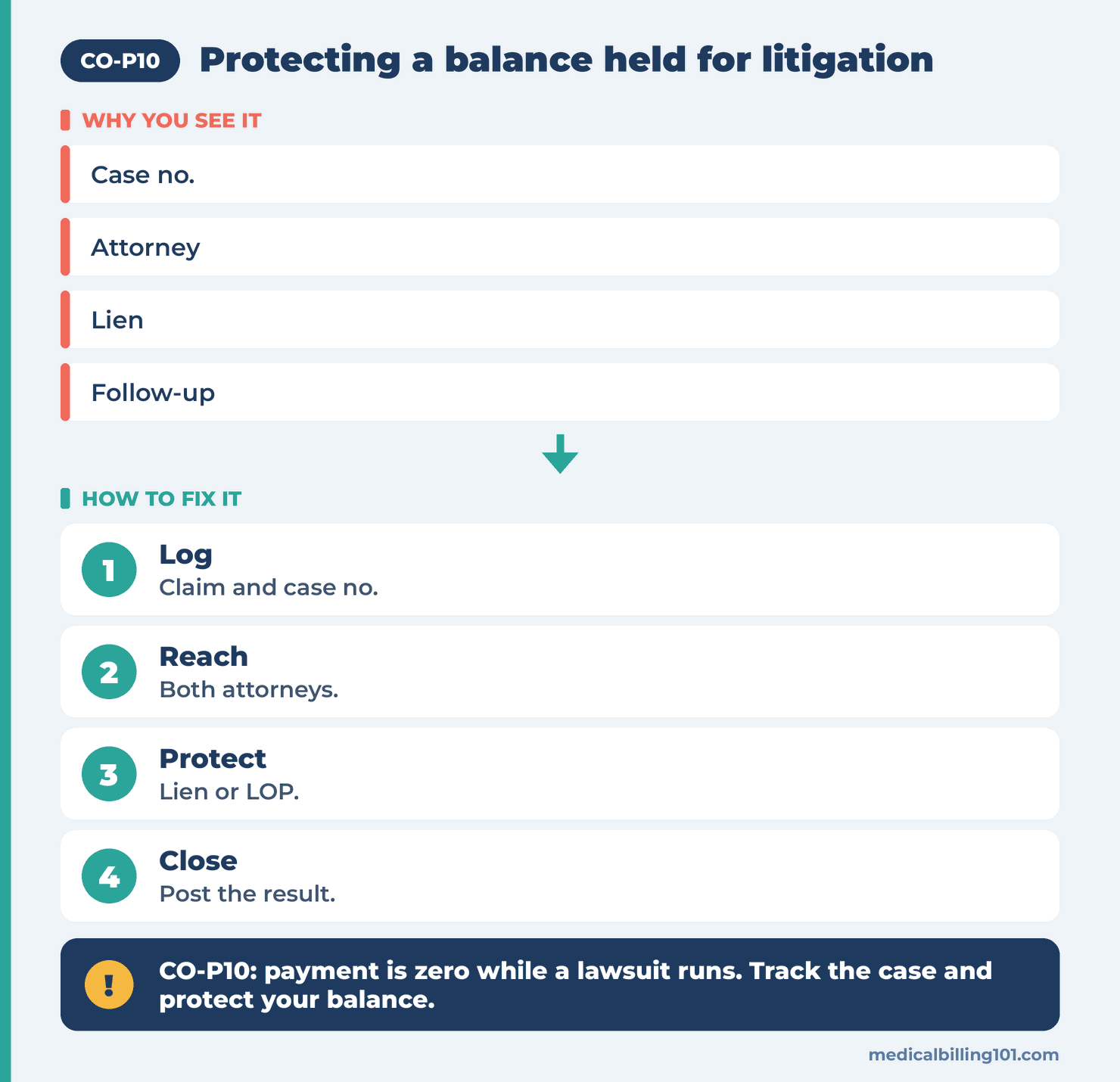
- Log the case. Record the claim number, the court case number if known, and the date of the P10 remittance.
- Find the attorneys. Ask the payer and the patient for both counsel contacts.
- Send your bill and records. Give the patient’s attorney an itemized bill and the visit notes, with the patient’s signed release.
- Check your lien rights. Many states let providers file a lien or accept a letter of protection. In Texas, for example, Property Code section 55.002 gives hospitals a lien on the patient’s injury claim when the patient is admitted within 72 hours of an accident caused by someone else’s negligence.
- Set follow-ups. Call the attorney’s office every 60 to 90 days and log each answer.
- Close it out. When the case ends, ask the payer for its promised update, then post the payment or the final denial.
Example scenario (fictional names), part 2
How the CO-P10 Denial Was Resolved
Priya called the insurer and got the patient’s attorney’s name. With the patient’s signed release, she sent the itemized bill, the visit note and the MRI report to the attorney.
Fix: the attorney sent a letter of protection for the open balance and the coming surgery. Priya logged the case number and set a 90-day follow-up. She did not send the patient a statement.
Outcome: the case settled eight months later. The insurer reprocessed the claim and paid the visit and MRI under its fee schedule. The surgery balance was paid from the settlement under the letter of protection.
Names and details are illustrative; no real patient data.
Names and details are illustrative; no real patient data.
Can I bill the patient while CARC P10 is open?
Not under the CO group. CO-P10 says the amount stays with your practice for now, and comp statutes, plus no-fault laws in many states, also restrict billing an injured patient. If the patient has a health plan, ask whether it will pay now and recover later; some plans do, others wait for the case.
What if the patient has Medicare?
Medicare has its own rules for injury claims that a liability, no-fault or comp payer may owe. Read the CMS coordination of benefits and recovery overview before you bill Medicare for a P10 claim. Billing in the wrong order can lead to repayment demands later.
Related codes
| Code | Meaning |
|---|---|
| CO-P8 | Claim is under investigation |
| CO-20 | Injury or illness is covered by the liability carrier |
| CO-21 | Injury or illness is the liability of the no-fault carrier |
| CO-P4 | Workers’ comp claim adjudicated as non-compensable |
| CO-19 | Work-related injury that is the liability of the comp carrier |
FAQ
What does CO-P10 mean?
The comp, auto or liability payer reduced payment to zero because a lawsuit about the claim is still open.
Should I resubmit a CO-P10 claim?
No. The claim was not wrong. Resubmitting creates duplicates. Track the case and wait for the payer’s update.
Will the payer contact me when the case ends?
X12 says additional information will be sent after the litigation ends. Still, follow up yourself, because letters get lost.
Can I charge interest on a P10 balance?
Only where your state law or a signed agreement allows it. Check with your practice’s attorney before adding charges.
What code did CARC P10 replace?
CARC P10 replaced code 244 when X12 moved property and casualty codes to the P series in 2013.
Sources
How we checked: the CARC P10 quote was matched word for word with the X12 CARC list on 22 November 2026.
- X12, Claim Adjustment Reason Codes (CARC P10, P8, P4, 19, 20, 21). Accessed 22 Nov 2026.
- CMS, Coordination of Benefits and Recovery overview. Accessed 22 Nov 2026.
- Texas Property Code section 55.002, hospital lien. Accessed 22 Nov 2026.
Last updated: 22 November 2026 · Educational content; not legal advice.