
CO-20 shows up when a payer believes someone else’s liability insurance should pay for an injury. For example, a fall in a store, a dog bite, or a crash where another driver is at fault. The payer has a liability record on file, and your claim looks like it belongs to that injury. (Primary source: X12 Claim Adjustment Reason Codes)
In brief: CARC 20 reads “This injury/illness is covered by the liability carrier.” If the visit treated the injury, bill the liability insurer first. If it did not, remove the copied accident data or appeal with proof the care was unrelated.
Part of our denial codes library. Written by Manikandan J, CPC, CRCR, who has worked accident and liability holds for physician practices and hospital outpatient teams. Published 26 October 2026. Last updated: 26 October 2026. Code wording quoted word for word from X12. Read about the author and our editorial policy, or contact us to report an error.
X12 entry
| Field | Value |
|---|---|
| Code | 20 |
| Description | “This injury/illness is covered by the liability carrier.” |
| Start | 01/01/1995 |
| Last modified | 09/30/2007 |
Source: X12 Claim Adjustment Reason Codes, checked 26 October 2026.
Key terms: A CARC is a Claim Adjustment Reason Code from the X12 list, and it says why a line was paid differently than billed. A RARC is a Remittance Advice Remark Code that adds detail to the CARC. The group code is the two-letter prefix; CO means contractual obligation, so the provider owns the balance and may not bill the patient for it. ORM means ongoing responsibility for medicals: the liability insurer has agreed to keep paying for care tied to the injury.
Methodology: the code wording above is copied from the X12 list, and each rule below links to the CMS manual or notice it comes from.
Example scenario (fictional names), part 1
CO-20 Denial Example: What Happened
Priya Lindqvist bills for Cedar Hollow Family Medicine, a fictional practice in Ohio. In spring, a patient broke her right wrist in a fall at a grocery store, and the store’s liability insurer opened a claim. In September, Dr. Tomas Reyes saw her for a routine diabetes check, billed as 99213.
The visit template copied old accident data. Box 10c “Other accident” said YES, and the wrist code S62101D sat next to E119. Brightway Health Plan, a fictional commercial plan, returned CAS*CO*20 with LQ*HE*N744. That is a CO-20 denial code on a visit that had nothing to do with the fall.
Should Priya send this diabetes visit to the store’s insurer? Keep reading, or jump to how the CO-20 denial was resolved.
Why payers deny with CARC 20
- A liability record matches your diagnosis. Medicare contractors deny when a claim’s diagnosis matches, or sits in the same family as, a diagnosis on a liability record with ORM. The rule is in the CMS MSP Manual, chapter 5, section 20.4. Commercial plans run similar subrogation checks.
- Your claim says “accident.” Box 10b or 10c on the CMS-1500, or occurrence code 03 (accident/tort liability) on the UB-04, tells the payer to look for another insurer.
- Copied data. Visit templates and registration screens often carry an old injury date or code into a new, unrelated visit.
- Remarks point the way. N744 reads “Adjusted because the services may be related to an auto/other accident.” N725 reads “A liability insurer has reported having ongoing responsibility for medical services (ORM) for this diagnosis.” Both come from the X12 RARC list.
Which accident code is it?
| Code | Other payer named | Typical trigger |
|---|---|---|
| CO-19 | Workers’ compensation | Work injury on file |
| CO-20 | Liability carrier | Fall, bite, or at-fault injury on file |
| CO-21 | No-fault carrier | Auto policy that pays regardless of fault |
Fixing a CO-20 denial step by step
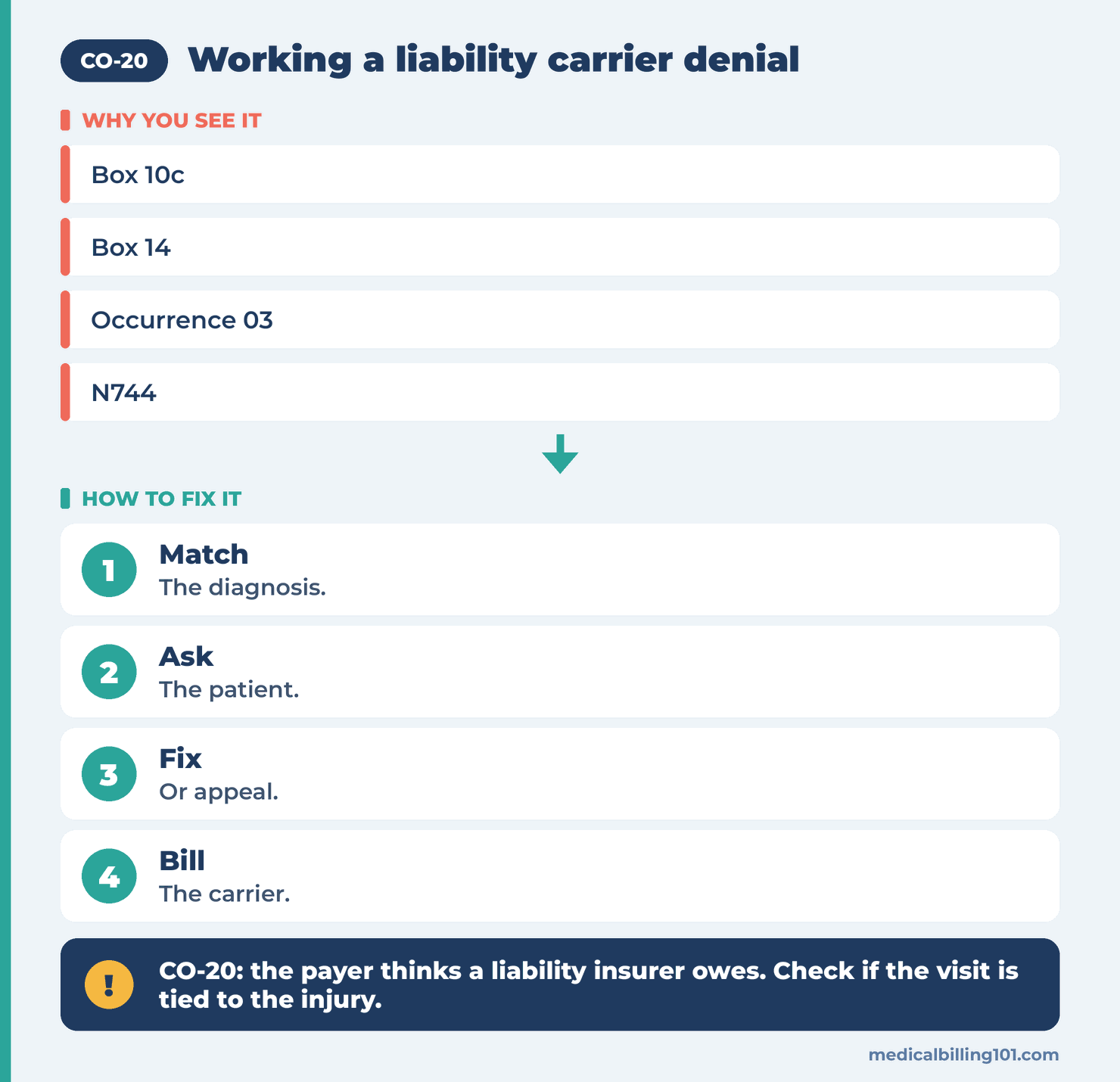
- Match the diagnosis. Compare each line’s diagnosis with the injury on file. CMS matches liability records at the line level, so one injury code can pull a whole visit into the denial (CMS CR 6795).
- Ask the patient. Confirm the injury, the date, and the liability insurer’s claim number. A short accident form at check-in saves weeks later.
- If the visit is unrelated, fix or appeal. Remove copied accident fields and injury codes, then send a corrected claim. If the claim was right, appeal with notes showing the care was for something else. CMS says the same in SE21002.
- If the visit is related, bill the liability insurer. Under 42 CFR 411.50, “promptly” for liability insurance means payment within 120 days. After that window, a Medicare provider may bill Medicare and drop its liability claims and liens, or keep the liens and not bill Medicare. See the MSP Manual, chapter 2, section 40.2.
- Never deny care. A liability record changes who pays, not whether the patient can be seen.
When the injury really is related
If the visit treated the injury, the payer is right. Send the claim to the liability insurer, such as the store’s or the other driver’s carrier, or file a lien on the settlement. Keep the insurer’s claim number in the account. If the insurer refuses in writing, send that denial to the health plan. Many plans will then pay, subject to recovery later. If one visit covers both the injury and something else, CMS asks providers to put the unrelated services on a separate claim (SE21002).
Claim form before and after
Both forms below come from the same fictional case. The red boxes show the copied accident fields that pulled the visit and the lab draw into the liability record.
[[CFV]]
Example scenario (fictional names), part 2
How the CO-20 Denial Was Resolved
Priya pulled the visit note and the claim side by side.
- The note covered blood sugar, an A1c draw, and a refill. The wrist was not examined.
- S62101D and the Box 10c YES came from the spring visit template.
- The hospital lab bill for the same A1c carried occurrence code 03 with the fall date.
Fix: Priya sent a corrected claim (Box 22 code 7 with the original claim number), set Box 10c to NO, removed the wrist code and cleared Box 14. The hospital lab dropped occurrence code 03 and rebilled as type of bill 0137.
Outcome: Both claims paid on reprocessing. Cedar Hollow now clears accident fields at every new visit unless the patient says the injury was treated.
Names and details are illustrative; no real patient data.
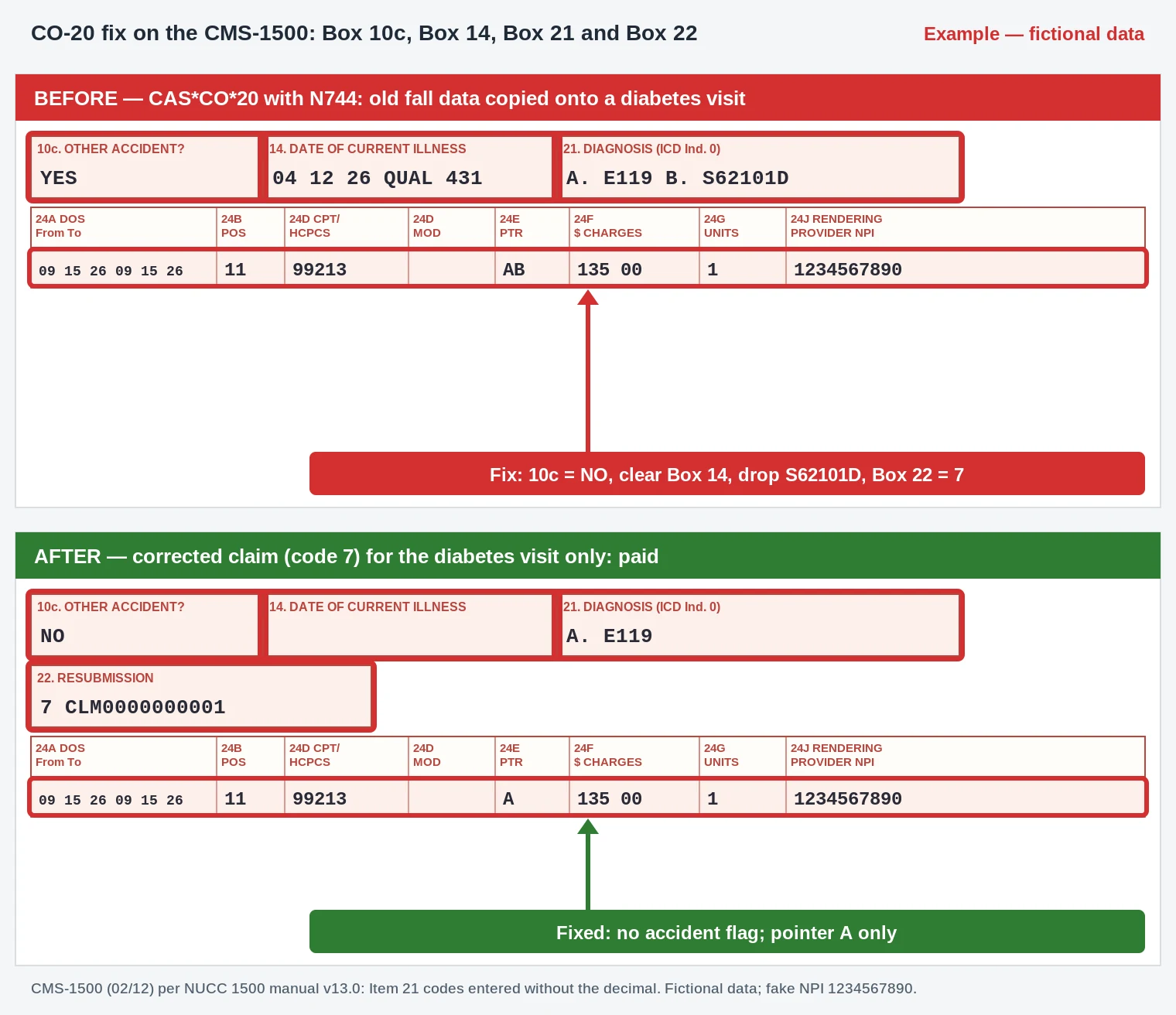
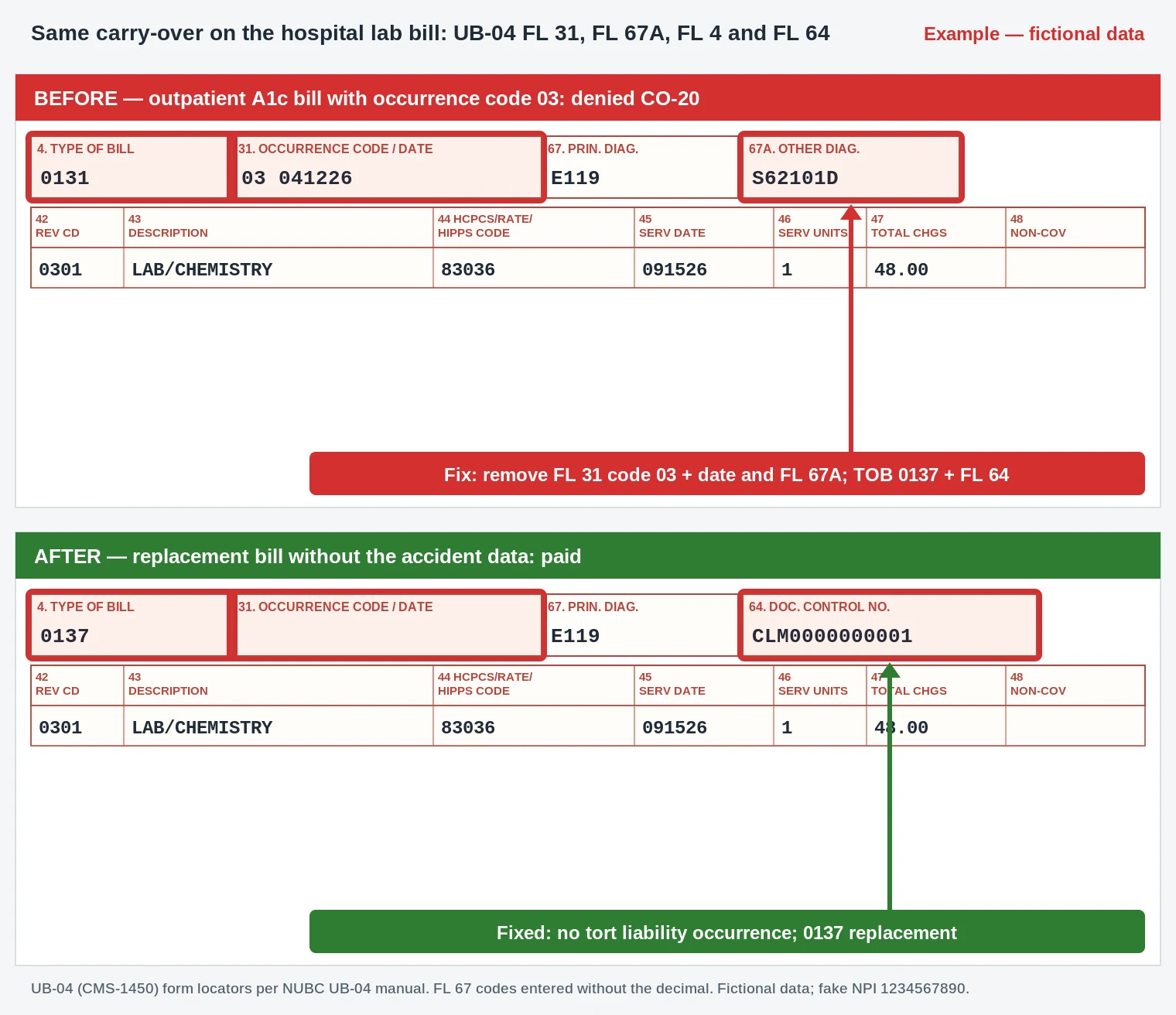
- Box 10c / FL 31: other accident changed from YES to NO; occurrence code 03 (accident/tort liability) and the 04/12/26 fall date removed.
- Box 14: the copied injury date with qualifier 431 cleared; this visit was not for the injury.
- Box 21 / FL 67A: S62.101D (entered as S62101D) removed; E11.9 (entered as E119) stays as the only diagnosis, so Box 24E points to A.
- Box 22 / FL 4 + FL 64: code 7, or type of bill 0137, with the original claim number.
- Box 24D / FL 44: 99213 and 83036 and their charges are unchanged.
Related codes
| Code | Meaning | Where to start |
|---|---|---|
| CO-20 | Liability carrier owes | Diagnosis match |
| CO-19 | Workers’ comp owes | Employer claim |
| CO-21 | No-fault carrier owes | Auto policy |
| CO-22 | Other coverage first | Payer order |
| CO-109 | Wrong payer | Bill the right plan |
FAQ
What does CO-20 mean?
The payer thinks a liability insurer should pay for the injury on this claim.
Can I bill the patient for CO-20?
Not for a CO amount. Bill the liability insurer or file a lien if the care was related.
What if the visit had nothing to do with the injury?
Remove copied accident data and injury codes and send a corrected claim, or appeal with the notes.
How long do I wait on the liability insurer?
For Medicare, the promptly period is 120 days under 42 CFR 411.50.
How is CO-20 different from CO-21?
CO-21 points to a no-fault carrier. CO-20 points to a liability carrier tied to fault.
Sources
How we checked: the CARC 20 quote was matched word for word with the X12 CARC list on 26 October 2026, and the N744 and N725 remarks with the X12 RARC list.
- X12, Claim Adjustment Reason Codes (CARC 20). Accessed 26 Oct 2026.
- X12, Remittance Advice Remark Codes (RARC N744, N725). Accessed 26 Oct 2026.
- CMS, MSP Manual chapter 5, section 20.4 (ORM). Accessed 26 Oct 2026.
- CMS, MSP Manual chapter 2, section 40.2 (Rev. 12436). Accessed 26 Oct 2026.
- CMS, SE21002 on NGHP ORM claim denials. Accessed 26 Oct 2026.
- CMS, CR 6795 line-level MSP diagnosis matching. Accessed 26 Oct 2026.
- eCFR, 42 CFR 411.50. Accessed 26 Oct 2026.
Last updated: 26 October 2026 · Educational content; not legal advice.