The radiology diagnosis coding guidelines let you code from what the ordering provider sent. That includes an attached office note, not only the order line. Use it to make “pain” specific, but never create a diagnosis yourself.
No CMS rule limits you to the literal order and the radiologist’s report. When the file gives no clear reason, ask the ordering office for one before you bill.
TL;DR: CMS defines an order as a communication from the treating provider, by signed paper, phone or email. The ICD-10-CM Official Guidelines tell you to code the reason for the test shown in the medical record. Diagnosis details the ordering office sends with the order, such as its visit note, can be used. If the final report confirms a diagnosis, code that instead of the symptom. If nothing gives a site or reason, query the ordering office.
Written by Manikandan J, CPC, CRCR, a certified coder and revenue cycle specialist. Published 28 November 2026. Last updated: 28 November 2026.
Table of Contents
What do the radiology diagnosis coding guidelines say?
Section IV.K of the ICD-10-CM Official Guidelines covers patients who get diagnostic services only. List first the reason for the test shown in the medical record. If the final report is available, code any confirmed diagnosis in the interpretation and drop the related symptoms.
The same section adds a rule for routine testing. When a routine radiology test has no sign, symptom or diagnosis behind it, assign Z01.89, Encounter for other specified special examinations.
Section IV.D says sign and symptom codes are fine when no diagnosis is confirmed. Section IV.H says not to code “probable,” “suspected,” “rule out” or “consistent with” in outpatient care. Read them in the FY 2027 ICD-10-CM Official Guidelines.
Ordering provider means the treating physician or practitioner who asks for the test. Interpreting physician means the radiologist who reads it. Testing facility means the group or site that performs and bills the test.
Can you use the ordering provider’s note on the radiology claim?
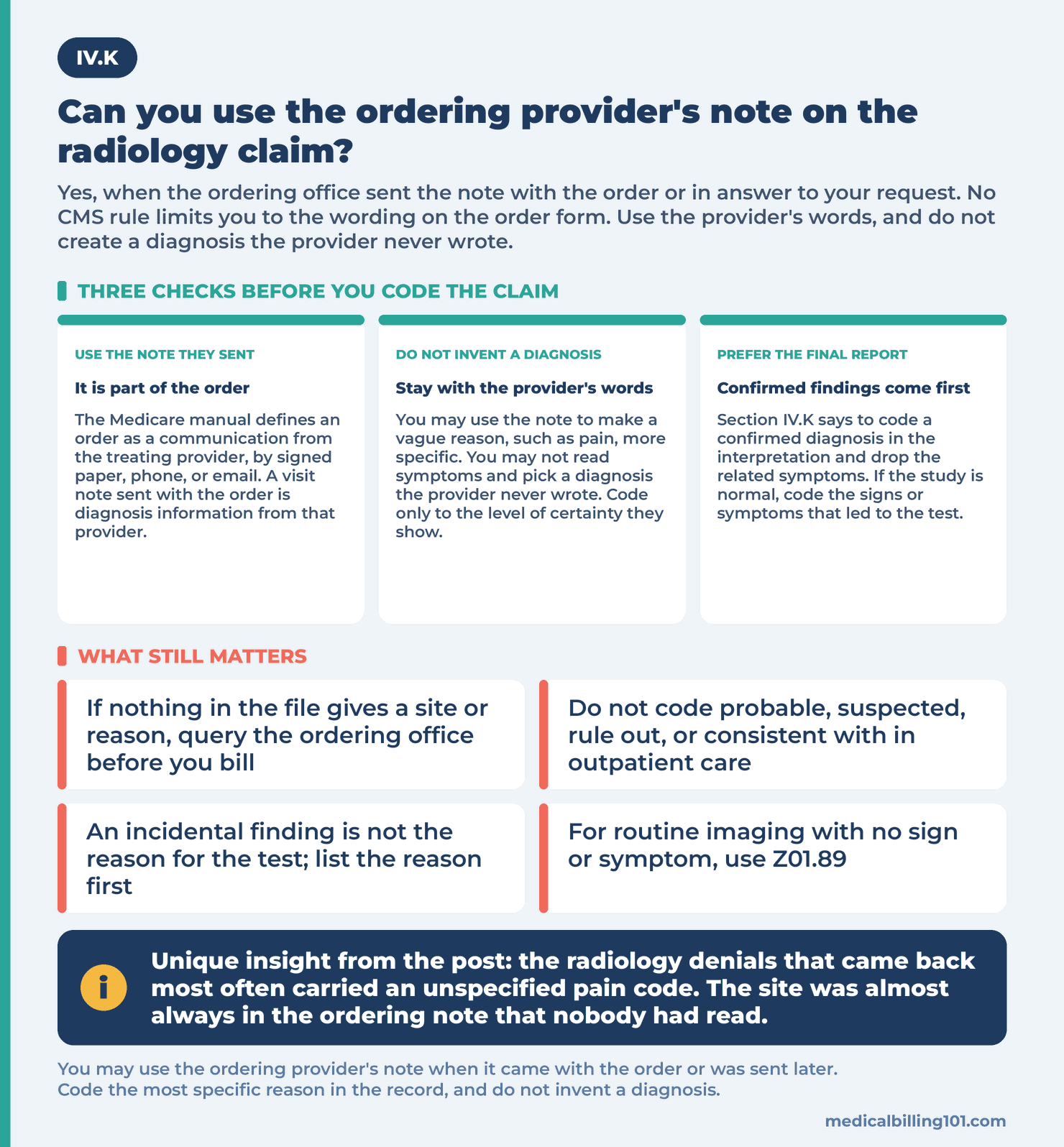
Yes, when the ordering office sent the note with the order or in answer to your request. That note is diagnosis information from the treating provider. No CMS manual or guideline limits the testing facility to the wording on the order form.
The Medicare Benefit Policy Manual, Chapter 15, section 80.6.1, defines an order as a communication from the treating provider. It may be a signed document, a phone call or an email. The provider must also document in the medical record the intent that the test be done.
The limit is who decides the diagnosis. The coder may not read symptoms in a note and pick a diagnosis the provider never wrote. Use the provider’s words, and code only to the level of certainty they show.
The CMS manual is the Medicare Benefit Policy Manual, Chapter 15. Its note says section 80.6 does not apply in a hospital setting, so a hospital outpatient department should also follow its own compliance policy.
Example scenario (fictional names), part 1
Radiology coding example: what happened
Brookfield Imaging Partners is a fictional radiology group in Ohio. Talia Brennerman leads its coding team. Dr. Oswin Marchetti reads its knee films.
An order for a knee x-ray said only “pain.” The ordering office sent its visit note with the order. The note said right knee pain after a fall at home.
The coder billed R52, Pain, unspecified. An internal auditor later said the team could never use the office note. A Medicare Advantage plan then denied a batch of similar claims for medical necessity.
Who was right? Keep reading, or jump to how the case was resolved.
Is there a CMS reference that supports using the ordering note?
The closest written rule is for labs. Under 42 CFR 410.32(d)(2), the billing entity keeps the documentation it gets from the ordering provider. It may also ask the ordering provider for more diagnostic information.
Section 410.32(d)(3) says a reviewer may ask the billing entity for the order and the diagnostic information the ordering provider supplied, including any codes or narratives. That text names diagnostic laboratory tests. I found no matching radiology rule, so cite it as support, not as a direct radiology mandate.
The rule is in 42 CFR 410.32 on eCFR. The Medicare Program Integrity Manual, Chapter 3, section 3.2.4, also lets reviewers contact other providers who hold supporting records.
AHA Coding Clinic has issued advice on outpatient testing. It is subscription material that I could not verify here, so it is not quoted in this post.
How do you code a radiology order that only says pain or MVA?
First, read the clinical history in the radiology report and any note sent with the order. If they name a site, code it. Order “pain” plus a note saying right knee pain becomes M25.561, Pain in right knee.
If nothing gives a site, you can code R52, Pain, unspecified, but many payers deny it for medical necessity. A short query to the ordering office for the site or reason is the better fix.
An order that says only “MVA” gives a cause, not a reason. Look for the injury or symptom in the note, such as S80.01XA, Contusion of right knee, initial encounter. External cause codes add detail, but the guidelines set no national requirement to report them.
Our ICD-10-CM guidelines cheat sheet sums up the symptom and uncertain-diagnosis rules in one place.
| What the file shows. | What to code. | Rule behind it. |
|---|---|---|
| Order says “pain,” office note says right knee pain. | M25.561, Pain in right knee. | IV.K, reason shown in the record. |
| Order says “pain,” nothing gives a site. | R52, or query the ordering office first. | IV.D, symptom when no diagnosis. |
| Order says “MVA,” note says right knee contusion. | S80.01XA, plus optional external cause codes. | IV.K and the external cause guideline. |
| Final report confirms a diagnosis for the symptom. | The confirmed diagnosis, not the symptom. | IV.K, final interpretation. |
| Report says “suspected” or “rule out.” | The signs or symptoms. | IV.H, uncertain diagnosis. |
| Routine imaging with no sign or symptom. | Z01.89. | IV.K, routine testing. |
Do you code signs and symptoms or the radiologist’s findings?
Code the radiologist’s confirmed findings when the final report is available. Section IV.K says to code any confirmed or definitive diagnosis in the interpretation. Do not add the related signs and symptoms as extra codes.
If the study is normal, code the signs or symptoms that led to the order. If the report only says “suspected” or “consistent with,” treat it as uncertain and code the symptoms.
An unrelated incidental finding is not the reason for the test. List the reason for the test first, and add the incidental finding after it when it is confirmed.
In my 10+ years in medical billing, the radiology denials that came back most often carried an unspecified pain code. The site was almost always in the ordering note that nobody had read.
How do you fix a radiology claim denied for diagnosis?
Start with the remit. A medical necessity denial often shows denial code CO-11 when the diagnosis does not fit the service. Then check the order, the note and the final report together.
If the file supports a more specific code, send a corrected claim. Our corrected claim guide lists the steps by payer type. If the code was right, appeal with the order and the note attached.
For coverage rules, compare your codes with the payer’s covered diagnosis list. Our post on 93306 denied for a diagnosis not covered by the LCD shows that check step by step. Our appeal letter generator gives you a starting letter.
Example scenario (fictional names), part 2
How the radiology case was resolved
- Talia showed the auditor the CMS definition of an order and section IV.K of the guidelines.
- She showed that the note came from the ordering office with the order, so it was diagnosis information the treating provider supplied.
- The final report found no fracture, so the reason for the test stayed a symptom.
Fix: the claims were corrected from R52 to M25.561, Pain in right knee, with the note kept in the billing file.
Outcome: the plan paid the corrected claims. The group now writes a policy on which ordering documents coders may use, and queries the office when nothing in the file gives a site.
Names and details are illustrative; no real patient data.
Where can you read more imaging billing answers?
For a PET diagnosis question, see which diagnosis code supports 78815 PSMA PET. For a professional component dispute, read why modifier 26 is denied for a SNF patient. For x-ray modifiers, see the x-ray claim changes for modifiers 50, 25, FX and FY.
The Medicare Program Integrity Manual is on the CMS PIM Chapter 3 page. Commercial payers may set their own documentation rules in their policies.
3-step checklist
- Read the order, any note sent with it and the final report before you pick a code.
- Code the confirmed diagnosis from the report, or the most specific symptom the provider wrote.
- Query the ordering office when no document gives a clear site or reason, and keep its answer on file.
FAQ
Can a radiology coder use the ordering provider’s office note?
Yes, when the note came to the testing site with the order or was sent by the ordering office later. Use only what the treating provider wrote. Do not read the note and decide a diagnosis yourself.
Does the radiology order have to list an ICD-10-CM code?
No national rule says the order must carry a code. It must carry the reason for the test. A narrative such as right knee pain after a fall is enough to code from.
What if the order only says pain?
Check the clinical history in the radiology report and any note sent with the order. If neither gives a site, code R52, Pain, unspecified, or ask the ordering office for a clearer reason.
Should you code a symptom or the finding in the report?
Code the confirmed diagnosis in the final interpretation when it explains the symptom. Do not add the related symptom as well. If the study is normal, code the signs or symptoms that led to the test.
Can the radiologist add a diagnosis that is not on the order?
Yes, when the radiologist confirms it in the final report. The guidelines tell you to code confirmed diagnoses from the interpretation. A suspected finding is not coded as a diagnosis in outpatient care.
Sources
My methodology was simple. I checked the FY 2027 guidelines, the CMS manuals, the federal rule text and the FY 2027 code descriptions.
- CMS and NCHS, ICD-10-CM Official Guidelines for Coding and Reporting FY 2027, sections IV.D, IV.H and IV.K (linked above). Accessed 28 Nov 2026.
- CMS, Medicare Benefit Policy Manual, Chapter 15, sections 80.6 and 80.6.1 (linked above). Accessed 28 Nov 2026.
- eCFR, 42 CFR 410.32(a) and (d), diagnostic tests (linked above). Accessed 28 Nov 2026.
- CMS, Medicare Program Integrity Manual, Chapter 3, sections 3.2.3.7 and 3.2.4 (linked above). Accessed 28 Nov 2026.
- CMS, FY 2027 ICD-10-CM code descriptions for M25.561, R52, S80.01XA and Z01.89. Accessed 28 Nov 2026.
Read about the author, or contact us with a question. See our editorial policy.
Last updated: 28 November 2026 · Educational content for U.S. coding and billing teams. Payer and facility policies may be stricter than the national rules shown here.