
The CO-P32 denial code means the payer cut your payment because liability for the injury was split, or apportioned, with another claim. The payer paid only its share. The remaining balance is not lost, but it usually belongs to a different claim, injury or insurance carrier. Your job is to find out which claim or carrier owes the other share, and then send that payer a complete bill for it. (Primary source: X12 Claim Adjustment Reason Codes)
In brief: reason code P32 is a share-of-liability cut, not a coding error. Ask the payer for the decision behind the split. If a real decision exists, bill the other claim for its share. If none exists, dispute the cut.
Part of our denial codes library. Written by Manikandan J, CPC, CRCR, who has worked comp remits for orthopedic and therapy clients with more than one open claim on the same body part. Published 28 November 2026. Last updated: 28 November 2026. Code wording quoted word for word from X12. Read about the author and our editorial policy, or contact us to report an error.
What does denial code CO-P32 mean?
Denial code CO-P32 says the payer adjusted the bill because of apportionment. In plain words, the payer believes it is responsible for only part of the treatment. Another claim, injury or insurance carrier is responsible for the remaining portion. The code itself does not say how large each share is, such as a 60/40 or a 50/50 split. That information comes from the payer’s claim file or from a compensation board decision.
| Field | Value |
|---|---|
| Code | P32 |
| Description | “Payment adjusted due to Apportionment.” |
| Use | Mostly workers’ comp and other injury claims |
| Group codes | No X12 group restriction; CO is the usual pairing |
| Start | 08/01/2022 |
| Remark codes | Vary by payer; read the line-level remark |
Source: X12 Claim Adjustment Reason Codes, checked 28 November 2026.
Methodology: the code wording is copied from the X12 list. The New York example follows the Board’s own table of required comp codes and its CMS-1500 billing rules. Other states handle apportionment in their own way.
Key terms: Apportionment is the split of liability between two or more causes or claims. A WCB case number is the number the New York Board gives each comp claim. Box 11b qualifier Y4 marks a property and casualty claim number on the CMS-1500.
CO-P32 vs OA-P32: who owns the unpaid share?
CO-P32 tells you the cut is the provider’s to resolve with the payers, so the worker should not get the bill. OA-P32 may show up too, because X12 sets no group limit on P32. With either group, the unpaid portion normally points to another claim that carries its own separate liability. The key step is the same: find which claim owns it.
| Group | What it suggests | First move |
|---|---|---|
| CO-P32 | Provider resolves the unpaid share with the payers | Ask for the decision behind the split |
| OA-P32 | Other adjustment, owner not named | Ask which claim the payer thinks owes the rest |
Example scenario (fictional names), part 1
CO-P32 Denial Example: What Happened
Tanya Brooks bills for Hudson Ridge Orthopedics in New York. Dr. Samuel Okafor treats a warehouse picker for his right knee. The worker has two accepted comp claims for that knee. One is a 2019 claim with the fictional carrier Brightwater Comp. The other is a 2025 claim with Old Mill Casualty.
Tanya billed a follow-up visit, 99214, with S83.241D (entered as S83241D), only to Old Mill. The remit paid part of the fee schedule amount. The rest came back as CAS*CO*P32.
Why would a carrier on an accepted claim pay only part of the visit? Keep reading, or jump to how the CO-P32 denial was resolved.
What causes a CARC P32 apportionment cut?
A P32 reduction appears when the payer believes another claim shares responsibility for the same treatment. For example, a worker may hurt the same knee in two separate work accidents. Here are the usual causes.
| Cause | What it looks like |
|---|---|
| Board decision split two claims | Payer pays its percentage only |
| Prior injury on the same body part | Payer points to an older claim |
| Bill sent to one claim only | Other claim never billed |
| Wrong or missing claim details | Payer cannot link the visit to its share |
| No decision at all | Payer applies a split on its own |
The New York Board’s required CARC and RARC table says payers use P32 when they reduce payment after a resolved apportionment of liability among other injuries. It lists the code as non-reportable and cites Workers’ Compensation Law sections 10 and 44.
How do I fix a CO-P32 denial?
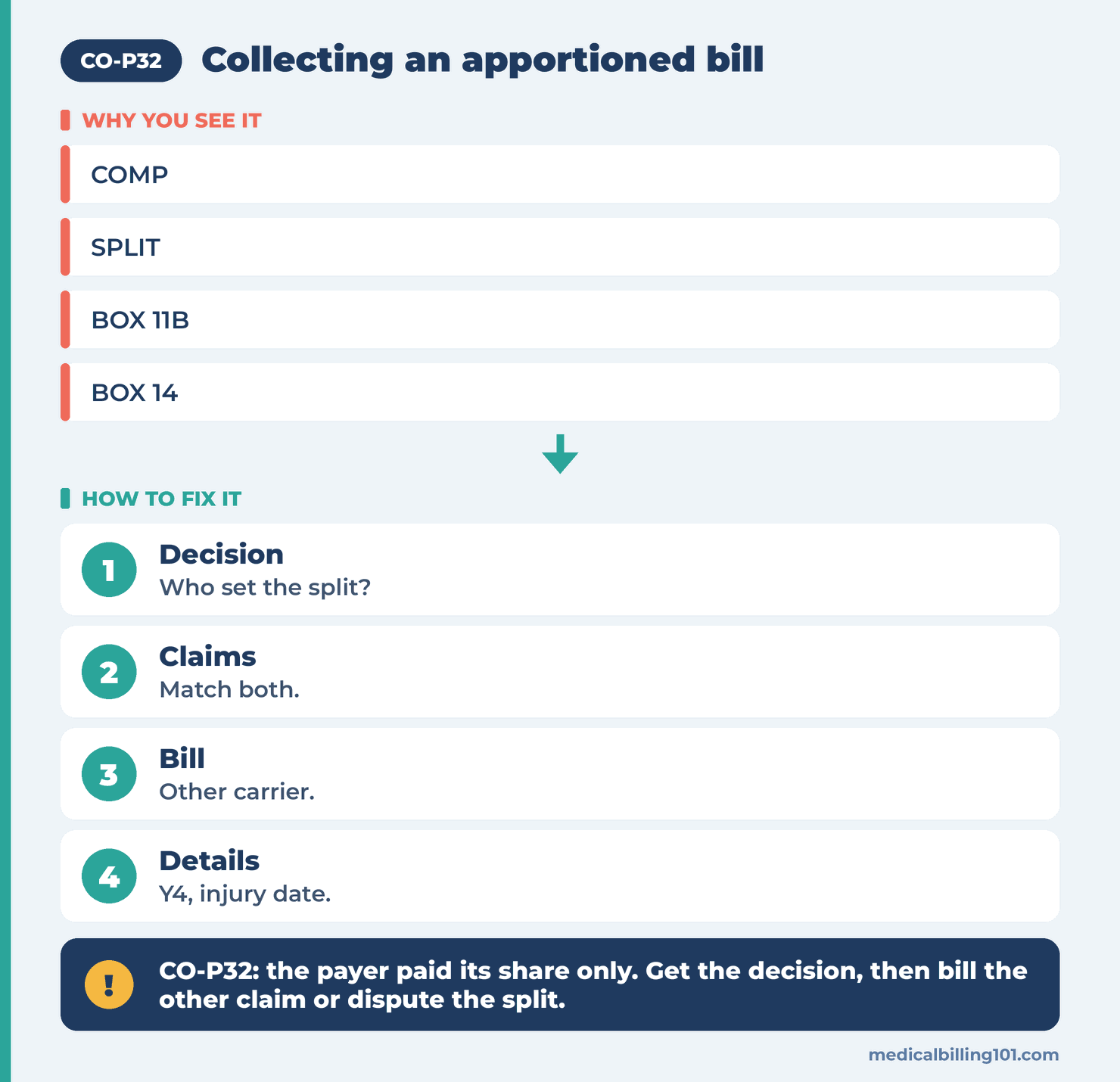
To fix CO-P32, first get the decision that set the split. Then bill the other claim for its share, using that claim’s own claim number, carrier name and date of injury. If the payer cannot show a decision, dispute the cut instead of rebilling.
| Step | Action | Where to check |
|---|---|---|
| 1 | Ask for the decision and the percentages | Adjuster or Board file |
| 2 | Match the visit to both claims | Treating report and claim list |
| 3 | Bill the other carrier for its share | New bill under that claim |
| 4 | Use that claim’s number and injury date | Box 11b (Y4), Box 11c and Box 14 |
| 5 | Attach the narrative and the decision | Medical narrative report |
| 6 | No decision on file? Dispute the cut | Payer review, then the Board process |
The Board’s CMS-1500 requirements page says every bill needs a medical narrative. Its sample physician bill shows the carrier claim number in Box 11b with qualifier Y4. NUCC defines Box 14 qualifier 431 as the onset date in its 1500 instructions.
Example scenario (fictional names), part 2
How the CO-P32 Denial Was Resolved
Tanya asked Old Mill for the basis of the cut. The adjuster sent a Board decision that split liability for the knee, 60 percent to the 2025 claim and 40 percent to the 2019 claim. Nobody in the office had ever sent a bill to Brightwater for the knee visits.
Fix: Tanya sent a new bill to Brightwater under the 2019 claim. Box 11b carried qualifier Y4 and the Brightwater claim number. Box 11c named Brightwater, and Box 14 showed the 2019 injury date with qualifier 431. She attached the narrative and the decision.
Outcome: Brightwater paid its 40 percent share. Tanya now flags any patient with two claims on one body part, so both carriers get a bill on day one.
Names and details are illustrative; no real patient data.
Names and details are illustrative; no real patient data.
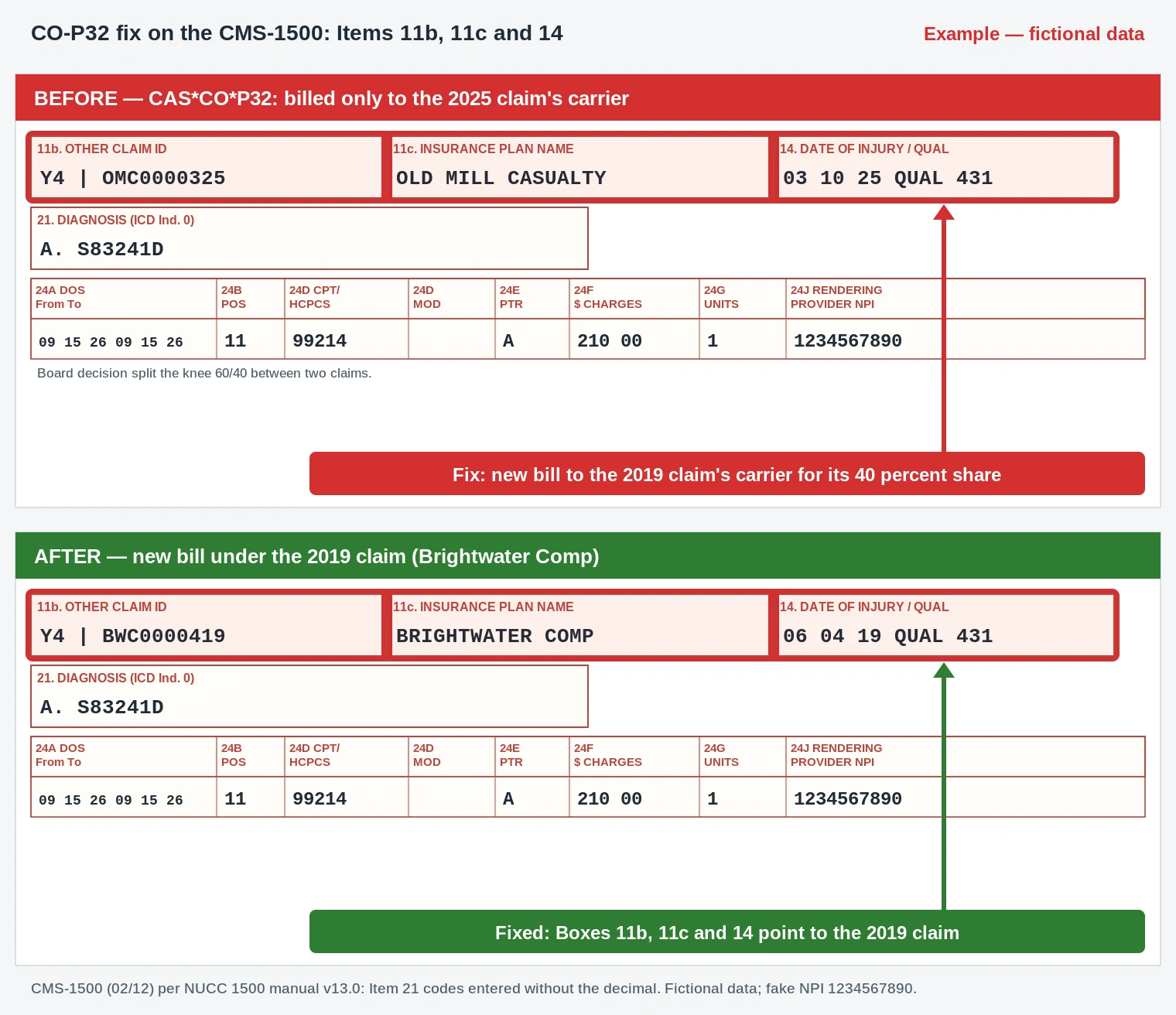
- Box 11b: qualifier Y4 now carries the Brightwater claim number for the 2019 claim, not the Old Mill number.
- Box 11c: the plan name changes to Brightwater Comp; this is a new bill to a second carrier, so Box 22 stays blank.
- Box 14: the 2019 date of injury with qualifier 431 (onset of current symptoms or illness).
- Box 21 / Box 24D: S83.241D (entered as S83241D) and 99214 are unchanged; the Board decision and narrative go with the bill.
- UB-04: not shown; the physician office bills New York comp only on the CMS-1500.
Can I bill the injured worker for a P32 cut?
No. A P32 cut moves the unpaid share to another claim or payer, not to the worker. In New York, a provider treating an accepted comp claim should look to the carriers for payment. Bill the other claim, or dispute the cut if there is no decision behind it.
Related codes
| Code | Meaning |
|---|---|
| CO-P12 | Workers’ comp fee schedule adjustment |
| CO-P13 | Payment reduced or denied under a workers’ comp rule |
| CO-B20 | Service partly or fully furnished by another provider |
| CO-P30 | Exacerbation denied for incomplete records |
| CO-P31 | Exacerbation care past the time allowed |
FAQ
What does CO-P32 mean?
The payer paid only its share of the bill because liability for the injury was split with another claim or cause.
Is CARC P32 only for workers’ comp?
The X12 text has no line of business limit. In practice it shows up mostly on comp and other injury claims.
How is P32 different from B20?
B20 is for care partly given by another provider. P32 is a split of liability between claims or injuries.
Where does the other share come from?
Usually from the carrier on the other claim. Send that carrier its own bill with its claim number and injury date.
What if the payer has no decision for the split?
Ask for one in writing. If it has none, dispute the cut through payer review and then the state process.
Sources
How we checked: the CARC P32 quote was matched word for word with the X12 CARC list on 28 November 2026. The New York rules come from the Board’s code table and its CMS-1500 pages.
- X12, Claim Adjustment Reason Codes (CARC P32, P12, P13, B20, P30, P31). Accessed 28 Nov 2026.
- New York Workers’ Compensation Board, Required CARC and RARC codes for payment objections. Accessed 28 Nov 2026.
- New York Workers’ Compensation Board, CMS-1500 requirements. Accessed 28 Nov 2026.
- New York Workers’ Compensation Board, CMS-1500 sample, authorized physician. Accessed 28 Nov 2026.
- NUCC, 1500 Claim Form Instructions. Accessed 28 Nov 2026.
Last updated: 28 November 2026 · Educational content; not legal advice.