
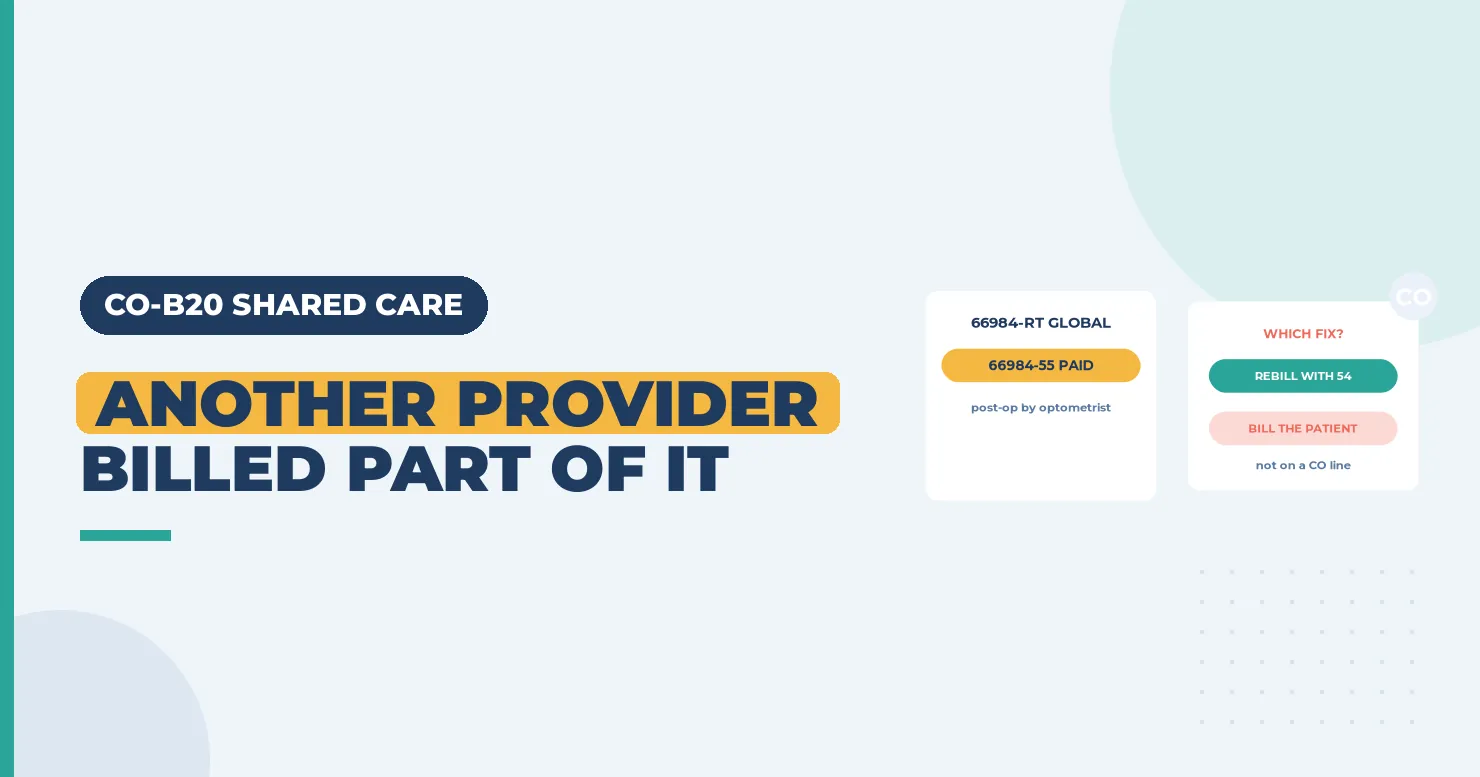
The CO-B20 denial code means the payer believes another provider already performed, and was paid for, part or all of the service on your claim. It shows up most with split surgical care, where one doctor operates and another handles the follow-up. The fix is to bill only your part, with the right modifier, or to appeal if your part was never billed by anyone else. (Primary source: X12 Claim Adjustment Reason Codes)
In brief: reason code B20 means two providers claimed the same piece of care. Find out who billed what. If care was shared, bill your portion with modifier 54 or 55. If you did the whole service, appeal with your notes.
Part of our denial codes library. Written by Manikandan J, CPC, CRCR, who has worked shared-care denials for eye surgery, orthopedic and general surgery practices. Published 20 November 2026. Last updated: 20 November 2026. Code wording quoted word for word from X12. Read about the author and our editorial policy, or contact us to report an error.
What does denial code CO-B20 mean?
Denial code CO-B20 says the procedure or service was partly or fully given by someone else. The payer has a claim on file from another provider for the same patient, procedure and date. Common triggers include surgery with shared post-op care, such as cataract surgery co-managed with an optometrist, and tests that another office already billed.
| Field | Value |
|---|---|
| Code | B20 |
| Description | “Procedure/service was partially or fully furnished by another provider.” |
| Group codes | No X12 group restriction; CO is the usual pairing |
| Start | 01/01/1995 (last modified 09/30/2007) |
| Common remarks | N472, N347 |
Source: X12 Claim Adjustment Reason Codes, checked 20 November 2026.
Methodology: the code wording is copied from the X12 list, and the split-care rules come from the CMS manual and the CMS global surgery booklet cited below.
Key terms: a global surgical package bundles the surgery with set pre-op and post-op care. Modifier 54 bills surgical care only. Modifier 55 bills post-op management only. A transfer of care agreement is the written note in which two doctors agree who handles which part.
CO-B20 or OA-B20: which one did you get?
| Group | Who carries the amount | What to do |
|---|---|---|
| CO-B20 | Your practice, as a contractual write-off; the patient is not billed | Bill your part or appeal |
| OA-B20 | No one is named, often a secondary payer repeating the primary result | Settle the split with the primary payer first |
Example scenario (fictional names), part 1
CO-B20 Denial Example: What Happened
Grace Liu bills for Ridgeline Eye Surgeons. Dr. Hannah Cole removed a cataract from a patient’s right eye, H25.11, and billed 66984-RT as a full global service.
The patient’s local optometrist, Dr. Sam Whitfield, handled all follow-up visits. His office billed first. When Dr. Cole’s claim arrived, the 835 showed CAS*CO*B20 with remark code N472, “Payment for this service has been issued to another provider.”
Dr. Cole did the surgery. So how could another provider be paid for it? Keep reading, or jump to how the CO-B20 denial was resolved.
How does split surgical care cause B20?
The CMS Claims Processing Manual, Chapter 12, section 40.2 says that when doctors agree on a transfer of care, the surgeon bills with modifier 54 and the doctor taking over bills with modifier 55. Both claims carry the same procedure code and the same date of service. The post-op doctor shows the date care was assumed in Item 19 of the CMS-1500.
| Who did what | Surgeon bills | Other doctor bills |
|---|---|---|
| Surgeon did everything | Procedure, no modifier | Nothing |
| Surgeon operated, other doctor took all post-op care | Procedure with 54 | Procedure with 55, date assumed in Item 19 |
| Surgeon saw the patient for a few days, then handed off | Procedure with 54, plus the date care was given up | Procedure with 55, date assumed |
Both doctors must keep a copy of the written transfer agreement in the patient’s record. The CMS global surgery booklet explains what each part of the package includes.
How do I fix a CO-B20 denial?
To fix a CO-B20 denial, call the payer or check the portal to learn which provider was paid and with what modifier. Then compare that with your notes and any transfer agreement.
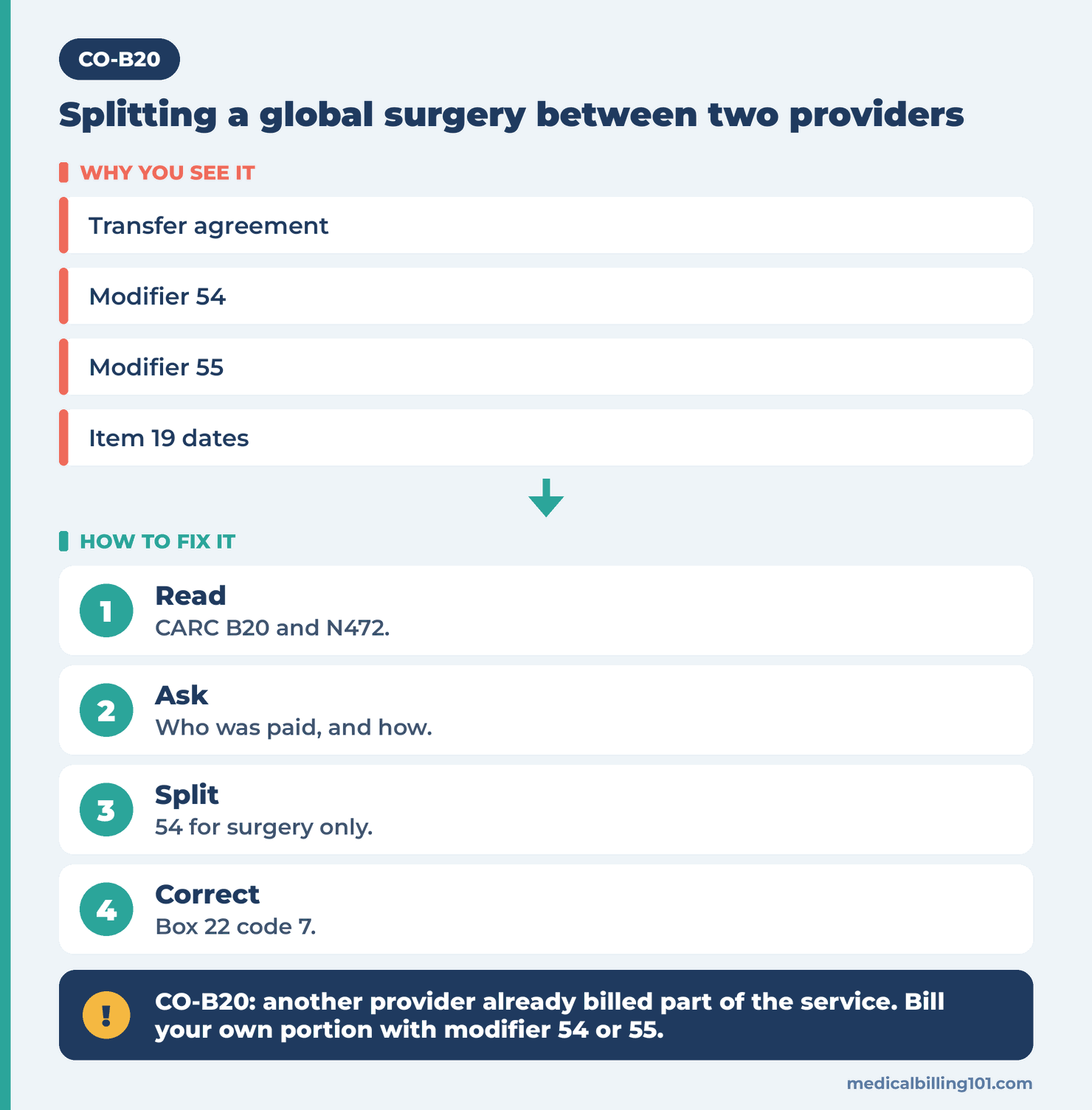
| Situation | Fix | Proof |
|---|---|---|
| Care was shared under an agreement | Corrected claim with modifier 54, Box 22 code 7 | Transfer agreement |
| You did all the care; the other office billed in error | Appeal and ask the payer to recover from the other office | Your op note and post-op visit notes |
| Test already billed by the ordering office | Ask the other office to void, or write off | Purchase or reading agreement |
| No agreement and both offices billed | Talk to the other office; only one global fee can be paid | Visit dates |
Example scenario (fictional names), part 2
How the CO-B20 Denial Was Resolved
Grace pulled the chart and called the optometrist’s office. Here is what she found:
- A signed transfer of care agreement was in the chart, dated the day of surgery.
- Dr. Whitfield billed 66984-55-RT with the date he assumed care in Item 19.
- Dr. Cole gave up care at discharge, so she should have billed surgical care only.
Fix: she sent a corrected claim with code 7 in Box 22 and the original claim number. Box 24D changed to 66984 with modifiers 54 and RT. H25.11 stayed the same.
Outcome: the payer paid the surgical portion of the global fee. Grace added a check that asks for the transfer agreement on every co-managed surgery before the charge posts.
Names and details are illustrative; no real patient data.
Names and details are illustrative; no real patient data.
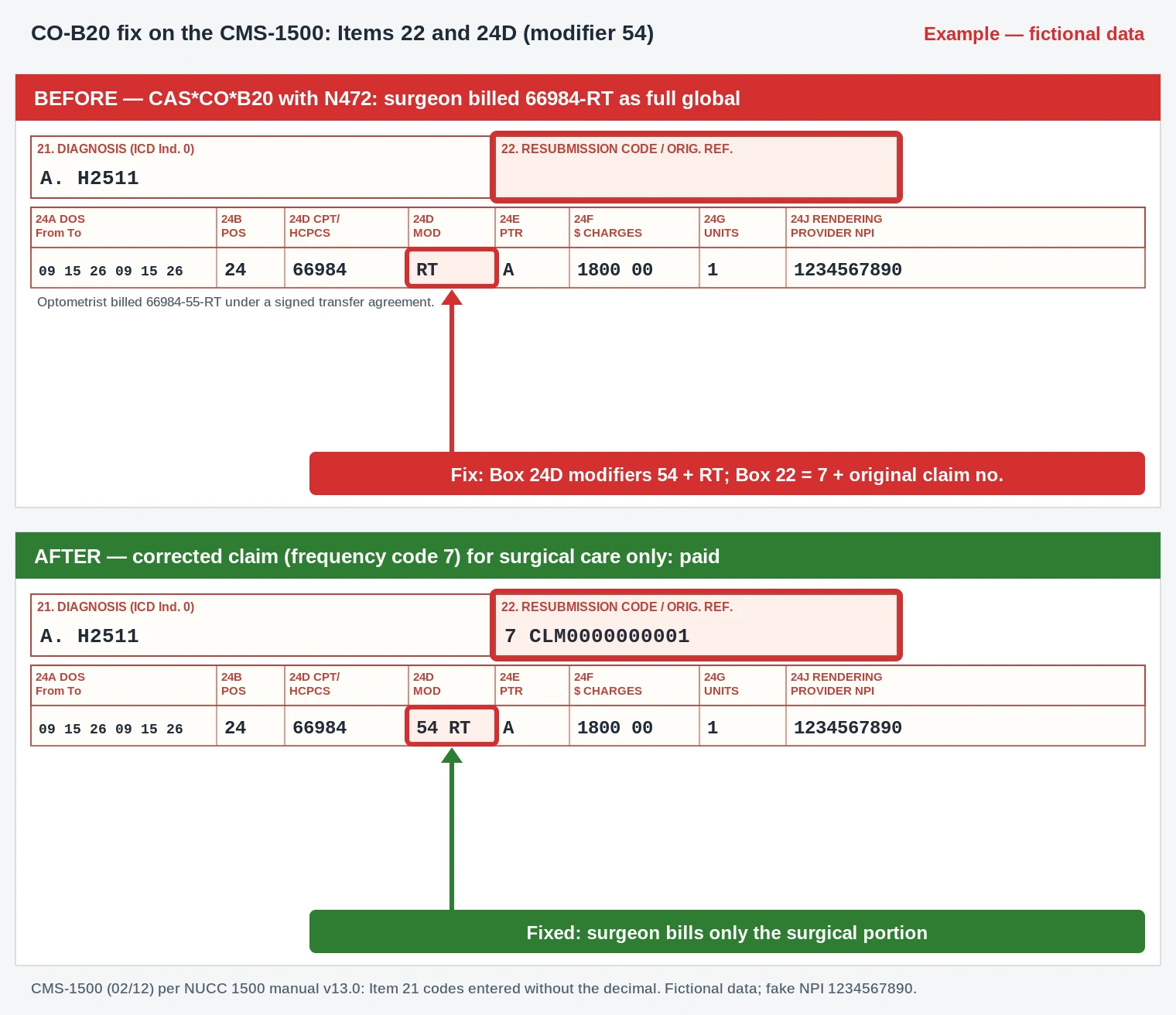
- Box 24D: modifier 54 added to 66984-RT, because the surgeon gave up care at discharge under a written transfer agreement.
- Box 24A: the date of service stays the date of surgery, matching the optometrist’s 66984-55 claim.
- Box 22: resubmission code 7 (corrected claim) with the original claim number.
- Box 21: H25.11 (entered as H2511) is unchanged.
- UB-04: not shown; split global modifiers apply to the surgeon’s professional fee, not facility fees.
Can I bill the patient for a CO-B20 denial?
No. The CO group code makes the denied amount a contractual provider write-off. Splitting care between two doctors should never raise what the patient pays for the global package.
How do I prevent CARC B20?
Prevent it by deciding the split before surgery and putting it in writing. Flag co-managed cases at scheduling, such as cataract surgery with an outside optometrist, so the surgeon’s charge goes out with modifier 54. For example, an eye practice that bills every 66984 as global will see B20 whenever a partner optometrist bills first.
Related codes
| Code | Meaning |
|---|---|
| CO-B13 | Previously paid; payment may have been made in an earlier payment |
| CO-B10 | Allowed amount reduced because a component was already paid |
| CO-54 | Multiple physicians or assistants are not covered in this case |
| CO-4 | Procedure code inconsistent with the modifier used |
FAQ
What does CO-B20 mean?
The payer believes another provider already performed and billed part or all of the service.
Which modifier fixes a split surgery B20?
Modifier 54 for the surgeon who did surgical care only, and modifier 55 for the doctor who took over post-op care.
Do both doctors need a transfer agreement?
Yes. CMS expects both to keep a copy of the written agreement in the patient’s record.
Which remark codes come with B20?
N472 says payment went to another provider. N347 is used when a referred or purchased service was already paid.
Which group code comes with CARC B20?
X12 sets no group restriction. CO is the most common pairing.
Sources
How we checked: the CARC B20 quote was matched word for word with the X12 CARC list on 20 November 2026, and N472 and N347 with the X12 RARC list.
- X12, Claim Adjustment Reason Codes (CARC B20, B13, B10, 54, 4). Accessed 20 Nov 2026.
- X12, Remittance Advice Remark Codes (N472, N347). Accessed 20 Nov 2026.
- CMS, Medicare Claims Processing Manual, Chapter 12 (section 40.2, split global surgery). Accessed 20 Nov 2026.
- CMS, Global Surgery booklet (MLN907166). Accessed 20 Nov 2026.
- NUCC, 1500 claim form reference instruction manual. Accessed 20 Nov 2026.
Last updated: 20 November 2026 · Educational content; not legal advice.