
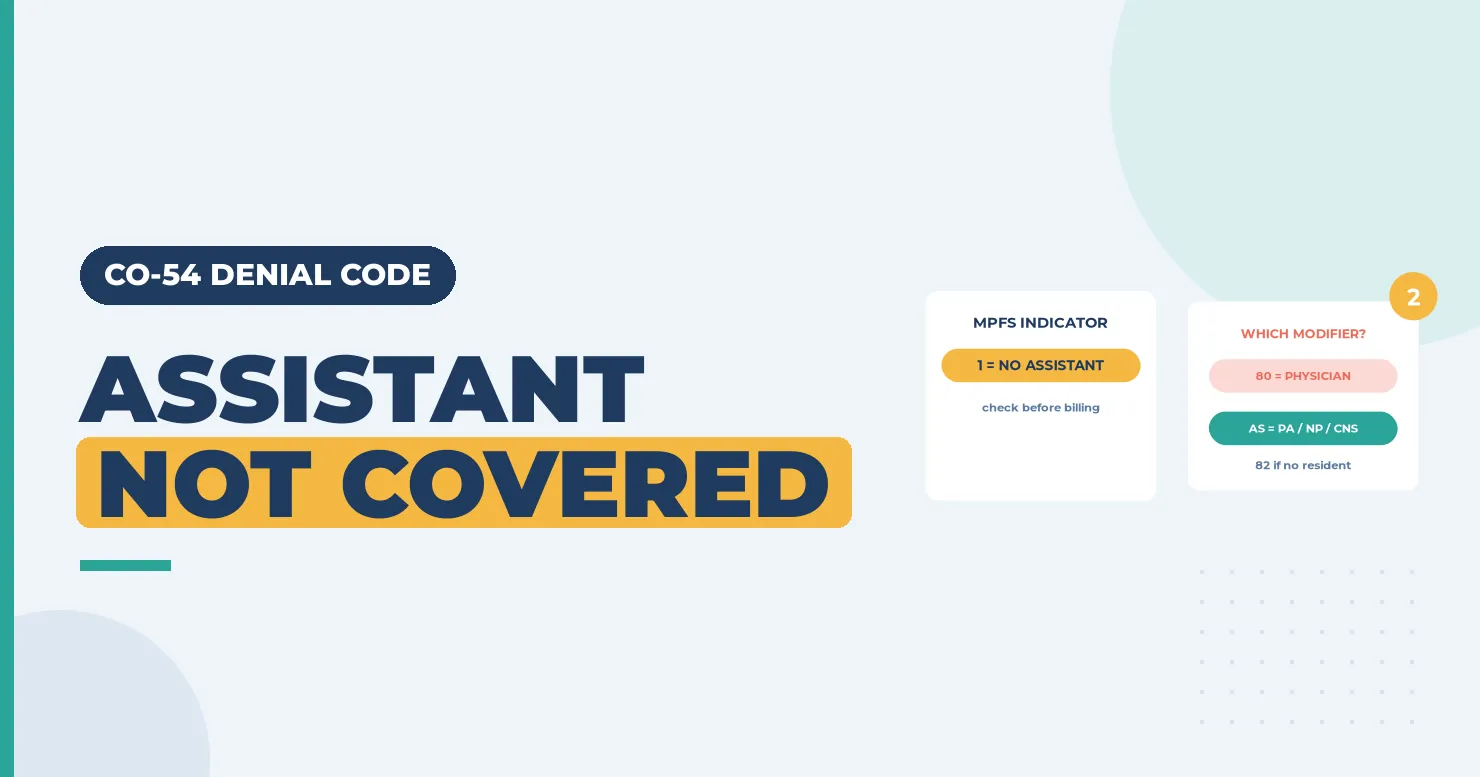
CO-54 means the payer won’t pay for more than one physician or assistant on this procedure. It hits assistant surgeon claims most often, but it can also land on co-surgeon or team surgery claims. The payer is saying the extra surgeon isn’t covered for this code. Most of the time the answer sits in one place. It’s the payment flags in the Medicare fee schedule, which many other payers copy. (Primary sources: X12 Claim Adjustment Reason Codes · CMS Physician Fee Schedule Relative Value Files).
In brief: CO-54 means “Multiple physicians/assistants are not covered in this case.” Look up the procedure’s assistant at surgery indicator (and the co-surgery and team surgery indicators if you used modifier 62 or 66). Indicator 1 means Medicare won’t pay an assistant at all. Indicator 0 means you need records showing medical necessity. Check the modifier and the teaching-hospital rules, then rebill or appeal.
Part of our denial codes library. Written by Manikandan J, CPC, CRCR, who has coded and appealed surgical claims for payers and billing companies. Published 20 October 2026. Last updated: 20 October 2026. Code wording is quoted word for word from X12.
Official CARC 54 text
| Field | Official X12 text |
|---|---|
| Description | “Multiple physicians/assistants are not covered in this case.” |
| Usage | “Refer to the 835 Healthcare Policy Identification Segment (loop 2110 Service Payment Information REF), if present.” |
| Start | 01/01/1995 |
| Last modified | 07/01/2017 |
Source: X12 Claim Adjustment Reason Codes, checked 20 October 2026.
Denial code 54, CARC 54 and reason code 54
You’ll see denial code 54 in portals, CARC 54 on the 835 and reason code 54 in team chats. They are one code. Under CO, the contract keeps the amount with the provider, so the assistant can’t bill the patient for it.
The three indicators behind most CO-54 denials
The Medicare fee schedule file lists payment indicators for every CPT code. An assistant at surgery indicator is the field that says whether Medicare pays a second surgeon who helps the primary surgeon. A co-surgeon indicator is the field that says whether two surgeons can each bill their distinct parts of one procedure. A team surgery indicator is the field for procedures that need a team of surgeons.
| Indicator value | Assistant at surgery (80, 81, 82, AS) | Co-surgery (62) | Team surgery (66) |
|---|---|---|---|
| 0 | Payment restriction applies unless records show medical necessity | Not permitted | Not permitted |
| 1 | Statutory restriction: not paid | Allowed with records | Allowed with records |
| 2 | Paid | Allowed, no records needed | Allowed, payment by report |
| 9 | Concept doesn’t apply | Concept doesn’t apply | Concept doesn’t apply |
Check the current-year file, because indicators can change. If you billed modifier 80 on an indicator 1 code, CO-54 is the expected result.
Which modifier fits the assistant?
| Modifier | Who assisted | Notes |
|---|---|---|
| 80 | Assistant surgeon, a physician | Full assistant role |
| 81 | Minimum assistant surgeon | Assisted for a small part only |
| 82 | Assistant surgeon when a qualified resident wasn’t available | Teaching hospital cases |
| AS | Physician assistant, nurse practitioner or clinical nurse specialist | Non-physician assistant |
A wrong modifier is a common cause of CO-54. For example, a PA’s claim billed with 80 instead of AS, or a teaching-hospital claim billed with 80 instead of 82.
Teaching hospitals and resident availability
Teaching hospitals have their own rule. If the hospital trains residents in that specialty, Medicare expects a resident to assist, so it usually won’t pay an outside assistant. There are a few exceptions. The main one is when no qualified resident was free to help. In that case, use modifier 82 and add a note to the record that says why no resident could assist. The CMS Claims Processing Manual, Chapter 12 sets out the rules.
Remark codes you may see with CO-54
Remark wording comes from the X12 RARC list:
- N646, “Reimbursement has been adjusted based on the guidelines for an assistant.” This often shows on a reduced, not denied, assistant line.
- N247 to N250 say the assistant’s taxonomy, name or ID is missing or wrong. These need a data fix, not an appeal.
How to work a CO-54
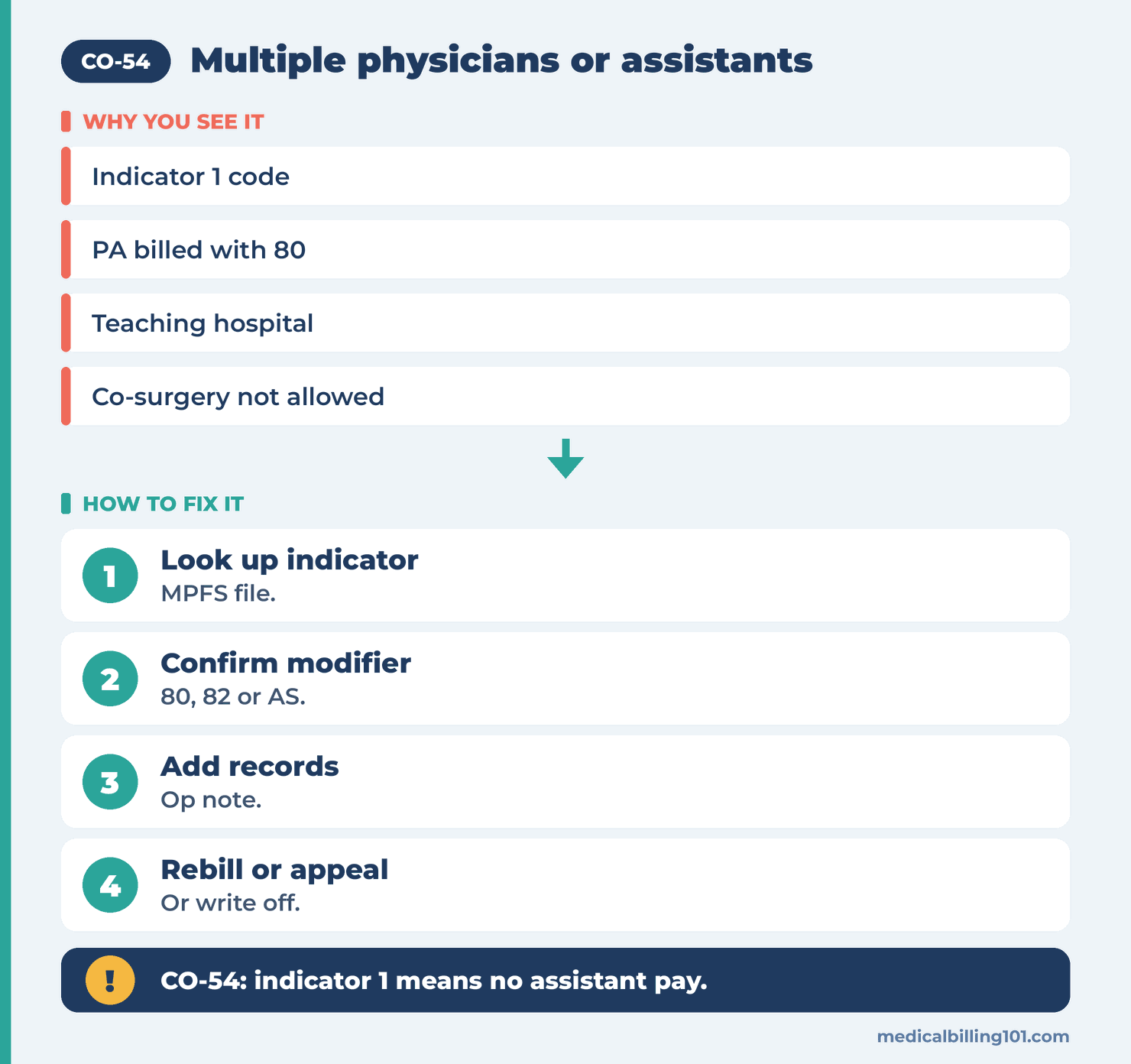
- Look up the indicator for the CPT code and date of service in the fee schedule file or the payer’s policy.
- Confirm the modifier. 80, 81, 82 or AS should match who assisted and where.
- Check the setting. In a teaching hospital, document why no resident could help.
- Add the records when the indicator is 0. The op note must show why a helper was needed.
- Rebill with a corrected claim (frequency code 7) if the modifier or the assistant’s data was wrong.
- Appeal when the indicator allows it or the records prove the need. Write it off when the indicator is 1.
Worked example (illustrative)
A PA helps on a gallbladder removal by scope, and the practice bills CPT 47562 with modifier 80. The payer denies with CAS*CO*54*310.00. The coder checks the fee schedule and finds the assistant indicator allows payment. The issue is the modifier. Modifier 80 is for physicians, so the claim is rebilled as a corrected claim with modifier AS. The payer pays the reduced non-physician assistant rate.
Consider a second case. A surgeon assists on a code with assistant indicator 1. The indicator means Medicare won’t pay any assistant, so no appeal will help. The practice writes off the line under CO and updates its charge rules so the assistant line isn’t billed again for that code.
Prevention checklist
- [ ] Check assistant, co-surgery and team surgery indicators before scheduling.
- [ ] Build charge edits that block modifier 80 on indicator 1 codes.
- [ ] Use AS for PAs, NPs and CNSs, not 80.
- [ ] Note resident availability in teaching-hospital op reports.
- [ ] Make sure the op report names the assistant and what they did.
Related denial codes
- CO-4: procedure code inconsistent with the modifier.
- CO-59: multiple or concurrent procedure rules.
- CO-50: not deemed a medical necessity.
- CO-97: service included in another service.
- CO-8: procedure inconsistent with provider type.
- Denial codes hub for every code we cover.
Key takeaways
CO-54 means the payer won’t pay for a second surgeon or helper on this code. Look up the indicator first. If it’s 1, write it off. If it’s 0, send the records. Fix modifier errors with a corrected claim, use AS for non-physician assistants, and document resident availability in teaching hospitals.
FAQ
What does CO-54 mean?
It means the payer doesn’t cover more than one physician or an assistant for this procedure.
What is assistant at surgery indicator 1?
It means the law bars payment, so Medicare won’t pay any assistant on that code.
Should a PA bill modifier 80 or AS?
AS. Modifier 80 is for a physician assistant surgeon.
Can CO-54 apply to co-surgeons?
Yes. If you billed modifier 62 on a code where co-surgery isn’t permitted, the payer may use CARC 54.
Can I bill the patient for CO-54?
No. Under the CO group, the contract keeps the amount with the provider.
When should I appeal a CO-54?
Appeal when the indicator is 0 or 2 and the records show the assistant was needed.
Sources
How we checked: every code quote on this page was compared word for word with the X12 CARC and RARC lists on 20 October 2026.
- X12, Claim Adjustment Reason Codes (CARC 54). Accessed 20 Oct 2026.
- X12, Remittance Advice Remark Codes (N646, N247 to N250). Accessed 20 Oct 2026.
- CMS, Physician Fee Schedule Relative Value Files. Accessed 20 Oct 2026.
- CMS, Medicare Claims Processing Manual, Ch. 12, Physicians/Nonphysician Practitioners. Accessed 20 Oct 2026.
Last updated: 20 October 2026 · This page is educational and doesn’t replace payer contracts or coding rules.