
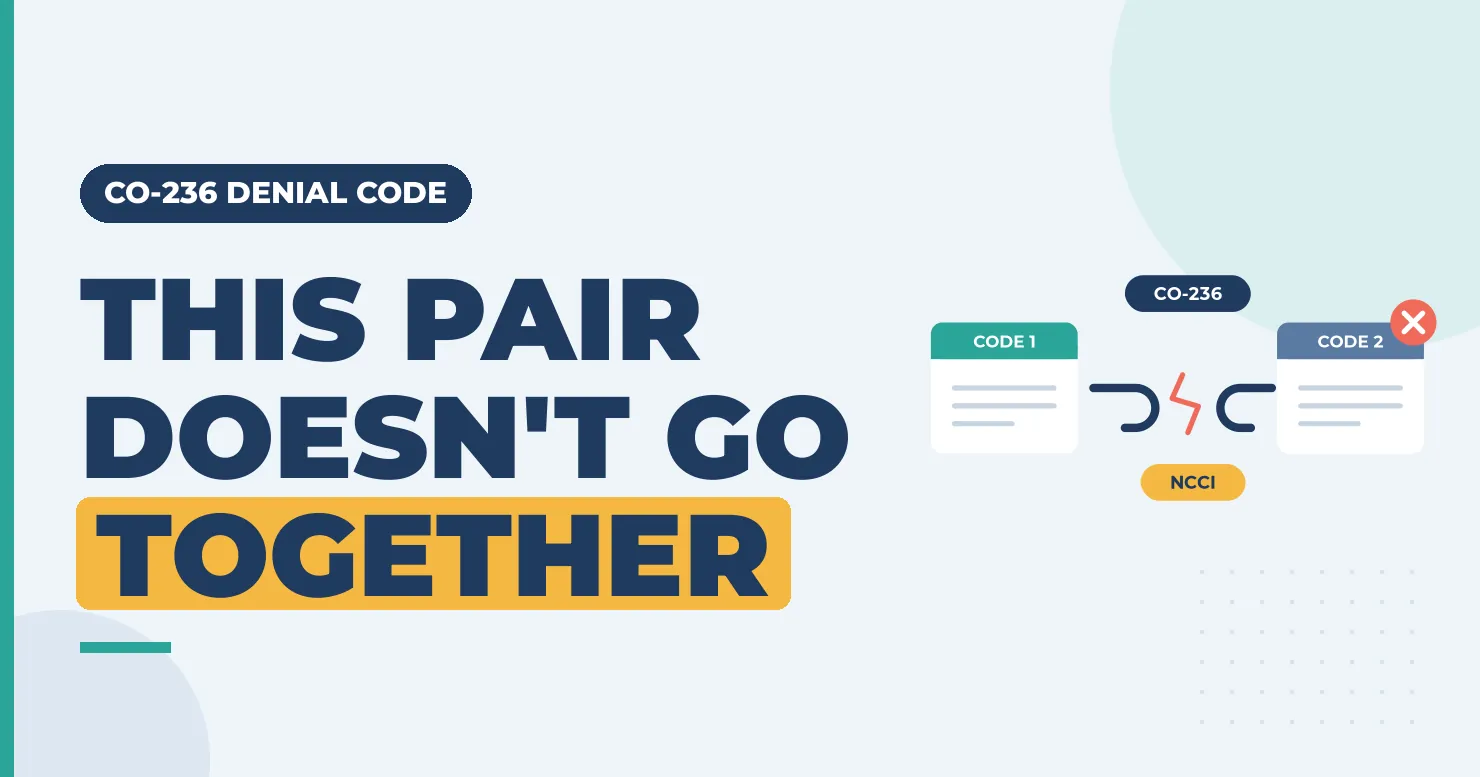
CO-236 is a Claim Adjustment Reason Code that means a procedure, or a procedure and modifier combination, can’t be paid with another service billed for the same patient on the same day under the National Correct Coding Initiative (NCCI) or a workers’ compensation fee schedule. The CO group code keeps it off the patient’s bill. (Primary sources: X12 Claim Adjustment Reason Codes · CMS Medicare Claims Processing Manual, Ch. 23, §20.9 · CMS NCCI PTP edits)
Quick answer: CO-236 means an NCCI procedure-to-procedure edit stopped one code in a same-day pair. You can’t bill the patient, and an ABN doesn’t change that. Look up the pair and its modifier indicator. If it’s 1 and the record shows a distinct service, add the right modifier and resubmit. If it’s 0, the denial stands.
Part of our denial codes library. Written by Manikandan, a revenue cycle management specialist with more than 10 years of US medical billing experience. Last reviewed: 6 October 2026. Official code wording is quoted word for word from X12; Medicare rules link to their CMS or Medicare contractor source.
CO-236 denial code description (official X12 wording)
X12 Claim Adjustment Reason Code 236, verbatim:
“This procedure or procedure/modifier combination is not compatible with another procedure or procedure/modifier combination provided on the same day according to the National Correct Coding Initiative or workers compensation state regulations/ fee schedule requirements.”
Source: X12 Claim Adjustment Reason Codes, checked 6 October 2026. Start: 01/30/2011 | Last Modified: 07/01/2013.
The code names two rule sets. For Medicare and most coding work, it’s NCCI. For injury claims, it can be a state workers’ compensation fee schedule that has its own pairing rules. Note “procedure/modifier combination”: a pair can fail because of the modifier used, not just the codes.
What CO-236 means in plain English
Each part of the code answers a different question:
- CO (Contractual Obligation) means the provider carries the amount. CMS describes CO adjustments as amounts “generally… considered a write off for the provider and are not billed to the patient” (Medicare Claims Processing Manual, Ch. 22, §60.1).
- CARC 236 means the payer’s edit found two codes on the same date that its rules don’t pay together as billed.
- The NCCI edit behind it has a Column 1 code (usually paid) and a Column 2 code (usually denied), plus a modifier indicator that says whether a modifier can ever break the pair.
CMS is direct about what kind of denial this is: “A denial of services due to a PTP edit is a coding denial, not a medical necessity denial” (CMS, Ch. 23, §20.9.3.1, effective July 16, 2026).
CO-236 vs CO-97, CO-4 and CO-151
| Code | Official X12 text (short) | What it tells you |
|---|---|---|
| 236 | “…not compatible with another procedure… according to the National Correct Coding Initiative…” | A same-day PTP pair failed. CMS tells MACs to use 236 for PTP edits |
| 97 | “The benefit for this service is included in the payment/allowance for another service/procedure that has already been adjudicated.” | Bundled into a paid service, for example post-op care in a global period. Some payers also report pair edits as 97 |
| 4 | “The procedure code is inconsistent with the modifier used.” | The modifier itself doesn’t fit the code |
| 151 | “Payment adjusted because the payer deems the information submitted does not support this many/frequency of services.” | Too many units. CMS assigns 151 for MUE edits |
The CMS rule reads: “MACs shall assign CARC 236 with Group Code CO and MSN 16.8 for claims that fail the PTP edits,” and “CARC 151 with Group Code CO for claims that fail the MUE edits.” For the CO-97 side, see our CO-97 guide. For modifier mismatches, see CO-4.
CO-236 vs PR-236 vs OA-236 vs PI-236
CARC 236 can come with any group code. The group code changes who owes the money:
| Group + 236 | Who carries the amount | Can you bill the patient? | When you’ll typically see it |
|---|---|---|---|
| CO-236 | Provider | No. Noridian: “Providers may not bill patient for NCCI edit denials” | The Medicare form required by CMS |
| PR-236 | Patient | Not for an NCCI coding edit | Shouldn’t appear for a coding edit. Ask the payer to correct the group code |
| OA-236 | Neither group fits | Check your contract first | Rare. Used “when no other group code applies” (CMS Ch. 22, §60.1) |
| PI-236 | Payer-initiated reduction | No | Non-Medicare remits only. CMS lists just CO, OA and PR as valid on Medicare remittances |
ABNs don’t help here. CMS says an ABN “shall not shift liability to the beneficiary” for services denied on a PTP edit, and Noridian tells providers they “should not complete an ABN for NCCI edits.”
Modifier indicators: 0, 1 and 9
Every PTP edit carries a Correct Coding Modifier Indicator (CCMI). It decides your next step:
| Indicator | What CMS and Noridian say | What you do |
|---|---|---|
| 0 | “there are no circumstances in which both procedures of a code pair should be paid; modifier is not allowed for NCCI purposes” | Don’t add a modifier. Bill only the code that’s correct, and write off the other |
| 1 | “modifiers associated with NCCI are allowed with this code pair when appropriate” | Add a modifier only if the record shows a distinct service |
| 9 | “NCCI edit does not apply to this code pair; edit for code pair was deleted retroactively” | The edit shouldn’t have fired. Ask for a reopening |
First Coast lists the NCCI-associated modifiers: anatomic modifiers (E1-E4, FA, F1-F9, TA, T1-T9, LT, RT, LC, LD, RC, LM, RI), global surgery modifiers (24, 25, 57, 58, 78, 79) and others (27, 59, 91, XE, XS, XP, XU). Its warning is plain: “Never append a modifier to solely bypass an NCCI PTP edit” (FCSO, CO 236 tips, Aug 25, 2026).
Remark codes and the 835
CMS’s instruction for PTP edits names the CARC and the Medicare Summary Notice message (16.8), not a remark code, and Noridian and First Coast both publish 236 on its own. So many CO-236 lines arrive with no RARC. Here’s a trimmed, illustrative example for a $112.00 line:
SVC*HC:17000*112.00*0.00**1~
DTM*472*20260916~
CAS*CO*236*112.00~
SVC*HC:17000is the denied Column 2 code.CAS*CO*236*112.00is the group code, reason code and adjusted amount.- The paid line on the same claim, here 11102, is usually the Column 1 code. Look up that pair.
How to fix CO-236: decision path
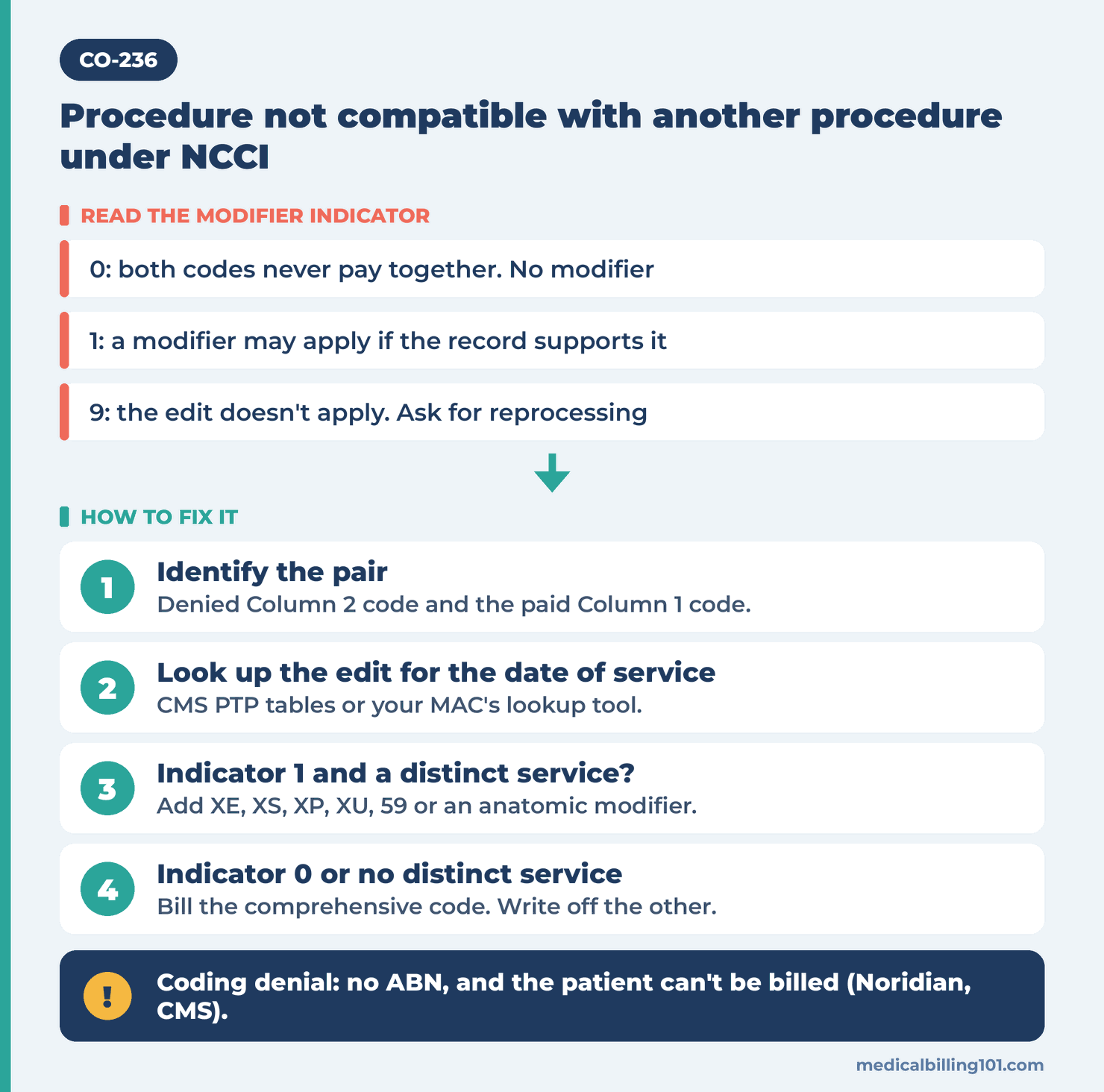
- Identify the pair. Note the denied code, the paid code on the same date for the same provider, and any modifiers on both.
- Look up the edit for the date of service. Use the CMS PTP tables or your MAC’s lookup tool, and use the practitioner or hospital file that matches the claim. Our NCCI PTP search guide walks through it.
- Read the modifier indicator. If it’s 0, stop: both codes won’t be paid. If it’s 9, the edit was deleted and the line should be reprocessed.
- If it’s 1, read the record. A modifier is allowed only for a separate site, encounter, practitioner or procedure that the note documents.
- Pick the modifier and the line. Noridian says the modifier “should be appended to Column 2 code.” First Coast adds that, effective with dates of service from July 1, 2019, modifier 59 or its X subsets “may be applied to either the major or minor code for Part B services only.”
- Send it the way your MAC wants. First Coast: “apply the appropriate modifier and resubmit the claim. Be sure to submit only the corrected line.” Noridian: “Submit Appeal request to add modifier, if appropriate,” through a reopening or redetermination. For commercial plans, follow the corrected claim process.
- If the coding was wrong, fix the code, not the modifier. First Coast: “Procedures are to be reported with the most comprehensive CPT code.”
Medicare and major payer notes
Original Medicare. CMS revised its NCCI manual section in transmittal 13701 (issued June 16, 2026, effective July 16, 2026). On appeal with an indicator of 0, if the claim was coded correctly, CMS says “there are no circumstances in which both procedures of the PTP code pair should be paid for the same beneficiary on the same day by the same provider or supplier.” With an indicator of 1, the reviewer may change the decision only if “an NCCI PTP-associated modifier could have been appended to either code of a correctly coded edit code pair.” CMS keeps “separate tables of edits for physicians/practitioners and outpatient hospital services” and posts changes “on a quarterly basis.” The October 1, 2026 files are version 323r0. Its PTP page sums up the rule: “the Column One code is eligible for payment, but the Column Two code is denied unless a clinically appropriate NCCI PTP-associated modifier is also reported.”
Medicare redeterminations. If you appeal, the request is due within 120 days of receiving the initial determination (CMS). Attach the note that shows the distinct service. See our Medicare appeals guide.
Commercial plans. Commercial payers set their own bundling rules, which may follow NCCI in whole or in part, and they may report pair edits as CO-97 or CO-236. Check the plan’s modifier and bundling policy and the loop 2110 REF policy ID before you add a modifier.
Workers’ compensation. Here the “state regulations/ fee schedule requirements” part of the code applies. Read the state fee schedule’s bundling and modifier rules, since they may differ from Medicare’s.
Worked example (illustrative)
A dermatologist sees a Medicare patient and does a tangential (shave) biopsy of a lesion on the back, CPT 11102. In the same visit, she freezes an actinic keratosis on the forehead, CPT 17000, billed at $112.00. The remit pays 11102 and shows:
CAS*CO*236*112.00on the 17000 line
Reading it: in the October 2026 practitioner PTP file (v323r0), 11102 is Column 1 and 17000 is Column 2, effective January 1, 2020, with modifier indicator 1. A modifier can apply if the services are distinct.
Fix: the note documents two different lesions at two different sites. Add XS (separate structure) to 17000. With First Coast, resubmit only that corrected line. With Noridian, request a reopening to add the modifier. If both procedures had been on the same lesion, no modifier would be appropriate.
Prevention: make the note name each lesion and its site, and run every same-day pair through an NCCI check before the claim goes out.
CO-236 reopening or appeal letter template
Use this when the indicator is 1 and the record supports a distinct service. Replace the bracketed text.
[Date]
[MAC or payer name] Reopenings / Redeterminations
[Address or portal reference]

Re: Request to add NCCI-associated modifier, CO-236 denial
Patient: [Name]   Medicare/Member ID: [ID]
Claim number: [ICN / claim #]   Date of service: [MM/DD/YYYY]
Denied line: [Column 2 CPT/HCPCS]   Paid line: [Column 1 CPT/HCPCS]
Remit codes: CO-236

The PTP edit [Column 1]/[Column 2] carries modifier indicator 1 for
this date of service. The services were distinct: [different site /
separate lesion / separate encounter / different practitioner], as
documented in the enclosed note ([page/section]).

Please reprocess [Column 2 code] with modifier [59 / XE / XS / XP /
XU / anatomic modifier].

Enclosed: remittance advice, claim copy, procedure note.

[Name, credentials]  [Practice, NPI]  [Phone / email]
If the indicator is 0, don’t appeal on modifier grounds. CMS won’t pay both codes.
CO-236 prevention checklist
- Load the current quarter’s PTP edits into your scrubber, using the practitioner or hospital file that matches your claims.
- Hold claims with a same-day pair until the modifier indicator is checked.
- Use a modifier only when the note shows a distinct site, lesion, encounter or practitioner.
- Prefer the most specific X modifier (XE, XS, XP, XU) where your payer accepts it.
- Never issue an ABN for a PTP edit.
- Bill the most comprehensive code instead of its parts.
- Re-check common pairs every quarter, when CMS posts new edit files.
Related denial codes
- CO-97: the service is included in another one already paid.
- CO-4: the procedure code is inconsistent with the modifier used.
- CO-B15: a qualifying service hasn’t been received or covered.
- CO-151: the units exceed what the payer allows, including MUE edits.
- CO-16: claim lacks information. Fix and resubmit.
FAQ
What is the CO 236 denial code description?
X12 says the procedure or procedure/modifier combination “is not compatible with another procedure or procedure/modifier combination provided on the same day according to the National Correct Coding Initiative” or a workers’ compensation fee schedule. With CO, the provider carries it.
What does denial code CO 236 mean?
It means an NCCI procedure-to-procedure edit stopped one code of a same-day pair. CMS treats it as a coding denial, not a medical necessity decision, so the patient can’t be billed and an ABN doesn’t apply.
How do I fix a CO 236 denial?
Look up the code pair for the date of service and read its modifier indicator. With indicator 1 and a documented distinct service, add the right modifier and send the corrected line or reopening your MAC requires. With indicator 0, the denial stands.
Can I bill the patient for CO-236?
No. Noridian says “Providers may not bill patient for NCCI edit denials,” and CMS says an ABN doesn’t shift liability for services denied on a PTP edit.
Which modifier fixes CO-236?
Only a modifier the record supports. NCCI-associated modifiers include anatomic modifiers such as RT, LT and F1, global surgery modifiers such as 25 and 79, and 59 or XE, XS, XP and XU. They work only when the indicator is 1.
What is the difference between CO-236 and CO-97?
CMS tells MACs to report NCCI PTP edit failures as CO-236. CO-97 means the service is included in another service already paid, such as care in a global surgical period. Some payers report pair edits as 97 too, so check the code pair either way.
Sources
- X12, Claim Adjustment Reason Codes (CARC 236, 97, 4, 151). CARC 236 Start 01/30/2011, Last Modified 07/01/2013. Accessed 6 Oct 2026.
- CMS, Transmittal 13701 / CR 14428: Medicare Claims Processing Manual, Ch. 23, §20.9, §20.9.3.1, §20.9.3.2 (issued June 16, 2026; effective July 16, 2026)
- CMS, Medicare NCCI Procedure to Procedure (PTP) Edits (practitioner and hospital files, version 323r0 effective October 1, 2026)
- Noridian JE Part B, Not Separately Payable/National Correct Coding Initiative (CO-236), last updated Jan 25, 2024
- First Coast Service Options, Tips to prevent CARC CO 236 (Aug 25, 2026)
- First Coast Service Options, Using web tools to handle top denied claims
- CMS, Medicare Claims Processing Manual (IOM 100-04), Ch. 22, §60.1 Group Codes
- CMS, First Level of Appeal: Redetermination by a Medicare Contractor
Last reviewed: 6 October 2026 · This page is educational and doesn’t replace payer-specific instructions.