
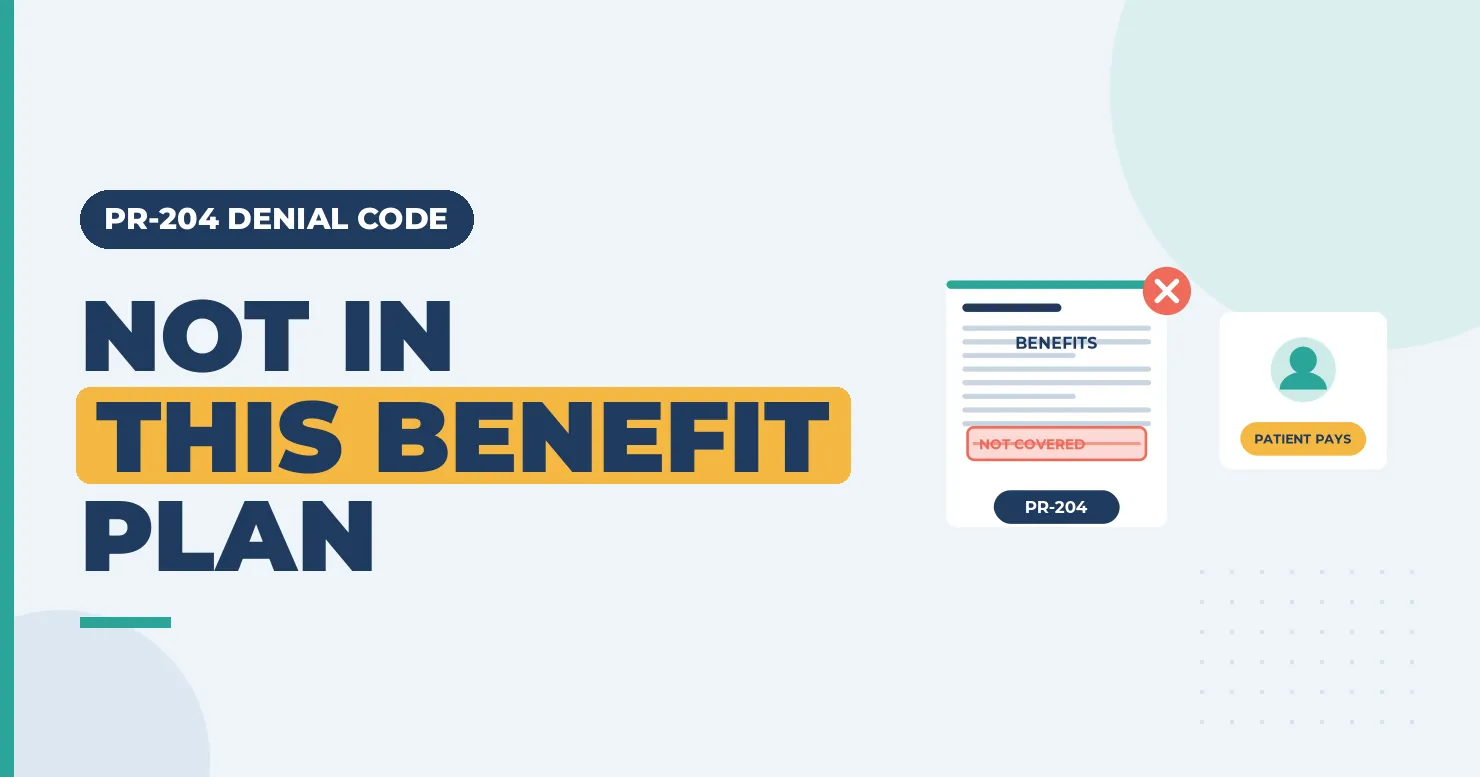
PR-204 is a Claim Adjustment Reason Code that means the service, equipment or drug isn’t a covered benefit under the patient’s current plan, and the payer has assigned the amount to the patient. It’s a plan-design decision, not a coding error, but it’s worth checking before you bill anyone. (Primary sources: X12 Claim Adjustment Reason Codes · Noridian JA DME, Reason Code 204 | Remark Code N130 · CMS Medicare Claims Processing Manual, Ch. 30)
Quick answer: PR-204 means the patient’s plan doesn’t include this service, equipment or drug, and the payer says the patient owes it. Read the remark code, often N130, and the plan’s benefit documents. Fix the code or payer if they were wrong. Appeal if the plan does cover it. Otherwise, bill the patient under your financial policy.
Part of our denial codes library. Written by Manikandan, a revenue cycle management specialist with more than 10 years of US medical billing experience. Last reviewed: 7 October 2026. Official code wording is quoted word for word from X12; Medicare rules link to their CMS or Medicare contractor source.
PR-204 denial code description (official X12 wording)
X12 Claim Adjustment Reason Code 204, verbatim:
“This service/equipment/drug is not covered under the patient’s current benefit plan”
Source: X12 Claim Adjustment Reason Codes, checked 7 October 2026. Start: 02/28/2007. (X12 prints it without a closing period. Noridian’s pages add one.)
Two words carry the meaning. Current means the plan the patient has now, so a service covered under last year’s plan can deny under this year’s. Benefit plan means the denial comes from the plan’s design, the list of what’s covered and what’s excluded, rather than from a medical necessity review.
What PR-204 means in plain English
Each part of the code answers a different question:
- PR (Patient Responsibility) means the payer says the amount “may be billed to the patient or insured” (Medicare Claims Processing Manual, Ch. 22, §60.1).
- CARC 204 tells you why: this service, item or drug isn’t part of the patient’s benefits.
Common examples are plan exclusions such as hearing aids or certain weight-loss drugs, services that a plan routes to a separate benefit (pharmacy, vision, dental or behavioral health), and items that don’t fit any benefit category. For drug denials, see our guide to Zepbound and Wegovy insurance denials.
PR-204 vs CO-96, CO-50, CO-167 and CO-119
| Code | Official X12 text (short) | What it tells you |
|---|---|---|
| 204 | “This service/equipment/drug is not covered under the patient’s current benefit plan” | The plan doesn’t include this benefit |
| 96 | “Non-covered charge(s).” | Not covered, with the reason in a required remark code. See CO-96 |
| 50 | “These are non-covered services because this is not deemed a ‘medical necessity’ by the payer.” | Covered benefit, but not medically necessary for this patient. See CO-50 |
| 167 | “This (these) diagnosis(es) is (are) not covered.” | The diagnosis isn’t covered |
| 119 | “Benefit maximum for this time period or occurrence has been reached.” | Covered, but the limit has been used up |
The difference matters for your next step. With 50 you argue medical necessity. With 119 you check counts. With 204 you check the plan’s benefit documents.
PR-204 vs CO-204 vs OA-204 vs PI-204
| Group + 204 | Who carries the amount | Can you bill the patient? | When you’ll typically see it |
|---|---|---|---|
| PR-204 | Patient | Yes, under your financial policy and any notice rules | The usual form for plan exclusions |
| CO-204 | Provider | No | The payer decided the provider is liable. Check your contract |
| OA-204 | Neither group fits | Check the remark codes and your contract | Used “when no other group code applies” (CMS Ch. 22, §60.1) |
| PI-204 | Payer-initiated reduction | No | Non-Medicare remits only. CMS lists just CO, OA and PR as valid on Medicare remittances |
Remark codes that come with 204
| RARC | Official X12 text | What it adds |
|---|---|---|
| N130 | “Consult plan benefit documents/guidelines for information about restrictions for this service.” | The usual pairing. The answer is in the plan’s benefit documents |
| N216 | “We do not offer coverage for this type of service or the patient is not enrolled in this portion of our benefit package.” | The benefit isn’t offered, or the patient isn’t enrolled in that part of the plan |
| N425 | “Statutorily excluded service(s).” | Excluded by law (Medicare), not by plan design |
| N381 | “Alert: Consult our contractual agreement for restrictions/billing/payment information related to these charges.” | Check your provider contract before billing the patient |
RARC wording is quoted from the X12 RARC list, checked 7 October 2026. Noridian’s DME contractors publish 204 with N130 for Jurisdiction A and Jurisdiction D.
Where PR-204 shows up in the 835
Here’s a trimmed, illustrative example for a $1,850.00 hearing aid line:
SVC*HC:V5257*1850.00*0.00**1~
DTM*472*20260902~
CAS*PR*204*1850.00~
LQ*HE*N130~
CAS*PR*204*1850.00is the group code, reason code and adjusted amount. PR puts it on the patient.LQ*HE*N130sends you to the plan’s benefit documents.- If the remit has a policy reference in loop 2110
REF, read that policy first.
How to fix PR-204: decision path
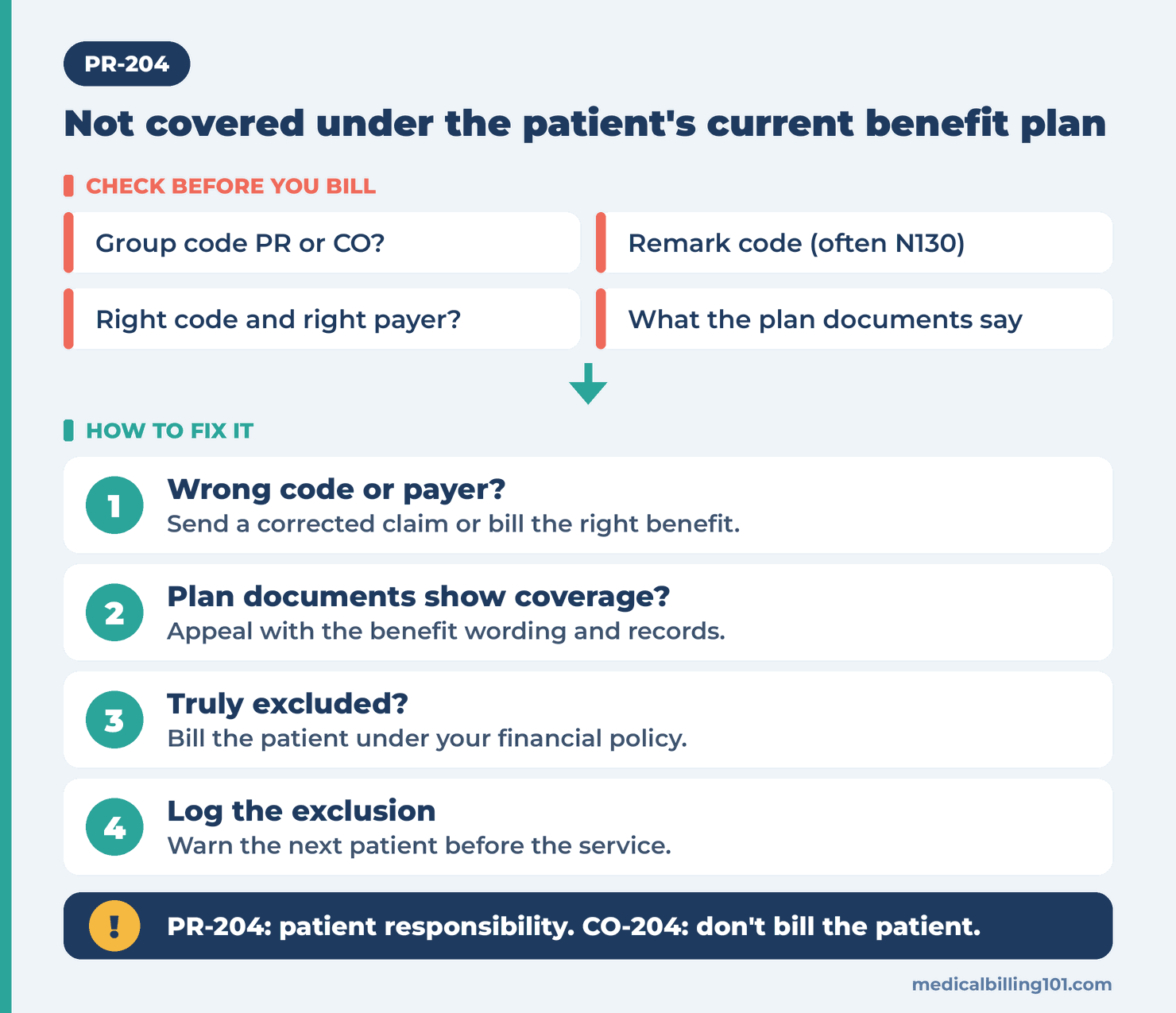
- Read every code on the line. Note the group code (PR or CO), the remark code and any policy reference, such as a plan policy number in loop 2110 REF. CO-204 means you can’t bill the patient.
- Check the claim was right. Was the correct procedure, HCPCS or NDC code billed? Was it sent to the right plan, or does a separate pharmacy, vision, dental or behavioral health benefit handle it? A wrong code or payer is fixed with a corrected claim, not an appeal.
- Read the plan’s benefit documents. N130 says to “Consult plan benefit documents/guidelines.” Look for the exclusion that applies, and note whether it’s absolute or has exceptions. For example, a plan may exclude a drug but cover it after step therapy.
- If the plan covers it, appeal. Send the benefit language, medical records and a letter of medical necessity if the benefit has criteria. For Medicare DME, Noridian says a “Redetermination request may be submitted with all relevant supporting documentation” after reviewing the LCD, policy article and documentation checklists.
- If it’s truly excluded, bill under your financial policy. PR lets you bill the patient. Check your contract, any state rules, and whether you gave the patient written notice before the service.
- Log the exclusion. Add it to your eligibility notes for that plan, so the front desk can warn the next patient before the service.
Medicare and major payer notes
Medicare DME. Noridian’s JA and JD DME pages list two common reasons for 204/N130: “This is a noncovered item” and “Item is not medically necessary.” To avoid future denials: “In order for an item to be covered by DME MAC, it must fall within one of ten benefit categories. Some items may not meet definition of a Medicare benefit or may be statutorily excluded” (Noridian JA DME).
Medicare statutory exclusions and the ABN. CMS says “ABNs are not required for care that is either statutorily excluded from coverage under Medicare (i.e. care that is never covered) or most care that fails to meet a technical benefit requirement.” It adds: “CMS strongly encourage healthcare providers and suppliers to issue the ABN for care that is never covered.” In that case, “The beneficiary should not be asked to choose an option box or sign the notice” (CMS IOM 100-04, Ch. 30, §50.2.1). First Coast lists CARC 96 with N425 (“Statutorily excluded service(s)”) among its most common denials for April – June 2026 (First Coast). See CO-96.
Commercial and Medicare Advantage plans. Each plan’s evidence of coverage or benefit booklet lists its own exclusions, and they change at renewal. That’s why X12 says current benefit plan. Check benefits for the specific service, not just “active coverage”, when you verify eligibility.
Worked example (illustrative)
A 58-year-old patient with an employer plan gets fitted for hearing aids. The audiology practice bills V5257. The remit comes back CAS*PR*204*1850.00 with LQ*HE*N130.
Reading it: PR-204 with N130 tells the practice to check the plan documents. The patient’s benefit booklet lists hearing aids under “Exclusions”, and this plan has no hearing aid rider.
Fix: there’s nothing to correct or appeal. The practice bills the patient under its financial policy. It had the patient sign a written estimate and financial agreement before the fitting, so the bill is no surprise.
Prevention: for elective items and services that plans often exclude, check the specific benefit before scheduling and give the patient a written estimate.
PR-204 appeal letter template
Use this when the plan’s own documents show the service is covered, or covered with criteria the patient meets. Replace the bracketed text.
[Date]
[Payer name] Appeals Department
[Address or portal reference]

Re: Appeal of PR-204 denial (service not covered under the
patient's current benefit plan)
Patient: [Name]   Member ID: [ID]   Plan/Group: [Plan name, group #]
Claim number: [Claim #]   Date(s) of service: [MM/DD/YYYY]
Service: [CPT/HCPCS/NDC and description]   Remit codes: PR-204, [N130]

We ask you to reprocess this claim. The service is a covered
benefit under the patient's current plan:
- Plan document: [name, effective date], section [#], page [#]:
  "[exact benefit wording]"
- The patient meets the stated criteria: [criteria and where
  they're documented in the record].

Enclosed: remittance advice, claim copy, plan benefit excerpt,
[medical records / letter of medical necessity].

[Name, credentials]  [Practice, NPI]  [Phone / email]
PR-204 prevention checklist
- Verify benefits for the specific service, not just active coverage.
- Keep a list of exclusions you see often, by plan.
- Ask whether pharmacy, vision, dental or behavioral health is a separate benefit.
- Give written estimates and financial agreements for services often excluded.
- For Medicare, offer a voluntary ABN for care that’s never covered.
- Recheck benefits when a plan renews, because exclusions can change.
- Read the loop 2110 policy reference on the remit when there is one.
- Train staff to tell PR-204 from CO-204 before billing patients.
Related denial codes
- CO-96: non-covered charge, with the reason in the remark code.
- CO-50: not medically necessary.
- PR-1, PR-2 and PR-3: deductible, coinsurance and copay.
- CO-109: the claim went to the wrong payer.
- CO-119: the benefit maximum has been reached.
- CO-167: the diagnosis isn’t covered.
FAQ
What is the PR-204 denial code description?
X12 describes CARC 204 as “This service/equipment/drug is not covered under the patient’s current benefit plan”. With the PR group code, the payer says the patient is responsible for the amount.
Can I bill the patient for PR-204?
Generally yes, because PR assigns the amount to the patient. First confirm the code and payer were right and the plan really excludes the service. Then follow your contract, state rules and financial policy, ideally with a signed estimate from before the service.
What is the difference between PR-204 and CO-204?
The reason is the same: the plan doesn’t cover the service. With PR-204 the patient owes it. With CO-204 the provider carries it and can’t bill the patient.
What does PR-204 with N130 mean?
N130 is “Consult plan benefit documents/guidelines for information about restrictions for this service.” It tells you the answer is in the plan’s benefit documents. Noridian’s DME contractors pair 204 with N130 for noncovered items.
Can I appeal a PR-204 denial?
Yes, if the plan’s documents show the service is covered or the patient meets the plan’s criteria. If the service is a clear plan exclusion, an appeal won’t change the outcome. For Medicare DME, Noridian accepts redetermination requests with supporting documentation.
What is the difference between PR-204 and CO-96?
Both mean the service isn’t covered. CARC 204 points to the patient’s benefit plan. CARC 96 is a general non-covered code that needs a remark code to explain why. First Coast’s most common denials include CARC 96 with N425 for statutorily excluded services.
Sources
- X12, Claim Adjustment Reason Codes (CARC 204, 96, 50, 167, 119). CARC 204 Start 02/28/2007. Accessed 7 Oct 2026.
- X12, Remittance Advice Remark Codes (N130, N216, N425, N381). Accessed 7 Oct 2026.
- Noridian JA DME, Reason Code 204 | Remark Code N130 (last updated Jun 06, 2025)
- Noridian JD DME, Reason Code 204 | Remark Code N130
- CMS, Medicare Claims Processing Manual (IOM 100-04), Ch. 30, §50.2.1 Optional ABN Uses
- CMS, Medicare Claims Processing Manual (IOM 100-04), Ch. 22, §60.1 Group Codes
- First Coast Service Options, Top claim errors, April – June 2026
Last reviewed: 7 October 2026 · This page is educational and doesn’t replace payer-specific instructions.