
CO-70 is a Claim Adjustment Reason Code that reports a cost-outlier adjustment — an additional payment (or related adjustment) when a case’s costs exceed the payer’s outlier threshold. On Medicare IPPS claims it is usually good news: an extra payment on top of the DRG, not a denial. (Primary sources: X12 Claim Adjustment Reason Codes · CMS, Outlier Payments · CMS Medicare Claims Processing Manual, Ch. 3)
Quick answer (TL;DR): CO-70 means a cost-outlier adjustment was applied to compensate for additional costs. For Medicare IPPS, confirm the case cleared the fixed-loss threshold using the hospital’s cost-to-charge ratio (CCR), post the outlier payment, and only dispute the line if the CCR, charges or threshold math look wrong — not by filing a “denial” appeal.
Part of our denial codes library. Written by Manikandan (About), a revenue cycle management specialist with more than 10 years of US medical billing experience. Last reviewed: 9 October 2026. Official code wording is quoted word for word from X12; Medicare rules link to their CMS or Medicare contractor source.
CO-70 denial code description (official X12 wording)
X12 Claim Adjustment Reason Code 70, verbatim:
“Cost outlier – Adjustment to compensate for additional costs.”
Source: X12 Claim Adjustment Reason Codes, checked 9 October 2026. Start: 01/01/1995 | Last Modified: 06/30/2001.
The phrase adjustment to compensate for additional costs is the tell: this code explains an outlier payment adjustment, not “service not covered.”
What CO-70 means in plain English
Each part of the code answers a different question:
- CO (Contractual Obligation) is the payer’s classification of who carries the amount. CMS says these adjustments are “Generally… considered a write off for the provider and are not billed to the patient” (Medicare Claims Processing Manual, Ch. 22, §60.1). On an outlier payment, you will also see payment amounts on the CLP/SVC segments — read the whole remit, not only the CAS reason.
- CARC 70 tells you why an adjustment related to cost outlier processing appears.
For example, under Medicare IPPS, Section 1886(d)(5)(A) of the Social Security Act provides additional payments for extraordinarily high-cost cases. To qualify, costs must exceed a outlier cost threshold. Regulations live at 42 CFR 412.80 through 412.86 (CMS Outlier Payments).
In plain terms: CO-70 often marks an extra outlier payment on a high-cost inpatient stay. Review the math before you appeal.
CO-70 vs day outlier (historical), CO-45 and CO-94
| Code | Official X12 text | What it tells you |
|---|---|---|
| 70 | “Cost outlier – Adjustment to compensate for additional costs.” | Cost-outlier adjustment |
| 45 | “Charge exceeds fee schedule/maximum allowable or contracted/legislated fee arrangement. …” | Ordinary allowable cutback. See CO-45 |
| 94 | “Processed in Excess of charges.” | Payment/processing relative to charges (different concept) |
| 97 | “The benefit for this service is included in the payment/allowance for another service/procedure that has already been adjudicated. …” | Bundling, not outlier. See CO-97 |
Medicare day outliers were discontinued after FY 1997; modern IPPS outliers are cost outliers. Don’t hunt for a separate “day outlier” CARC on current remits.
CO-70 vs PR-70 vs OA-70 vs PI-70
| Group + 70 | Who carries the amount | Can you bill the patient? | When you’ll typically see it |
|---|---|---|---|
| CO-70 | Provider contractual / payment adjustment context | No patient bill for the contractual piece | Typical IPPS outlier reporting |
| PR-70 | Patient | Only if remit assigns PR | Unusual for Medicare outlier add-on |
| OA-70 | Neither group fits | Check remark codes | When no other group code applies |
| PI-70 | Payer-initiated reduction | No | Non-Medicare remits only |
Always reconcile CO-70 against the paid amount. An outlier add-on increases payment even though a CAS adjustment segment is present.
Remark codes that help with CARC 70
Outlier lines may carry informational remarks. Common ones to read carefully:
| RARC | Official X12 text | What it adds |
|---|---|---|
| N381 | “Alert: Consult our contractual agreement for restrictions/billing/payment information related to these charges.” | Points to contract/payment rules |
| N9 | “Adjustment represents the estimated amount a previous payer may pay.” | Other-payer estimate (COB context; different issue) |
| N211 | “Alert: You may not appeal this decision.” | Informational alert on some adjustments |
RARC wording is quoted from the X12 RARC list, checked 9 October 2026. Many outlier remits rely on the CARC wording alone — still verify the Pricer/outlier fields on the remittance or provider portal.
Where CO-70 shows up in the 835
Here’s a trimmed, illustrative inpatient example:
CLP*PT20260801A*1*125000.00*82000.00*15000.00*MB*2626000121001~
CAS*CO*45*28000.00~
CAS*CO*70*-5000.00~
- The claim pays an IPPS amount plus an illustrative outlier component.
CAS*CO*70may appear as a signed adjustment depending on payer mapping; always tie it back to the outlier payment on the remittance, not to a “denied” balance.
This 835 snippet is illustrative only. Sign conventions and placement (claim vs service level) vary; use your payer’s 835 companion guide.
How to work CO-70: decision path
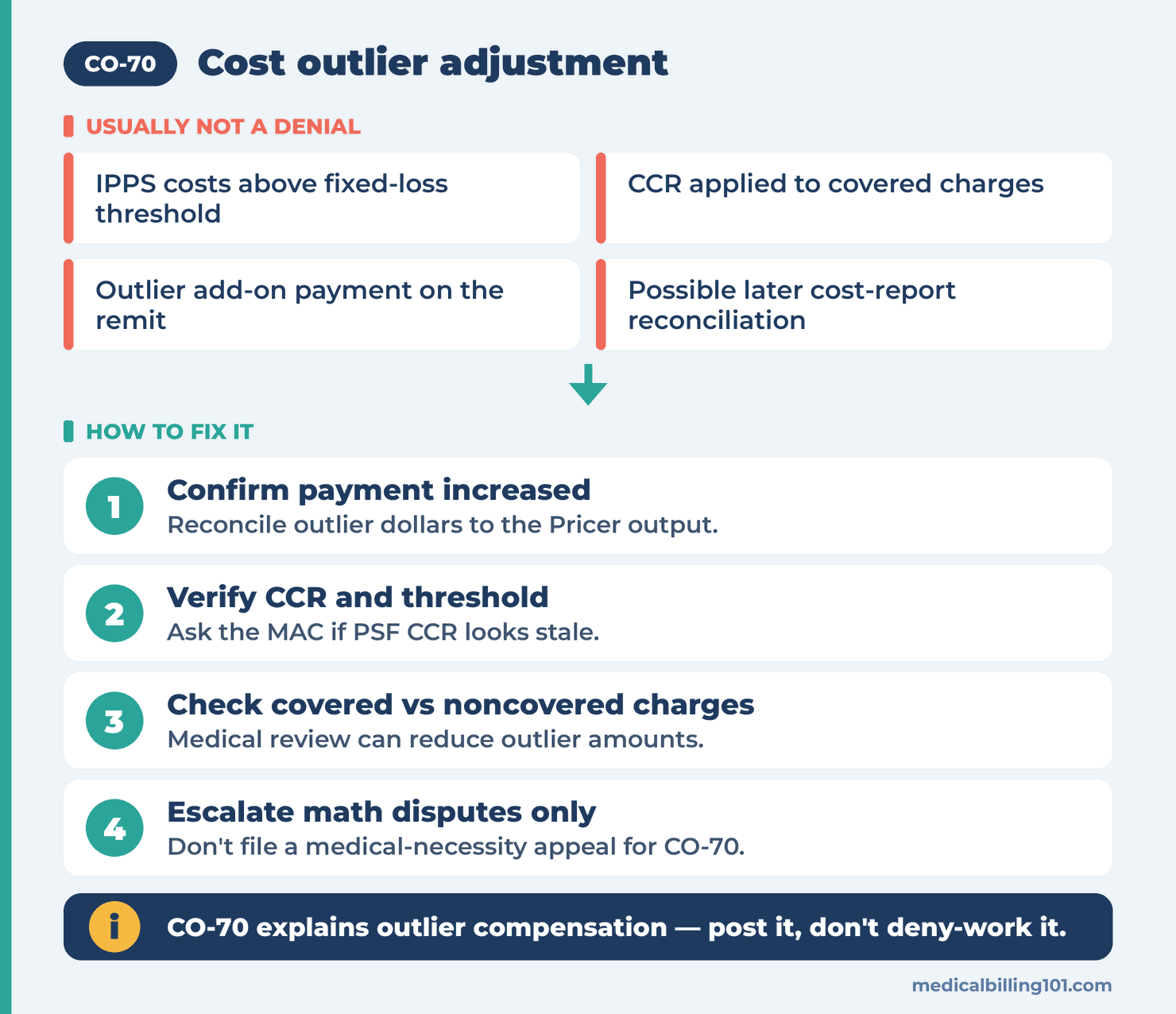
- Don’t treat it like a denial first. Confirm whether payment increased relative to the base DRG.
- Verify IPPS (or other PPS) outlier eligibility. CMS: hospital-specific operating and capital CCRs are applied to covered charges and compared with the outlier threshold; marginal factor is generally 80% of costs above the threshold (90% for burn DRGs) (CMS Outlier Payments).
- Check charges and covered charges. Noncovered charges removed on medical review can reduce outlier amounts (see 42 CFR 412.84 discussion in CMS materials).
- Check the CCR used. MACs update PSFs from tentative or final settled cost reports. A stale or wrong CCR causes wrong outlier payments and later reconciliation.
- Post the payment. Update expected reimbursement and contractual adjustments so AR doesn’t show a false underpayment.
- Escalate only for math / CCR / threshold disputes. Ask the MAC how the outlier was priced; supply itemized charges if needed.
- Watch year-end cost report check. CMS requires MACs to refer certain cost reports for outlier reconciliation when CCR changes and outlier dollars meet thresholds (including updated percentage tests for cost-report periods beginning on/after October 1, 2025 per recent Claims Processing Manual revisions). Keep finance in the loop.
Medicare and major payer notes
CMS outlier policy. “To qualify for outlier payments, a case must have costs above a outlier cost threshold amount.” CMS publishes the threshold in the annual IPPS final rule (CMS Outlier Payments). Manual computational detail is in Pub. 100-04, Chapter 3 (including CCR worksheets and reconciliation sections).
Medical review. Outlier cases can be sampled for medical review; noncovered services reduce outlier payments.
Other PPS settings. LTCH, IRF, IPF and others have their own outlier rules. Confirm the payment system before applying IPPS math.
Commercial / Medicaid. Some plans mimic cost-outlier logic; others don’t use CARC 70 at all. Use the plan’s contract and remit glossary.
Worked example (illustrative)
An IPPS claim pays the DRG plus an outlier. The 835 shows a CO-70 adjustment alongside the payment. The poster keys it as a denial and sends a redetermination appeal.
Reading it: For example, CO-70 here explains the outlier component. A denial appeal is the wrong tool.
Fix: cancel the appeal, reconcile the outlier dollars to the Pricer output (CCR × covered charges vs threshold × marginal factor), and post contractuals. If the CCR on the PSF looks outdated versus the latest settled cost report, open a MAC inquiry — not a medical-necessity appeal.
Prevention: map CARC 70 to an “outlier payment — reconcile” work reason in the denial toolkit, separate from true denials.
CO-70 reconciliation inquiry template
[Date]
[MAC name] Provider Contact Center / Cost Report Liaison
[Address, fax or portal reference]

Re: CO-70 cost outlier adjustment — pricing verification
Patient: [Name]   MBI: [MBI]   DOB: [MM/DD/YYYY]
Claim number: [Claim #]   Discharge date: [MM/DD/YYYY]
DRG: [###]   Provider: [Name, CCN/NPI]

The remittance reports CARC 70 ("Cost outlier - Adjustment to
compensate for additional costs"). Please confirm:
[ ] Operating and capital CCRs used to price this claim.
[ ] Fixed-loss threshold and marginal factor applied.
[ ] Covered charges included in the outlier computation.
[ ] Whether this claim is subject to cost-report outlier
    reconciliation for FY [year].

Enclosed: remittance advice, UB claim, itemized charges,
psf/CCR screenshot if available.

[Name, credentials]  [Hospital, CCN]  [Phone / email]
CO-70 prevention / control checklist
- Train posters: CO-70 is usually an outlier payment flag, not a denial.
- Reconcile outlier dollars to Pricer/CCR math monthly.
- Keep finance informed of CCR updates after cost-report settlement.
- Audit high-charge cases for accurate covered vs noncovered charges.
- Separate CO-70 from CO-45/CO-97 queues in the denial system.
- Monitor CMS IPPS final-rule outlier threshold each FY.
- Document MAC answers on disputed outlier math.
- Track reconciliation risk when CCR changes materially.
Related denial codes
- CO-45: charge exceeds fee schedule or contracted allowable.
- CO-97: benefit included in another payment.
- CO-96: non-covered charge.
- CO-16: claim lacks information.
- OA-18: exact duplicate.
- CO-109: wrong payer/contractor.
Quick tip from denial queues
For example, if your posters treat every CAS reason as a denial, CO-70 will create false underpayments. Map it to a payment-recon reason code and have finance spot-check outlier dollars each month against the Pricer.
From the claim desk
Billing teams see CO-70 on high-cost inpatient remits more than on denials worklists. Treat it as payment news first. Then check the dollars.
In short
CO-70 marks a cost outlier adjustment. On many Medicare inpatient remits it is an extra payment. Check the CCR math. Post the payment. Ask the MAC only when the dollars look wrong.
FAQ
What is the CO-70 denial code description?
X12 describes CARC 70 as “Cost outlier – Adjustment to compensate for additional costs.” It identifies a cost-outlier adjustment, typically an additional payment when costs exceed the outlier threshold.
Is CO-70 a denial?
Usually no. On Medicare IPPS remits it commonly marks outlier payment processing. Reconcile the dollars before filing an appeal.
How does Medicare calculate IPPS cost outliers?
CMS applies hospital-specific CCRs to covered charges and compares estimated costs with a outlier threshold. Payment is generally 80% of costs above the threshold (90% for burn DRGs) (CMS Outlier Payments). See also 42 CFR 412.80–412.86.
When should I contact the MAC about CO-70?
When the CCR, covered charges, threshold or paid outlier amount don’t match your calculation, or when you need to know if the claim will be included in cost-report outlier reconciliation.
Can I bill the patient for CO-70?
No for a CO contractual/outlier payment adjustment. Post the payment and contractuals per the remit.
How is CO-70 different from CO-45?
CO-45 reduces payment to a fee schedule or contracted allowable. CO-70 relates to cost-outlier compensation for extraordinarily high-cost cases. Key named sources on this page include Claim Adjustment Reason Codes, Outlier Payments pages, Claims Processing Manual chapter notes, Cost To Charge worksheets and Centers For Medicare IPPS Final Rule thresholds.
Quick facts
| Item | Value |
|---|---|
| X12 code | 70 |
| X12 start | 01/01/1995 |
| Last reviewed | 9 October 2026 |
| Page type | WordPress Page under Denial Codes hub 183 |
| Primary keyword | co-70 denial code |
Sources
- X12, Claim Adjustment Reason Codes (CARC 70). Start 01/01/1995, Last Modified 06/30/2001. Accessed 9 Oct 2026.
- X12, Remittance Advice Remark Codes. Accessed 9 Oct 2026.
- CMS, Outlier Payments (IPPS)
- CMS, Medicare Claims Processing Manual (IOM 100-04), Ch. 3 (clm104c03.pdf)
- CMS, Medicare Claims Processing Manual (IOM 100-04), Ch. 22, §60.1 Group Codes
- 42 CFR 412.80–412.86 (outlier payment regulations)
See also our editorial policy and disclaimer.
Last reviewed: 9 October 2026 · This page is educational and doesn’t replace payer-specific instructions.