
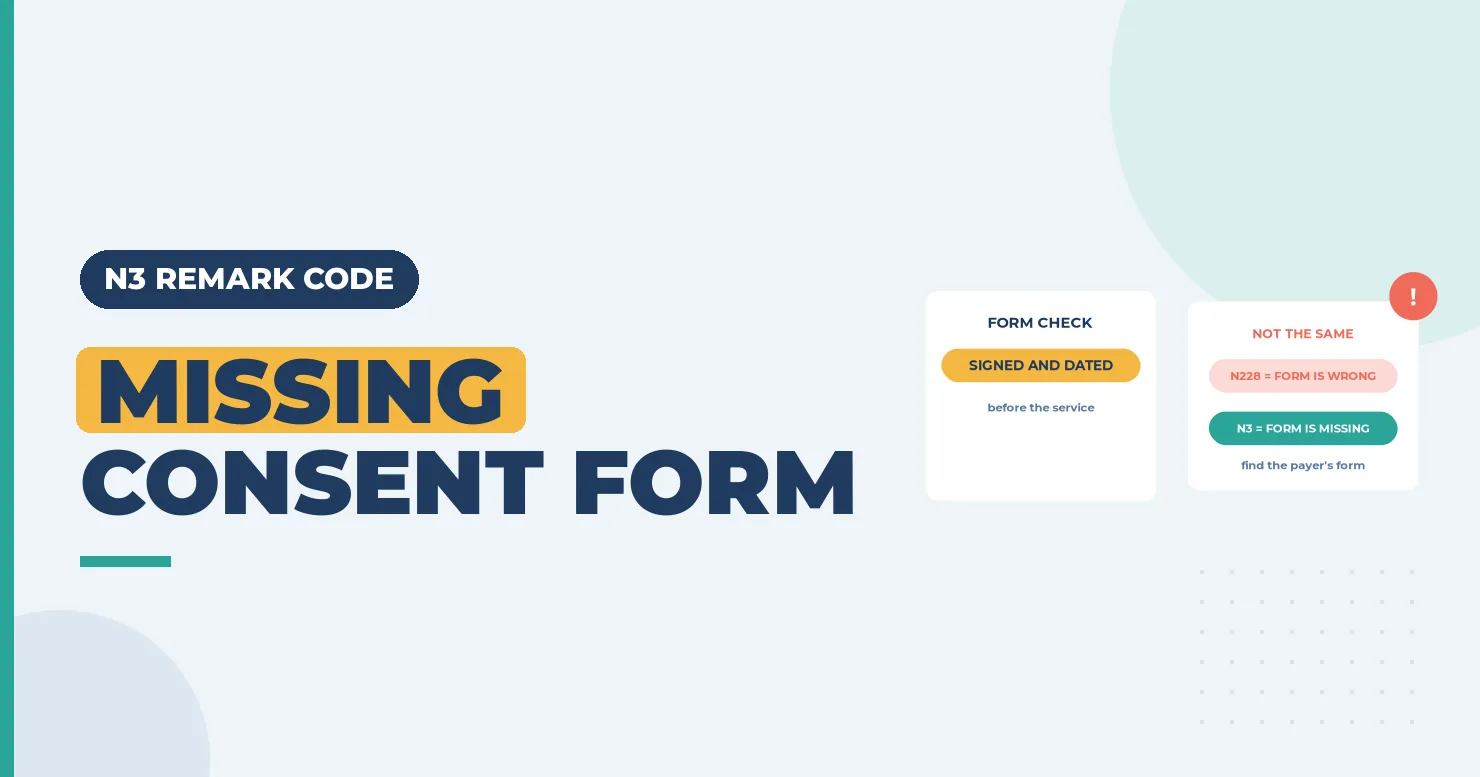
N3 is a Remittance Advice Remark Code (RARC) with one official meaning: “Missing consent form.” A remark code is a message on a remittance that adds detail to a payment or adjustment. A consent form is a signed document that shows the patient agreed to a service after being told what it involves. N3 is a remark, not a Claim Adjustment Reason Code, so the CARC and group code on the same line carry the money. Many people search for “n3 remark code”, and that is the phrase this page answers. (Primary sources: X12 Remittance Advice Remark Codes · 42 CFR Part 441, Subpart F · NYS Medicaid 835 edit mapping)
Quick answer: N3 means the payer did not find a required consent form. The best-documented case is Medicaid sterilization and hysterectomy, where federal rules require a consent form or an acknowledgment before the state can pay. Read the CARC on the same line, find out which form the payer expects, and check that it is complete. If the form exists, resubmit with it attached. If it was never completed, the claim often cannot be fixed.
Part of our denial codes library. Written by Manikandan, a revenue cycle management specialist with more than 10 years of US medical billing experience. Last reviewed: 17 October 2026. Official code wording is quoted word for word from X12; federal rules link to their source.
N3 remark code description (official X12 wording)
X12 Remittance Advice Remark Code N3, verbatim:
“Missing consent form.”
Source: X12 Remittance Advice Remark Codes, checked 17 October 2026. Start: 01/01/2000. Last modified: 02/28/2003. X12 notes: “Related to N228.”
N228 is the sister code. X12 words it as “Incomplete/invalid consent form.” N3 means the form is absent. N228 means a form arrived but it is incomplete or invalid.
What N3 means in plain English
- The payer looked for a consent form and did not find one. That is all the code says.
- It does not name the form. The payer’s manual or the claim edit tells you which one it wanted.
- The CARC and group code carry the money. Read them first.
- It is common in sterilization and hysterectomy billing. Federal Medicaid rules require paperwork for both.
- It is about missing, not wrong. A form with a bad signature or date points to N228 instead.
Why Medicaid ties payment to a consent form
Federal rules sit in 42 CFR Part 441, Subpart F. They apply to sterilizations and hysterectomies paid by Medicaid. Section 441.252 says a state plan must pay for these only if all the requirements of the subpart were met. Section 441.256 adds that the Medicaid agency must get documentation before it pays. That documentation includes a consent form, an acknowledgment of receipt of hysterectomy information, or a physician’s certification, as the case requires.
So the claim edit is simple. No paperwork on file, no payment. The payer then returns N3.
Sterilization consent: what the form must show
Under 42 CFR 441.253, federal funds are available for a sterilization only if these things are true:
- The person was at least 21 years old when consent was given.
- The person is not a mentally incompetent individual.
- The person gave informed consent that meets §441.257 and §441.258.
- At least 30 days, but not more than 180 days, passed between consent and surgery.
There is one timing exception. For premature delivery or emergency abdominal surgery, the person may consent if at least 72 hours have passed. For premature delivery, consent must have been given at least 30 days before the expected delivery date.
Section 441.258 says the consent form must be signed and dated by:
- The person to be sterilized.
- The interpreter, if one was used.
- The person who obtained consent.
- The physician who performed the sterilization.
Section 441.257(b) says consent may not be obtained while the person is in labor or childbirth, is seeking or having an abortion, or is under the influence of alcohol or other substances that affect awareness.
Hysterectomy: acknowledgment instead of a consent form
For a hysterectomy, 42 CFR 441.255 uses an acknowledgment. The person who secured authorization must tell the patient, orally and in writing, that the hysterectomy will make her permanently unable to reproduce. The patient or her representative must sign a written acknowledgment of receipt.
The rule has two exceptions that rely on a physician’s written certification:
- The patient was already sterile before the hysterectomy, and the cause is stated.
- A life-threatening emergency made prior acknowledgment impossible, and the emergency is described.
Section 441.255(e) adds a path for hysterectomies during a period of retroactive Medicaid eligibility. The physician certifies in writing that the patient was told before surgery, or that one of the exceptions applied.
Federal funds are also not available for a hysterectomy done solely to make the patient unable to reproduce (§441.255(a)).
N3 vs N228, N28 and lookalikes
| Code | Type | Official idea | Difference |
|---|---|---|---|
| N3 | RARC | Missing consent form | Form not found. This page |
| N228 | RARC | Incomplete/invalid consent form | Form found but wrong or incomplete |
| N28 | RARC | Consent form requirements not fulfilled | Rules for the form not met |
| N398 | RARC | Missing elective consent form | Elective procedure form absent |
| N399 | RARC | Incomplete/invalid elective consent form | Elective form present but flawed |
| CO-16 | CARC | Claim/service lacks information or has submission/billing error(s) | Often the reason code beside N3. See CO-16 |
| CO-252 | CARC | An attachment/other documentation is required to adjudicate this claim/service | Attachment needed. See CO-252 |
Which CARC comes with N3
X12 does not fix one CARC for N3. A public example is the New York State Medicaid edit mapping for the 835. It maps its hysterectomy and sterilization form edits to N3. Some edits return CARC 16 and others return CARC 252. Your state or plan may use different pairings, so read your own remit.
Common triggers for an N3 line
- Form not attached. The form was completed but did not go with the claim.
- Form never completed. The service was done without the required paperwork.
- Form is not readable or not scanned. For example, a faint fax that the payer could not read.
- Wrong claim path. The claim went out electronically with no attachment, or on paper with no form.
- Another provider holds the form. The surgeon or the clinic that took consent did not share it with the facility or the anesthesia group.
- The wrong form was used. The payer wanted its own state form.
Where N3 shows up in the 835
CLP*PCN23318*4*1480.00*0.00*0.00*MC*CLAIM771204~
SVC*HC:58671*1480.00*0.00**1~
CAS*CO*16*1480.00~
LQ*HE*N3~
- Status code 4 means the claim was denied.
- The line paid $0.
- LQ*HE*N3 carries the remark code. In some remits it appears in an RMK segment instead.
- The CARC on the CAS segment is the reason for the adjustment. Here it is 16.
- This sample is illustrative only. Real remits vary.
How to work an N3 line: decision path
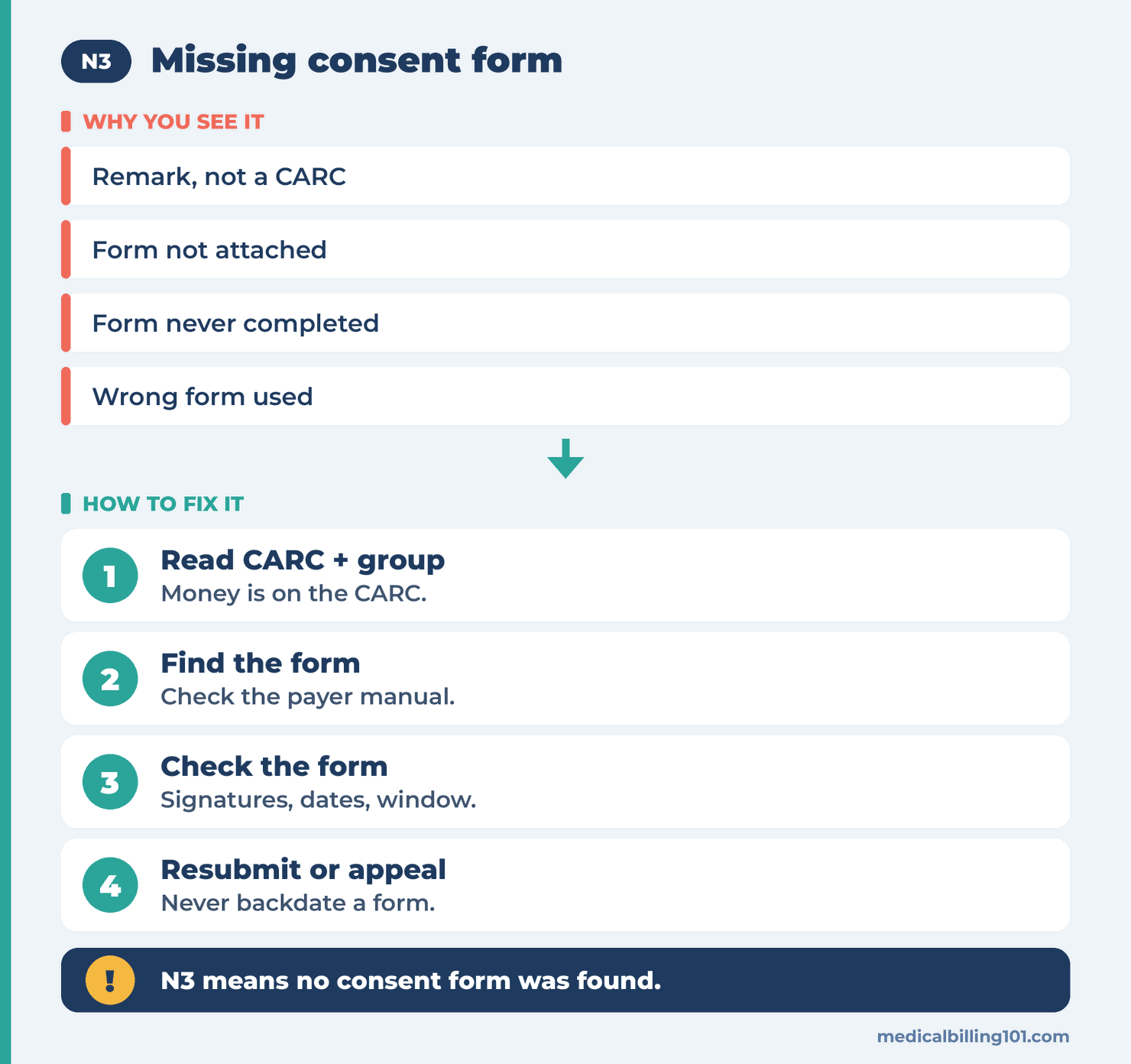
- Read the CARC and group code on the same line. Note the amount.
- Find out which form the payer expects. Check the state Medicaid manual or the plan’s provider manual.
- Look in the chart for the signed form or acknowledgment.
- Check the form for all signatures, the dates, the 30-day to 180-day window, and any interpreter statement.
- If the form exists and was not sent, resubmit with it attached, as the payer’s rules allow.
- If the form has errors, expect N228 next. Ask the payer whether a correction is possible.
- If the form was never completed, ask whether the payer has any exception route. Do not alter or backdate a form.
- Check who is liable under the group code and your provider agreement before you consider billing the patient.
Medicare, commercial and Medicaid notes
Medicaid. This is where N3 is best documented. Federal rules in 42 CFR Part 441, Subpart F set the minimum. States can add more. The eCFR text says a consent form must be a copy of the form in the appendix to the subpart or another form approved by the Secretary. Your state may also require its own form, so check the manual.
Medicare. The consent rules on this page are Medicaid rules. If you see N3 on a Medicare remit, read the CARC and the claim, and use your MAC’s guidance.
Commercial. Plans set their own consent and attachment rules. Ask the plan which form it wants and how to send it.
Worked example (illustrative)
A surgery center bills a tubal sterilization for a Medicaid patient. The remit shows CAS*CO*16*1480.00 with remark N3.
Reading it: The payer says a consent form was not found. The CARC says the claim lacks information.
Check: The chart holds a completed sterilization consent form. The patient signed it 45 days before surgery. The surgeon, the person who obtained consent and the interpreter signed it too. It was never attached to the claim.
Fix: The billing team resubmits the claim with a clear scan of the form, in the way the state’s manual describes. The 30-day to 180-day window is met, so the form should satisfy the edit.
Second scenario: The chart has no form at all. The team asks the payer whether any exception route applies and does not recreate or backdate the form. If none applies, the line stays denied and the team follows its contract on write-offs.
Prevention checklist
- [ ] Add a hard stop at scheduling for sterilization and hysterectomy cases that asks for the form.
- [ ] Check all signatures and dates on the form before the date of service.
- [ ] Confirm the 30-day to 180-day window for sterilization consent.
- [ ] Scan the form in a readable format and attach it at claim submission.
- [ ] Share the form between the surgeon, the facility and the anesthesia group.
- [ ] Keep the CARC and RARC guide handy for staff training.
Related codes
- CO-16: claim lacks information or has a billing error.
- CO-252: an attachment or other documentation is required.
- MA130: unprocessable claim with no appeal rights.
- N381: consult the contractual agreement.
- CARC and RARC guide.
Key takeaways
N3 means the payer did not find a required consent form. For Medicaid sterilization and hysterectomy, federal rules make that form a condition of payment. Find the form the payer wants, check it is complete and on time, and resubmit with it attached.
FAQ
What is the N3 remark code description?
X12 describes N3 as “Missing consent form.” X12 adds that it is related to N228, “Incomplete/invalid consent form.”
Is N3 a denial?
No. It is a remark code. The CARC and group code on the line explain the adjustment.
What is the difference between N3 and N228?
N3 means no consent form was found. N228 means a form was found but it is incomplete or invalid.
How long before sterilization must the consent be signed?
Under 42 CFR 441.253, at least 30 days and not more than 180 days before the sterilization. For premature delivery or emergency abdominal surgery, at least 72 hours.
Does a hysterectomy need a consent form?
Federal Medicaid rules require a signed acknowledgment that the patient was told the hysterectomy makes her permanently unable to reproduce, unless a physician’s certification covers an exception.
Can I fix an N3 line after the fact?
If the form was completed on time and just not sent, resubmit with it. If it was never completed, do not recreate or backdate it. Ask the payer about any exception route.
Quick facts
| Item | Value |
|---|---|
| X12 RARC | N3 |
| X12 start | 01/01/2000 |
| X12 last modified | 02/28/2003 |
| Type | Remark code |
| Official wording | Missing consent form |
| Related code in X12 notes | N228 |
| Best-documented use | Medicaid sterilization and hysterectomy forms |
| Last reviewed | 17 October 2026 |
Sources
- X12, Remittance Advice Remark Codes (N3, N28, N228, N398, N399). N3 Start 01/01/2000. Accessed 17 Oct 2026.
- X12, Claim Adjustment Reason Codes (16, 252). Accessed 17 Oct 2026.
- eCFR, 42 CFR Part 441, Subpart F, Sterilizations and hysterectomies (§§441.250 to 441.259). Accessed 17 Oct 2026.
- NYS Medicaid (eMedNY), 835 crosswalks: Edit Mapping for 835 in the Order of Edit Number. Accessed 17 Oct 2026.
Code wording and federal rules on this page were checked on 17 October 2026 against X12 and eCFR sources.
Last reviewed: 17 October 2026 · This page is educational and doesn’t replace payer-specific contracts or coding rules.