
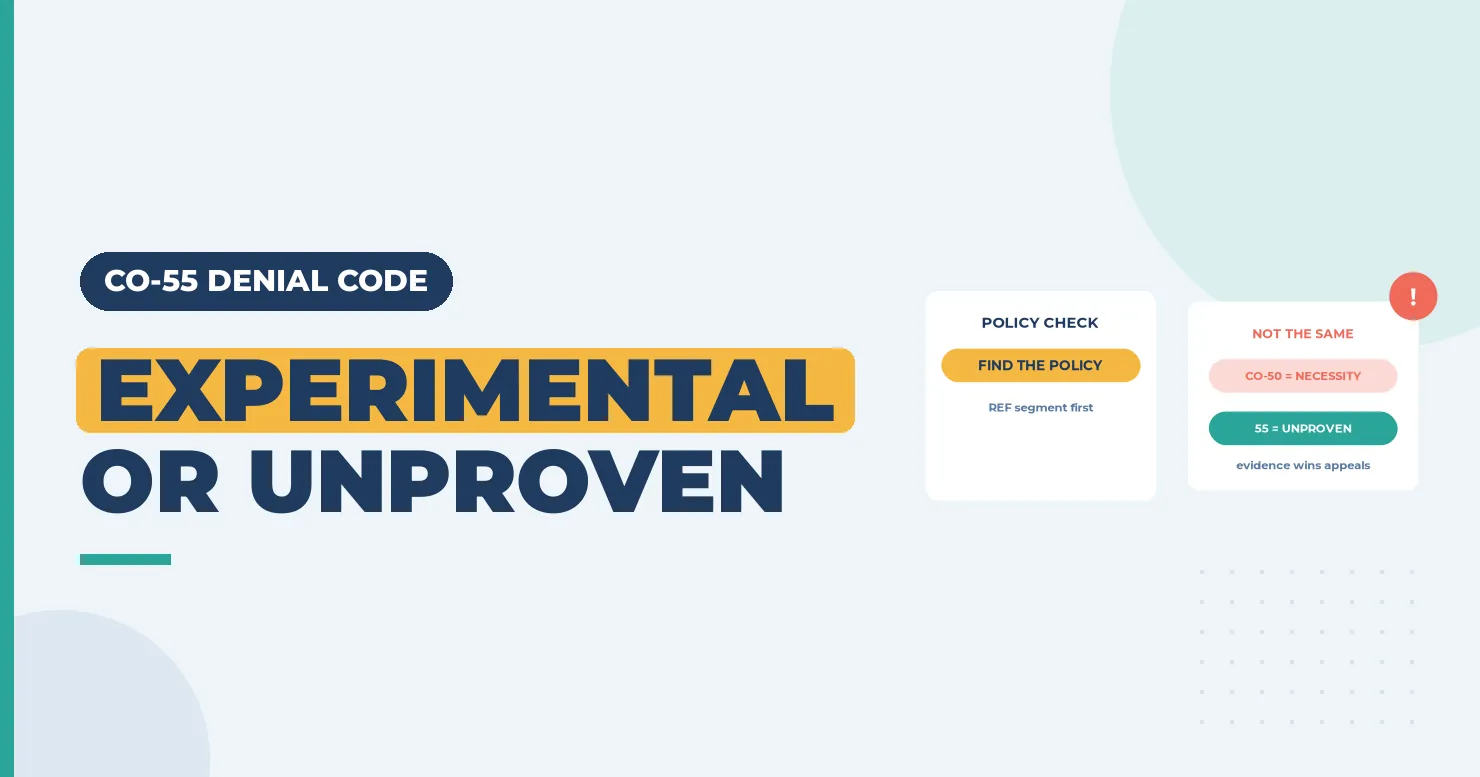
A CO-55 denial is a coverage call about the treatment itself. The payer has classed the procedure, treatment or drug as experimental or investigational under its own medical policy, so it won’t pay, and the CO group code keeps the patient out of the bill. Unlike a missing-data denial, you usually can’t fix CO-55 by correcting a field. You win it, if at all, with evidence. (Primary sources: X12 Claim Adjustment Reason Codes · X12 Remittance Advice Remark Codes · CMS NCD 310.1, Routine Costs in Clinical Trials).
In brief: CO-55 means “procedure/treatment/drug is deemed experimental/investigational by the payer.” Find the medical policy the payer used, often named in the 835 REF segment. If the service is part of a qualifying clinical trial, check that the trial number, modifiers and diagnosis were billed. If the policy is out of date, appeal with published evidence. If the policy clearly excludes it and no waiver was signed, the CO amount is a write-off.
Part of our denial codes library. Written by Manikandan J, CPC, CRCR, who has more than 10 years of US medical billing and revenue cycle experience. Published 20 October 2026. Last updated: 20 October 2026. Code wording is quoted word for word from X12.
Official X12 wording for CARC 55
| Field | Official X12 text |
|---|---|
| Description | “Procedure/treatment/drug is deemed experimental/investigational by the payer.” |
| Usage | “Refer to the 835 Healthcare Policy Identification Segment (loop 2110 Service Payment Information REF), if present.” |
Source: X12 Claim Adjustment Reason Codes, checked 20 October 2026. Start: 01/01/1995. Last Modified: 07/01/2017.
Note the words “by the payer.” Investigational means the payer thinks the evidence is not yet strong enough. X12 doesn’t define what counts as experimental. Each plan does that in its medical policy, so two payers can treat the same service differently. That is why the REF policy reference on the 835 is the most useful thing on the remit.
Is denial code 55 the same as CO-55?
Yes. Denial code 55, CARC 55 and reason code 55 all point to the same X12 reason. “CO-55” adds the group code. With CO the provider absorbs the amount. With PR-55 the payer says the patient may owe it, which usually only happens when the patient agreed in writing to pay for a non-covered service.
Who pays: CO-55 vs PR-55 vs OA-55
| Group + CARC | Who carries it | Typical situation |
|---|---|---|
| CO-55 | Provider | Network contract bars billing the patient for services the plan calls investigational. |
| PR-55 | Patient | The patient signed a valid financial waiver before the service, where the plan allows one. |
| OA-55 | Not assigned | Informational or secondary-payer line. Read the remark code. |
| PI-55 | Provider (non-Medicare) | A payer-initiated reduction. Treat like CO and check your contract. |
CMS describes CO adjustments as amounts that are “generally… considered a write off for the provider and are not billed to the patient” (Medicare Claims Processing Manual, Ch. 22, §60.1).
Why payers send CARC 55: causes, remark codes and fixes
The remark code narrows the reason. Pairings vary by payer, so treat this as a guide. All RARC wording comes from the X12 RARC list.
| Cause | Typical RARC | Fix |
|---|---|---|
| Plan policy lists the service as unproven or experimental | N623 | Get the policy. Appeal with peer-reviewed evidence and specialty society guidance if the policy is outdated. |
| Service is covered only inside a clinical trial | N721 | Confirm trial enrollment. Bill with the trial number and the trial modifiers. |
| Clinical trial missing its number or the IDE number | MA50 | Add the trial or Investigational Device Exemption number and send a corrected claim. |
| Plan doesn’t cover clinical trial care at all | N789 | Check the plan documents and any state law on trial coverage. Appeal if the law requires it. |
| FDA trial approval period has ended | M61 | Confirm the trial dates. Write off if the approval lapsed before the service. |
| Plan benefit documents exclude the service | N130 | Read the exclusion. Bill the patient only if a valid waiver was signed and the contract allows it. |
| Drug used off-label for this diagnosis | N623 or N130 | Appeal with compendia listings and published studies that support the use. |
How to work a CO-55 denial
An IDE is an Investigational Device Exemption, the FDA approval that lets a device be used in a study. Keep that number handy.
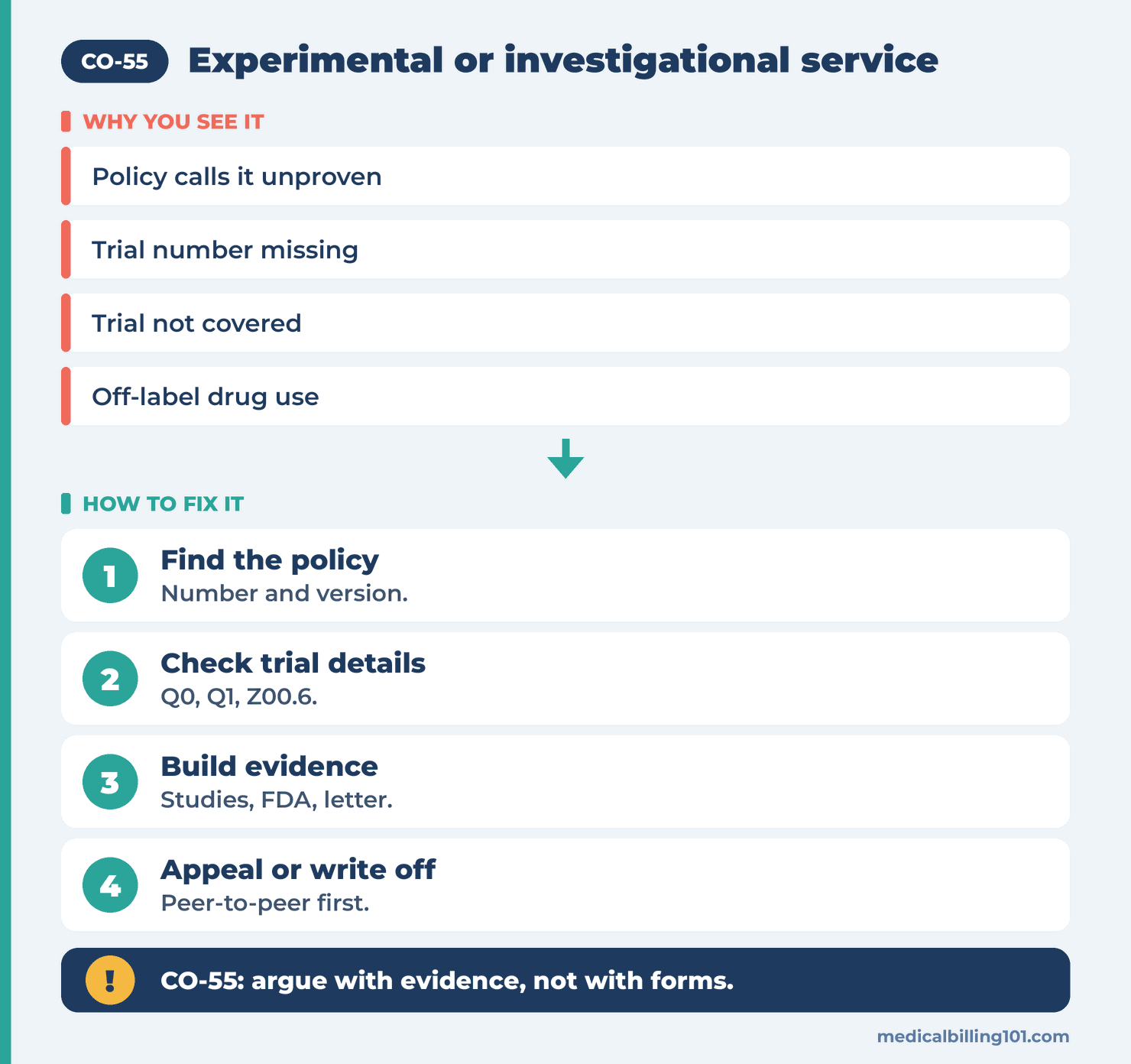
- Find the policy. Check the 835 REF segment in loop 2110, then the payer’s medical policy site. Note the policy number and its last review date.
- Check the trial facts. Is the patient in a trial? Confirm the trial number and which items count as routine care.
- Check what you billed. For Medicare trial claims this means modifiers such as Q0 or Q1, the clinical trial diagnosis Z00.6 and the trial number.
- Decide the route. A billing error gets a corrected claim. A policy dispute gets an appeal. A clear exclusion gets a write-off, or a patient bill only with a valid waiver.
- Build the case. Gather good studies, FDA status, specialty guidelines and a letter from the doctor.
- Appeal within the deadline. Ask for a peer-to-peer review if the payer offers one.
- Ask about outside review. Many plans must offer an independent review once the internal appeal is done.
Medicare clinical trial billing
Medicare’s national rule, NCD 310.1, covers the routine costs of qualifying clinical trials. It doesn’t cover the investigational item itself unless it is otherwise covered, items given only for data collection, or items the sponsor provides free. Billing practice on these claims uses:
- Modifier Q0 for an investigational clinical service in an approved study.
- Modifier Q1 for a routine clinical service in an approved study.
- ICD-10-CM Z00.6 as a secondary diagnosis for a clinical research exam.
- The 8-digit trial number from ClinicalTrials.gov on the claim.
Missing any of these can turn a covered routine cost into a denial. Check your Medicare contractor’s current billing article before you correct the claim.
Writing the appeal
An appeal for CO-55 is an argument that the treatment is no longer experimental, or is not experimental for this patient. Keep it focused:
- State the CARC, remark code, policy number and date of service in the first lines.
- Quote the policy criteria the payer applied.
- Show where the evidence has moved, for example FDA approval, a new guideline or several large published trials.
- Explain why this patient’s case fits, in the treating physician’s own words.
- Ask for a peer-to-peer review with a reviewer in the same specialty.
Keep it short. Two or three strong, recent sources beat twenty weak ones.
Questions to ask the payer about a CO-55
- Which medical policy number and version did you apply?
- When is the policy next due for review?
- Is the service covered inside a clinical trial, and what must be on the claim?
- Do you offer peer-to-peer review before a formal appeal?
- Is the plan fully insured or self-funded, and is external review available?
- Can the patient be billed if they signed a waiver?
Worked example (illustrative)
A patient in a registered oncology trial has a routine office visit and lab work. The remit shows CAS*CO*55*285.00 with remark MA50. The billing team sees the claim went out without the trial number. They add the 8-digit number, append modifier Q1 to the routine services and list Z00.6 as a secondary diagnosis. The corrected claim pays the routine costs. The investigational drug, supplied free by the sponsor, was never billed.
How to prevent CO-55
- [ ] Read the payer’s policy before you book a new procedure or an off-label drug.
- [ ] Ask for prior auth even when it isn’t required. You get a coverage answer in writing.
- [ ] Flag trial patients in the PM system so trial modifiers and numbers are added.
- [ ] Use a signed waiver when the plan lets you bill the patient for care it won’t cover.
- [ ] Track CO-55 by payer and policy so you can spot outdated policies.
Related denial codes
- CO-50: not deemed a medical necessity. About the patient’s need, not the treatment’s status.
- CO-96: non-covered charges, a broader coverage denial.
- PR-204: not covered under the patient’s current benefit plan.
- CO-197: prior authorization missing.
- CO-8: the procedure doesn’t fit the provider type.
- Denial codes hub for every code we cover.
Key takeaways
CO-55 is the payer’s view that a treatment is not yet proven. Get the policy, check any trial billing details and decide quickly between a corrected claim, an evidence-based appeal and a write-off. The patient isn’t billed under CO.
FAQ
What does the CO-55 denial code mean?
It means the payer sees the care as unproven under its own policy. Under the CO group, the provider carries the amount.
Is CO-55 the same as a medical necessity denial?
No. Medical necessity denials use CARC 50 and question whether the patient needed the service. CO-55 questions whether the treatment is proven.
Can a CO-55 denial be overturned?
Yes, when the evidence has moved past the payer’s policy or the patient meets the criteria. Appeal with recent studies, FDA status and the physician’s letter, and ask for peer-to-peer review.
Can I bill the patient for CO-55?
Not under CO. A PR-55 line or a valid signed waiver, where the plan and contract allow it, are the usual exceptions.
Does Medicare pay for anything in a clinical trial?
Medicare pays the routine costs of trials that qualify. Bill them with the trial number, modifier Q1 and diagnosis Z00.6.
Which remark code comes with CO-55 most often?
It varies by payer. N623 is a common one. It says the plan won’t pay for care it sees as unproven or out of date.
Sources
How we checked: every code quote on this page was compared word for word with the X12 CARC and RARC lists on 20 October 2026.
- X12, Claim Adjustment Reason Codes (CARC 55). Accessed 20 Oct 2026.
- X12, Remittance Advice Remark Codes (N623, N721, MA50, N789, M61, N130). Accessed 20 Oct 2026.
- CMS, NCD 310.1 Routine Costs in Clinical Trials. Accessed 20 Oct 2026.
- CMS, Medicare Claims Processing Manual, Ch. 22, §60.1 Group Codes. Accessed 20 Oct 2026.
Last updated: 20 October 2026 · This page is educational and doesn’t replace payer contracts or coding rules.