

CO-40 is an emergency-level denial. The payer is saying the visit didn’t qualify as emergency or urgent care under its rules. It shows up on ER and urgent care claims, most often when the payer judged the visit by its final diagnosis. Many denials can be overturned when the records show symptoms that a reasonable person would treat as an emergency. (Primary sources: X12 Claim Adjustment Reason Codes · HealthCare.gov, emergency medical condition).
In brief: CO-40 means “charges do not meet qualifications for emergent/urgent care.” Read the policy reference in the 835 if there is one. Compare the patient’s symptoms on arrival with the emergency definition, not just the final diagnosis. Send the triage notes and ER records with an appeal. If the visit really wasn’t urgent, check whether it can be billed at a lower level of care.
Part of our denial codes library. Written by Manikandan J, CPC, CRCR, who has more than 10 years of US medical billing and revenue cycle experience. Published 20 October 2026. Last updated: 20 October 2026. Code wording is quoted word for word from X12.
X12 wording for CARC 40
| Field | Official X12 text |
|---|---|
| Description | “Charges do not meet qualifications for emergent/urgent care.” |
| Usage | “Refer to the 835 Healthcare Policy Identification Segment (loop 2110 Service Payment Information REF), if present.” |
| Start | 01/01/1995 |
| Last modified | 07/01/2017 |
Source: X12 Claim Adjustment Reason Codes, checked 20 October 2026.
Denial code 40, CARC 40 and reason code 40
One X12 code, three common names. When you see denial code 40 or reason code 40 in a portal, the remit will also show a group code. With CO-40 your contract keeps the amount with the provider. With PR-40 the payer assigns it to the patient.
Emergency vs urgent care: the definitions
An emergency medical condition is, in HealthCare.gov’s glossary, an illness, injury or symptom so serious that a reasonable person would seek care right away to avoid severe harm.
Urgent care is care for a problem serious enough that a reasonable person would want it right away, but not so severe that it needs the ER. See the HealthCare.gov urgent care entry.
Both definitions turn on what a reasonable person would think at the time. That’s why the symptoms on arrival matter more than the final diagnosis.
Who pays: group code table
| Group + CARC | Who carries it | What to know |
|---|---|---|
| CO-40 | Provider | Contract bars patient billing. Appeal or rebill. |
| PR-40 | Patient | Billable to the patient after you’ve ruled out an appeal. |
| OA-40 | Not assigned | Check the primary payer’s handling. |
CMS describes CO adjustments as amounts that are “generally… considered a write off for the provider and are not billed to the patient” (Medicare Claims Processing Manual, Ch. 22, §60.1).
Common causes of CO-40
Remark wording is from the X12 RARC list. Pairings vary by payer.
| Cause | Typical RARC | Fix |
|---|---|---|
| Payer judged the visit by the final diagnosis | N391 | Appeal with triage notes showing the presenting symptoms. |
| ER records not sent | N391 | Send the emergency department records. |
| Records incomplete or unclear | N392 | Send complete records, including triage and vitals. |
| Urgent and other services billed together | N772 | Rebill the urgent or emergency and other services separately. |
| Visit truly wasn’t urgent | N391 | Check whether a lower level of care can be billed. |
Resolving CO-40 step by step
Presenting symptoms are the complaints and signs the patient had on arrival, before tests or diagnosis.
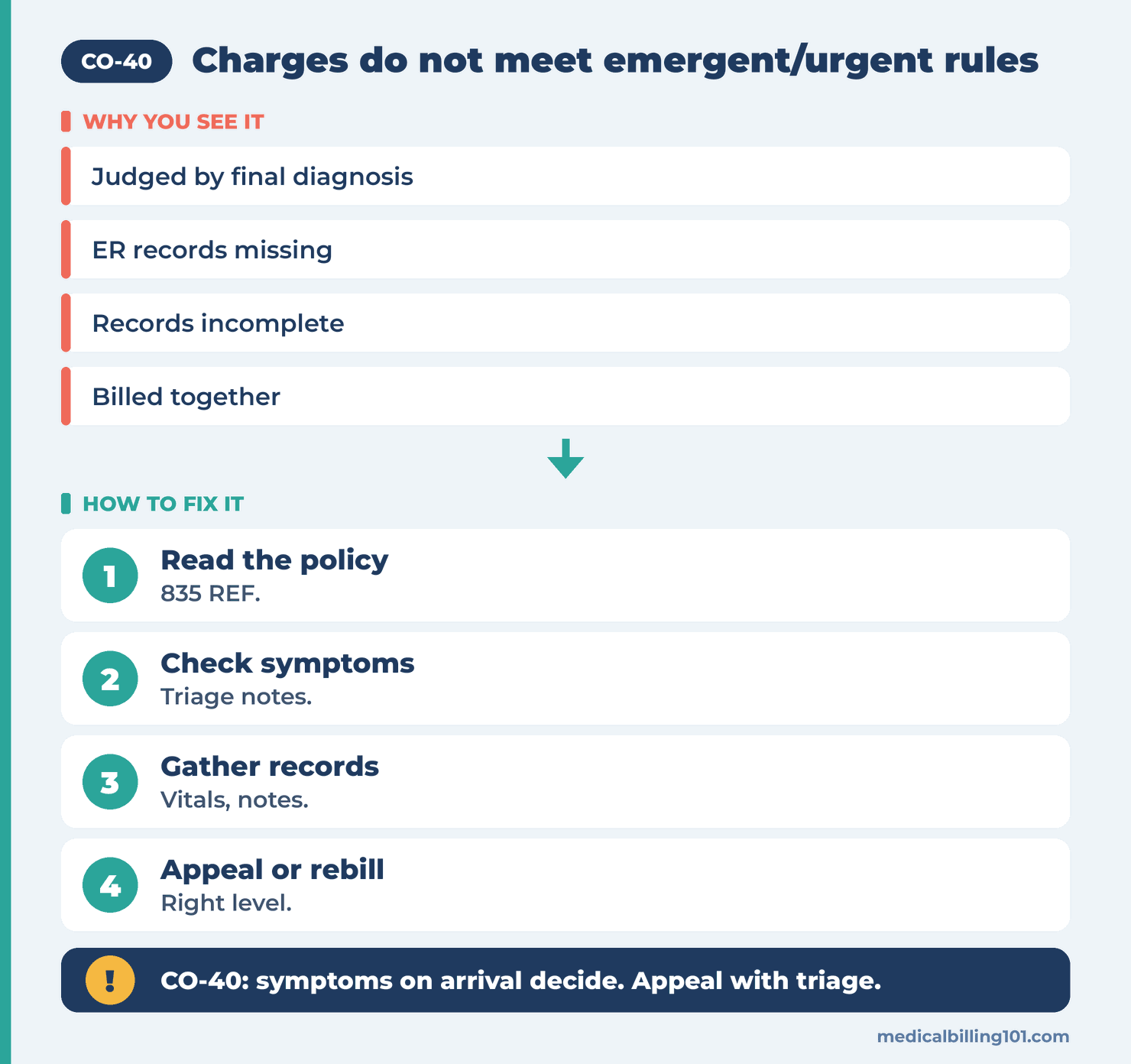
- Read the policy reference. The 835 REF segment may name the payer policy behind the denial.
- Pull the triage notes. For example, chest pain at arrival matters even if the final diagnosis was reflux.
- Code the symptoms. Make sure the claim shows the presenting symptoms, not only the final diagnosis.
- Gather the records. Include triage, vitals, the physician note and any tests ordered.
- Appeal with the records and the reasonable-person argument.
- Rebill at another level only if the visit truly wasn’t urgent and the contract allows it.
Appeal approach
Build the appeal around what the patient knew on arrival. Quote the chief complaint and vitals from triage. Explain why a reasonable person with those symptoms would seek care right away. Under the ACA, most health plans must judge emergency visits by this kind of standard, not by the final diagnosis alone. Attach the full ER record.
Questions to ask the payer about a CO-40
- Which policy did you apply, and is it in the 835 REF segment?
- Did the review use the final diagnosis or the presenting symptoms?
- Which records do you need for an appeal?
- Can urgent and other services be rebilled separately?
Worked example (illustrative)
A patient arrives at the ER with chest pain and shortness of breath. Tests rule out a heart attack, and the final diagnosis is heartburn. The remit shows CAS*CO*40*890.00. The biller sees the claim listed only the heartburn code. The biller adds the chest pain code and appeals with the triage note. Consider why it works: a reasonable person with chest pain would seek care right away. The payer reverses the denial.
Prevention checklist
- [ ] Code presenting symptoms, such as chest pain, along with the final diagnosis.
- [ ] Make sure triage notes record the chief complaint and vitals.
- [ ] Send ER records with claims for payers that often deny.
- [ ] Bill urgent and other services separately where a payer asks.
- [ ] Track CO-40 by payer and diagnosis to spot patterns.
Related denial codes
- CO-50: not deemed a medical necessity.
- CO-197: precertification or authorization absent.
- CO-11: diagnosis inconsistent with the procedure.
- CO-252: attachment or documentation required.
- CO-96: non-covered charges.
- Denial codes hub for every code we cover.
Key takeaways
CO-40 means the payer decided the visit wasn’t emergency or urgent care. Judge it by the symptoms on arrival, code those symptoms, and appeal with the triage notes. Rebill at a lower level only when the visit truly wasn’t urgent.
FAQ
What does denial code CO-40 mean?
It means the charges don’t meet the payer’s rules for emergency or urgent care. The CO group keeps the amount with the provider.
Can a payer deny an ER visit because of the final diagnosis?
Most health plans must judge emergencies by what a reasonable person would think from the symptoms. Appeal with the triage notes.
What records should I send?
Triage notes, vitals, the physician note and any tests ordered.
What does RARC N391 mean with CO-40?
N391 says “Missing emergency department records.” Send the ER records.
Can I bill the patient for CO-40?
Not under the CO group. Under PR-40 you can, after ruling out an appeal.
Should I appeal CO-40?
Yes, when the symptoms on arrival would lead a reasonable person to seek care right away.
Sources
How we checked: every code quote on this page was compared word for word with the X12 CARC and RARC lists on 20 October 2026.
- X12, Claim Adjustment Reason Codes (CARC 40). Accessed 20 Oct 2026.
- X12, Remittance Advice Remark Codes (N391, N392, N772). Accessed 20 Oct 2026.
- HealthCare.gov, Emergency medical condition. Accessed 20 Oct 2026.
- HealthCare.gov, Urgent care. Accessed 20 Oct 2026.
- CMS, Medicare Claims Processing Manual, Ch. 22, §60.1 Group Codes. Accessed 20 Oct 2026.
Last updated: 20 October 2026 · This page is educational and doesn’t replace payer contracts or coding rules.