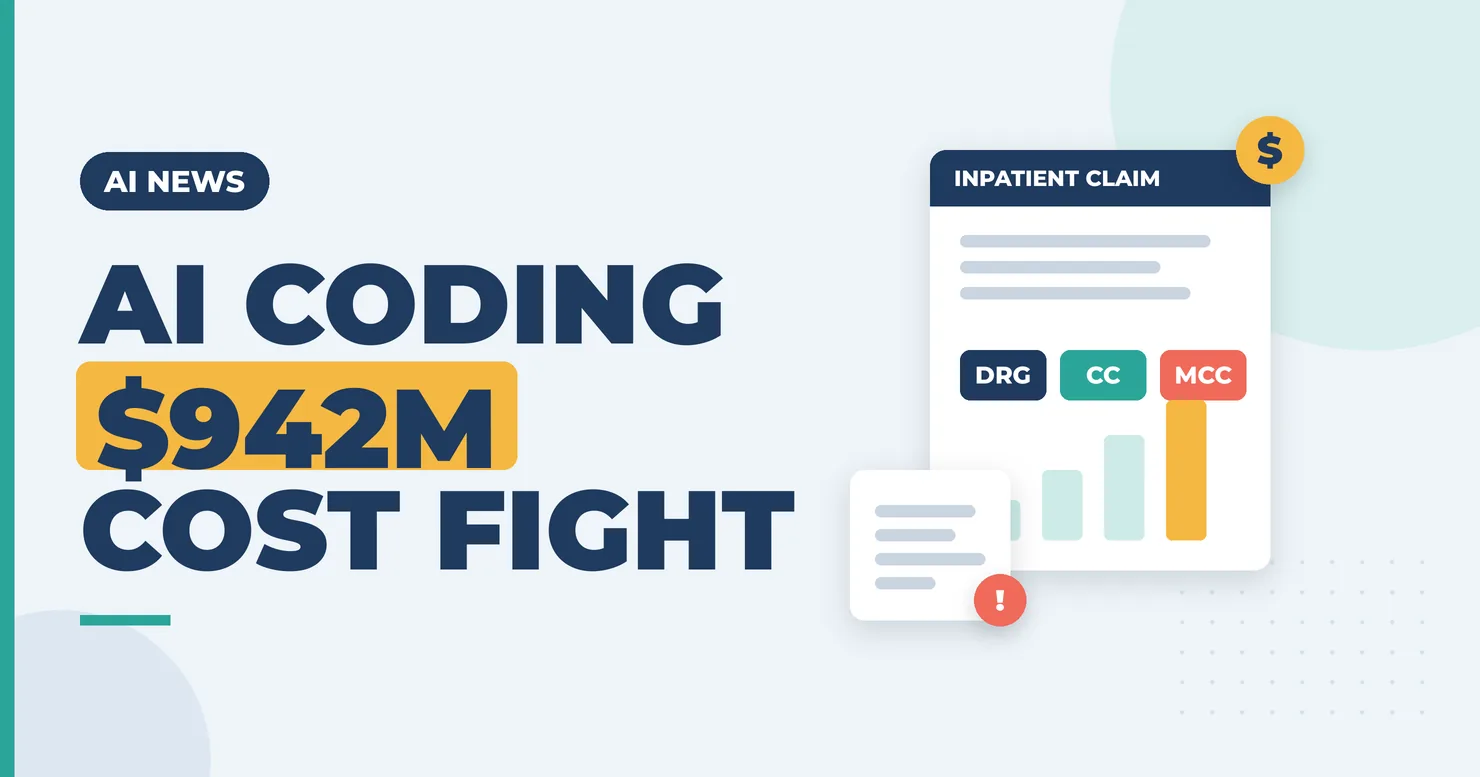
The Blue Cross Blue Shield Association (BCBSA) says hospitals’ use of AI-assisted coding added about $942 million to Blue plan costs from 2023 to 2025. Most of it, about $653 million, came from extra secondary diagnoses that moved inpatient stays into higher-paying DRGs. BCBSA found no matching rise in treatment. Hospitals say patients are simply sicker. For billing teams, the practical takeaway is simple: every secondary diagnosis now needs to clearly meet the official “clinically significant” test, because payers are looking.
The report came out on September 24, 2026. It is still driving debate two weeks later. CNBC covered it on October 1, and STAT ran a resident physician’s response on October 6. This is our plain-English breakdown of what the data says, what it can’t prove, and what to do about it.
Key takeaways
- BCBSA says the share of inpatient cases billed as medically complex rose from 37% in early 2023 to 40% by the end of 2025.
- About 70% of the increase came from more than 55,000 extra cases where a secondary diagnosis pushed the claim into a higher-severity DRG.
- BCBSA admits a key limit: it used claims data, not medical records. So it can show a pattern, not prove that any single code was wrong.
- The American Hospital Association (AHA) disputes the report. It says patients are older and more complex, and that AI helps capture real conditions.
- Expect more payer clinical-validation reviews of common “bump codes” such as anemia, malnutrition and low sodium.
How this article was checked: figures come from Fierce Healthcare’s report on BCBSA’s media briefing and CNBC’s interview with BCBSA’s Luke Chalker. We cross-checked them against Healthcare Dive. Coding rules are quoted from the FY 2027 ICD-10-CM Official Guidelines. BCBSA’s white paper PDF did not load for us, so we rely on that reporting. Last reviewed 7 October 2026. This is educational content, not legal advice.
Table of Contents
What BCBSA found
BCBSA and its analytics arm studied Blue plan inpatient claims from 2023 through 2025. The main numbers, as reported by Fierce Healthcare and CNBC:
| Measure | What BCBSA reported |
|---|---|
| Share of cases billed as complex | 37% (early 2023) → 40% (end of 2025) |
| Extra complex cases from secondary diagnoses | More than 55,000 |
| Added cost, all coding intensity | About $942 million over two years |
| Added cost from secondary diagnoses | About $653 million (around $11,000 per extra complex case) |
| Major bowel procedures, highest-severity share | 10.2% → 22.7% |
| Posthemorrhagic anemia coding, top-quartile hospitals vs. others | 13.7% vs. 9.9% |
| Transfusion rate among those coded with anemia | 16.9% (top quartile) vs. 19.3% (others) |
That last pair is the core of BCBSA’s case. Hospitals that coded anemia most often were less likely to transfuse those patients. BCBSA reads that as more diagnoses without more care. Chalker told CNBC that “any clinical denial is always reviewed by a qualified human clinician” on the Blue side. He also said the findings “suggest” AI tools play a role. He did not say AI caused all of it.
What the report can’t prove
BCBSA itself said the analysis relies on claims, not clinical documentation. A claim shows codes and payments. It does not show the lab trend, the physician’s note or why a doctor thought the anemia mattered. So the report finds a pattern. It can’t tell you whether a given hospital’s coding was right or wrong.
The pushback is real, too. An AHA spokesperson told CNBC that “patients today are older and more clinically complex.” AHA also said BCBSA’s analysis “lacks the context” to judge how these tools affect quality, access or spending. AI coding vendors interviewed by Healthcare Dive argued that their software captures conditions providers used to miss. In a fee-for-service system, they said, more complete coding means higher payment.
Both things can be true. Some extra diagnoses are real and were under-coded before. Others are lab blips that never changed care.
Why “bump codes” sit at the center of this
Inpatient stays are usually paid by DRG. A secondary diagnosis that counts as a CC or MCC can move a stay into a higher-paying DRG. That is why coders sometimes call these “bump codes.”
In STAT on October 6, resident physician Leah Pierson described automated documentation tools that flag lab-based conditions like low sodium and prompt doctors to address them. She argues those tools often presume a finding is clinically significant. She suggests they should let doctors say when it isn’t.
The official rule is already clear. Section III of the FY 2027 ICD-10-CM Official Guidelines defines “other diagnoses” as “additional clinically significant conditions that affect patient care.” To count, a condition must require at least one of these:
- clinical evaluation
- therapeutic treatment
- diagnostic procedures
- extended length of hospital stay
- increased nursing care and/or monitoring
The same section says abnormal lab findings “are not coded and reported unless the provider indicates their clinical significance.” An AI flag on a low lab value is not that indication. The provider’s documentation is.
What this means for coders and CDI teams
This is our read of what comes next. It is not a prediction BCBSA made.
- Expect more clinical-validation reviews. BCBSA has said Blue companies are working to “establish clear expectations for hospitals using AI tools” (BCBSA, March 2026). In practice, that usually means more DRG audits and downgrades on anemia, malnutrition, hyponatremia and similar codes.
- Test each secondary diagnosis against Section III. Before final coding, ask: what evaluation, treatment, test, extra monitoring or longer stay does the record show for this condition? If you can’t point to one, query or leave it off.
- Keep an AI audit trail. Log which codes the tool suggested, which a human accepted, and why. If a payer challenges a pattern, you’ll need that record.
- Audit AI output like a new coder. Pull a regular sample of AI-assisted charts. Compare them with a human re-review, by DRG family and by bump code.
- Fight bad downgrades with the record, not the algorithm. A strong appeal points to the clinical evidence in the chart. Our guide to what payers look for in medical necessity documentation covers how to build that file.
Coding patterns that drift upward can also draw government attention. See our explainer on OIG audit triggers in medical billing.
What this means for patients
BCBSA’s argument is that higher hospital payments end up in your premiums. Chalker told CNBC those costs “can eventually show up in the form of higher premiums and out-of-pocket costs.” The report doesn’t measure that pass-through directly. Still, it matters for your own bills:
- Coinsurance plans feel it most. If your plan charges a percentage of the inpatient payment, a higher DRG can raise your share. If you pay a flat inpatient copay, it usually won’t change.
- Check the diagnoses on your paperwork. Your Explanation of Benefits and itemized hospital bill should match your stay. Diagnoses also become part of your medical record. If one looks wrong, ask the hospital’s billing office to review it. You can also ask the hospital to amend your record under HIPAA (45 CFR 164.526).
- Watch for denials on the other side. The same fight means insurers are also using automated tools to review and downgrade claims. If a stay is denied or cut, our guide to appealing a “not medically necessary” denial walks you through it.
The bigger picture: an AI arms race on both sides
Hospitals use AI to code more completely. Insurers use AI to review claims and push back. Brown University health economist Christopher Whaley told CNBC this could become an “administrative arms race.” Patients pay for both sides through premiums and taxes.
The same week, AKASA launched a fully autonomous inpatient coding product, which puts even more coding in software’s hands. We cover what that means in our analysis of AKASA’s autonomous coding launch.
There’s no quick fix in this report. The likely near-term result is more audits, more appeals and more attention to documentation. Teams that can show why each diagnosis was clinically significant will lose less money in that fight.
FAQ
Did BCBSA say hospitals committed fraud?
No. BCBSA described coding intensity rising without matching treatment. It did not allege fraud, though one BCBSA leader told reporters that technology-enabled upcoding was the more likely explanation. BCBSA also acknowledged its analysis is limited because it used claims, not medical records.
What is a “bump code”?
It’s informal slang for a secondary diagnosis that counts as a complication or comorbidity (CC or MCC). These codes can move an inpatient stay into a higher-paying DRG. Common examples in this debate are acute blood-loss anemia, malnutrition and low sodium.
Can an AI tool add a diagnosis on its own?
The rule doesn’t change with AI. The provider must document a condition and its clinical significance before it is coded. Abnormal lab findings aren’t coded unless the provider indicates they’re clinically significant.
Will this raise my premium?
BCBSA says added hospital payments eventually show up in premiums and out-of-pocket costs. The report doesn’t measure how much, and premiums depend on many factors.
What should I do if my hospital bill lists a diagnosis I never had?
Ask the hospital billing office for a coding review and an itemized bill. You can also ask the hospital to amend your medical record under HIPAA’s amendment right. If the error affected what insurance paid, ask whether a corrected claim will be sent.
Sources
- Fierce Healthcare, Hospitals’ use of AI coding tools cost BCBSA plans $942M more for similar care: analysis, Sept. 24, 2026.
- CNBC, Health insurer points finger at AI as nearly $1 billion in questionable hospital charges appear, Oct. 1, 2026.
- Healthcare Dive, Insurers say AI could add billions in health costs. Billing companies disagree, Sept. 28, 2026.
- STAT First Opinion, I’m a doctor. Here’s what I want the public to know about AI tools and health care costs, Oct. 6, 2026.
- CMS, ICD-10-CM Official Guidelines for Coding and Reporting FY 2027, Section III.
- BCBSA, New BCBSA Research Suggests AI in Hospital Billing is Leading to Higher Health Care Costs, March 5, 2026.
- eCFR, 45 CFR 164.526, Amendment of protected health information.

Manikandan J is a CPC (AAPC) and CRCR (HFMA) certified medical billing professional with billing and RCM experience at athenahealth, Omega Healthcare, UnitedHealthcare, Blue Cross Blue Shield and Access Healthcare. He writes Medical Billing 101’s guides on denial codes, appeals and patient billing help for US billers, providers and insured patients.