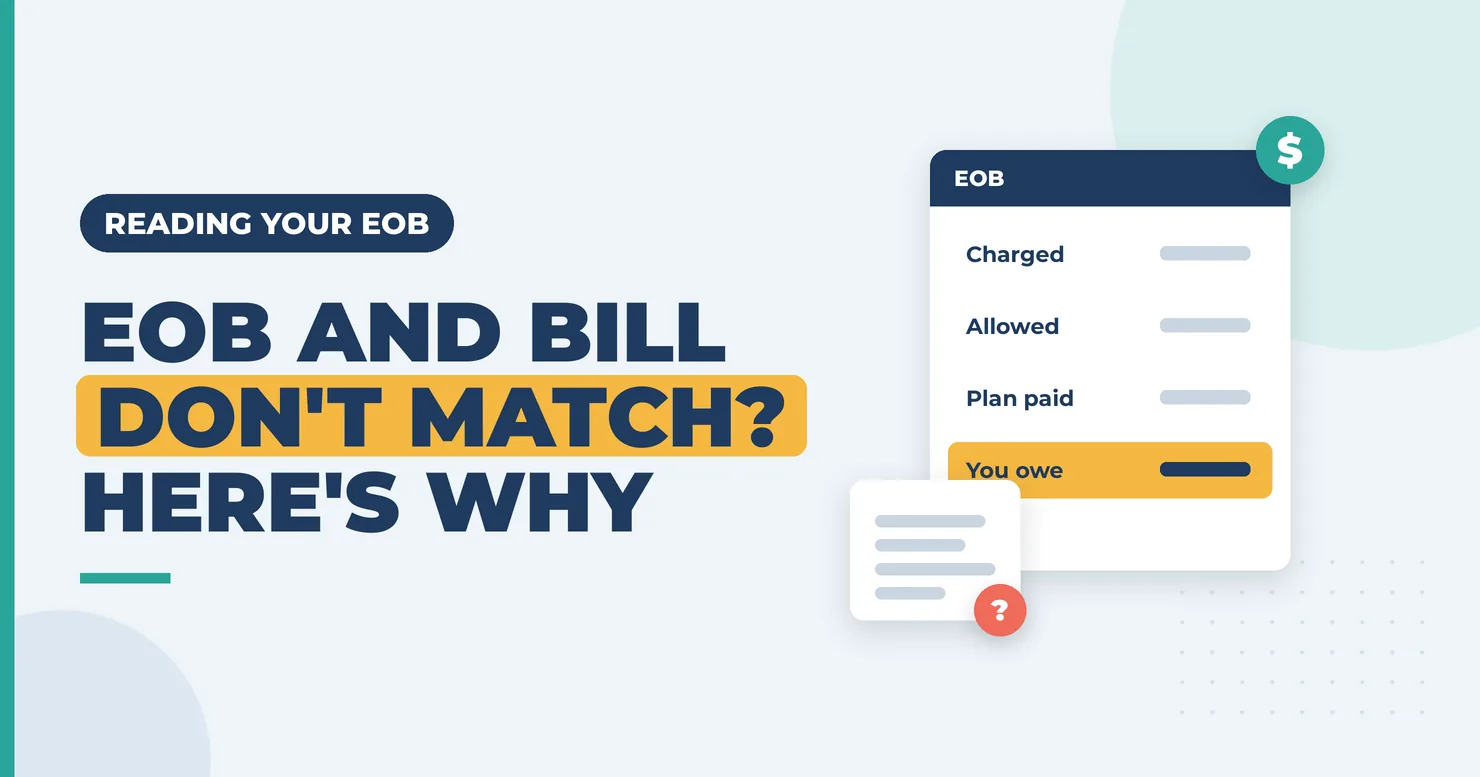
An Explanation of Benefits (EOB) is your insurer’s receipt for a claim. It is not a bill. To read one, find four numbers: what the provider charged, what your plan allows, what the plan paid, and what you owe. The last number, often called “Patient Balance” or “What You Owe,” is the most a network provider should bill you for that service. If your bill is higher, CMS says to talk to your provider, and you can use the letter below.
The billing office reads the same claim through codes. Every dollar the insurer didn’t pay is tagged with a group code (CO, PR or OA) and a reason code. Learning just two of these, CO-45 and PR-1, PR-2 and PR-3, explains most EOBs.
Key takeaways
- CMS: “An explanation of benefits isn’t a bill.” Wait for the provider’s bill before you pay.
- CMS: “Your bill should not be higher than the Patient Balance. If it is, talk to your provider.”
- CO-45 is the network discount. In network, you don’t owe it.
- PR-1, PR-2 and PR-3 are your deductible, coinsurance and copay. You do owe those.
- In KFF’s 2023 survey, 52% of insured adults who had a denied claim said their EOBs were hard to understand (KFF, 2023). You’re not alone.
How this guide was checked: column names and advice come from CMS’s EOB guide, and code wording comes from the X12 code lists. This is educational content, not legal advice.
Table of Contents
The four numbers on every EOB
CMS’s guide to reading an EOB names the main columns. Your insurer may use slightly different labels, but the meaning is the same.
| EOB column (CMS wording) | What it means | Do you owe it? |
|---|---|---|
| Provider Charges | The provider’s full list price for the service | No, not by itself |
| Allowed Charges | The amount the provider will be paid under your plan. It “may not be the same as the Provider Charges” | Split between plan and you |
| Paid by Insurer | What your plan pays the provider | No |
| What You Owe / Patient Balance | What’s left for you “after your insurer has paid everything else” | Yes, unless you already paid it |
The EOB also lists who got the care, the date of service, a claim number and a short description of each service, such as “office visit.” The allowed amount is the price your plan agreed to pay for the service. At the bottom you’ll find remark codes, which CMS describes as notes from the health plan that explain the costs and payments.
One catch: CMS points out that the EOB “only shows what you owe, not if you’ve already paid for it.” If you paid a copay at check-in, subtract it before you compare.
A worked example (made-up numbers)
Say a specialist visit shows Provider Charges of $300, Allowed Charges of $180, Paid by Insurer of $144 and Patient Balance of $36. The $120 gap between $300 and $180 is the network discount. The $36 is your coinsurance. If you paid nothing at the visit, a bill for $36 is correct. A bill for $156 is not.
The billing-side view: CO-45 vs PR-1, PR-2 and PR-3
Behind the EOB, the insurer sends the provider an electronic remittance with standard Claim Adjustment Reason Codes (CARCs) from the X12 code list. A CARC is a short code that says why a claim line was paid less than billed. The two-letter group code in front tells you who carries that amount.
| Code | Official X12 wording | Who carries it |
|---|---|---|
| CO-45 | “Charge exceeds fee schedule/maximum allowable or contracted/legislated fee arrangement.” | The provider (contractual write-off) |
| PR-1 | “Deductible Amount” | You |
| PR-2 | “Coinsurance Amount” | You |
| PR-3 | “Co-payment Amount” | You |
| OA-23 | “The impact of prior payer(s) adjudication including payments and/or adjustments.” | Depends on the other payer |
CO stands for contractual obligation. When an in-network provider sees CO-45, it must write that amount off. It shouldn’t move to your bill. PR means patient responsibility. Our PR-1, PR-2 and PR-3 page and CO-45 page show exactly how billers post these lines.
If you see a denial code instead, like CO-50 (medical necessity) or CO-97 (bundled into another service), the denial code list explains it. For example, CO-97 means the plan considers the service part of another one it already paid. Here’s how billing teams handle CO-97. To appeal a denial, try our free appeal letter generator.
Step-by-step: compare your EOB to your bill
- Match the claim. Check that the date of service, provider name and service description on the bill match the EOB.
- Find the Patient Balance line. Add up the PR amounts if your insurer shows codes instead of a balance column.
- Subtract what you already paid. Include copays paid at the front desk.
- Compare to the bill. If the bill is equal or lower, it’s probably right. If it’s higher, don’t pay the difference yet.
- Call the billing office with the claim number. Say: “My EOB for claim [number] shows a patient balance of $[X]. Your bill shows $[Y]. Can you adjust the account to match the EOB?”
- Follow up in writing. If the call doesn’t fix it, send the letter below and keep a copy.
- Escalate if needed. For a surprise out-of-network bill, the No Surprises Help Desk is 1-800-985-3059, which CMS lists on its EOB page.
Common mismatches and what they usually mean
| What you see | Likely cause | What to ask for |
|---|---|---|
| Bill is higher than Patient Balance | The provider billed you before the insurance payment posted, or didn’t write off CO-45 | An adjusted statement that matches the EOB |
| EOB says $0, but you got a bill | Bill sent before the claim processed, or a posting error | A corrected bill with a $0 balance |
| EOB says you owe, but no bill came | Normal lag. The provider may not have billed yet | Nothing yet. Keep the EOB and watch for the bill |
| Two EOBs for the same visit | Doctor and facility bill separately, or a claim was reprocessed | The latest EOB for each claim number |
| EOB mentions “other insurance” | The plan thinks another plan pays first | See our guide to coordination of benefits denials |
Free template: “please correct my balance to match the EOB”
[Your name] | [Address] | [Phone]
[Date]

[Provider or hospital] - Patient Billing Office
[Address from your bill]

Re: Account [number] - balance does not match my EOB
Patient: [name]   Date of service: [ ]   Insurer claim number: [ ]

Your statement dated [date] shows a balance of $[amount].
My insurer's Explanation of Benefits dated [date] (copy enclosed)
shows a patient responsibility of $[amount] for this claim.
I have already paid $[amount] on [date].

The difference of $[amount] appears to be an amount the insurer
listed as a contractual adjustment (group code CO), which I
understand an in-network provider cannot bill to the patient.

Please:
1. Adjust my account to match the EOB, and send me an updated
   statement.
2. Hold the account from collections while you review it.
3. If you believe I owe more, explain why in writing and send the
   remittance detail for this claim.

Thank you,
[Signature]
Printable EOB vs bill checklist
- ☐ Same patient, provider and date of service on both
- ☐ Insurer claim number written on the bill or noted by you
- ☐ Patient Balance (or total PR amount) found on the EOB
- ☐ Copays or deposits already paid subtracted
- ☐ Any CO amount appearing on your bill circled
- ☐ Remark codes at the bottom of the EOB looked up
- ☐ Call logged: date, name of person, what they said
- ☐ Letter sent and copy saved, if the call didn’t fix it
FAQ
Is an EOB a bill?
No. CMS says plainly that “an explanation of benefits isn’t a bill.” It shows how your plan processed the claim. Wait for the provider’s bill before you pay.
What does “allowed amount” mean on my EOB?
It’s the amount the provider will be paid for the service under your plan, split between your insurer and you. It’s often lower than the provider’s charge because of network discounts.
What is CO-45 on an EOB?
CO-45 is the contractual adjustment: the part of the charge above the allowed amount. When the provider is in network, the provider writes it off, and you don’t owe it.
What do PR-1, PR-2 and PR-3 mean?
They’re your share: PR-1 is the deductible, PR-2 is coinsurance and PR-3 is the copay. These are the amounts a provider can bill you.
My EOB says I owe nothing but the provider keeps billing me. What should I do?
Call the billing office with the claim number and ask them to match the EOB. If that fails, send the letter above and ask them to hold the account from collections. If the bill has already gone to collections, see our guide on disputing a medical bill in collections.
Related patient guides
- Claim denied as “not medically necessary”
- Got a medical bill months later?
- Charged for your “free” annual physical?
Disclaimer: This article is educational and is not legal advice. What you owe depends on your plan, your provider’s network status and the facts of each claim. Contact your insurer or provider about your account, and check each linked source, since rules can change.
Written by Manikandan, RCM specialist at Medical Billing 101.
Sources
- CMS, How to read a health insurance explanation of benefits, retrieved 4 Oct 2026.
- X12, Claim Adjustment Reason Codes, retrieved 4 Oct 2026.
- KFF, Consumer Survey Highlights Problems with Denied Health Insurance Claims (Sep 29, 2023), retrieved 4 Oct 2026.
Related denial codes
- PR-1, PR-2 and PR-3: Deductible, Coinsurance and Copay (Patient Responsibility)
- CO-45: Charge Exceeds Fee Schedule or Contracted Amount
- CO-16: Claim Lacks Information or Has a Billing Error
- PR-2: Coinsurance Amount (Patient Responsibility)
- OA-18: Exact Duplicate Claim or Service
- CO-22: Care May Be Covered by Another Payer (Coordination of Benefits)