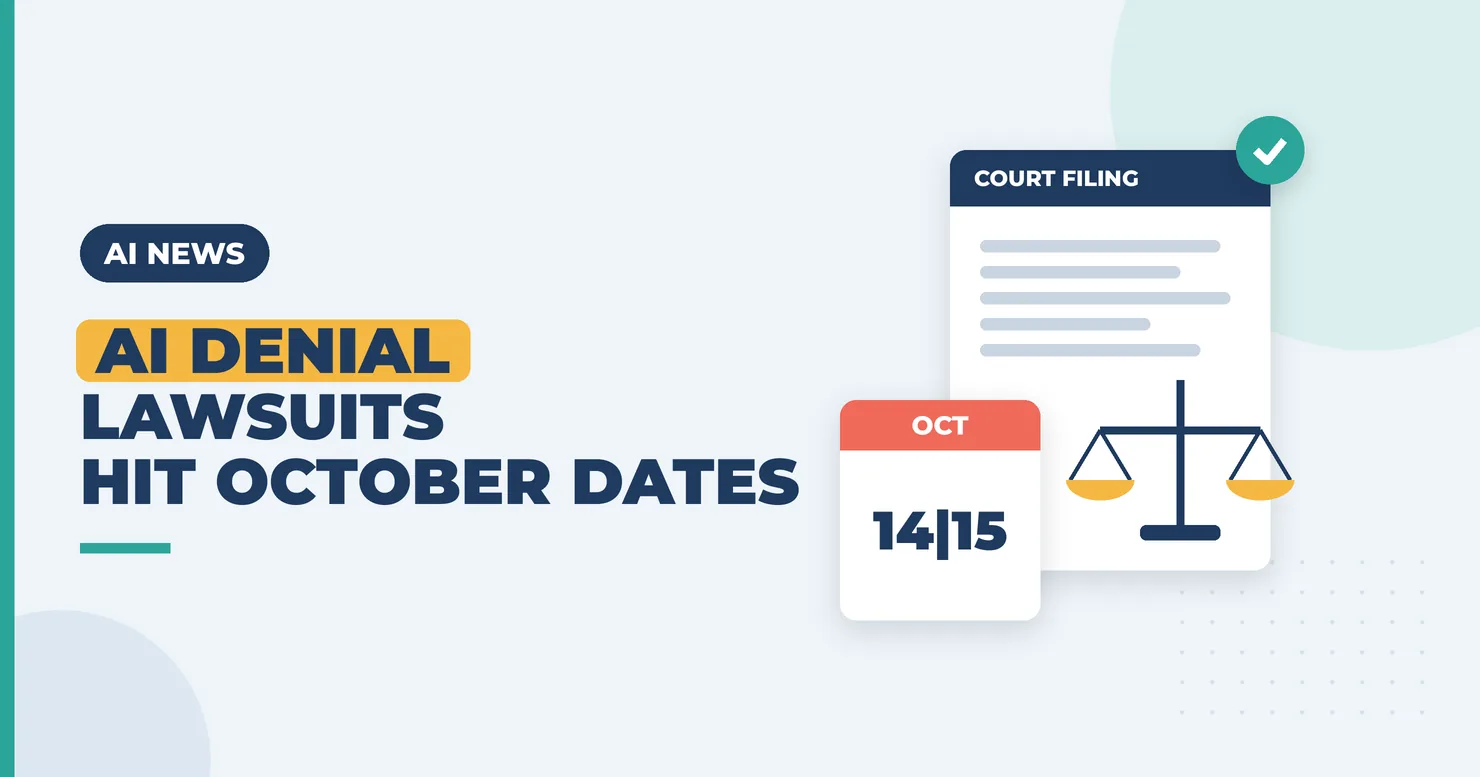
Two class actions claim Medicare Advantage insurers used an AI tool called nH Predict to cut off nursing-home and rehab coverage too early. Both reach key deadlines this month. On September 29, 2026, plaintiffs suing Humana asked the court to let them add naviHealth, the company that built nH Predict, as a defendant. Their class-certification motion is due October 15. In the UnitedHealth case, plaintiffs’ class-certification expert declarations are due October 14. Both insurers deny that the tool makes coverage decisions. Neither case is near a verdict. But if you’re in a skilled nursing facility today, your fast-appeal rights apply now.
These lawsuits are the best-known legal test of insurer AI in coverage decisions. Here’s where each one stands, based on the court filings, and what patients and post-acute billing teams can do in the meantime.
Key takeaways
- Barrows v. Humana (W.D. Ky.): plaintiffs filed a motion for leave to file a second amended complaint that adds naviHealth as a defendant. The class-certification motion and expert reports are due October 15, 2026.
- Lokken v. UnitedHealth Group (D. Minn.): plaintiffs’ class-certification expert declarations are due October 14, 2026. The class-certification motion is due February 16, 2027. The case is set to be trial-ready around February 7, 2028.
- Humana says it “did not use nH Predict to make adverse coverage determinations.” It says physician medical directors make those decisions.
- CMS rules already say a predicted length of stay “alone cannot be used as the basis to terminate post-acute care services.”
How this article was checked: dates and quotes come from the court documents themselves (complaints, answers, scheduling orders and a discovery order), copied from the Georgetown O’Neill Institute’s Health Care Litigation Tracker. CMS and Medicare rules come from CMS and Medicare.gov. Allegations are claims, not findings. Last reviewed 7 October 2026. This is educational content, not legal advice.
Table of Contents
The two cases at a glance
| Barrows v. Humana | Lokken v. UnitedHealth Group | |
|---|---|---|
| Court | U.S. District Court, Western District of Kentucky (No. 3:23-cv-00654) | U.S. District Court, District of Minnesota (No. 23-cv-3514) |
| Filed | Dec. 12, 2023 | Nov. 14, 2023 |
| Defendants | Humana Inc.; plaintiffs now seek to add naviHealth | UnitedHealth Group, UnitedHealthcare, naviHealth |
| What’s alleged | nH Predict was used to cut short post-acute care for Medicare Advantage members | Same tool, same type of care |
| Insurer’s position | Physician medical directors make denials, not AI | Has said nH Predict is not used to make coverage decisions |
| Next deadline | Oct. 15, 2026: class-certification motion and expert reports | Oct. 14, 2026: plaintiffs’ class-certification expert declarations |
| Later dates | Humana’s response Jan. 13, 2027; plaintiffs’ reply Apr. 13, 2027 | Class-certification motion Feb. 16, 2027; fact discovery closes Apr. 26, 2027; trial-ready about Feb. 7, 2028 |
What’s new in the Humana case
On September 29, plaintiffs filed a motion for leave to file a proposed second amended complaint. The big change is a new defendant: naviHealth, Inc. The proposed complaint says naviHealth “conceived of, engineered, marketed, and profited from nH Predict.” It argues naviHealth “did not merely operate a tool at Humana’s direction.”
The filing quotes material from discovery that Humana and naviHealth marked confidential. So the public copy is redacted, and plaintiffs filed a motion to seal the full version. The court has to approve the amendment. The filing doesn’t show that it has yet.
One number in the complaint deserves care. It says “roughly 0.2%” of policyholders appeal denied claims. The footnote cites a KFF study of ACA Marketplace plans from 2021, not Medicare Advantage. That’s a different market, so treat it as a rough signal, not a measured MA appeal rate.
Humana’s side is in its August 26, 2026 amended answer. It calls the allegations “false.” Humana says denials are made “on an individualized basis, by physician Medical Directors—not artificial intelligence.” It also says those decisions follow CMS’s skilled nursing facility coverage criteria. Humana is keeping its argument that federal Medicare law preempts the claims.
The July 17 scheduling order sets October 15, 2026 for the plaintiffs’ class-certification motion and expert reports.
Where the UnitedHealth case stands
In March, the Minnesota court ordered UnitedHealth to produce broad discovery about nH Predict (March 9, 2026 order). That covers documents on how the tool works, its development goals and anticipated benefits, and the people who designed it. The judge refused to order production of the tool’s “data, rules, source code, and medical guidelines.” The order also notes an October 2024 U.S. Senate investigation report. That report found UnitedHealthcare’s post-acute denial rate “more than doubled” after it began using naviHealth and nH Predict in 2019.
The September 18, 2026 scheduling order resets the calendar. Plaintiffs’ class-certification expert declarations are due October 14, 2026. The class-certification motion is due February 16, 2027. The court set a trial-ready date of about February 7, 2028.
Why class certification matters
Class certification decides whether a few named patients can sue for everyone in a similar situation. If a class is certified, a ruling or settlement could reach many Medicare Advantage members whose post-acute care ended early. If not, the cases could shrink to the named plaintiffs. The October filings are where plaintiffs start making that case with expert evidence. Briefing runs to April 2027 in the Humana case and mid-2027 in the UnitedHealth case, so class rulings are unlikely before then.
What the rules already say
Patients don’t have to wait for these lawsuits. CMS addressed this exact situation in a February 2024 FAQ memo to Medicare Advantage plans:
- An algorithm “can be used to assist” in predicting length of stay, “but that prediction alone cannot be used as the basis to terminate post-acute care services.”
- The patient “must no longer meet the level of care requirements” when services end. That “can only be determined by re-assessing the individual patient’s condition.”
- A plan’s decision to end skilled nursing, home health or outpatient rehab facility (CORF) services is an appealable decision.
What to do if your Medicare Advantage plan ends nursing-home or rehab coverage
- Look for the notice. Medicare says you should get a “Notice of Medicare Non-Coverage” at least 2 days before covered services end in a skilled nursing facility, home health agency or CORF (Medicare.gov). If you don’t get it, ask for it.
- Ask for a fast appeal right away. The notice tells you how. An independent reviewer, the Beneficiary and Family Centered Care Quality Improvement Organization (BFCC-QIO), decides whether coverage should continue.
- Get the treating team’s view in writing. Ask the therapists and doctor for notes showing what you still need, such as progress, function and safety. Those notes matter more than any predicted discharge date.
- Keep appealing if needed. If the fast appeal fails, there are further levels. Our guide to the 5 levels of Medicare appeals explains each step. For denials framed as “not medically necessary,” see how to appeal and get an external review.
What this means for post-acute billing teams
- Document function, not just diagnoses. Coverage turns on whether the patient still needs a skilled level of care. Weekly notes should show measurable progress, current limits and why skilled services are still needed.
- Check for a real reassessment. When an MA plan ends coverage, ask what new clinical review supported it. If the termination date matches a prediction and nothing in the chart changed, say so in the appeal.
- Help the patient file the fast appeal on time. Deliver the notice correctly and help the patient or family call the BFCC-QIO. Track outcomes by plan.
- Know the codes. A post-service medical-necessity denial often posts as CO-50. Missing authorization shows up as CO-197. Strong appeals rely on medical necessity documentation tied to the plan’s criteria.
FAQ
What is nH Predict?
It’s a tool built by naviHealth, an Optum subsidiary within UnitedHealth Group, that, according to the lawsuits, predicts how long a patient will need post-acute care. Plaintiffs say insurers used those predictions to end coverage. The insurers say doctors make the decisions.
Has a court ruled that the insurers used AI to deny care?
No. These are allegations. In the UnitedHealth case, the court let some contract-based claims go forward and ordered broad discovery, but there’s no finding of wrongdoing. Humana denies using nH Predict to make adverse decisions.
Am I part of the class?
No class has been certified in either case. The Humana plaintiffs’ motion is due October 15, 2026, and the UnitedHealth plaintiffs’ motion is due February 16, 2027. If a class is certified later, the court will decide who’s included and how members are notified.
What should I do if my Medicare Advantage plan says my rehab coverage is ending?
Read the Notice of Medicare Non-Coverage and ask for a fast appeal with the BFCC-QIO right away. Ask your care team for notes showing why you still need skilled care.
Can Medicare Advantage plans use AI at all?
Yes, to assist. CMS says an algorithm can help predict length of stay, but the prediction alone can’t be the basis for ending post-acute care. The patient’s current condition must be reassessed.
Sources
- Proposed Second Amended Class Action Complaint, Barrows v. Humana, No. 3:23-cv-00654 (W.D. Ky.), Doc. 143-2, filed Sept. 29, 2026.
- Plaintiffs’ Motion for Leave to File Under Seal, Barrows v. Humana, Doc. 144, Sept. 29, 2026.
- Defendant’s Amended Answer, Barrows v. Humana, Aug. 26, 2026.
- Scheduling Order, Barrows v. Humana, Doc. 135, July 17, 2026.
- Order Granting Joint Motion to Amend Scheduling Order, Lokken v. UnitedHealth Group, No. 23-cv-3514 (D. Minn.), Doc. 211, Sept. 18, 2026.
- Order on Motion to Compel, Lokken v. UnitedHealth Group, Doc. 162, March 9, 2026.
- Georgetown O’Neill Institute, Health Care Litigation Tracker: Barrows v. Humana and Lokken v. UnitedHealth Group.
- CMS, FAQs related to Coverage Criteria and Utilization Management Requirements in CMS Final Rule (CMS-4201-F), Feb. 6, 2024.
- Medicare.gov, Your right to a fast appeal.

Manikandan J is a CPC (AAPC) and CRCR (HFMA) certified medical billing professional with billing and RCM experience at athenahealth, Omega Healthcare, UnitedHealthcare, Blue Cross Blue Shield and Access Healthcare. He writes Medical Billing 101’s guides on denial codes, appeals and patient billing help for US billers, providers and insured patients.