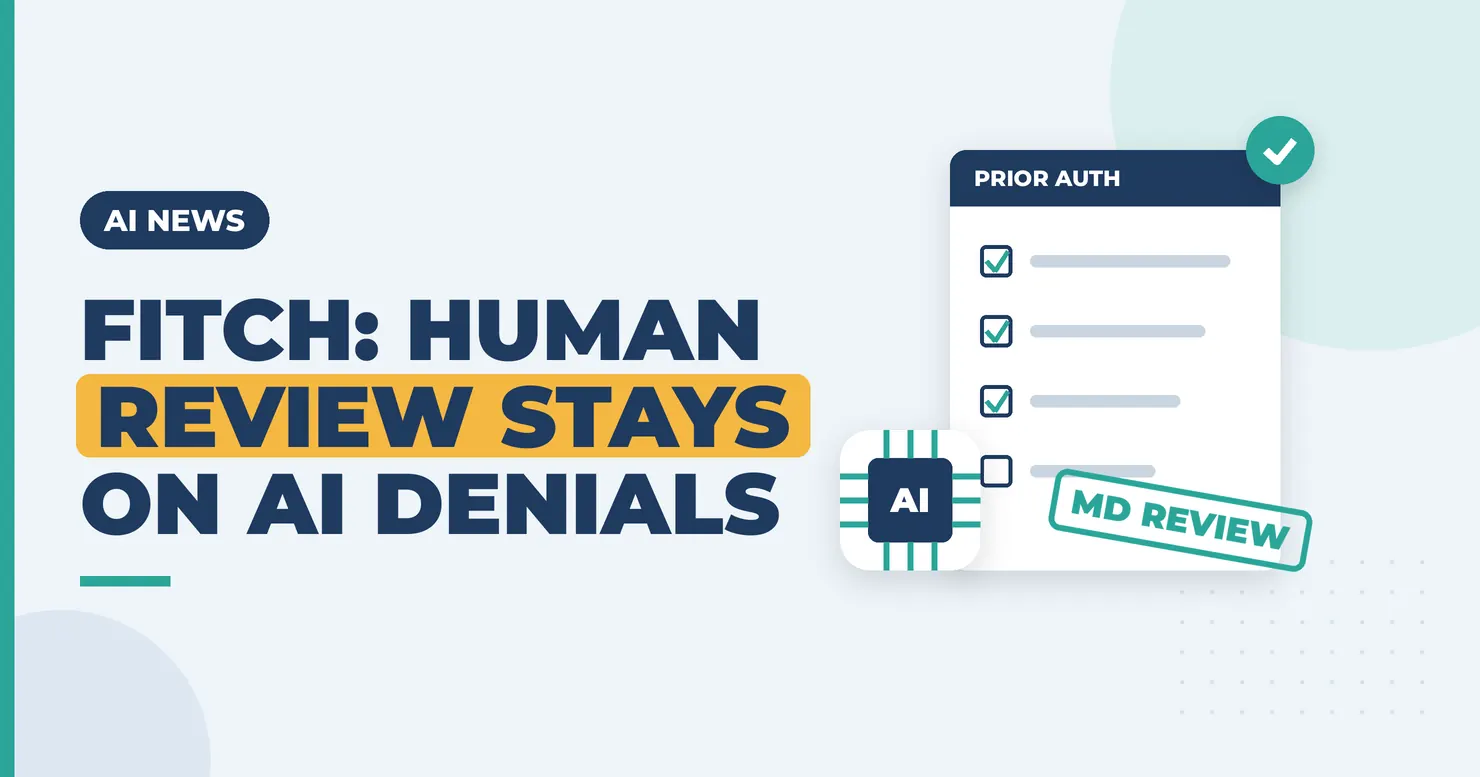
Fitch Ratings’ Artificial Intelligence Stress Test, published October 5, 2026, scores health insurers at 20 out of 100. That is well below the 40-point mark that signals potential negative rating action. The bigger RCM takeaway sits in prior authorization: Fitch expects AI to speed reviews, but says “regulatory expectations for human involvement in care-denial decisions are likely to persist.” For billers, that means AI denials are not a free pass for payers — and not a reason to skip a complete clinical packet.
The report covers 107 sub-sectors over a five-year horizon. Becker’s Hospital Review and Beinsure both covered the health-care angles. This piece translates the credit view into plain steps for US billing staff, providers and insured patients. It does not rewrite the separate debate over hospital AI coding costs.
Key takeaways
- Score ≥40 = potential negative rating action under Fitch’s adverse AI scenarios. Health insurers scored 20. Healthcare providers also scored 20. Pharma scored 30.
- Expanded AI in prior auth has already drawn regulator and lawmaker scrutiny, and some prior-auth requirement cuts have followed.
- Broader AI should shorten review times, but lasting human-review expectations partly offset those efficiency gains.
- Payers also use AI for claims processing, customer service, enrollment, appeals and fraud, waste and abuse (FWA).
- Separately, Fitch warns hospital AI cost savings could push payers and policymakers to reprice reimbursement — still not enough, in its view, for rating moves in five years under the adverse scenario.
How this article was checked: sector scores and the human-review quote come from Becker’s Hospital Review’s Oct. 5 coverage of Fitch’s AI Stress Test and from Beinsure’s Oct. 6 sector summary. The hospital AI-savings / reimbursement-repricing angle comes from a second Becker’s piece the same day. We did not invent numbers or quotes. Last reviewed 9 October 2026. This is educational content, not investment or legal advice.
- What Fitch’s AI Stress Test scored
- Why human review of AI prior-auth denials matters
- The provider–payer AI contest on coding and pricing
- Could payers claw back hospital AI savings?
- Where else payers are putting AI
- What this means for billing teams and providers
- What this means for insured patients
- FAQ
- Sources
Table of Contents
What Fitch’s AI Stress Test scored
Fitch’s AI Stress Test is a credit framework. It asks how adverse AI scenarios could affect issuers over about five years. Fitch scored 107 sub-sectors. A score of 40 or higher signals potential negative rating action for a typical issuer in that sub-sector.
| Sub-sector (healthcare) | Fitch score | What it implies (per Fitch’s scale, as reported) |
|---|---|---|
| Health insurers | 20 | Minor credit pressure possible, not enough to move the rating |
| Healthcare providers | 20 | Same band; below the 40 threshold |
| Pharmaceuticals | 30 | Still below 40 |
| Medical devices / diagnostics / products | 20 | Same limited near-term disruption band |
Across the full study, about 86% of sub-sectors scored 40 or below. Services such as business-process outsourcing sat much higher. Insurance as a whole was among the more insulated groups in Beinsure’s summary of the report.
Fitch has not taken rating actions on health insurers that it attributes directly to AI-driven disruption, according to Becker’s.
Why human review of AI prior-auth denials matters
Prior authorization is one of the clearest places where payer AI meets patients and providers.
Fitch said expanded AI use in prior-authorization decisions has drawn more scrutiny from regulators and lawmakers. That scrutiny has already led to reductions in prior-authorization requirements for some services. Broader AI adoption should shorten review times and make processing more efficient. But Fitch also said “regulatory expectations for human involvement in care-denial decisions are likely to persist,” which partially offsets those gains (Becker’s Hospital Review, 2026).
That is not a ban on AI. It is a credit analyst’s view that humans will stay in the loop when care is denied. State law is already moving the same way. Alabama’s AI prior authorization law (SB 63) took effect October 1, 2026, under the enrolled act on the Alabama Legislature site. It requires a licensed clinician to make medical-necessity denials, delays or modifications when AI is used on prior auth for covered plans.
The provider–payer AI contest on coding and pricing
Fitch also described an arms race that billing teams already feel day to day:
- Providers use AI to optimize coding and maximize reimbursement per encounter.
- Insurers use AI to flag aggressive coding patterns and bake expected impact into pricing.
- Fitch said provider coding optimization has modestly contributed to high medical costs that pressure insurers’ underwriting.
That framing sits next to — and is distinct from — the Blue Cross Blue Shield Association’s late-September claim that AI-assisted hospital coding added about $942 million to Blue plan costs. We cover that report separately in our BCBSA $942M AI coding analysis. Fitch’s stress test is a credit view, not a claims white paper.
Could payers claw back hospital AI savings?
In a companion Becker’s piece the same day, Fitch said AI-driven hospital cost cuts in diagnostics, imaging, workflow and administration could prompt payers and policymakers to reprice reimbursement. It cited “real potential for policy changes affecting profitability in major service lines.”
Even under Fitch’s adverse scenario, that pressure stays limited. Repricing plus competition from lower-cost, AI-enabled entrants for low-acuity care still would not, in Fitch’s view, move provider ratings over the next five years. Barriers it cited include regulation and licensing, proprietary clinical data, the physical nature of care delivery, and providers’ own AI use.
Where else payers are putting AI
Prior auth is only one lane. Becker’s reporting on the stress test notes that insurers also apply AI to:
- claims processing
- customer service
- enrollment
- appeals management
- fraud, waste and abuse detection
For RCM staff, that means AI can show up before care (prior auth), at claim submission, in post-pay audits and in appeal routing. A clean denial letter and a clean appeal packet still matter.
What this means for billing teams and providers
- Treat AI prior-auth denials like clinician denials. Ask who reviewed the decision, what criteria were used, and whether the patient’s history was considered. If the plan is fully insured in a state like Alabama, point to the clinician-review rule.
- Send a complete clinical packet the first time. AI triage rewards incomplete requests with fast “no” letters. Attach history, failed treatments, imaging and the treating clinician’s reasoning. See our prior authorization denial guide and medical necessity documentation checklist.
- Log patterns by payer. Identical denial language, denials minutes after submission, or denials that ignore attached records are worth tracking. Patterns support peer-to-peer reviews and regulator complaints.
- Don’t let a skipped auth become CO-197. If care proceeds without approval, expect CO-197 (precertification/authorization absent). Fix the auth path when you can.
- Keep coding defensibly human-reviewed. Fitch’s note on provider coding optimization is a signal that payers will keep feeding AI into clinical validation. Document why each secondary diagnosis meets the clinically significant test.
What this means for insured patients
- Ask for the reviewer and the criteria. When prior auth is denied, ask your doctor’s office for the denial letter and which type of professional made the decision.
- Know your plan type. State AI prior-auth laws often reach fully insured plans more clearly than self-funded ERISA plans. Medicare Advantage follows federal rules; a CMS FAQ on utilization management (CMS-4201-F) already warns against coverage algorithms that ignore the individual patient’s history. HR or your plan documents can tell you which commercial plan type you have.
- Appeal on the clinical facts. Human-review rules do not replace your appeal rights. Use them together.
- File a complaint when a denial looks purely automated. If the letter ignores your history or reads like a form, your state insurance department may take complaints — Alabama’s Department of Insurance is one example under SB 63.
FAQ
What did Fitch say about AI prior-authorization denials?
Fitch said broader AI use should shorten review times, but “regulatory expectations for human involvement in care-denial decisions are likely to persist,” which partly offsets efficiency gains for insurers.
What score did health insurers get on Fitch’s AI Stress Test?
Health insurers scored 20. A score of 40 or higher signals potential negative rating action. Healthcare providers also scored 20; pharmaceuticals scored 30.
Does Fitch say AI will tank hospital or insurer credit ratings?
No. Under the adverse scenarios Fitch modeled, health insurers and providers stayed below the 40 threshold. Fitch said it has not taken AI-attributable rating actions on those groups.
How does this relate to Alabama’s AI prior auth law?
Alabama SB 63 already requires a licensed clinician for medical-necessity denials, delays or modifications when AI is used on prior auth for covered plans. That is the kind of human-involvement rule Fitch expects to persist more broadly.
Will payers cut hospital rates because of AI savings?
Fitch said there is real potential for policy changes that affect profitability in major service lines if AI lowers hospital costs. It still does not expect that pressure alone to move provider ratings over five years under its adverse scenario.
Sources
- Becker’s Hospital Review, Fitch: Human review in AI prior authorization denials likely here to stay (Andrew Cass, covering Fitch’s Oct. 5, 2026 AI Stress Test).
- Becker’s Hospital Review, Will payers claw back hospitals’ AI savings? (Andrew Cass, Oct. 5, 2026).
- Beinsure, AI Could Trigger Rating Downgrades in High-Risk Sectors, Insurance Insulated (Peter Sonner, Oct. 6, 2026) — sector-score context for the same Fitch framework.
- Alabama Legislature, SB 63 (2026 Regular Session), enrolled act.
- CMS, FAQ on Coverage Criteria and Utilization Management (CMS-4201-F), Feb. 6, 2024.
- Medical Billing 101, Alabama AI prior authorization law (SB 63).
- Medical Billing 101, BCBSA $942M AI coding report.

Manikandan J is a CPC (AAPC) and CRCR (HFMA) certified medical billing professional with billing and RCM experience at athenahealth, Omega Healthcare, UnitedHealthcare, Blue Cross Blue Shield and Access Healthcare. He writes Medical Billing 101’s guides on denial codes, appeals and patient billing help for US billers, providers and insured patients.