

CO-105 means the payer took tax out of your payment before sending it. In US claims, this is most often backup withholding, which is federal income tax a payer must hold back when the IRS says your taxpayer ID and name don’t match its records. The claim isn’t denied. The money goes to the IRS, not to the plan. Your job is to fix the ID problem so the withholding stops, and to make sure your accountant claims credit for what was withheld. (Primary source: X12 Claim Adjustment Reason Codes)
In brief: CARC 105 reads “Tax withholding.” Check the TIN and legal name the payer has on file. Send a corrected W-9 that matches IRS records. Track every withheld amount; it shows on the payer’s tax form and counts as tax paid.
Part of our denial codes library. Written by Manikandan J, CPC, CRCR, who has fixed payer enrollment and TIN records for physician groups. Published 21 October 2026. Last updated: 21 October 2026. Code wording is quoted word for word from X12.
Official CARC 105 entry
| Field | X12 text |
|---|---|
| Code | 105 |
| Description | “Tax withholding.” |
| Start | 01/01/1995 |
Source: X12 Claim Adjustment Reason Codes, checked 21 October 2026.
Example scenario (fictional names), part 1
CO-105 Denial Example: What Happened
Marcus Bell does billing for Alder Creek Dermatology. Dr. Ruth Kim removed a benign skin lesion from a patient’s back (D23.5), billed as 11402. The claim went to Northfield Health Plan, a fictional commercial plan.
The allowed amount looked right. The payment didn’t. The 835 showed CAS*CO*105 for a slice of the payment and remark LQ*HE*N209. Every Northfield claim that week had the same cut. Alder Creek hadn’t changed anything, or so Marcus thought.
Why would a health plan start acting like a tax collector? Keep reading, or jump to how the CO-105 denial was resolved.
Why payers withhold tax
The IRS requires backup withholding in some cases. Its backup withholding page says the current rate is 24 percent. It applies when a payee hasn’t given a correct taxpayer identification number, among other reasons. A TIN is the taxpayer identification number, such as an EIN for a group. A B notice is the IRS letter that tells a payer a name and TIN don’t match.
Common triggers in medical billing:
- A legal name change, such as after a merger, with no new W-9 sent to payers.
- A DBA on the W-9 instead of the legal name the IRS has on file.
- A typo in the TIN in the payer’s vendor file.
- A new TIN after a change of ownership that never reached the plan.
Remark codes linked to tax and TIN issues
| RARC | X12 wording |
|---|---|
| N209 | “Missing/incomplete/invalid taxpayer identification number (TIN).” |
| N852 | “The pay-to and rendering provider tax identification numbers (TINs) do not match” |
Check the X12 RARC list for the full set.
How to stop and recover CARC 105 withholding
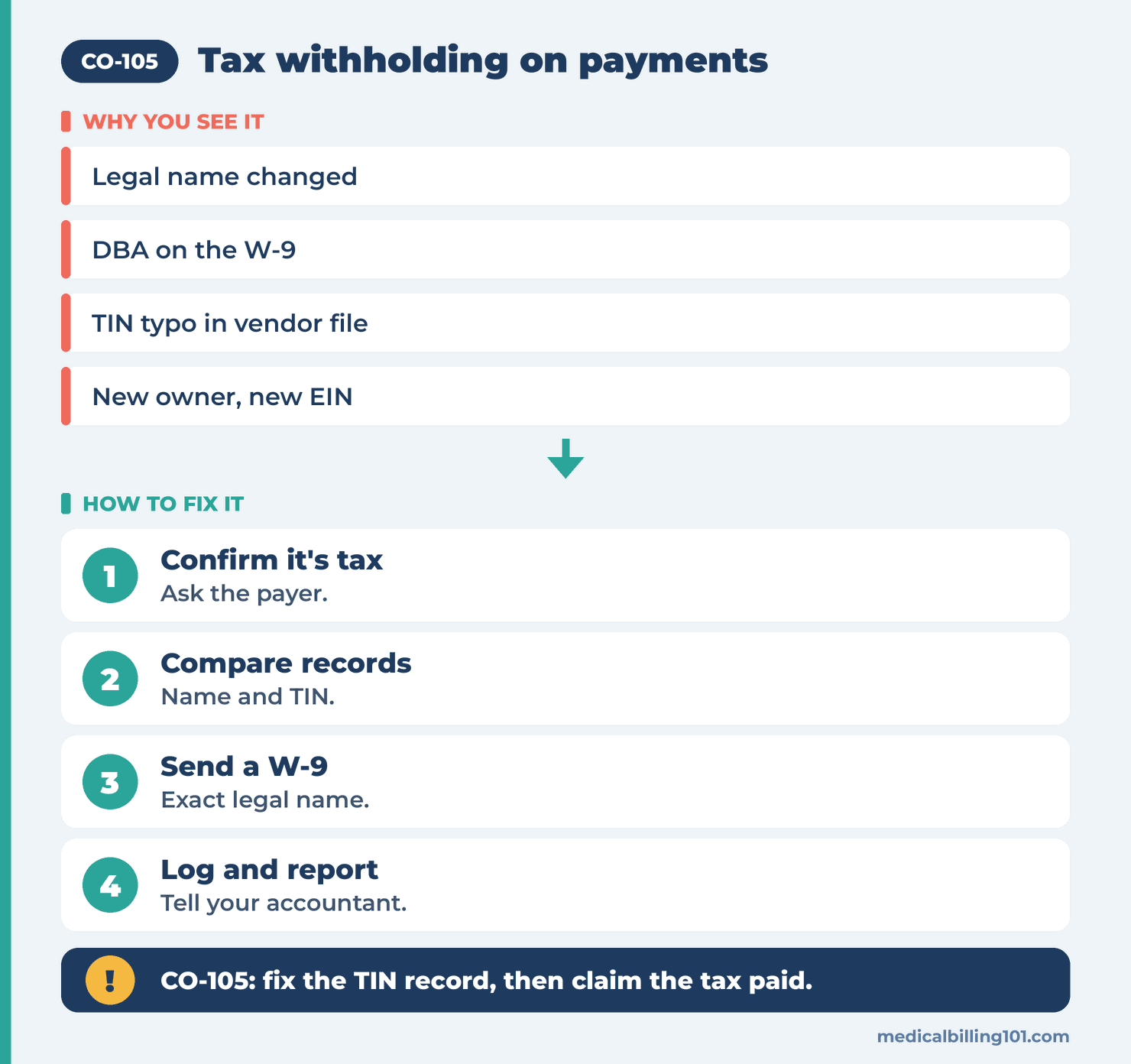
- Confirm it’s tax. Look for CARC 105 and ask the payer which program the withholding falls under.
- Compare your records. Match your legal name and TIN to the IRS letter that assigned the EIN.
- Send a corrected W-9. Use the exact legal name and TIN. The IRS Form W-9 page has the current form.
- Update enrollment. Make sure the payer’s provider file and the claim’s billing provider match too.
- Track what was withheld. Keep a log by payer. Ask for a year-end statement.
- Tell your accountant. Withheld tax is reported on the payer’s information return and counts toward your tax payments.
Example scenario (fictional names), part 2
How the CO-105 Denial Was Resolved
Marcus asked Northfield why. N209 pointed to the TIN, and the vendor team said the IRS had flagged a name mismatch. Alder Creek had merged with another group months earlier. The new legal name was on its EIN letter, but Northfield still had the old name.
Fix: Marcus sent a new W-9 with the exact legal name and TIN, plus the EIN letter. No claim correction was needed.
Outcome: the withholding stopped a few cycles later. The practice’s accountant used Northfield’s year-end form to claim the withheld tax as paid.
Names and details are illustrative; no real patient data.
Worked example (illustrative)
A physical therapy group sees CARC 105 on remits from two plans after a change of ownership. The new owner had a new EIN, but the old W-9 was still on file with both plans. The office manager sends new W-9s and updates both plans’ provider records. She keeps a log of the withheld amounts for the tax return.
CARC 105 vs other money-taken codes
| Code | What was taken | Who gets it |
|---|---|---|
| CARC 105 | Tax | The taxing authority |
| CO-253 | Sequestration cut | Not paid by Medicare |
| CO-104 | Managed care withhold | Plan’s risk pool until settlement |
| CO-45 | Amount above the contract rate | Written off |
Key takeaways
CO-105 is tax, not a denial. It usually means your name and TIN don’t match IRS records in the payer’s file. Send a corrected W-9, update the payer’s provider record and track every withheld amount. Your accountant can claim it as tax paid, so don’t write it off as lost.
FAQ
What does CARC 105 mean?
It means “Tax withholding.” The payer withheld tax from the payment.
Why is a health plan withholding tax?
Usually because the IRS told it your name and TIN don’t match. That triggers backup withholding.
How much is backup withholding?
The IRS lists the current rate as 24 percent.
How do I stop CO-105 withholding?
Send the payer a W-9 with your exact legal name and TIN, and update your provider record.
Is withheld tax lost?
No. It’s reported on the payer’s year-end tax form and counts toward your tax payments. Ask your accountant.
Can I bill the patient for CO-105?
No. It’s tax on your income, not the patient’s share.
Sources
How we checked: each code quote on this page was compared word for word with the X12 CARC and RARC lists on 21 October 2026.
- X12, Claim Adjustment Reason Codes (CARC 105, 45, 104, 253). Accessed 21 Oct 2026.
- X12, Remittance Advice Remark Codes (N209, N852). Accessed 21 Oct 2026.
- IRS, Backup withholding. Accessed 21 Oct 2026.
- IRS, About Form W-9. Accessed 21 Oct 2026.
Last updated: 21 October 2026 · This page is educational and isn’t tax advice. Ask your accountant about your situation.