
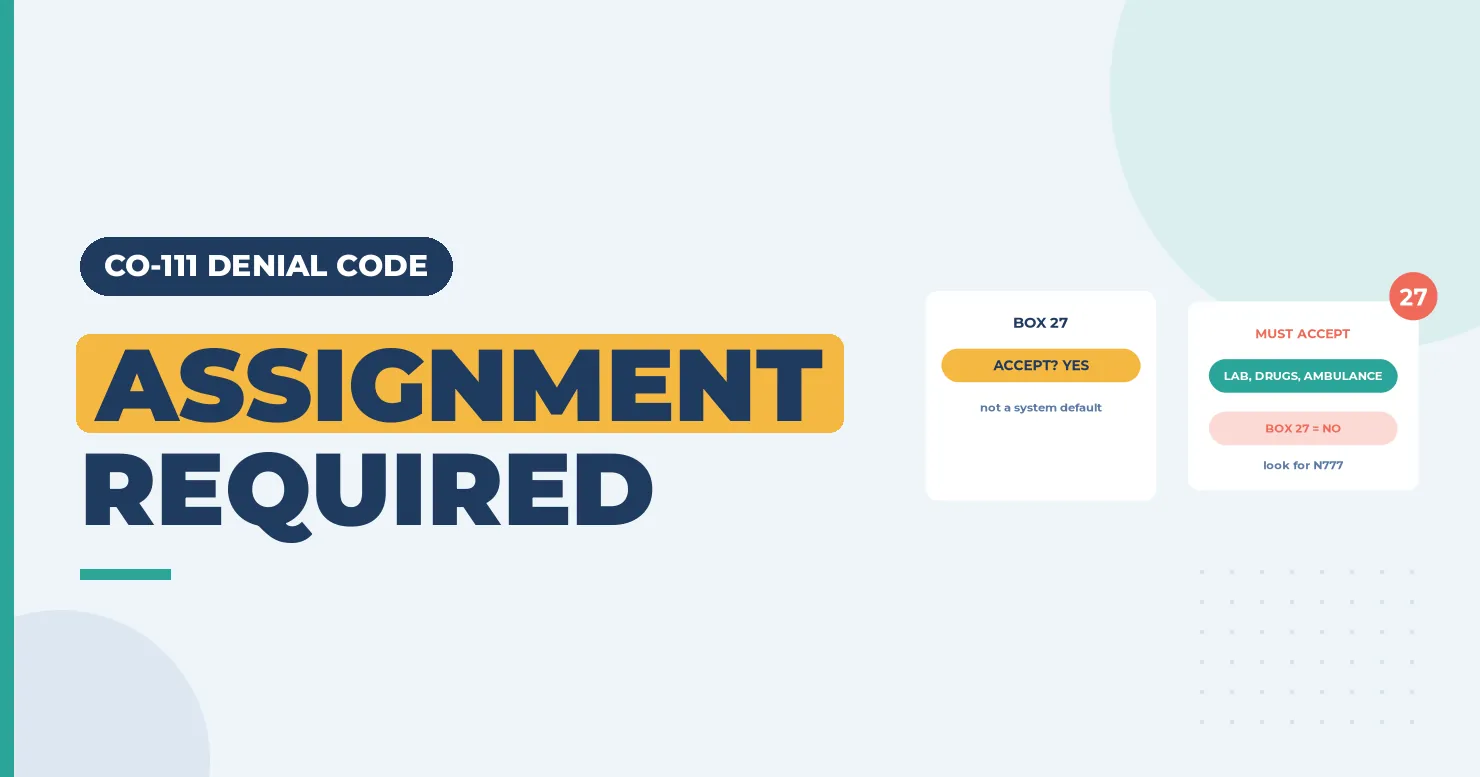
CO-111 means the payer will cover the service only if you accept assignment, and your claim said you didn’t. Accepting assignment means agreeing to take the payer’s allowed amount as payment in full, with the patient owing only their cost share. On a paper claim that’s Box 27 of the CMS-1500. In the electronic claim, it’s a yes or no flag. One wrong default in a billing system can deny a whole batch of claims. (Primary source: X12 Claim Adjustment Reason Codes)
In brief: CARC 111 reads “Not covered unless the provider accepts assignment.” Check Box 27 (accept assignment) and Box 13 (benefits assigned to you). If you do accept assignment for this payer or service, send a corrected claim with the right answers.
Part of our denial codes library. Written by Manikandan J, CPC, CRCR, who has set up claim defaults for labs and multi-specialty groups. Published 21 October 2026. Last updated: 21 October 2026. Code wording is quoted word for word from X12.
Official wording of CARC 111
| Field | X12 text |
|---|---|
| Code | 111 |
| Description | “Not covered unless the provider accepts assignment.” |
| Start | 01/01/1995 |
Source: X12 Claim Adjustment Reason Codes, checked 21 October 2026.
Example scenario (fictional names), part 1
CO-111 Denial Example: What Happened
Lena Novak runs billing at Clearview Diagnostic Lab. The lab ran a comprehensive metabolic panel, 80053, for a patient with type 2 diabetes (E11.9). The claim went to Ashford Health Plan, a fictional commercial plan whose lab benefit needs the lab to accept assignment.
The 835 showed CAS*CO*111 on the line with remark LQ*HE*N777. Clearview always accepts assignment from Ashford. Every Ashford lab claim from that week had the same denial.
What changed on claims that nobody edited by hand? Keep reading, or jump to how the CO-111 denial was resolved.
Assignment: two boxes, two meanings
Box 13 is the patient’s authorization to pay benefits to you. Box 27 is your statement that you accept assignment. They’re different, and CARC 111 is mostly about Box 27.
| Claim field | CMS-1500 | What it tells the payer |
|---|---|---|
| Accept assignment | Box 27 | You’ll take the allowed amount as payment in full |
| Benefits assigned | Box 13 | The patient OKs payment to you |
| Signature on file | Box 12 and 13 | Signed forms are on file |
Services where Medicare requires assignment
Under Medicare, some services can only be billed on an assigned basis. The Medicare Claims Processing Manual, Chapter 1 (section 30.3.1) lists them, such as:
- Clinical diagnostic lab services
- Physician services to patients with both Medicare and Medicaid
- Services of PAs, NPs, clinical nurse specialists and several other practitioners
- Ambulatory surgical center services
- Drugs and biologicals
- Ambulance services
The manual says that when these claims come in as unassigned, Medicare processes them as assigned. That’s why Medicare often shows a remark like N71 instead of denying. Commercial and other plans may deny with CARC 111 instead.
Remark codes with CARC 111
| RARC | X12 wording |
|---|---|
| N777 | “Missing Assignment of Benefits Indicator.” |
| N71 | “Your unassigned claim for a drug or biological, clinical diagnostic laboratory services or ambulance service was processed as an assigned claim.” |
N71’s full text is longer; see the X12 RARC list.
How to fix a CO-111 denial
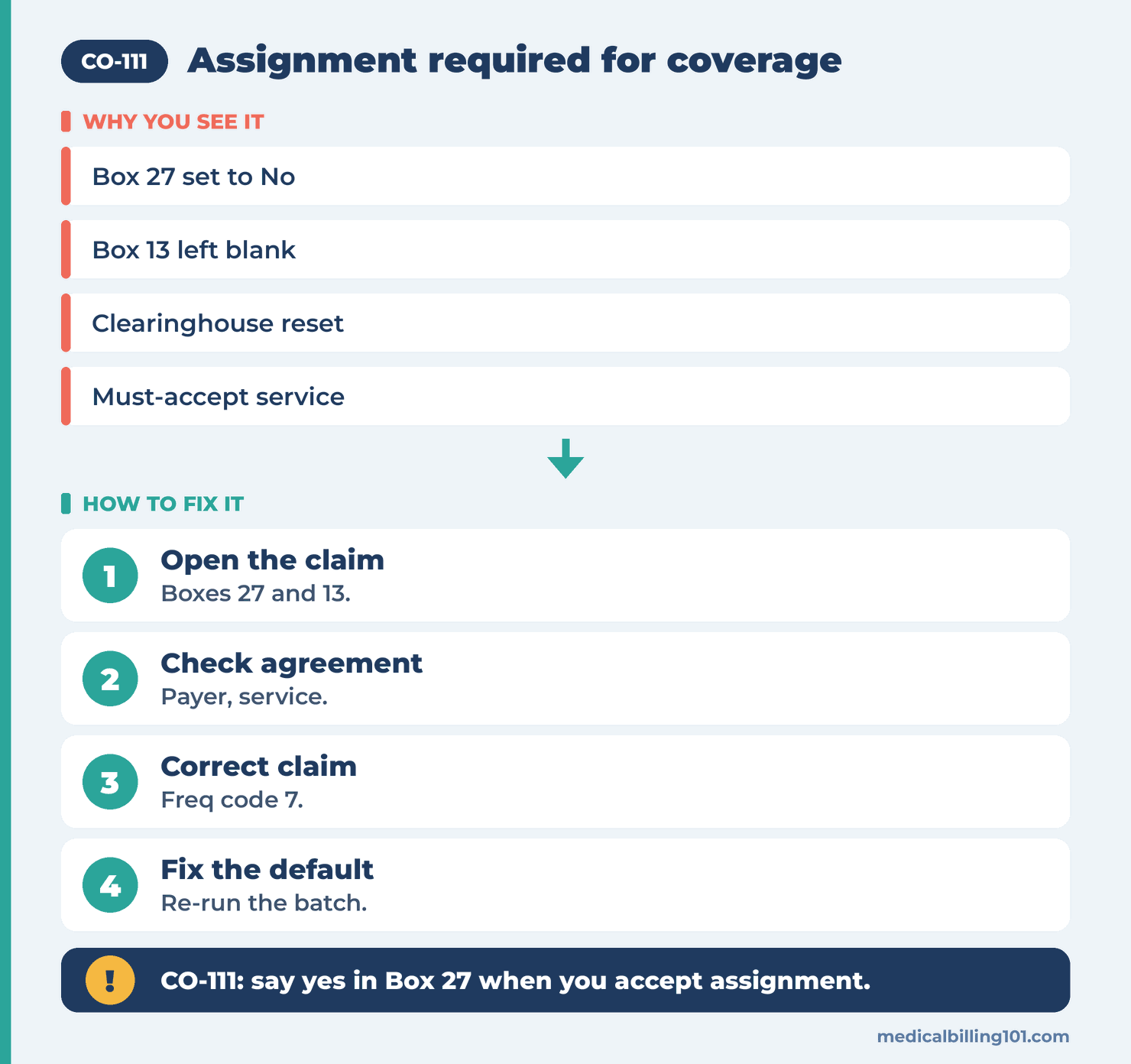
- Open the claim as sent. Look at Box 27 and Box 13, or the matching fields in the electronic claim.
- Check your agreement. Do you accept assignment with this payer, or for this service? Labs and drug suppliers often must.
- Find the cause. Look for a payer or location default set to “No,” or a new clearinghouse mapping.
- Send a corrected claim. Use frequency code 7, with Box 27 set to accept and Box 13 filled when the patient has signed.
- Fix the default. Set the payer or location to accept assignment where you do.
- Re-run the batch. Search for other claims with the same default and correct them too.
Example scenario (fictional names), part 2
How the CO-111 Denial Was Resolved
Lena pulled the claim file. N777 said the assignment flags were empty or wrong. Box 27 had gone out as “No” and Box 13 was blank. A clearinghouse update had reset Ashford to a default meant for out-of-network payers.
Fix: Lena reset the Ashford payer setup and sent corrected claims with frequency code 7. Box 27 now said accept, and Box 13 showed the signed form on file.
Outcome: Ashford paid the corrected claims. Lena now spot-checks one claim per payer after every clearinghouse update.
Names and details are illustrative; no real patient data.
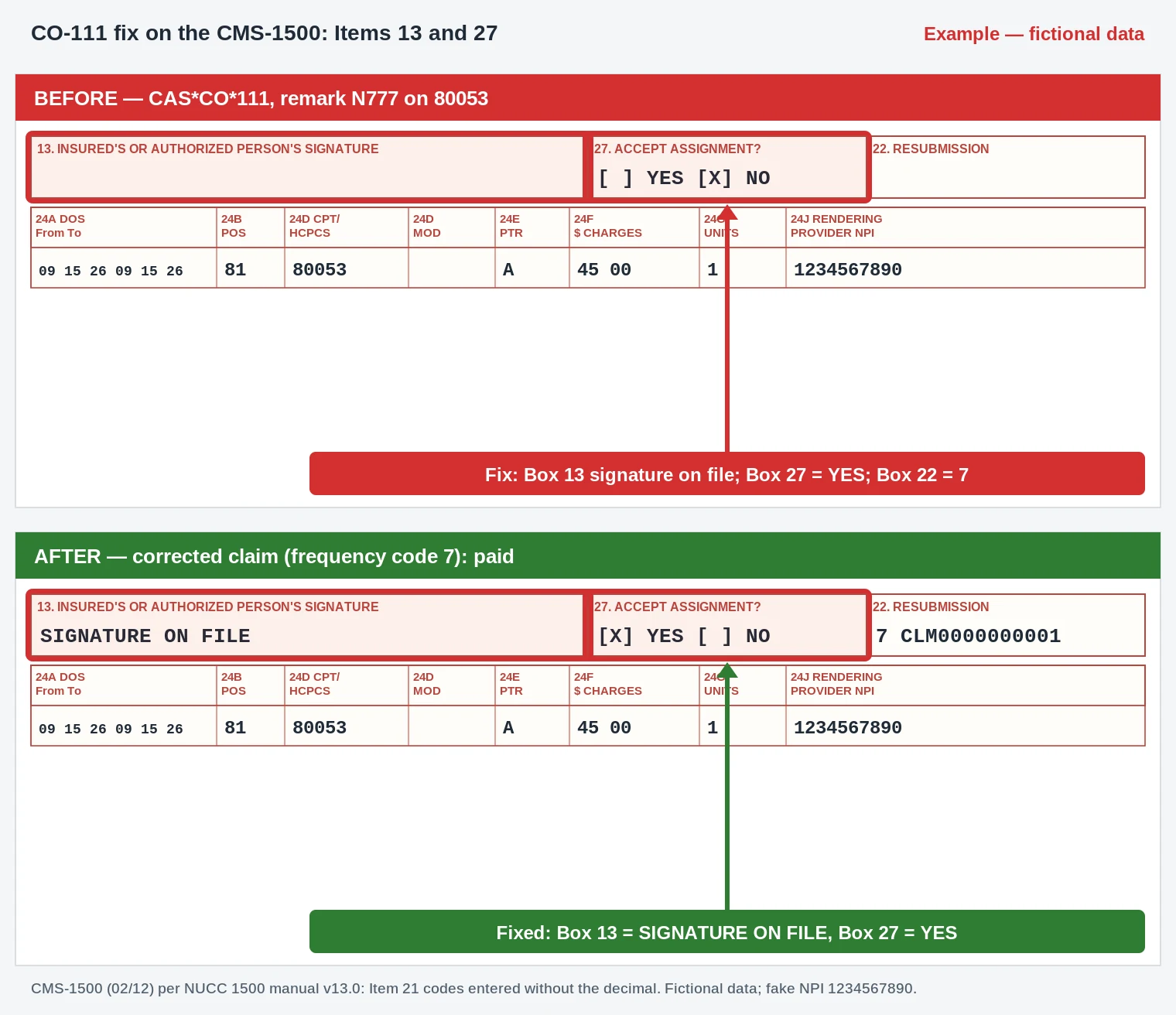

- Box 27: changed from No to Yes (accept assignment). The UB-04 has no Box 27; assignment is shown in FL 53.
- Box 13 / FL 53: blank changed to signature on file; on the UB-04, FL 53 assignment of benefits = Y.
- Box 22 / FL 4 + FL 64: frequency code 7 with the original claim number (type of bill 0147 for a non-patient lab claim).
- Box 24D / FL 44: 80053 and E11.9 (entered as E119) are unchanged.
Worked example (illustrative)
A nurse practitioner in a non-participating practice bills Medicare unassigned for an office visit. The remit processes the claim as assigned anyway. The biller learns that NP services fall under mandatory assignment, so the practice can’t collect more than the Medicare allowed amount plus cost share. She updates the NP’s billing setup to always accept assignment.
Prevention tips
- Map assignment by payer and service. Labs, drugs and ambulance are common must-accept areas.
- Check after updates. System and clearinghouse changes can reset defaults.
- Keep signed forms current. Box 13 needs a signed form on file for each patient.
- Track CARC 111 weekly. A spike often means one setting changed.
Related codes
- CO-16: claim lacks information or has billing errors.
- CO-45: charge exceeds the fee schedule.
- OA-100: payment made to the patient.
Key takeaways
CO-111 says a service needs assignment and the claim said no. Check Box 27 and Box 13, find the default that changed, and send corrected claims. Under Medicare, labs, drugs, ambulance and several practitioner types must accept assignment, so set them up to accept from the start.
FAQ
What does CO-111 mean?
It means “Not covered unless the provider accepts assignment.” The claim said you don’t accept assignment for a service that requires it.
Which CMS-1500 box is accept assignment?
Box 27. Box 13 is the patient’s authorization to pay benefits to you.
What does N777 mean?
N777 means “Missing Assignment of Benefits Indicator.”
Which Medicare services need assignment?
Clinical lab services, drugs and biologicals, ambulance, ASC services and several practitioner types, among others in Chapter 1, section 30.3.1.
Can I bill the patient for CO-111?
No. The CO group makes it a provider issue. Fix the claim instead.
How do I fix CO-111?
Send a corrected claim with frequency code 7 and Box 27 set to accept assignment.
Sources
How we checked: each code quote on this page was compared word for word with the X12 CARC and RARC lists on 21 October 2026.
- X12, Claim Adjustment Reason Codes (CARC 111, 16, 45, 100). Accessed 21 Oct 2026.
- X12, Remittance Advice Remark Codes (N777, N71). Accessed 21 Oct 2026.
- CMS, Medicare Claims Processing Manual, Chapter 1, section 30.3.1. Accessed 21 Oct 2026.
Last updated: 21 October 2026 · This page is educational and doesn’t replace payer contracts or Medicare rules.