
CO-112 is a records denial. The payer says it can’t confirm the service was given directly to the patient, or the records don’t show it was done at all. It often appears after a records request. Medical review also triggers it when notes are missing, unsigned or about a different date. The service may well have happened. The payer simply didn’t see proof. Since the group is CO, you can’t bill the patient. Your path is better records, sent the right way. (Primary source: X12 Claim Adjustment Reason Codes)
In brief: CARC 112 reads “Service not furnished directly to the patient and/or not documented.” Find out which half applies. If the records were incomplete, appeal with the full, signed note for that date. If the service wasn’t given to the patient directly, check whether it’s billable at all.
Part of our denial codes library. Written by Manikandan J, CPC, CRCR, who has handled records requests and medical review appeals for specialty groups. Published 21 October 2026. Last updated: 21 October 2026. Code wording is quoted word for word from X12.
X12 entry for CARC 112
| Field | X12 text |
|---|---|
| Code | 112 |
| Description | “Service not furnished directly to the patient and/or not documented.” |
| Start | 01/01/1995 |
| Last modified | 09/30/2007 |
Source: X12 Claim Adjustment Reason Codes, checked 21 October 2026.
Example scenario (fictional names), part 1
CO-112 Denial Example: What Happened
Olivia Grant handles appeals for Harborline Cardiology. Dr. Daniel Mercer read an ECG for a patient seen in the clinic for chest pain (R07.9). The group billed 93010 for the interpretation and report to Stonebridge Health Plan, a fictional commercial plan. The plan asked for records first.
The records went out, and the 835 came back with CAS*CO*112 and remark LQ*HE*N237. Olivia knew Dr. Mercer had read that tracing.
So what did the reviewer find missing in the packet? Keep reading, or jump to how the CO-112 denial was resolved.
The two halves of CARC 112
Not furnished directly means the patient didn’t receive the service in the way the code requires. Examples include a visit billed for a phone call with a relative, or a service billed under a doctor who never saw the patient. Not documented means the records don’t prove the service. A signed note is a record entry with a legible signature or a valid electronic signature from the person who did the work.
| Problem | What the reviewer sees | Fixable? |
|---|---|---|
| Missing report | Only the order or the raw data | Yes, if the report exists |
| Unsigned note | A note with no valid signature | Sometimes, with an attestation the payer accepts |
| Wrong date | A note for another visit | Yes, if the right note exists |
| Patient not present | A call or message billed as a visit | Usually not; rebill the right code if one fits |
| Wrong provider | Another clinician did the work | Rebill under the right provider if the rules allow |
Medicare’s rules for medical review and signatures are in the Medicare Program Integrity Manual, Chapter 3. Many commercial plans use similar tests.
Remark codes that point to the problem
| RARC | X12 wording |
|---|---|
| N237 | “Incomplete/invalid patient medical record for this service.” |
| M127 | “Missing patient medical record for this service.” |
| N706 | “Missing documentation.” |
| N705 | “Incomplete/invalid documentation.” |
See the X12 RARC list for full entries.
How to appeal a CO-112 denial
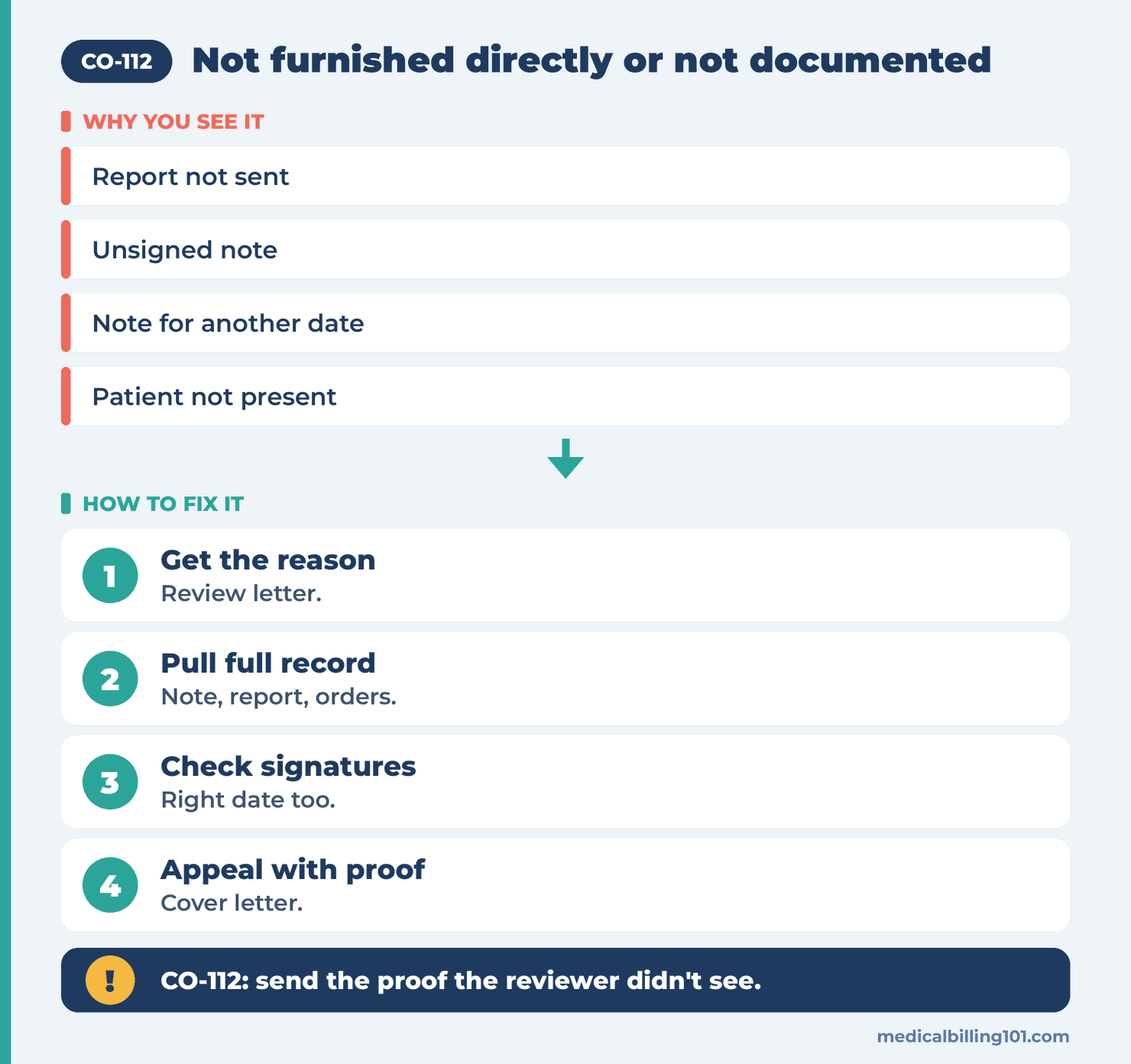
- Get the reviewer’s reason. Ask the plan what was missing, or read the review letter.
- Pull the full record for that date. Include the note, the report, orders and any test data.
- Check signatures and dates. Each note needs a valid signature and the right date of service.
- Match the code to the record. For example, 93010 needs the written interpretation, not just the tracing.
- Write a short cover letter. List what’s enclosed and where the proof sits on each page.
- Appeal within the deadline. Send by the plan’s preferred route and keep proof of delivery.
Example scenario (fictional names), part 2
How the CO-112 Denial Was Resolved
Olivia read the review letter. N237 meant the record was there but incomplete. The packet had the ECG tracing and the visit note, but not Dr. Mercer’s signed interpretation. The EHR had filed it under the tracing, so the records export skipped it.
Fix: Olivia sent an appeal with the signed interpretation for that date. Her cover letter pointed to the page with the report.
Outcome: Stonebridge reversed the denial and paid 93010. Harborline added the interpretation report to its records-request checklist for every test code.
Names and details are illustrative; no real patient data.
Worked example (illustrative)
A behavioral health group bills a psychotherapy session that took place by phone with the patient’s parent while the patient wasn’t present. The plan denies with CARC 112 and N706. The billing lead reviews the note and confirms the patient wasn’t there. Instead of appealing, she checks whether a family therapy code without the patient fits the plan’s rules and the note, and rebills only if it does.
Documentation habits that prevent CO-112
- Sign notes promptly; set EHR alerts for unsigned charts.
- Keep test reports linked to the visit, not only to the device data.
- Write who was present for every visit and session.
- Use a records-request checklist by code type.
- Review CARC 112 denials monthly to find repeat gaps.
Related codes
- CO-50: not deemed a medical necessity.
- CO-16: claim lacks information or has billing errors.
- CO-252: an attachment or other documentation is required.
- CO-96: non-covered charges.
Key takeaways
CO-112 means the payer couldn’t confirm the service was given directly to the patient, or the records didn’t prove it. Find out which. Send the full, signed record for that date with a clear cover letter when the proof exists. When the patient wasn’t involved, check whether any code fits before you appeal.
FAQ
What does CO-112 mean?
It means “Service not furnished directly to the patient and/or not documented.” The payer couldn’t confirm the service from the records.
Can I appeal CO-112?
Yes, when the records exist. Send the complete, signed note or report for the date of service.
What does N237 mean with CARC 112?
N237 means “Incomplete/invalid patient medical record for this service.” Something in the record was missing or invalid.
Does an unsigned note cause CO-112?
It can. Reviewers need a valid signature. Some payers accept a signature attestation; check their rules.
Can I bill the patient for a CO-112 denial?
No. The CO group makes it a provider write-off unless the appeal succeeds.
What if the patient wasn’t present?
Many codes require the patient to be present. Check whether another code fits the service before rebilling.
Sources
How we checked: each code quote on this page was compared word for word with the X12 CARC and RARC lists on 21 October 2026.
- X12, Claim Adjustment Reason Codes (CARC 112, 16, 50, 252). Accessed 21 Oct 2026.
- X12, Remittance Advice Remark Codes (N237, M127, N706, N705). Accessed 21 Oct 2026.
- CMS, Medicare Program Integrity Manual, Chapter 3. Accessed 21 Oct 2026.
Last updated: 21 October 2026 · This page is educational and doesn’t replace payer policies or legal advice.