
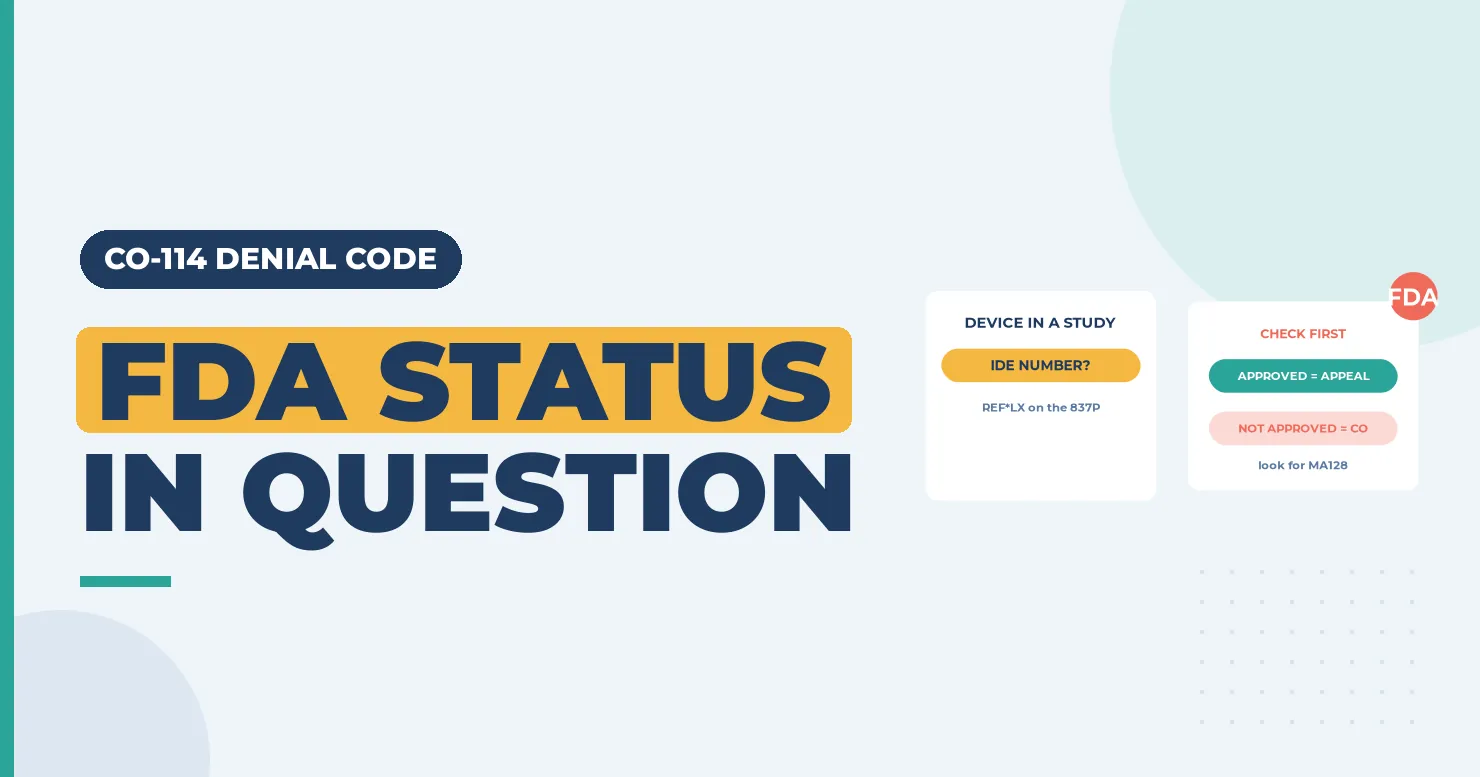
CO-114 means the payer believes the drug, device or procedure on the claim lacks FDA approval for the way it was used. Sometimes that’s true. Often it isn’t. The product may be approved, but the claim didn’t carry the data the payer needed to see that. A device used in an approved study is a common example. The CO group makes the amount a provider write-off unless you prove approval or fix the claim. (Primary source: X12 Claim Adjustment Reason Codes)
In brief: CARC 114 reads “Procedure/product not approved by the Food and Drug Administration.” Check the product’s FDA status and the payer’s policy. For devices in a study, add the IDE number. For drugs, check the NDC and the approved use.
Part of our denial codes library. Written by Manikandan J, CPC, CRCR, who has billed device and drug claims for hospital outpatient and cardiology programs. Published 21 October 2026. Last updated: 21 October 2026. Code wording is quoted word for word from X12.
Official X12 text for CARC 114
| Field | X12 text |
|---|---|
| Code | 114 |
| Description | “Procedure/product not approved by the Food and Drug Administration.” |
| Start | 01/01/1995 |
Source: X12 Claim Adjustment Reason Codes, checked 21 October 2026.
Example scenario (fictional names), part 1
CO-114 Denial Example: What Happened
Rachel Moore bills for Bayside Heart Institute. Dr. Victor Chen closed a patient’s left atrial appendage (33340) for paroxysmal atrial fibrillation (I48.0). He used a newer device being studied in an FDA-approved trial. The claim went to Crestline Health Plan, a fictional commercial plan that covers some trial devices.
The 835 showed CAS*CO*114 with remark LQ*HE*MA128. The procedure was routine for the team. The device had full trial approval.
So why did the plan think the FDA had never signed off? Keep reading, or jump to how the CO-114 denial was resolved.
Key terms behind CARC 114
FDA approval is the agency’s clearance or approval to market a drug or device for stated uses. An IDE, or investigational device exemption, lets a device not yet approved be used in a clinical study. Off-label use is using an approved drug for a purpose not on its label.
| Situation | What payers often do | What to check |
|---|---|---|
| Product not approved at all | Deny with CARC 114 | Is there an approved alternative? |
| Device in an approved IDE study | May cover with the IDE number | IDE number on the claim, payer study policy |
| Approved drug, off-label use | May cover if policy or compendia support it | Payer drug policy |
| Approved product, wrong code or NDC | Deny until the data is fixed | Code, NDC, units |
The FDA explains device approval on its premarket approval page. Medicare’s coverage of IDE studies is on the CMS IDE studies page.
Remark codes with CARC 114
| RARC | X12 wording |
|---|---|
| MA128 | “Missing/incomplete/invalid FDA approval number.” |
| M102 | “Service not performed on equipment approved by the FDA for this purpose.” |
| M61 | “We cannot pay for this as the approval period for the FDA clinical trial has expired.” |
Check the X12 RARC list for others.
How to fix a CO-114 denial

- Confirm the product’s status. Look up the device or drug in FDA records, and note the approval number and approved uses.
- Read the payer’s policy. Many plans have rules for study devices and off-label drugs.
- Check the claim data. For study devices, the IDE number goes in the claim’s IDE field (REF*LX in the 837P). For drugs, check the NDC and units.
- Correct the claim when data was missing. Send it with frequency code 7.
- Appeal when the product is approved. Attach the approval proof and the payer policy section.
- Write off when it truly isn’t approved and not covered. Tell the patient before service next time, if your contract allows.
Example scenario (fictional names), part 2
How the CO-114 Denial Was Resolved
Rachel checked the claim file. MA128 said the approval number was missing or invalid. The IDE number was in the study binder but had never been added to the billing system. Crestline’s policy covered devices in approved studies only when the IDE number came with the claim.
Fix: Rachel added the IDE number to the claim’s IDE field and sent a corrected claim with frequency code 7. She attached the study approval letter.
Outcome: Crestline reprocessed and paid the claim under its study device policy. Bayside now enters the IDE number when a patient enrolls in a study.
Names and details are illustrative; no real patient data.
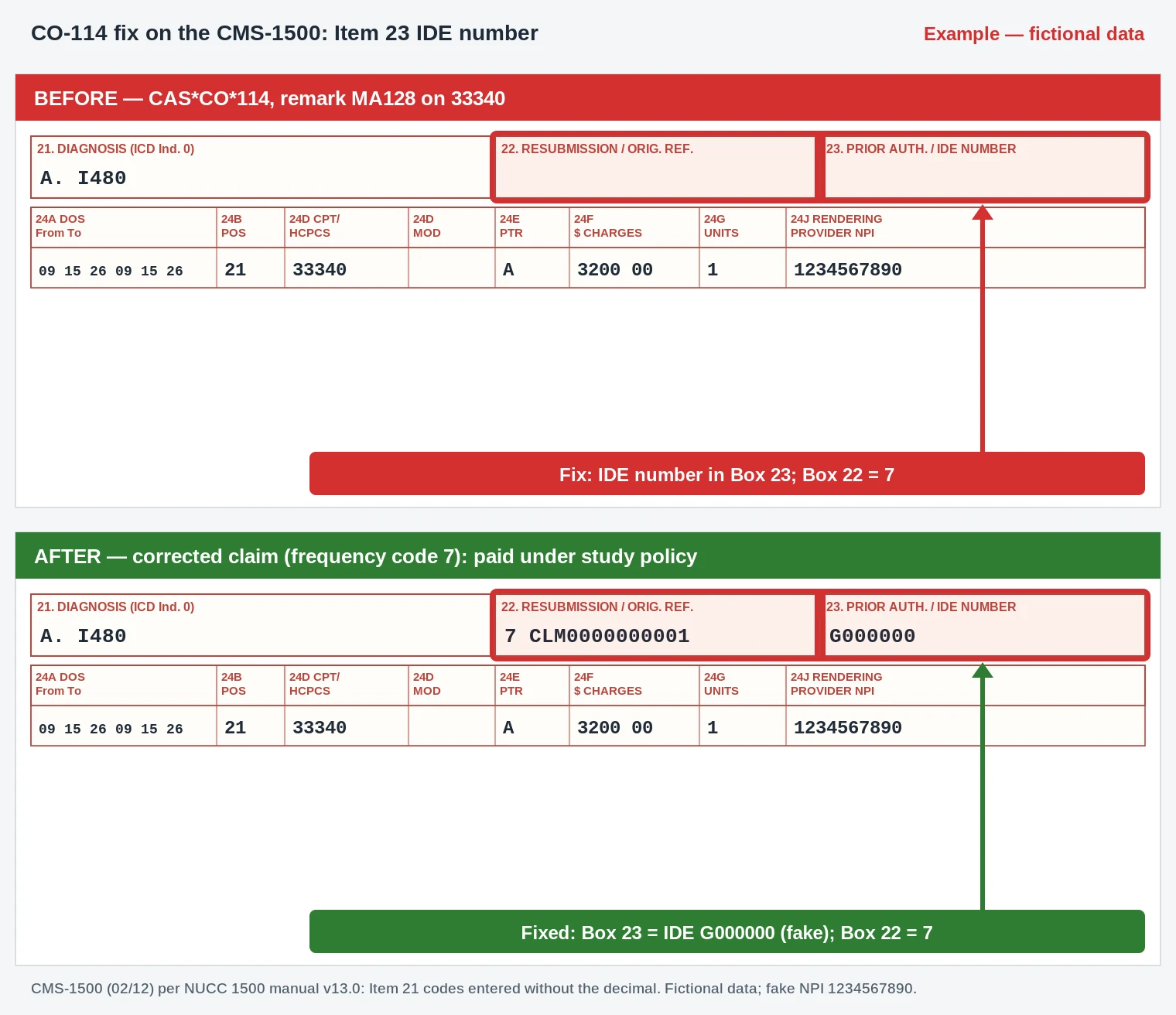
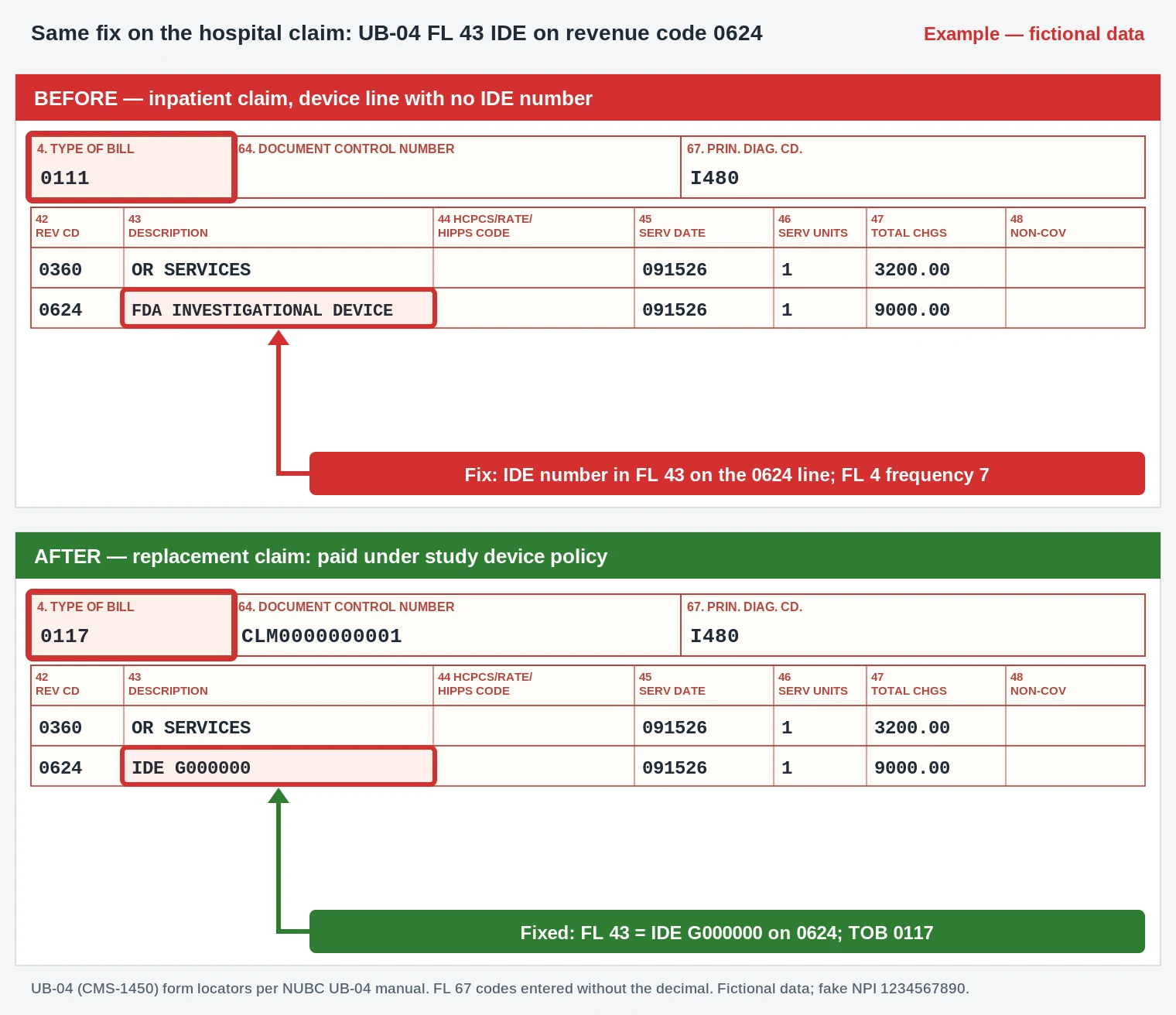
- Box 23 / FL 43: the trial’s IDE number added (fake G000000). On the UB-04 it goes in FL 43 next to revenue code 0624.
- Box 22 / FL 4 + FL 64: frequency code 7 and the original claim number (type of bill 0117 for the inpatient stay).
- Box 24D: 33340 and I48.0 (entered as I480) are unchanged; the study approval letter goes with the claim.
Worked example (illustrative)
An orthopedic practice injects a compounded product into a knee. The plan denies with CARC 114 because compounded products aren’t FDA approved. The practice confirms there’s no approved version with the same makeup. The amount stays as a write-off, and the practice starts using an approved product for future cases.
CO-114 vs similar denials
- CO-50: not deemed a medical necessity. The product may be approved but the payer thinks it isn’t needed.
- CO-96: non-covered charges. The plan excludes it, approved or not.
- CO-16: missing information. Sometimes used instead of 114 for a missing IDE number.
Key takeaways
CO-114 is about FDA status as the payer sees it from your claim. Check the real status, read the payer’s policy and look for missing claim data, such as an IDE number or NDC. Correct the claim when data was missing, appeal with proof when the product is approved, and write off only when it truly isn’t.
FAQ
What does CO-114 mean?
It means “Procedure/product not approved by the Food and Drug Administration.” The payer thinks the product lacks FDA approval for that use.
Can a device in a clinical trial be covered?
Sometimes. Many payers cover devices in approved IDE studies when the IDE number is on the claim.
What does MA128 mean?
MA128 means “Missing/incomplete/invalid FDA approval number.”
Is off-label drug use the same as not FDA approved?
No. The drug is approved; the use isn’t on the label. Payers handle it under their drug policies.
Can I bill the patient for CO-114?
Not for a CO amount. Check your contract and any advance notice rules before service.
Where does the IDE number go on an electronic claim?
In the claim-level IDE reference (REF*LX) in the 837P.
Sources
How we checked: each code quote on this page was compared word for word with the X12 CARC and RARC lists on 21 October 2026.
- X12, Claim Adjustment Reason Codes (CARC 114, 16, 50, 96). Accessed 21 Oct 2026.
- X12, Remittance Advice Remark Codes (MA128, M102, M61). Accessed 21 Oct 2026.
- FDA, Premarket Approval (PMA). Accessed 21 Oct 2026.
- CMS, Investigational Device Exemption (IDE) Studies. Accessed 21 Oct 2026.
Last updated: 21 October 2026 · This page is educational and doesn’t replace payer policies or FDA guidance.