

CO-137 isn’t a denial in the usual sense. It’s the payer’s way of showing a government-driven amount on the remittance: a surcharge, an assessment, an allowance or a health-related tax. The amount may raise or lower your payment, and it’s set by law or regulation rather than by your fee schedule. Cash posters see it most in states that fund health programs through surcharges on claims. (Primary source: X12 Claim Adjustment Reason Codes)
In brief: CARC 137 reads “Regulatory Surcharges, Assessments, Allowances or Health Related Taxes.” Identify which program the amount belongs to, check the rate against the published schedule, and post it to its own adjustment code. Don’t bill the patient for it, and dispute it only when the rate or the program doesn’t apply.
Part of our denial codes library. Written by Manikandan J, CPC, CRCR, who has set up payment posting rules for multi-state hospital groups. Published 22 October 2026. Last updated: 22 October 2026. Code wording quoted word for word from X12.
Official CARC 137 description
| Field | X12 text |
|---|---|
| Code | 137 |
| Description | “Regulatory Surcharges, Assessments, Allowances or Health Related Taxes.” |
| Start | 02/28/1999 |
| Last modified | 09/30/2007 |
Source: X12 Claim Adjustment Reason Codes, checked 22 October 2026.
Key terms behind CARC 137
A surcharge is an extra percentage added to a payment by law, often paid to a state fund rather than to you. An assessment is a charge a state levies on payers or providers to fund programs. A health-related tax is a tax tied to health care services, such as a provider tax.
New York is a well-known case. Its Health Care Reform Act (HCRA) page explains that certain third-party payors and providers take part in funding state health initiatives through authorized surcharges and assessments. Other states use their own programs, so always check the rules where the service took place.
How CARC 137 appears on the 835
- As a reduction. For example, the payer withholds a surcharge from your payment and remits it to the state.
- As an addition. Some payers add a surcharge or allowance on top of the contract rate, shown as a negative CAS amount.
- On some lines only. A state program may cover only certain services, such as hospital inpatient or outpatient care.
Example scenario (fictional names), part 1
CO-137 Denial Example: What Happened
Dana Whitfield is the cash posting lead at Lakeshore Regional Medical Center in upstate New York. An outpatient knee arthroscopy (29881) for a meniscus tear (S83.241A) went to Bluehaven Assurance, a fictional commercial insurer. The 835 showed the contract rate on the line, plus a separate CAS*CO*137 amount that didn’t match the surcharge rate in Lakeshore’s payer setup table.
Her system had posted the 137 amount into the contractual write-off, so the account looked underpaid by a few dollars. A second Bluehaven claim from the same week didn’t show CARC 137 at all.
Was Bluehaven applying the surcharge wrong, or was Lakeshore’s setup out of date? Keep reading, or jump to how the CO-137 denial was resolved.
Remark codes that can appear with CARC 137
| RARC | X12 wording | What it tells you |
|---|---|---|
| N381 | “Alert: Consult our contractual agreement for restrictions/billing/payment information related to these charges.” | The contract or program terms explain the amount |
| N246 | “State regulated patient payment limitations apply to this service.” | A state rule limits what the patient pays |
See the X12 RARC list for the full set.
How to post and check a CO-137 amount
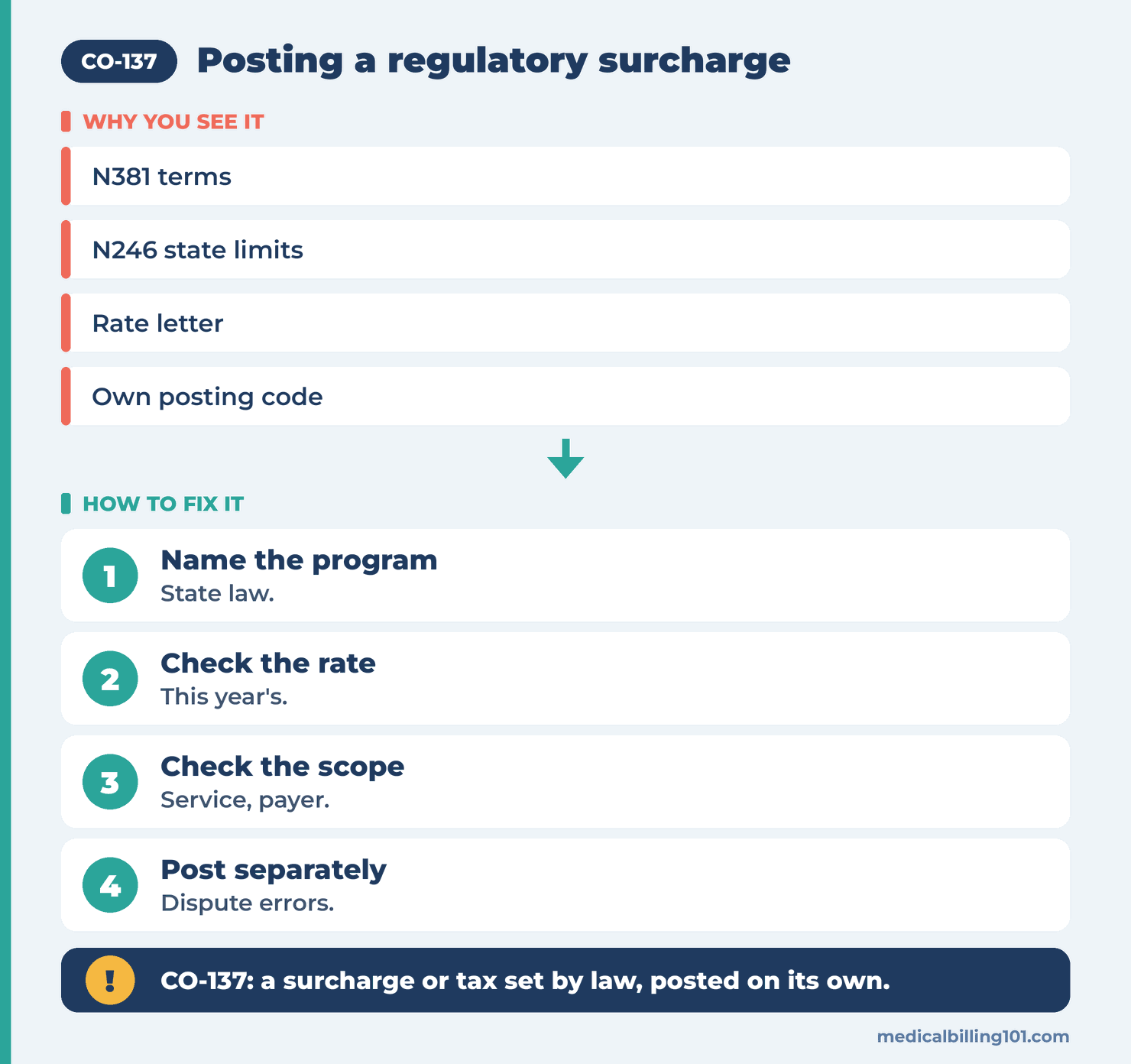
- Name the program. Find which state law or regulation the amount belongs to. The payer’s provider manual often says.
- Check the rate. Compare the amount to the current published rate for that program and service type. Rates can change each year.
- Check the scope. Confirm the service, setting and payer type are covered by the program. Some plans, such as certain self-funded plans, may be treated differently.
- Post to a dedicated code. Keep CARC 137 out of the contractual write-off so variance reports stay clean.
- Leave the patient out of it. The CO group means the patient isn’t billed for this amount.
- Dispute only real errors. Send the payer the rate source and your math if the rate or scope is wrong.
Example scenario (fictional names), part 2
How the CO-137 Denial Was Resolved
Dana pulled the state’s current rate letter and compared it to Lakeshore’s setup table. The table still held last year’s rate. Bluehaven had applied the new one correctly. The claim without CARC 137 was for a self-funded employer plan that Bluehaven administered, and that plan had elected to pay the surcharge directly to the state, so nothing showed on the line.
Fix: no dispute was needed. Dana updated the rate table, mapped CO-137 to its own surcharge adjustment code and reposted the week’s Bluehaven remits.
Outcome: the variance report dropped to zero for that payer. Dana added a yearly calendar reminder to check the state rate letters each January.
Names and details are illustrative; no real patient data.
Worked example (illustrative)
A hospital’s outpatient claim is allowed at $1,000 under contract. The payer’s state surcharge program adds a small percentage on top and reports it as CAS*CO*137 with a negative amount. The hospital receives $1,000 plus the surcharge, then follows the program rules on whether that money stays with the hospital or passes to the state fund. The patient’s share is still based on the $1,000 allowed amount.
CO-137 vs similar codes
| Code | What it means | Main difference |
|---|---|---|
| CO-137 | Regulatory surcharge, assessment, allowance or tax | Set by law, not by contract |
| CO-45 | Charge exceeds fee schedule or contracted amount | Contract-driven write-off |
| CO-105 | Tax withholding | Tax withheld from the payment to you |
| CO-143 | Portion of payment deferred | Money held back for later |
Posting checklist
- A separate adjustment code exists for CARC 137.
- Rate tables are updated when the state publishes new rates.
- Variance reports exclude CARC 137 from contract underpayment flags.
- Self-funded plans that pay the surcharge directly are noted in payer setup.
Recap
CO-137 shows a regulatory surcharge, assessment, allowance or health tax on the remit. Identify the program, check the current rate and scope, and post it to its own code. The patient isn’t billed for it. Most problems come from outdated rate tables, not payer errors.
FAQ
What does denial code CO-137 mean?
The payer applied a regulatory surcharge, assessment, allowance or health-related tax to the claim payment.
Is CO-137 a denial?
Not really. It’s a payment adjustment required by law or regulation.
Can I bill the patient for CARC 137?
No. The CO group means the amount isn’t the patient’s responsibility.
Why does CO-137 show on some claims and not others?
The program may cover only some services, settings or payer types. Some self-funded plans pay the surcharge directly instead.
How do I check if the CO-137 amount is right?
Compare it to the current published rate for the program and the service type, then recalculate.
Should CO-137 go into the contractual write-off?
No. Post it to its own code so contract variance reports stay accurate.
Sources
How we checked: each code quote on this page was matched word for word with the X12 CARC and RARC lists on 22 October 2026.
- X12, Claim Adjustment Reason Codes (CARC 137, 45, 105, 143). Accessed 22 Oct 2026.
- X12, Remittance Advice Remark Codes (N381, N246). Accessed 22 Oct 2026.
- New York State Department of Health, Health Care Reform Act (HCRA). Accessed 22 Oct 2026.
Last updated: 22 October 2026 · Educational content; not legal advice.