
CO-159 is rare, and that’s exactly why it confuses billing teams when it lands. The payer is saying the injury or illness came from an act of terrorism and that its policy excludes or redirects that kind of loss. Some health and casualty policies carry a terrorism or war exclusion. Others route these claims to a different payer, such as workers’ compensation when the patient was injured on the job. Your task is to confirm the cause, find the payer that owes it and rebill cleanly. (Primary source: X12 Claim Adjustment Reason Codes)
In brief: CARC 159 reads “Service/procedure was provided as a result of terrorism.” Check the accident and cause fields on the claim, read the policy exclusion, and look for another payer. If the patient was at work, workers’ compensation is the usual next stop. If the cause was coded wrong, correct the claim.
Part of our denial codes library. Written by Manikandan J, CPC, CRCR, who has worked trauma and liability claims for hospital business offices. Published 22 October 2026. Last updated: 22 October 2026. Code wording quoted word for word from X12.
Official CARC 159 description
| Field | X12 text |
|---|---|
| Code | 159 |
| Description | “Service/procedure was provided as a result of terrorism.” |
| Start | 09/30/2003 |
| Last modified | 09/30/2007 |
Source: X12 Claim Adjustment Reason Codes, checked 22 October 2026.
Key terms behind CARC 159
An exclusion is a type of loss or service a policy doesn’t pay for. HealthCare.gov’s excluded services entry defines it as services the plan doesn’t pay for or cover. A terrorism exclusion is a clause that removes injuries from acts of terrorism from coverage, or sends them to another source. Workers’ compensation is the insurance that pays for work-related injuries, whatever caused them.
ICD-10-CM has a chapter of external cause codes for terrorism (the Y38 category). Those codes tell the payer how the injury happened, so they drive this denial as much as the diagnosis does.
Why payers apply CARC 159
- The policy excludes it. For example, some accident, travel or casualty policies exclude losses from terrorism or war.
- Another payer comes first. If the patient was working, workers’ compensation usually owes the claim before any health plan.
- A government program applies. Some events lead to dedicated federal or state programs that pay for related care.
- The cause code was wrong. A Y38 external cause code on an ordinary injury will trigger the edit by mistake.
Example scenario (fictional names), part 1
CO-159 Denial Example: What Happened
Rafael Ortiz handles emergency department follow-up at Bayview Medical Center. A security guard was hurt by flying glass when a device went off at the office tower where he worked. The ED repaired a 4 cm forearm laceration (12002) and coded S51.812A with a Y38 external cause code.
The claim went to the guard’s health plan, Summit Ridge Health, a fictional insurer. The 835 showed CAS*CO*159 on the line with remark LQ*HE*N130, “Consult plan benefit documents/guidelines for information about restrictions for this service.” Box 10a on the claim said the condition wasn’t related to employment.
Was the claim dead, or had it simply gone to the wrong payer? Keep reading, or jump to how the CO-159 denial was resolved.
Remark codes often paired with CARC 159
| RARC | X12 wording | What it tells you |
|---|---|---|
| N130 | “Consult plan benefit documents/guidelines for information about restrictions for this service.” | Read the exclusion in the plan documents |
| N193 | “Alert: Specific federal/state/local program may cover this service through another payer.” | Look for a program that pays instead |
| N598 | “Health care policy coverage is primary.” | The health plan says it’s primary, used when the sequence is disputed |
See the X12 RARC list for the full set.
How to fix a CO-159 denial
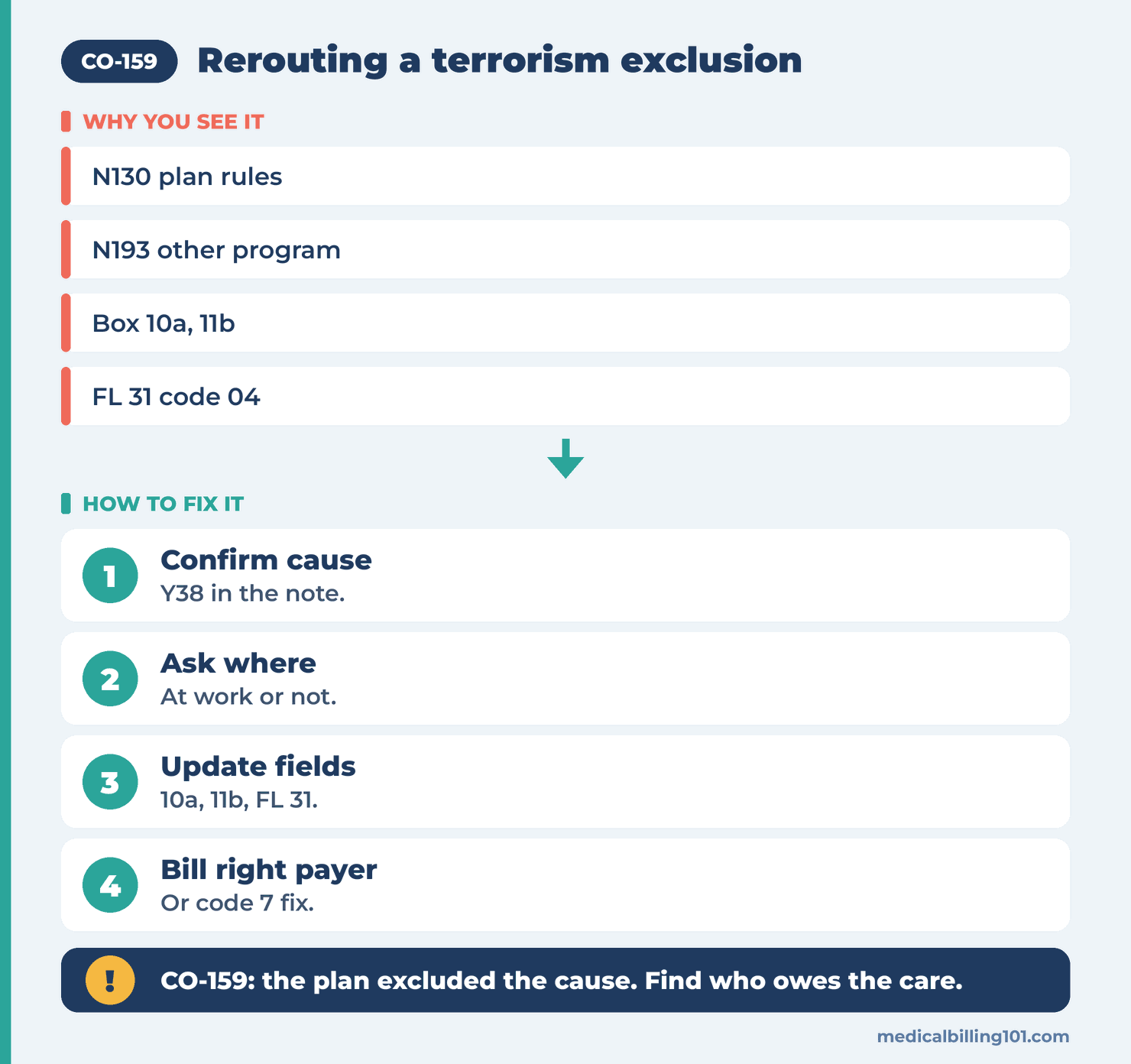
- Confirm the cause. Read the ED note and the external cause codes. Make sure the Y38 code reflects what the record says.
- Ask where it happened. If the patient was at work, get the employer, the date of injury and the workers’ compensation carrier.
- Update the claim fields. On the CMS-1500 that means Box 10a (employment) and the workers’ compensation claim number in Box 11b. On the UB-04, occurrence code 04 in FL 31 marks an employment-related accident.
- Bill the right payer. Send the claim to the workers’ compensation carrier or the program that covers the event.
- If the cause was miscoded, remove the wrong external cause code and send a corrected claim to the health plan with frequency code 7.
- Don’t bill the patient for a CO amount. Keep the account open until the right payer responds.
Example scenario (fictional names), part 2
How the CO-159 Denial Was Resolved
Rafael called the guard’s employer. The guard was on shift when the device went off, and the employer had already opened a workers’ compensation claim with Ironbridge Casualty, a fictional carrier. The health plan had applied its terrorism exclusion because nothing on the claim showed a work injury.
Fix: Rafael set Box 10a to yes, added the Ironbridge claim number in Box 11b with qualifier Y4, and billed Ironbridge as the payer. The facility side of the visit got occurrence code 04 in FL 31 and Ironbridge in FL 50.
Outcome: Ironbridge paid both claims under the state workers’ compensation fee schedule. Rafael asked Summit Ridge to close the original claim so it wouldn’t sit as an open denial.
Names and details are illustrative; no real patient data.
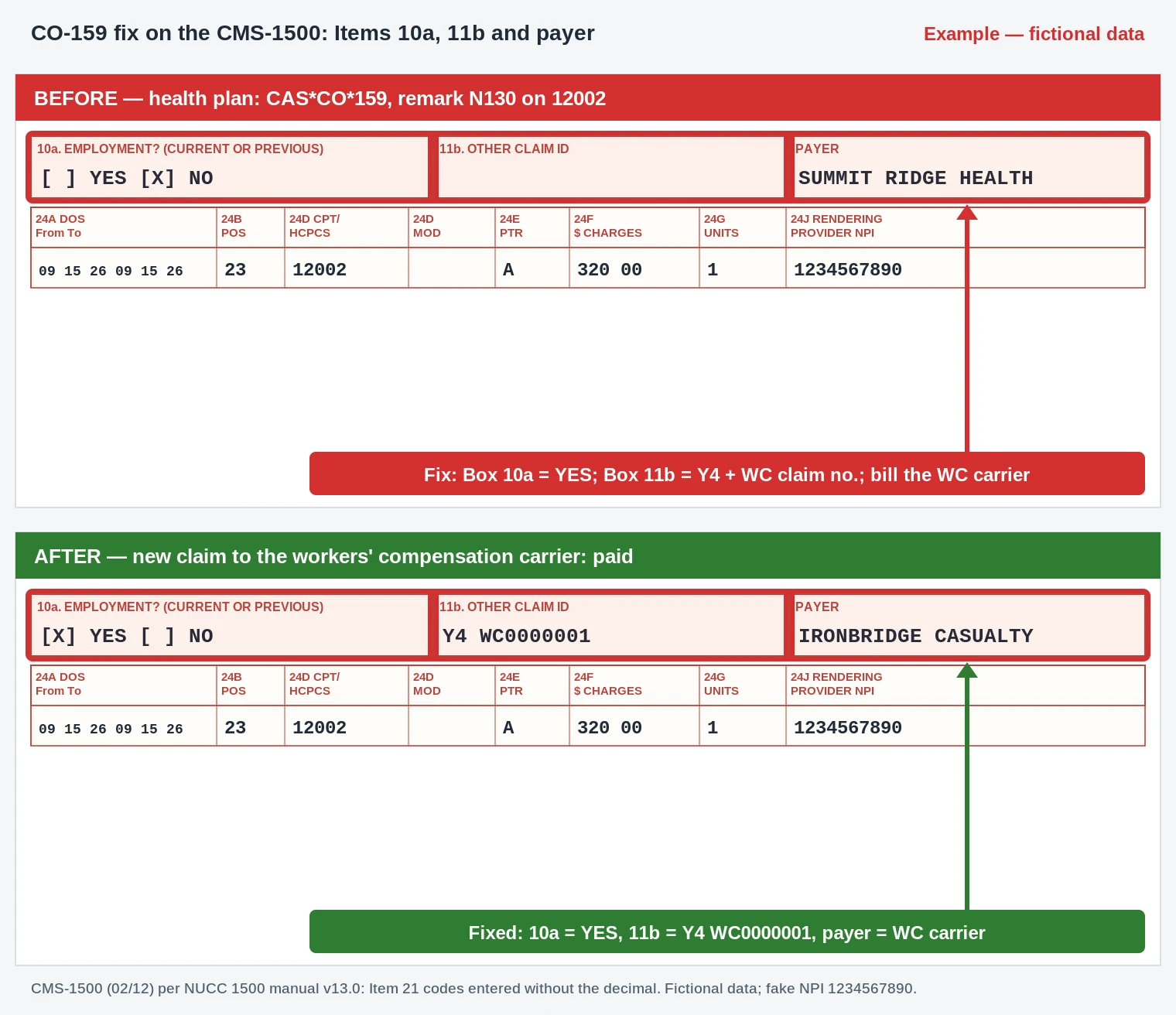
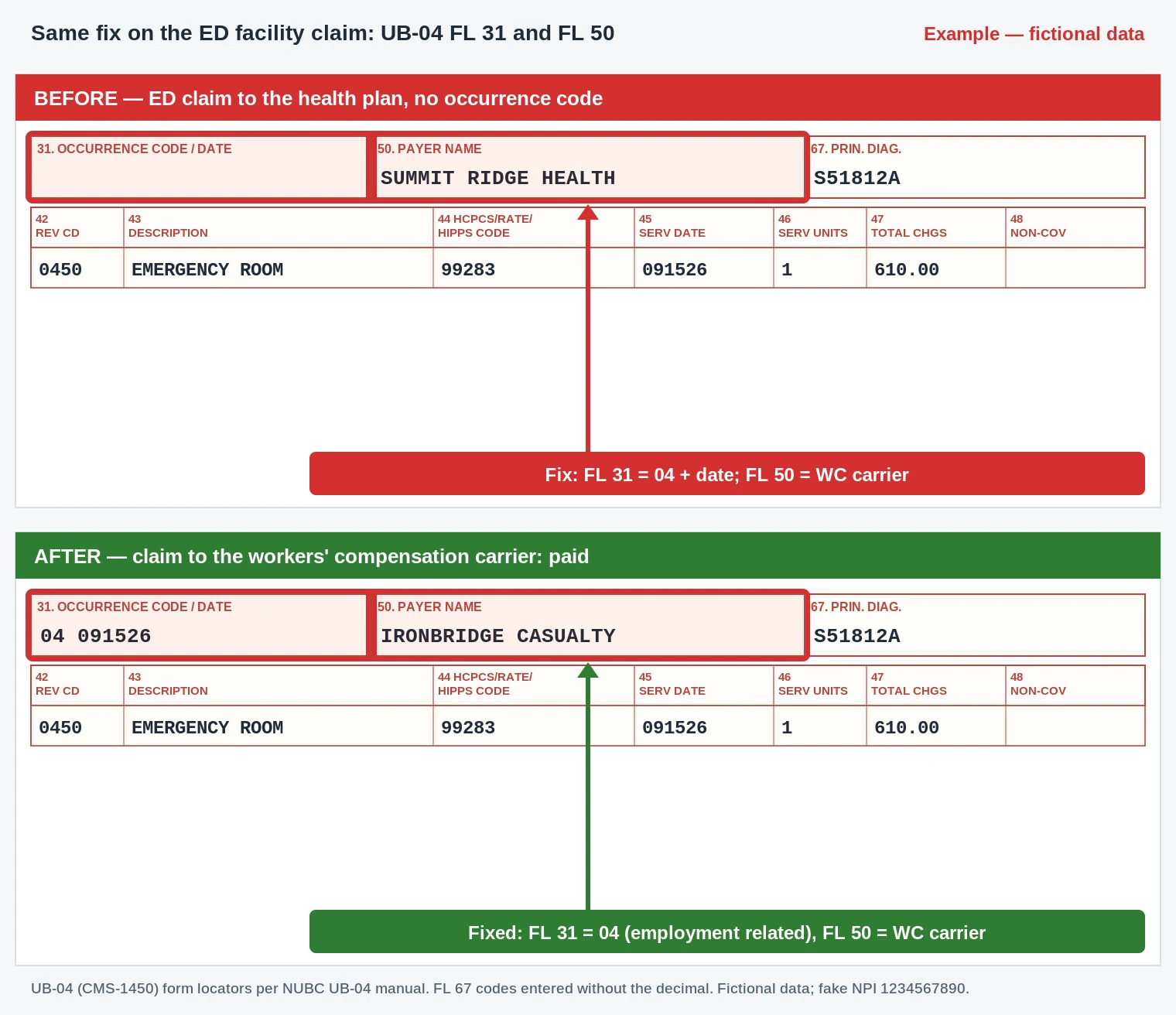
- Box 10a / FL 31: employment-related set to Yes; on the UB-04, occurrence code 04 (accident/employment related) with the date of injury.
- Box 11b: workers’ compensation claim number with qualifier Y4 (property and casualty claim number).
- Payer / FL 50: the claim goes to the workers’ compensation carrier instead of the health plan.
- Box 21 / FL 67: S51.812A (entered as S51812A) and the Y38 external cause code stay as documented.
Worked example (illustrative)
A tourist is hurt during an attack while on vacation and treated in an ED. The travel medical policy excludes terrorism and the claim comes back with CO-159. The patient also has an employer health plan with no such exclusion. The hospital bills that plan as the next payer and attaches the travel policy’s denial. Nothing about the patient’s job is involved, so workers’ compensation doesn’t apply.
CO-159 vs similar codes
| Code | What it means | Main difference |
|---|---|---|
| CO-159 | Service due to terrorism | Cause-of-injury exclusion |
| CO-19 | Work-related injury or illness; liability of the workers’ compensation carrier | Work cause, no terrorism element |
| CO-21 | Injury or illness is the liability of the no-fault carrier | Auto or no-fault coverage |
| CO-96 | Non-covered charges | General exclusion not tied to cause |
Checklist before you rebill
- External cause codes match the record.
- Employment status at the time of injury is documented.
- Workers’ compensation carrier and claim number are on the account.
- Any program that covers the event has been checked.
- The original health plan denial is saved for the next payer.
Recap
CO-159 means the plan treated the service as a result of terrorism and excluded it. Confirm the cause codes, ask whether the patient was working, and bill workers’ compensation or the right program. Correct the claim if the external cause code was wrong. Don’t bill the patient for a CO amount.
FAQ
What does denial code CO-159 mean?
The payer says the service was provided because of an act of terrorism and its policy excludes or redirects that loss.
Who pays if the health plan denies with CO-159?
Often workers’ compensation, if the patient was injured at work, or another policy or government program that covers the event.
Can I bill the patient for CO-159?
Not while the group code is CO. Find the right payer first.
What claim fields matter for CARC 159?
External cause codes, Box 10a for employment and Box 11b for a workers’ compensation claim number on the CMS-1500. On the UB-04, occurrence codes in FL 31 and the payer in FL 50.
What if the terrorism code was added by mistake?
Remove it, fix the diagnosis coding and send a corrected claim with frequency code 7.
Is CARC 159 common?
No. It’s rare, which is why it’s easy to miss the payer change it calls for.
Sources
How we checked: each code quote on this page was matched word for word with the X12 CARC and RARC lists on 22 October 2026.
- X12, Claim Adjustment Reason Codes (CARC 159, 19, 21, 96). Accessed 22 Oct 2026.
- X12, Remittance Advice Remark Codes (N130, N193, N598). Accessed 22 Oct 2026.
- HealthCare.gov, Excluded services (glossary). Accessed 22 Oct 2026.
- NUCC, 1500 claim form instructions (Items 10a and 11b). Accessed 22 Oct 2026.
Last updated: 22 October 2026 · Educational content; not legal advice.