
CO-166 is about timing on the payer’s side, not the patient’s. The patient may have been fully covered on the date of service, but the payer you billed no longer processes claims for that plan. Maybe the employer moved to a new administrator, a managed care plan left the market, or the plan ended and its run-out period closed. The claim isn’t wrong in content. It’s in the wrong mailbox, and sometimes it’s simply too late. (Primary source: X12 Claim Adjustment Reason Codes)
In brief: CARC 166 reads “These services were submitted after this payers responsibility for processing claims under this plan ended.” Find out who took over the plan’s claims, confirm the deadline for that payer, and send the claim there. If no successor exists and the run-out has passed, check whether you have proof of an earlier submission.
Part of our denial codes library. Written by Manikandan J, CPC, CRCR, who has handled payer transitions and plan terminations for hospital business offices. Published 22 October 2026. Last updated: 22 October 2026. Code wording quoted word for word from X12.
Official CARC 166 description
| Field | X12 text |
|---|---|
| Code | 166 |
| Description | “These services were submitted after this payers responsibility for processing claims under this plan ended.” |
| Start | 02/28/2005 |
| Typical group | CO |
Source: X12 Claim Adjustment Reason Codes, checked 22 October 2026.
Key terms behind CARC 166
A run-out period is the time after a plan or contract ends during which the old payer still accepts claims for earlier dates of service. A successor payer is the plan or administrator that takes over claims after a transition. A plan transition is any change in who processes claims for a group of members, such as a new administrator, a managed care plan leaving a state program, or a merger.
State Medicaid programs post notices when managed care plans enter or leave. HealthCare.gov has a plain Medicaid glossary entry that explains how the program is run by states under federal rules.
Common causes of CO-166
- Employer switched administrators. For example, the old administrator’s run-out ended 90 days after the switch, and a late claim hit it anyway.
- A managed care plan exited. Members moved to another plan or to fee-for-service, and claims must follow them.
- The plan terminated. The group plan ended and its run-out window closed.
- Billing used old payer setup. Registration kept the old payer ID after the transition.
Example scenario (fictional names), part 1
CO-166 Denial Example: What Happened
Grace Okafor handles Medicaid follow-up at Hillcrest Community Health Center. Lark Valley Health Plan, a fictional Medicaid managed care plan, left the state program on 30 June. Its members moved to Bright Harbor Health, another fictional plan, on 1 July.
Hillcrest saw a child on 15 September for an ear infection (H66.92) and billed 99213 to Lark Valley, because registration still showed the old plan. The 835 came back with CAS*CO*166 and remark LQ*HE*N59, “Alert: Please refer to your provider manual for additional program and provider information.”
Was the visit uncovered, or had the claim just gone to a plan that no longer existed? Keep reading, or jump to how the CO-166 denial was resolved.
Remark codes often paired with CARC 166
| RARC | X12 wording | What it tells you |
|---|---|---|
| N59 | “Alert: Please refer to your provider manual for additional program and provider information.” | The payer’s notices explain the transition |
| N193 | “Alert: Specific federal/state/local program may cover this service through another payer.” | Another payer may own the claim now |
| N191 | “The provider must update insurance information directly with payer.” | Update your payer details for the member |
See the X12 RARC list for the full set.
How to fix a CO-166 denial
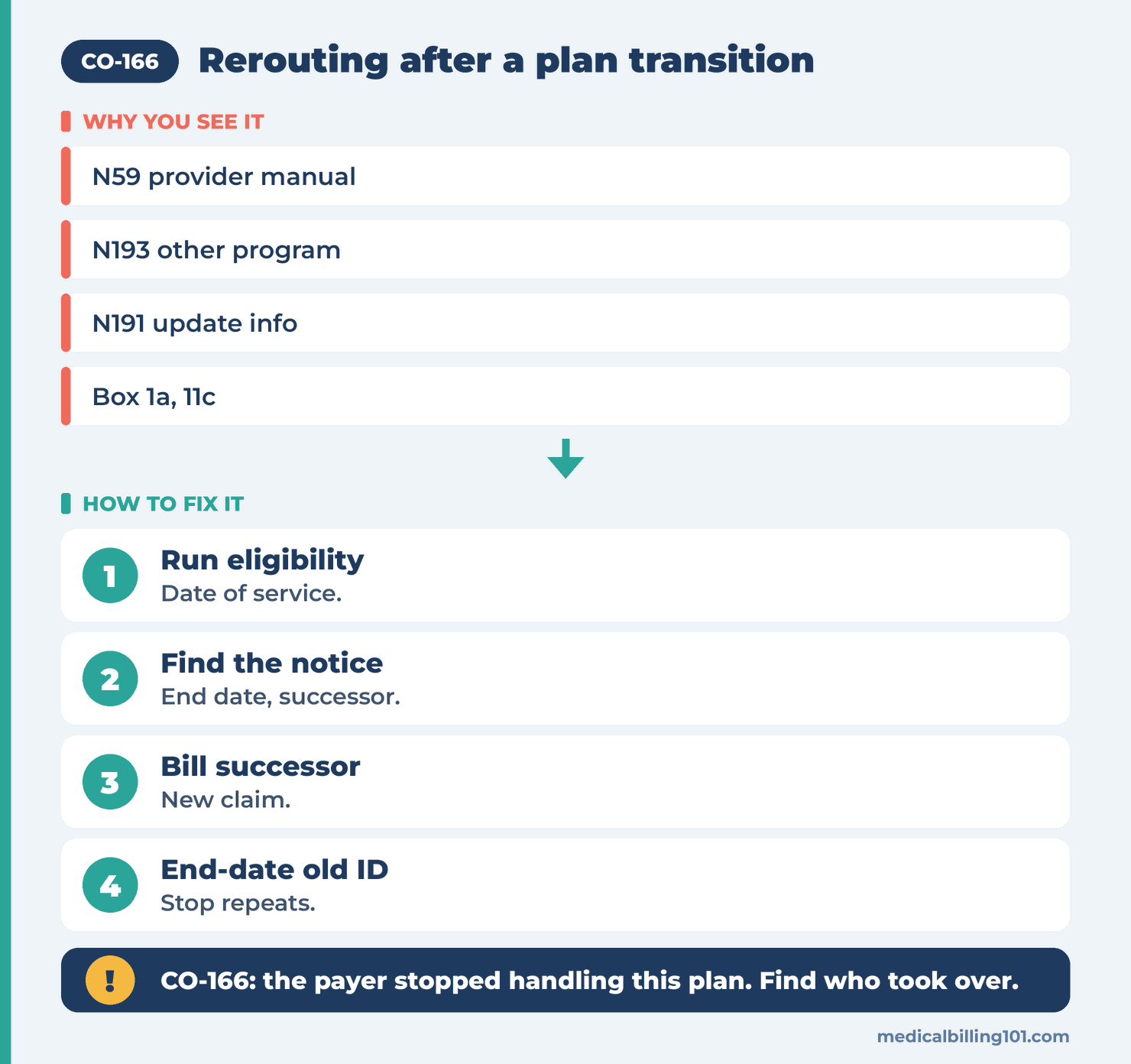
- Run eligibility for the date of service. Use the state portal or a 270/271 check to see which payer covered the patient that day.
- Find the transition notice. Note the end date, the successor payer and any run-out deadline.
- If a successor covers the date, update registration and send a new claim to that payer with its member ID and payer ID.
- If the old payer still owed the date, check its run-out deadline and whether you have proof of earlier submission.
- Watch timely filing with the successor. Some successors honor the original submission date during a transition; others don’t.
- Update payer setup so the old payer ID can’t be chosen for dates after the end date.
Example scenario (fictional names), part 2
How the CO-166 Denial Was Resolved
Grace ran eligibility for 15 September through the state portal. It showed the child enrolled with Bright Harbor from 1 July, with a new member ID. Lark Valley’s notice said it would process claims only for dates of service through 30 June.
Fix: Grace updated registration and sent a new claim to Bright Harbor, with the new member ID in Box 1a and Bright Harbor’s plan name in Box 11c. It was a new claim to a new payer, so Box 22 stayed blank.
Outcome: Bright Harbor paid the visit within its normal cycle. Grace asked IT to end-date Lark Valley in the payer table so it couldn’t be picked for later visits, and she ran a report of other Lark Valley claims dated after 30 June. Six more were found and rerouted.
Names and details are illustrative; no real patient data.
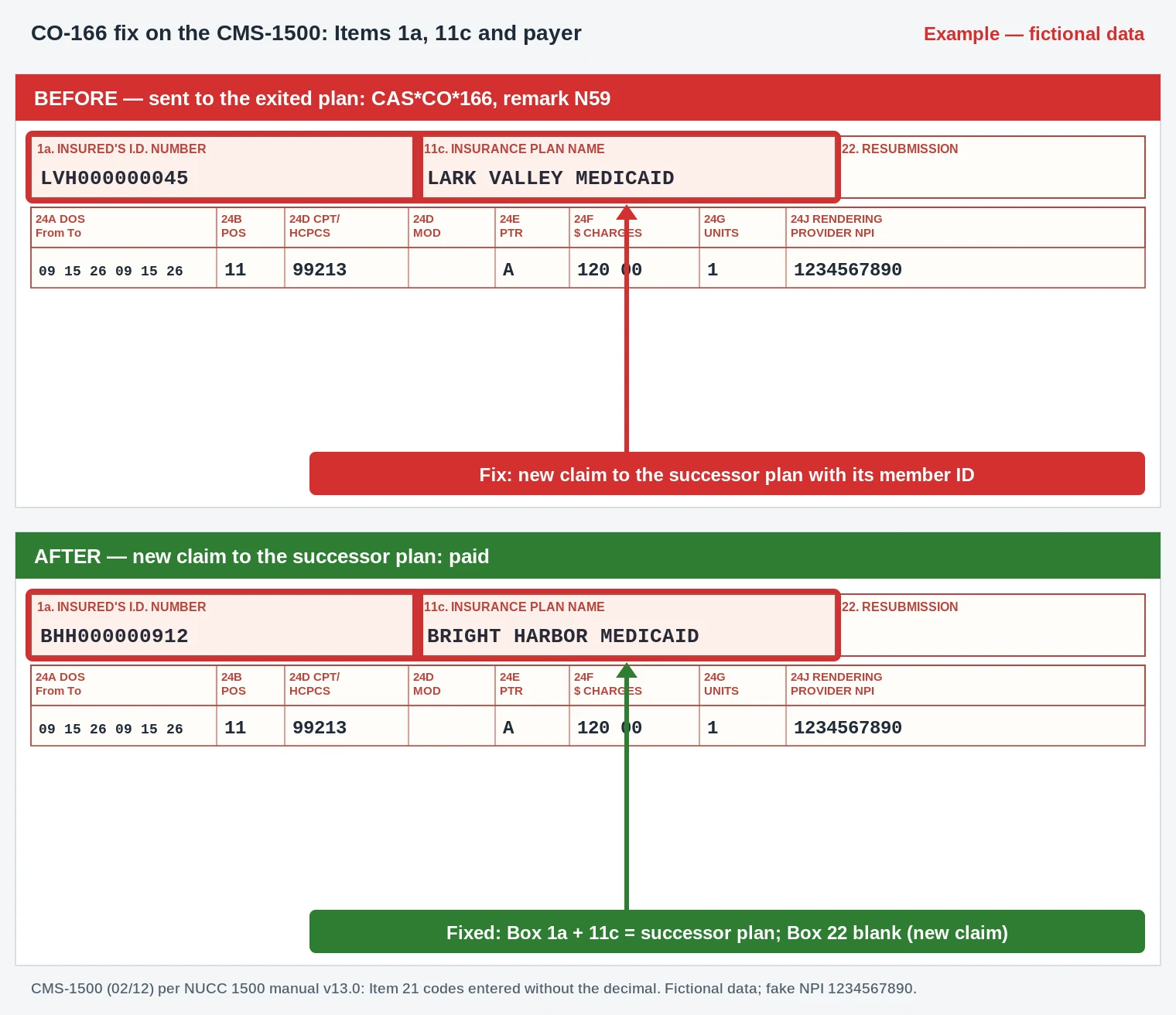
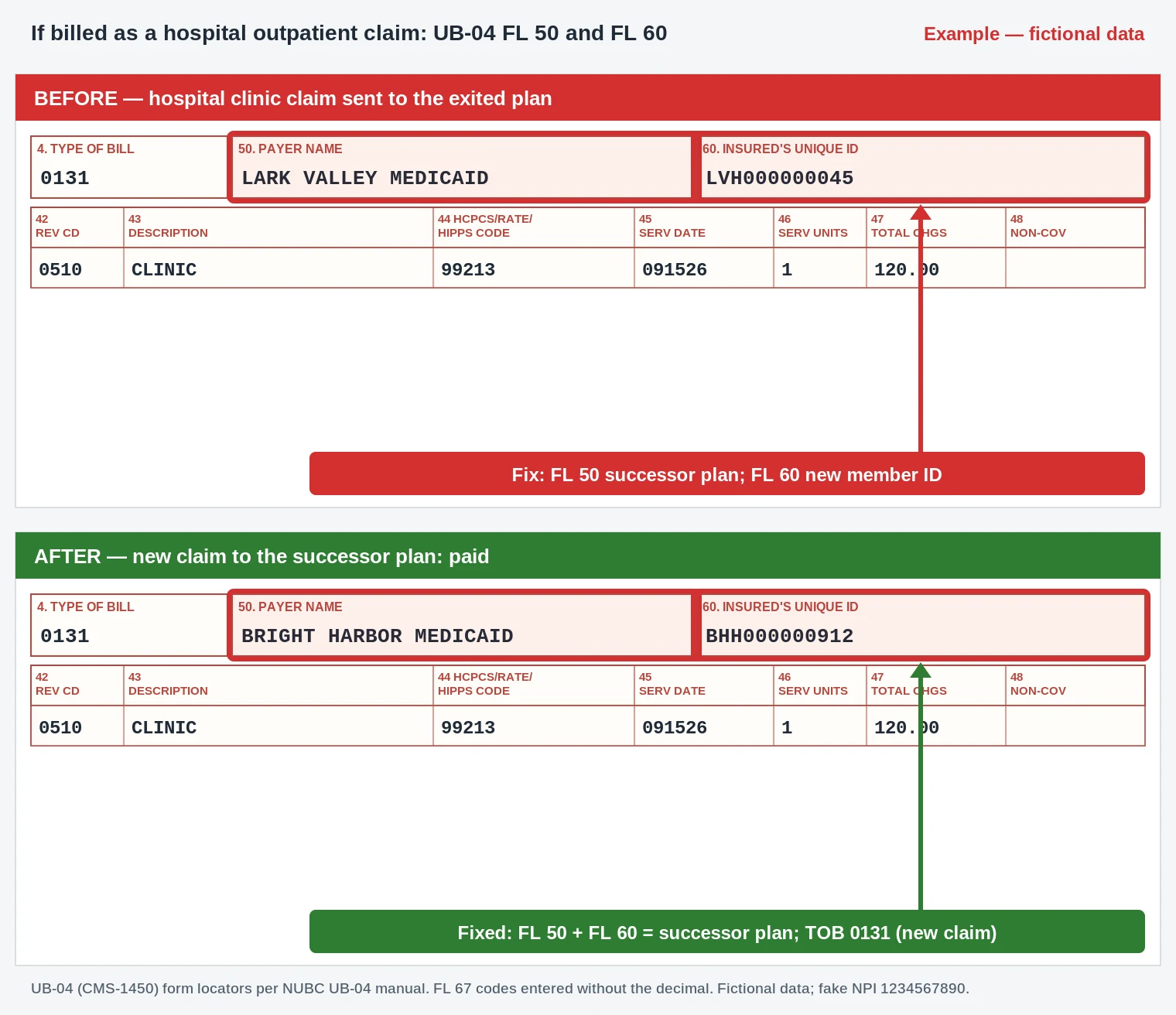
- Box 1a / FL 60: the old plan’s member ID replaced with the successor plan’s ID from the state eligibility check.
- Box 11c / FL 50: payer changed to the successor plan, which covered the date of service.
- Box 22 / FL 4: left as a new claim (blank / 0131). A corrected claim only goes to the payer that processed the original.
- Box 24D / FL 44: 99213 with H66.92 (entered as H6692) is unchanged.
Worked example (illustrative)
A manufacturer moves its self-funded plan from one administrator to another on 1 January. The old administrator accepts claims for dates of service before 1 January until 31 March. A hospital sends a December claim on 10 April and gets CO-166. The new administrator didn’t cover December, so it won’t pay either. The hospital checks its clearinghouse records and finds an earlier submission in February that was rejected for a typo. It appeals to the old administrator with that proof, asking for an exception to the run-out deadline.
CO-166 vs similar codes
| Code | What it means | Main difference |
|---|---|---|
| CO-166 | Submitted after the payer’s responsibility for the plan ended | The payer stopped processing the plan |
| CO-27 | Expenses incurred after coverage terminated | The patient’s coverage ended |
| CO-29 | The time limit for filing has expired | Late filing with an active payer |
| CO-109 | Claim not covered by this payer; send to the correct payer | Wrong payer, not tied to a plan ending |
Prevention checklist
- Payer transition notices are logged with end dates and successor payers.
- Old payer IDs are end-dated in the system.
- Eligibility runs for every visit in the months after a transition.
- Run-out deadlines are tracked for terminated plans.
Recap
CO-166 means the payer you billed no longer handles claims for that plan. Run eligibility for the date of service, find the successor payer and send the claim there. If the old payer still owed the date, check its run-out deadline and your proof of earlier submission.
FAQ
What does denial code CO-166 mean?
The claim reached the payer after its responsibility for processing claims under that plan had ended.
Is the patient uninsured if I get CO-166?
Not necessarily. Another payer may have taken over the plan or the member.
What is a run-out period?
The time after a plan or contract ends when the old payer still accepts claims for earlier dates of service.
Do I send a corrected claim or a new claim?
To a successor payer, send a new claim. A corrected claim only goes to the payer that processed the original.
Can I bill the patient for CO-166?
No. It’s a CO denial tied to payer timing, not patient responsibility.
Can I appeal a CO-166?
Yes, if you have proof you submitted before the run-out deadline.
Sources
How we checked: each code quote on this page was matched word for word with the X12 CARC and RARC lists on 22 October 2026.
- X12, Claim Adjustment Reason Codes (CARC 166, 27, 29, 109). Accessed 22 Oct 2026.
- X12, Remittance Advice Remark Codes (N59, N193, N191). Accessed 22 Oct 2026.
- HealthCare.gov, Medicaid (glossary). Accessed 22 Oct 2026.
Last updated: 22 October 2026 · Educational content; not legal advice.