
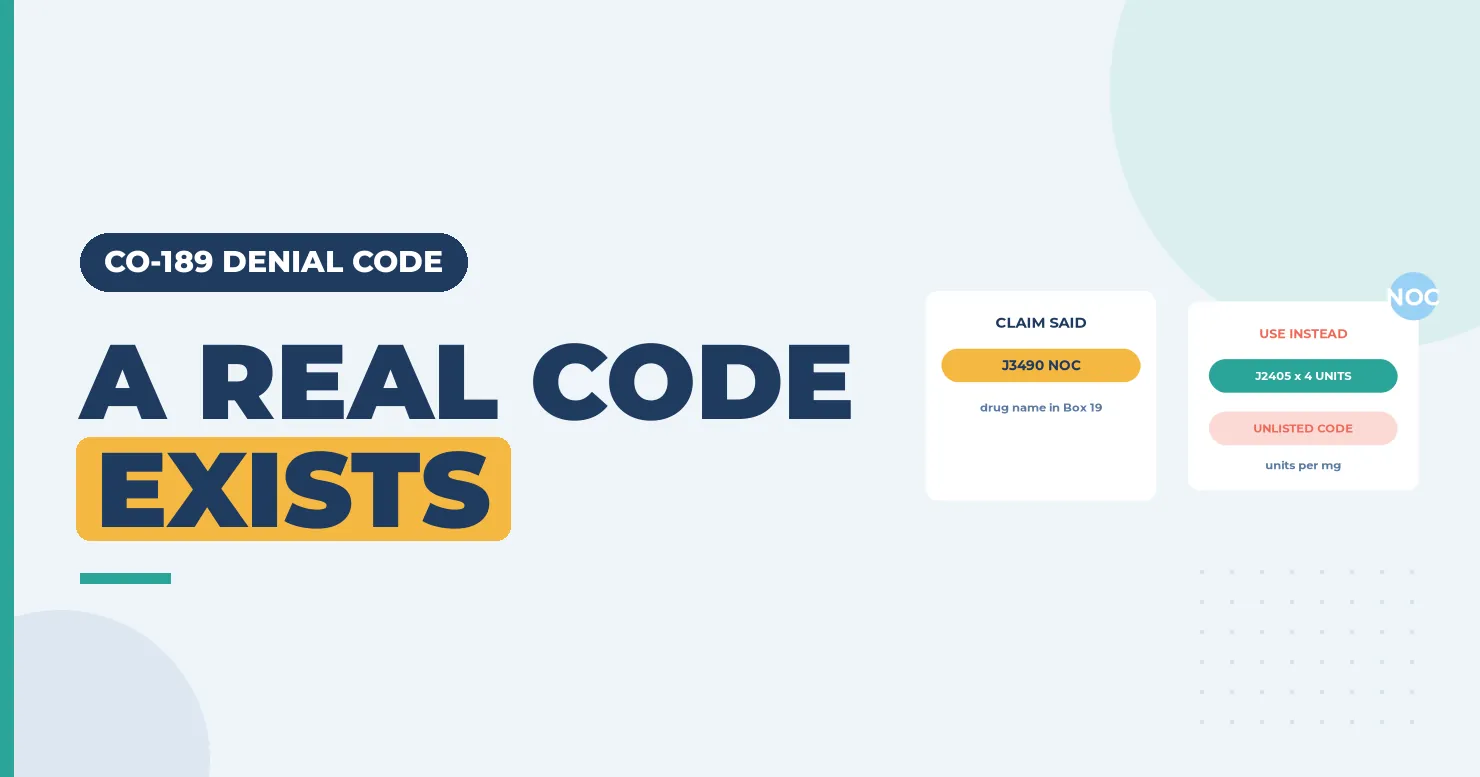
CO-189 means the claim used an unlisted or “not otherwise classified” code, and the payer found a specific code that describes the service. Unlisted codes are a last resort. When a real code exists, the payer won’t price an unlisted one. The fix is almost always a corrected claim with the specific code, the right units and no extra narrative. (Primary source: X12 Claim Adjustment Reason Codes)
In brief: CARC 189 reads “‘Not otherwise classified’ or ‘unlisted’ procedure code (CPT/HCPCS) was billed when there is a specific procedure code for this procedure/service” Look up the specific CPT or HCPCS code for what was done, recalculate units from its descriptor, and send a corrected claim. Appeal only if no specific code truly fits.
Part of our denial codes library. Written by Manikandan J, CPC, CRCR, who has cleaned up drug and supply charge masters for urgent care and infusion clinics. Published 22 October 2026. Last updated: 22 October 2026. Code wording quoted word for word from X12.
Official CARC 189 description
| Field | X12 text |
|---|---|
| Code | 189 |
| Description | “‘Not otherwise classified’ or ‘unlisted’ procedure code (CPT/HCPCS) was billed when there is a specific procedure code for this procedure/service” |
| Start | 06/30/2005 |
Source: X12 Claim Adjustment Reason Codes, checked 22 October 2026.
Unlisted vs NOC codes
An unlisted code is a CPT code for a procedure with no specific code, such as 64999 (unlisted procedure, nervous system). A NOC code is a HCPCS Level II code for an item without its own code, such as J3490 (unclassified drugs). Both need a description, and payers price them by hand. That’s why a payer rejects them when a specific code is available. Our guide on when to use unlisted CPT codes covers the rules in more depth.
Example scenario (fictional names), part 1
CO-189 Denial Example: What Happened
Jasmine Patel bills for Summit Walk-In Care. A patient came in vomiting, and the provider, Dr. Owen Fischer, gave 4 mg of ondansetron by injection. The clinic’s charge sheet still mapped the drug to J3490 with the name and dose in Box 19, a leftover from an old supply list. The claim to Brightwater Health, a fictional commercial plan, listed nausea with vomiting (R11.2).
The 835 showed CAS*CO*189 on the drug line with remark LQ*HE*N657, “This should be billed with the appropriate code for these services.”
Was the drug not covered, or was it just billed under the wrong code? Keep reading, or jump to how the CO-189 denial was resolved.
Why payers deny with reason code 189
- Old charge master entries. A drug or supply got its own HCPCS code, but the system still maps it to the NOC code.
- Quick coding shortcuts. For example, a coder picks an unlisted CPT code instead of searching for a newer category I or category III code.
- Wrong code family. The service has a specific code in another section, such as a HCPCS G-code instead of a CPT code.
- Units confusion. Staff use the NOC code because they aren’t sure how to convert the dose into the specific code’s units.
How to fix a CO-189 denial
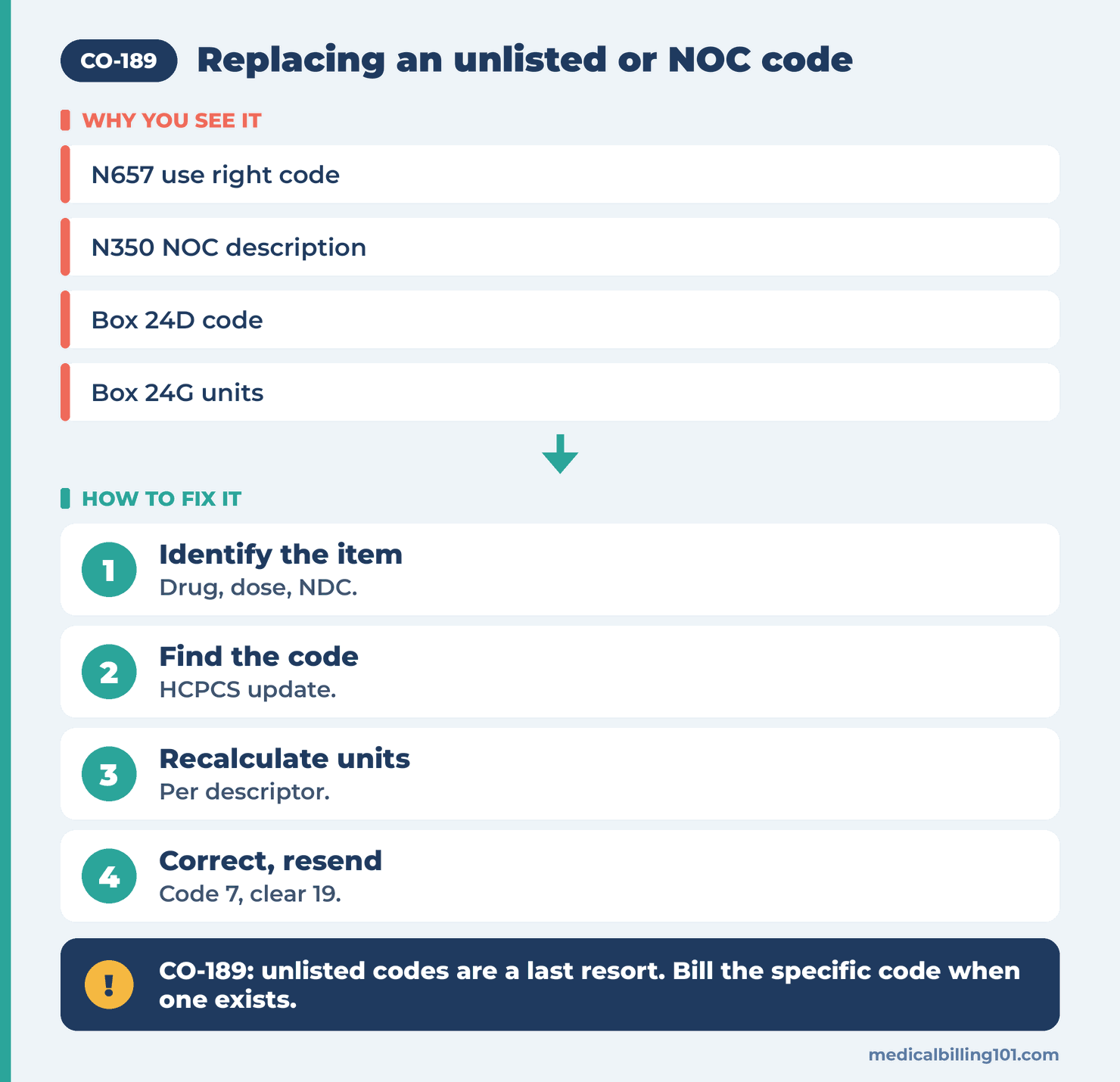
- Identify exactly what was done. For drugs, get the drug name, the dose given and the NDC.
- Search for a specific code. Use the current HCPCS quarterly update and the CPT code set. Check the effective date against the date of service.
- Recalculate units from the specific code’s descriptor. A drug code billed per 1 mg needs one unit for each mg given.
- Remove the NOC narrative. Box 19 is for NOC descriptions. Once a specific code is used, that text isn’t needed.
- Send a corrected claim with frequency code 7 and the original claim number in Box 22.
- Fix the source. Update the charge master or charge sheet so the old mapping can’t be used again.
Example scenario (fictional names), part 2
How the CO-189 Denial Was Resolved
Jasmine checked the HCPCS file. Ondansetron injection has its own code, J2405, billed per 1 mg. The clinic’s old supply list predated the switch, so every dose still went out as J3490.
Fix:
- She replaced J3490 with J2405 in Box 24D.
- She changed the units in Box 24G from 1 to 4, one per mg.
- She cleared the drug description from Box 19 and sent the claim with frequency code 7.
Outcome: Brightwater paid the J2405 line. Summit updated its charge sheet and found six other drugs still mapped to J3490.
Names and details are illustrative; no real patient data.
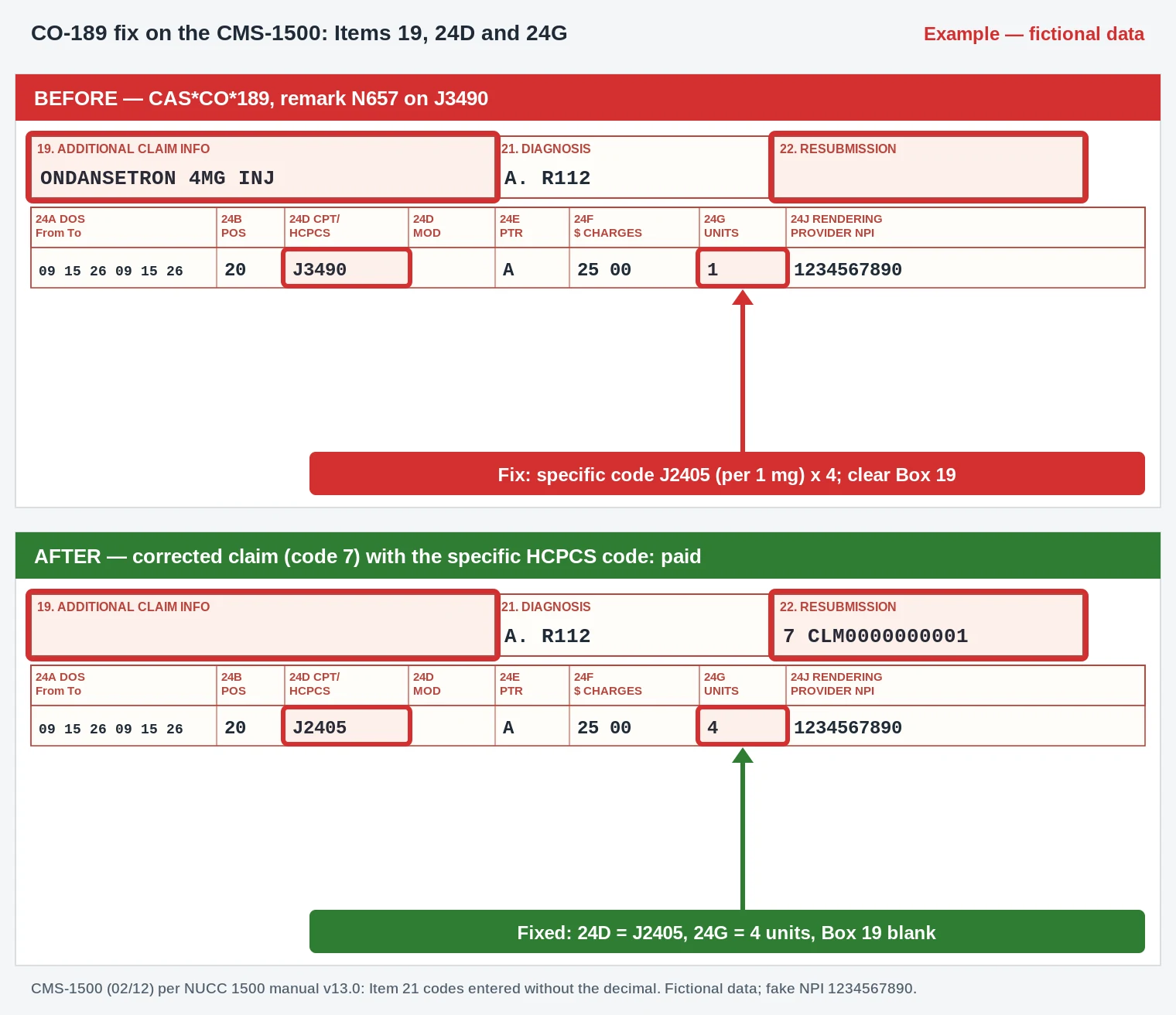
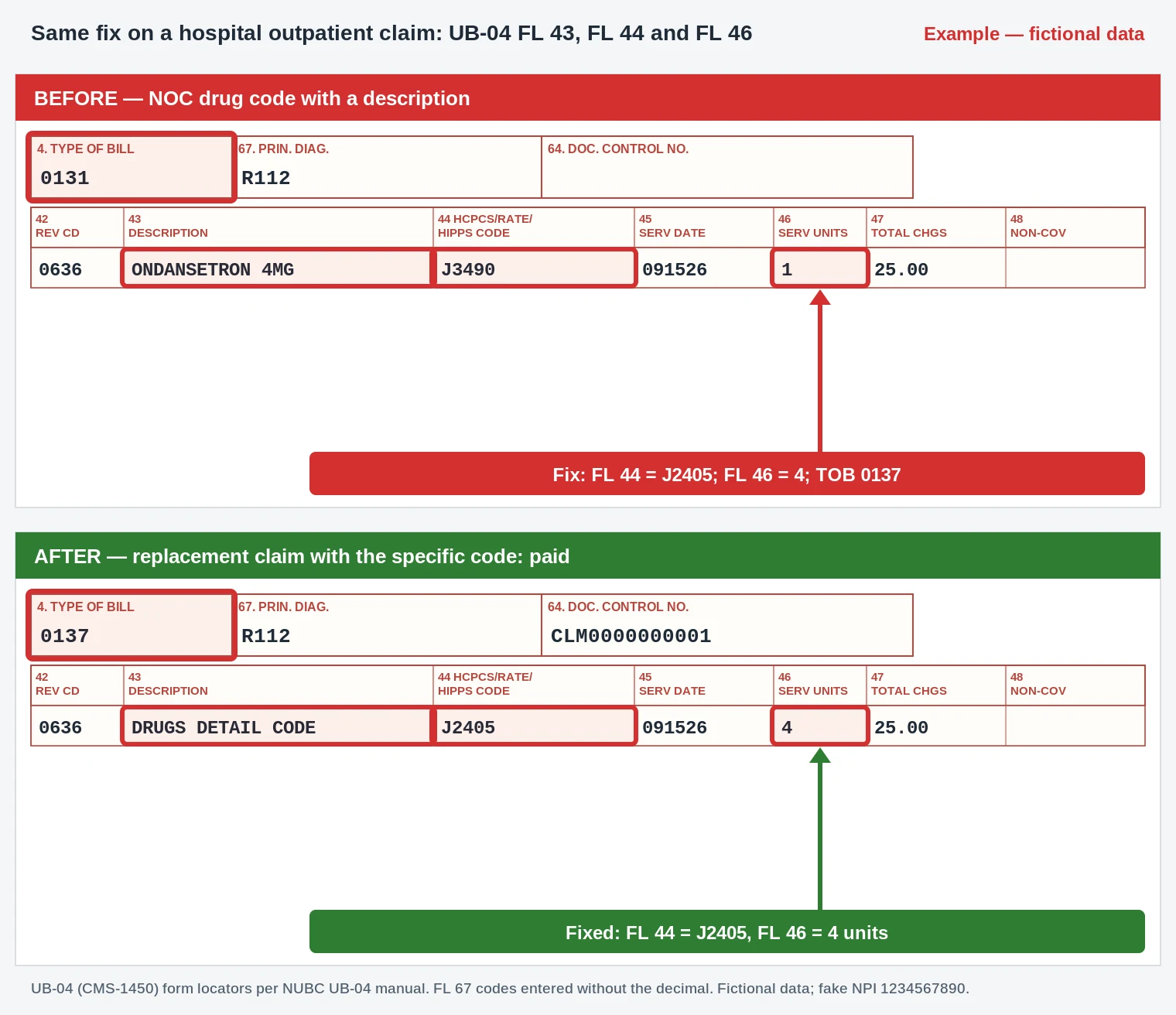
- Box 24D / FL 44: NOC code J3490 replaced with J2405 (ondansetron hydrochloride, per 1 mg).
- Box 24G / FL 46: units changed from 1 to 4 (4 mg given).
- Box 19 / FL 43: the NOC drug description is no longer needed and was removed.
- Box 22 / FL 4 + FL 64: frequency code 7 with the original claim number (type of bill 0137).
- Box 21 / FL 67: R11.2, entered as R112, is unchanged.
When an unlisted code is still the right choice
Use an unlisted or NOC code only when no specific code describes the service on the date it was done. Then:
- Describe the service or drug in Box 19 (or the line note on an electronic claim), including the dose and NDC for drugs.
- Send supporting records if the payer asks, and name a comparable code to help pricing. See our guide on writing a comparable procedure narrative.
- If the payer returns N350, “Missing/incomplete/invalid description of service for a Not Otherwise Classified (NOC) code or for an Unlisted/By Report procedure.” the problem is the description, not the code choice.
CARC 189 vs related codes
| Code | What it says | Key difference |
|---|---|---|
| CO-189 | Unlisted or NOC code billed when a specific code exists | Use the specific code |
| CO-16 | Claim lacks information | Often a missing NOC description |
| CO-4 | Procedure code inconsistent with the modifier | Modifier problem |
| CO-181 | Procedure code was invalid on the date of service | Code not valid yet or anymore |
Recap
CO-189 means an unlisted or NOC code was billed for a service that has its own code. Find the specific CPT or HCPCS code, recalculate units, drop the NOC narrative and send a corrected claim. Then fix the charge master so the old mapping doesn’t come back.
FAQ
What does CO-189 mean?
The payer says an unlisted or not otherwise classified code was billed when a specific procedure code exists for the service.
Can I appeal a CO-189 denial?
Only if no specific code fits the service on the date it was done. Otherwise, send a corrected claim.
How do I convert units for a specific drug code?
Divide the dose given by the amount in the code’s descriptor. For example, 4 mg of a drug billed per 1 mg is 4 units.
Do I still need Box 19 after switching codes?
No. Box 19 descriptions are for NOC and unlisted codes. Remove them once the specific code is used.
Can I bill the patient for a CO-189 line?
No. Group code CO keeps the amount with the provider until the claim is corrected.
Where do I find new HCPCS codes?
CMS posts HCPCS updates every quarter on its HCPCS quarterly update page.
Sources
How we checked: each code quote on this page was matched word for word with the X12 CARC and RARC lists on 22 October 2026.
- X12, Claim Adjustment Reason Codes (CARC 189, 16, 4, 181). Accessed 22 Oct 2026.
- X12, Remittance Advice Remark Codes (N657, N350). Accessed 22 Oct 2026.
- CMS, HCPCS quarterly update. Accessed 22 Oct 2026.
- NUCC, 1500 Claim Form instructions. Accessed 22 Oct 2026.
Last updated: 22 October 2026 · Educational content; not legal advice.